
Apple cider mug shared household product shortlist guide: 3 options
Reading time: about 9 minutes
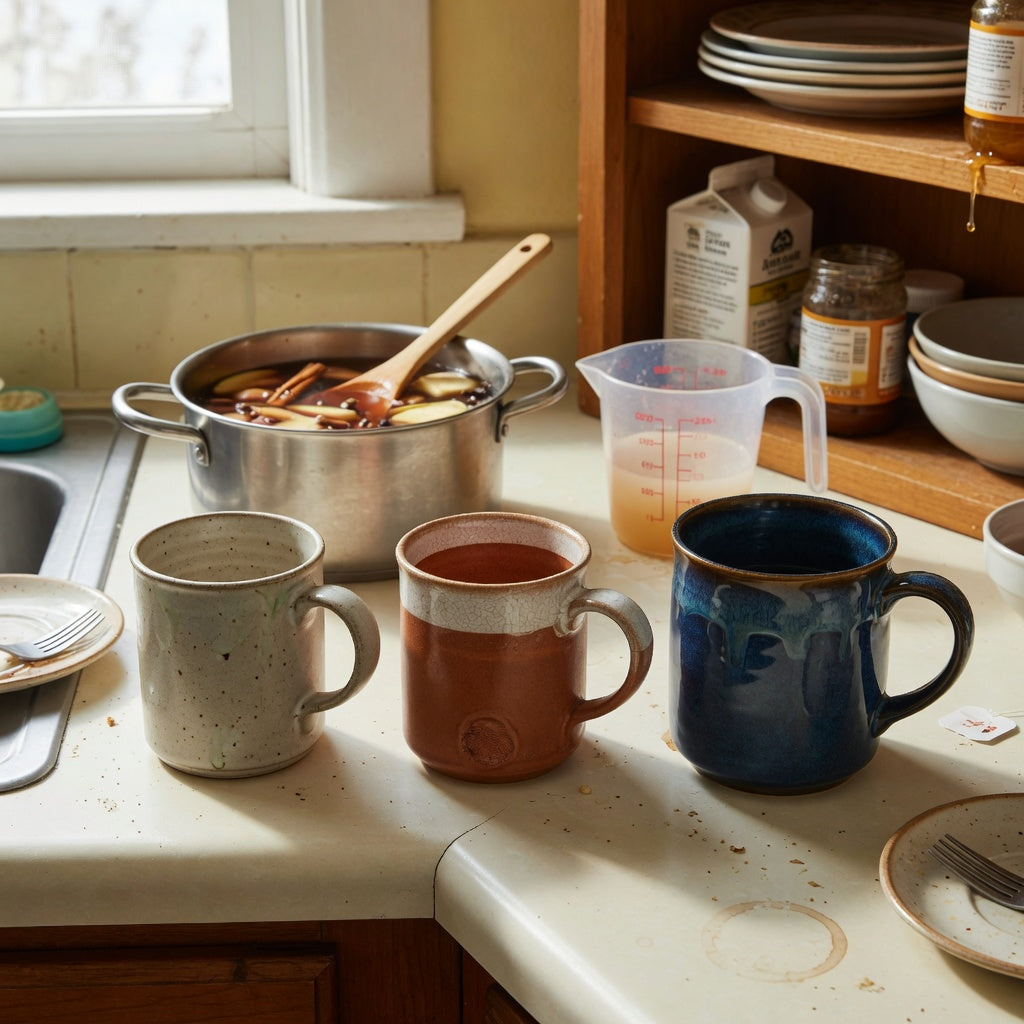
The cider pot reaches the counter, one person takes the biggest mug, and another puts it back because the handle crowds their fingers. That repeat kitchen argument is why our apple cider mug shared household product shortlist guide starts with capacity, handle geometry, and ordinary ceramic storage. At CoffeifyMug, we evaluate mugs as objects that must work on busy counters, crowded shelves, office desks, and washing days, not just look appealing in a product photo.
This shortlist uses the verified catalog facts that matter here: The Gradient is 400 ml, The Flow is 400 ml, and The Rock is 480 ml. It compares three individual product options rather than presenting them as a bundled set. It also does not assume cider mix, spoons, lids, or other items are included, and we make no insulation or specialized temperature-performance claims. The practical question is narrower: which mug best fits each person's normal serving and grip?
Why does 400 ml versus 480 ml matter at a shared cider pot?
Listed capacity is a useful starting point, but it is not necessarily the amount someone will carry through the house. A sensible serving leaves some space below the rim so the drink is less likely to slosh between the kitchen and the couch. The Gradient and The Flow provide the same 400 ml nominal capacity, while The Rock adds 80 ml of nominal capacity at 480 ml.
That difference matters most when one household member repeatedly returns for a refill or claims the largest mug in the cabinet. It matters less when people pour smaller servings and prefer a lighter mug in hand. More liquid also means more carried weight, so the person who wants the larger serving still needs to be comfortable with the handle once the mug is filled.
- Start at 400 ml when most household servings are moderate and a predictable everyday capacity is the priority.
- Consider 480 ml when one person consistently wants more room in a single serving.
- Shortlist both capacities when serving habits differ. There is no practical reason to force every person into the same volume.
Before choosing, measure a normal serving in a mug already in the cabinet. Use the level people actually carry, not a brim-full measurement. That quick check gives better information than guessing from the word large or medium.
Which handle details keep a mug from becoming shelf decor?
A capacity number says nothing about finger clearance. In our experience handling ceramic mugs, grip problems are easier to identify through specific contact points than through broad descriptions such as comfortable or ergonomic. One person may place four fingers through a handle, while another uses two fingers and supports the body with the opposite hand.
- Finger opening: Compare the visible handle opening with a mug the user already reaches for. Check how many fingers normally pass through it.
- Knuckle clearance: Look at the distance between the handle and mug body. A close fit can cause larger knuckles to press against the ceramic.
- Handle-to-body junction: Notice where the handle meets the mug. The position affects leverage when the vessel is filled, even when two mugs have the same capacity.
- Cabinet clearance: A projecting handle can catch neighboring handles or consume more shelf width than the mug body suggests.
Product photography helps with the first comparison, but check any current dimensions and care directions shown on the live product page before ordering. If handle preference is the main disagreement in the household, comparing The Gradient and The Flow is useful because both are 400 ml. Capacity stays constant, allowing grip and body profile to break the tie.
Apple cider mug shared household product shortlist guide: three scenarios
This is a scenario shortlist, not a claim that the three mugs should be purchased together. Each recommendation connects a recurring household situation to one individual option, followed by an explicit reason to skip it.
| Product | Listed capacity | Best shortlist situation | Main reason to skip |
|---|---|---|---|
| The Gradient | 400 ml | Most users want a consistent moderate capacity and prefer its pictured handle and body profile | A household member routinely wants a larger single serving |
| The Flow | 400 ml | Capacity is settled at 400 ml, but handle shape is still the deciding variable | You expect it to provide more volume than The Gradient |
| The Rock | 480 ml | One user regularly chooses the roomiest mug available | Lower filled weight and compact storage matter more than extra capacity |
The Gradient for a shared 400 ml baseline
Situation: Most people in the household are satisfied with a moderate serving, and the goal is to choose an everyday capacity that does not encourage an unnecessarily heavy pour. Why it fits: The Gradient's verified 400 ml capacity establishes a clear baseline. The sensible reason to choose it over The Flow is not volume; it is a preference for the handle and body profile visible on its product page.
Skip it if: One user repeatedly needs more capacity, or the pictured handle opening does not resemble the handles that person already finds comfortable. Next step: Review the current photos and product details for The Gradient 400 ml coffee and tea mug, then compare its handle against a familiar mug from your cabinet.
The Flow when grip preference must break a 400 ml tie
Situation: The household has already agreed that 400 ml is suitable, but two people favor different handle shapes or ways of holding a mug. Why it fits: The Flow provides another 400 ml option, so shoppers can compare form without changing serving capacity. That makes it useful when the complaint is about finger room or grip position rather than refill frequency.
Skip it if: You are switching from The Gradient because you expect additional capacity; both are listed at 400 ml. Also skip it for a particular user if its pictured handle geometry does not pass the finger-clearance and knuckle-clearance checks. Next step: Examine the current images for The Flow 400 ml coffee and tea mug beside the handle of the user's current favorite.
The Rock for the person who always wants a fuller serving
Situation: One household member routinely takes the largest available mug or dislikes returning to the kitchen for another pour. Why it fits: The Rock is listed at 480 ml, giving it 80 ml more nominal capacity than The Gradient or The Flow. That is the clearest capacity-based distinction in this shortlist.
Skip it if: The intended user favors a lighter filled mug, drinks smaller servings, or has limited cabinet space. Capacity alone does not confirm exterior dimensions, so compare the current product information with your usable shelf opening. Next step: Check the handle, body profile, and listed details on The Rock 480 ml coffee and tea mug.
If none of these handle profiles suits the people who will use them, do not force the shortlist. Browse our unique ceramic coffee mug collection and compare other shapes against the same capacity, grip, and storage checks.
How does everyday ceramic fit a crowded cabinet?
Ceramic works well for ordinary home drinkware, but it is not unbreakable. Common damage points in a mixed cupboard include rim chips caused by contact with another mug, impact damage around the handle-to-body junction, and glaze marking from abrasive cleaning tools. Those are general ceramic care concerns, not a claim that a specific CoffeifyMug product will develop them.
- Check the live product page for current care instructions before assuming a mug can go through a dishwasher cycle.
- If machine-washing guidance is not provided, hand wash with mild dish soap and a soft, non-abrasive sponge.
- Give the rim and handle clearance from heavier dishes. Do not wedge a ceramic handle tightly over a dishwasher rack tine.
- Inspect the rim, body, and handle junction after a hard knock. A mug with a structural crack or damaged handle should not remain in normal hot-drink rotation.
- Measure usable cabinet height and width, including the door frame and neighboring handles, rather than measuring only the shelf board.
These mugs are everyday ceramic options, not sealed travel vessels or shatter-resistant outdoor drinkware. A household that needs a lid for commuting, insulation claims, or greater resistance to drops should choose a travel tumbler or another material category. That is a better fit than expecting a ceramic cider mug to perform a job it was not selected to do.
Where should a shared household compromise, and where should it not?
- Same serving size, different grips: Keep both The Gradient and The Flow on the shortlist, then let handle preference decide between the two 400 ml options.
- Different serving sizes: Compare either 400 ml mug with The Rock. Do not make a frequent large-serving user accept 400 ml solely for visual uniformity.
- Tight cabinet or dishwasher space: Verify current exterior dimensions where available. Capacity by itself does not reveal total height, width, or handle projection.
- A gift for a shared home: Avoid guessing from appearance alone. Ask which mug the recipient currently uses most and note its capacity and handle opening before selecting a replacement.
The best use of an apple cider mug shared household product shortlist guide is to eliminate poor fits before ordering. Capacity resolves the serving question. Handle inspection resolves the grip question. Cabinet and care checks decide whether the mug can join the household's regular rotation without creating another storage problem.
Frequently asked questions
How should I use an apple cider mug shared household product shortlist guide?
Start by measuring each person's usual serving and identifying the handle they already prefer. Use 400 ml as the comparison point for The Gradient and The Flow, then consider The Rock if 480 ml better matches one user's normal pour. Check the live product photos and details before making the final selection.
Is 400 ml or 480 ml better for serving apple cider at home?
Neither capacity is automatically better. A 400 ml mug suits moderate servings and may feel easier to carry when filled, while a 480 ml mug gives a frequent large-serving user 80 ml more nominal room. Measure an actual serving and leave carrying space below the rim before deciding.
Do The Gradient and The Flow hold the same amount?
Yes. Both are listed at 400 ml. Choose between them by comparing handle shape, body profile, current product details, and the preferences of the person who will use the mug most often.
Can I assume these ceramic mugs are dishwasher-safe?
No blanket dishwasher claim should be made without checking the current care directions for the specific product. If machine-washing instructions are not shown, hand washing with a soft sponge is the cautious option. During any dishwasher cycle permitted by the care directions, leave enough space to prevent the rim and handle from striking heavier items.
Should everyone in a shared household use the same mug?
No. Matching drinkware can look orderly, but a single capacity and handle shape may not suit different serving habits or hand sizes. Shortlist individual mugs according to the people using them rather than assuming the household needs a uniform set.
A five-minute counter check before ordering
- Measure each person's normal serving in a mug already used at home.
- Record whether that person uses two, three, or four fingers through the handle.
- Measure the usable cabinet opening and note any handles that collide on the shelf.
- Choose between the 400 ml baseline and the 480 ml larger-serving option.
- Compare live product photos and care information before placing the order.
Start with the household member whose current mug causes the most friction. Match that person's capacity and grip first, then use the CoffeifyMug unique mug collection to compare any remaining handle, style, or cabinet needs.
More from our blog
Read more

Breakfast Coffee Cup Shared Household Product Shortlist Guide: 3 Sizes
Compare the Retro 170 ml, Pleated 200 ml, and Landscape Tall 350 ml by refill pace, table footprint, storage clearance, and care checks. Each option includes a clear choose-or-skip case.
Read more
Coffee Mug Birthday Gift Ideas: Shared Household Checklist
Use this shared-household checklist to compare serving volume, handle fit, storage, care habits, and design before choosing a birthday mug. It maps three CoffeifyMug styles to specific recipient si...
Read more
Leave a comment
This site is protected by hCaptcha and the hCaptcha Privacy Policy and Terms of Service apply.