



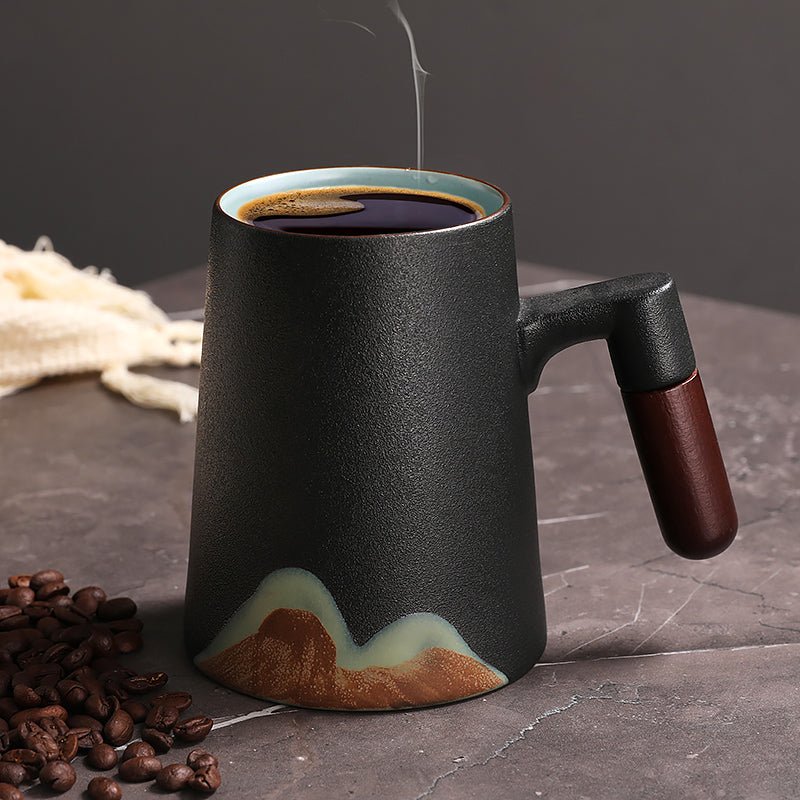
15 Oz Ceramic Coffee Mugs Replacement Purchase Product Shortlist Guide
Reading time: about 11 minutes
Six-forty in the morning, and the mug you have trusted for years is sitting on the counter with a hairline crack weeping down the handle. Or the interior has gone the color of old tea and nothing lifts it. You are not shopping for a first mug. The questions you have now are narrower than the ones you had the first time.
That is the entire method behind this 15 oz ceramic coffee mugs replacement purchase product shortlist guide: name what failed, then compare only the candidates that answer it. We sell these mugs and we process the returns, so the list below is built from complaints we actually hear — cracked handle joints, short pours, dulled glaze — rather than a category overview.
Why does the old mug set the brief better than a feature list?
A first-time buyer has to weigh size, shape, clay body, finish, and care all at once because there is nothing to compare against. You already ran that experiment. The mug in your hand has survived hundreds of wash cycles, a few near-drops, and every pour you make before you have fully woken up.
So skip the syllabus. Write one sentence about the mug you are retiring: “the handle cut into my fingers,” or “it held less than the photo suggested,” or “the rim chipped the second time it hit the dishwasher.” That sentence does most of the selection work for you. In our experience, buyers who can name the failure in a sentence end up choosing between two or three mugs. Buyers who cannot end up with eleven tabs open and no order placed.
If the sentence will not come, the list below usually shakes it loose.
Which failure on the old mug is the one worth fixing?
Ceramic problems cluster into a few predictable patterns. Match yours, then check the one thing on the next mug that would have prevented it:
- Chipped rim. Usually a thin, rolled rim paired with hard nesting in the cupboard. A marginally thicker rim helps; so does storing mugs side by side instead of stacked lip-to-foot.
- Handle cracked at the joint. Heat cycling and dishwasher cycles stress the seam where the handle meets the body, and a tight opening makes it worse because you lever the mug off your fingers every morning. A handle you can slide three fingers through without pressing is the actual fix.
- Crazing — the fine web of lines in the glaze. Glaze and clay body expand at slightly different rates, so the finish ages visibly. It is not automatically unsafe, but a crazed interior is a reason to inspect the mug, not to ignore it.
- Permanent staining inside. Worn or porous glaze traps coffee oils. A plain, light interior shows the truth; a dark interior hides it until the mug tastes off.
- Short pours. The mug was listed larger than it fills. Only a measured capacity solves this — not a bigger photo.
- Fatigue. Fine empty, tiring full. That is a weight problem, and it is solved by capacity, not by hunting for a lighter version of the same size.
What does 15 oz actually pour once you leave headroom?
Fifteen US fluid ounces is roughly 444 mL, which is a useful anchor. For scale, the FDA's ceramic guidance describes the ordinary cup or mug as small hollowware normally around 240 mL, or 8 fl oz. A 15 oz mug is close to double that reference size, which is exactly why it feels substantial and why the weight question keeps surfacing in reviews.
Here is the part listings leave out: the headline number is almost always brim capacity. Leave half an inch to an inch of headroom — about 1.3 to 2.5 cm — for cream, foam, or a spoon, and a 15 oz mug holds closer to 12 or 13 oz of actual drink. For most people that is a generous single serving. If you routinely fill right to the lip, you are a candidate for the next size up rather than a true 15 oz mug.
Weight follows the same arithmetic. A brim-full 444 mL pour adds roughly 444 g of liquid on top of the mug's own mass — and the mug's mass is the number almost nobody publishes. That is the figure your wrist feels at 6:45 a.m., so ask for the empty weight before you commit to carrying a mug from kitchen to home office every day.
Which mug earns a place on the 15 oz ceramic coffee mugs replacement purchase shortlist guide?
Our current lineup has no mug stamped exactly 15 oz. It has three capacities that bracket it, which is often more useful for a replacement than an exact match. The capacities are exact:
| Mug | Stated capacity | Approx. fl oz | Choose it if | Skip it if |
|---|---|---|---|---|
| The Flow | 400 ml | ~13.5 | The old mug felt heavy or too tall at the end of a full pour | You want a full 12 oz brew plus milk with room to spare |
| Morning and Night | 440 ml | ~14.9 | The old size was right and only the condition was wrong | You need slack for a very large latte or a 16 oz single-serve brew |
| The Rock | 480 ml | ~16.2 | You add milk, creamer, or ice and still want a full cup | Cupboard and dishwasher space is tight, or you want the lightest mug in hand |
Read that table as a filter, not a ranking. Morning and Night at 440 ml is the closest thing we sell to what the market calls a 15 oz mug, and it is the safe default when the failure was condition rather than size. The Flow at 400 ml is the honest answer when the real complaint was weight, grip, or cupboard space — dropping capacity cuts ceramic mass and liquid weight at the same time. The Rock at 480 ml deliberately overshoots, which suits drinkers who pour coffee plus milk, or iced drinks where the ice takes up volume.
What none of the three will do is turn a 12 oz brew into a brim-full 15 oz pour. If that is genuinely the requirement, buy the volume and accept the weight. The unique coffee mugs collection lists every current option with its stated capacity so you can compare without jumping between product pages.
Will the mug clear your grip, your desk, and the dishwasher rack?
Volume is the easy variable. These are the ones listings publish least often, and two of them you can measure today with a tape and a mug you already own:
- Handle opening. You want a clear gap that takes three fingers without pressing the knuckles. Larger hands or arthritic joints do better with a loose grip than with a wide body.
- Full weight. Estimate it, do not guess it: 444 mL of coffee is about 444 g, and that sits on top of the mug. If the total feels like too much to hold one-handed while standing, drop a size.
- Footprint. Wide, tapered bodies crowd a keyboard and foul a mouse hand. On a packed desk, diameter matters more than volume.
- Dishwasher clearance. Measure the interior height of your top rack, not just the gap between tines. Tall bodies and thick handles are the usual obstructions.
- Stacking. If mugs share a shelf, a shorter body lets you stack without putting load on the rim — the failure mode that started half these replacements.
If grip and heft are the leading issues rather than capacity, our ceramic mug comparison for coffee and tea drinkers covers the shape trade-offs in more detail.
When should glaze and decoration outrank capacity?
If the mug will hold hot, acidic coffee every morning for years, the finish deserves the same scrutiny as the ounce count. The regulatory picture is more concrete than most listings admit.
- The FDA's guidance for ceramic cups and mugs sets a lead guideline of 0.5 micrograms per mL of leaching solution, judged on any one of six units, with methods that include ASTM C738 and AOAC 973.32 and 973.82.
- Cadmium guidance is 0.5 micrograms per mL for small hollowware, defined as under 1.1 liters — a 444 mL mug sits comfortably inside that bracket.
- California's Department of Public Health notes that lead cannot be seen in glaze or paint, that coffee and tea are acidic and leach lead faster than water, that microwaving speeds the process, and that repeated dishwashing can damage a glaze and make later leaching more likely. It also notes lead is rarely found in plain white dishes.
- Under 21 CFR 109.16, decorative ceramicware that looks like foodware needs a permanent warning on the base if it is not meant for food. A gilded rim or metallic trim is the usual giveaway that a mug is display-first.
Two boundaries worth repeating. A microwave-safe mark is not a lead test result — those are different claims backed by different evidence. And “lead free” printed on a box is a statement, not a lab report; the FDA has documented imported pottery carrying that label that still released extractable lead.
Ask us directly whether finished-mug leach results exist for a specific piece. If the answer is no, that is information too, and it should change how you treat a heavily decorated mug. For the clay-body side of the decision, our ceramic versus porcelain capacity guide is the reference we point customers to most often.
When is 15 oz the wrong target entirely?
Plenty of replacements should go smaller, and we would rather say so than upsell you upward.
- A shared office cupboard full of tightly stacked mugs rewards a shorter, narrower body. The Flow at 400 ml nests more forgivingly than a 480 ml mug.
- A cappuccino you drink in three minutes does not need 444 mL of volume; it needs a shape that keeps foam together.
- Small hands and tea drinkers are often happier one size down, because the fatigue problem is the mug's mass, not the drink.
- Gift and promotional orders are frequently bought at 11 oz because they suit more hands and pack more cheaply. Step up to 15 oz when the recipient is a committed black-coffee drinker who fills to the top.
- A house full of teenagers is not a home for a hand-wash-only finish, no matter how good it looks on the shelf.
For the ounce-by-ounce breakdown of everyday sizes, our guide to how many ounces are in a mug of coffee is a quick read before you commit.
What belongs on the checklist before checkout?
- Name the failure on the old mug in one sentence.
- Decide whether the new target is smaller, the same, or larger — in millilitres or fluid ounces, not adjectives.
- Confirm the measured capacity or interior dimensions, not just the headline ounce figure.
- Get the empty weight and estimate the full weight for the size you chose.
- Check the handle opening against your own grip, especially for three or four fingers.
- Confirm microwave and dishwasher guidance for that specific finish and decoration — not for ceramic in general.
- Ask whether lead and cadmium leach testing is available for the finished mug.
- Measure your cupboard shelf and dishwasher rack before committing to a wider or taller body.
If you want the decision finished today, start with the pour you actually make rather than the size you used to own, then compare The Flow, Morning and Night, and The Rock on stated capacity in the current ceramic mug lineup. Two minutes with a measuring cup and a tape measure will settle more of this than another hour of reading.
Frequently asked questions
Is a 15 oz mug too big for one cup of coffee?
It depends on your pour. Fifteen US fluid ounces is about 444 mL, and leaving headroom for cream or stirring brings the usable pour closer to 12 or 13 oz. That is a large but common single serving. If you rarely finish a full mug, a 400 ml body will feel better in hand and get used more often.
Why do some 15 oz mugs seem to hold less than advertised?
Most listed capacities are brim-full measurements taken to the very lip. Once you leave space for milk, foam, or a spoon, the practical volume drops by roughly 2 to 3 oz. Listings that publish a measured fill or interior dimensions are the ones worth trusting over a styled photo.
What should I check on a 15 oz ceramic coffee mugs replacement purchase product shortlist guide before I buy?
Four things, in order: the exact capacity in millilitres, the empty weight, the handle opening, and the care instruction for that specific finish. Then ask whether any lead or cadmium leach result is available for the finished mug. If a listing answers none of those, treat it as a decorative object until proven otherwise.
Can I put a 15 oz ceramic coffee mug in the dishwasher and microwave?
Only if that specific mug says so. Microwave and dishwasher suitability depend on the clay body, the glaze, and any applied decoration, so guidance for one mug does not transfer to another — and a metallic rim or hand-applied print often rules out both. Check the base of the mug or the product page for your exact piece rather than the category.
What is the best replacement if my old 15 oz mug was simply too heavy?
Drop a size rather than hunting for a lighter 15 oz mug. A 400 ml body reduces ceramic mass and liquid weight together, which is where most of the fatigue actually comes from. Check the empty weight first, then the handle opening — a generous handle makes a heavier mug feel easier, but it cannot fix an oversized pour.
Ready to pick your mug? Two ways to save on today's order:
Ordering 1–3 mugs? Get an extra 10% off your 1st order with code 10_OFF Apply 10% Off & Shop Wooden-Handle Mugs →
Gifting 4+ mugs? Buy 3, Get the 4th Free applies automatically at checkout (no code needed; offers do not stack) · Free standard shipping (Nov pre-Christmas delivery: 15–20 calendar days US) · Free replacement if chipped in transit.
Popular mug buying guides: Ceramic Tea Cups & Infuser Mugs · Ceramic Mugs with Lids Compared · Wooden-Handle Tea Infuser Mugs Compared · Christmas & Secret Santa Mugs 2026 · Espresso & Cortado Cups Guide · Cup & Saucer Gift Sets · All 25 Mugs Spec Table · Mug Size Guide · Shipping & Promo FAQ
FIRST ORDER 10% OFF (CODE: 10_OFF) · OR BUY 3, GET THE 4TH FREE


Read more

Large Round Coffee Mugs Replacement Purchase Product Shortlist Guide
Build a short, scenario-based shortlist from what your old mug got wrong — capacity, brewer clearance, handle room — then match it to three rounded mugs listed at 400, 440 and 480 ml, with the trad...
Read more
Wide Based Coffee Mugs Replacement Purchase Product Shortlist Guide
Tired of knocking over top-heavy mugs or settling for the wrong volume? We evaluate three wide-based replacement candidates across 250 ml, 400 ml, and 480 ml capacities to help you balance desk sta...
Read more
Leave a comment
This site is protected by hCaptcha and the hCaptcha Privacy Policy and Terms of Service apply.