



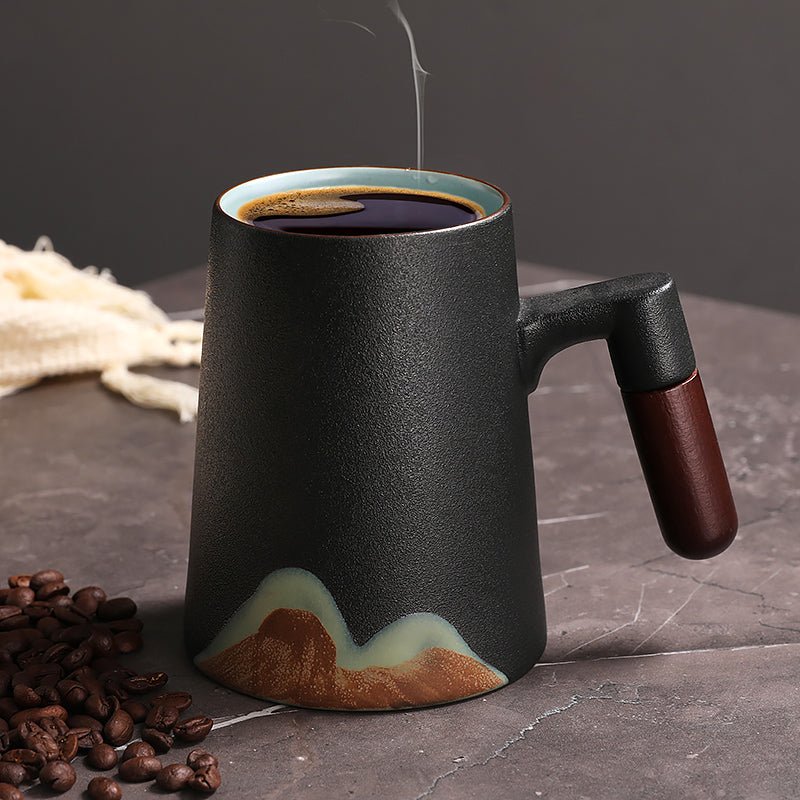
15 Oz Ceramic Coffee Mugs Replacement Purchase Practical Purchase Checklist
Reading time: about 10 minutes
Four years of morning routines, a chipped rim you kept ignoring, and a hairline base fracture that finally leaks: finding an exact replacement for a favorite mug feels simple until you browse online listings. Most brands list brim capacity rather than usable volume, meaning a mug advertised at 15 ounces often leaves you with cold, spilled, or skimpy pours. In our store, we see shoppers make the same sizing mistakes repeatedly, which is why this 15 oz ceramic coffee mugs replacement purchase practical purchase checklist focuses on matching the physical dimensions, empty weight, and grip clearance of the cup you already love before you spend a dime.
Brim capacity versus usable pour: why your new 15 oz mug might feel small
A fluid ounce measures liquid volume rather than mass. Under United States customary measures, 15 fluid ounces equals approximately 443.6 milliliters (commonly rounded to 444 ml). When you see a commercial listing for a 15 oz mug, that number almost universally represents brim capacity: the absolute maximum amount of water the vessel can hold when filled flush with the lip on a dead-level surface.
Nobody drinks from a brim-full cup. To carry coffee from the counter to your desk without splashing your knuckles, you naturally leave between 0.5 inches and 0.75 inches (12 to 20 mm) of headroom. On a standard cylindrical or slightly tapered mug, that missing top margin accounts for roughly 60 to 75 ml of space. That means your usable pour in a standard 15 oz vessel is actually between 370 ml and 385 ml (around 12.5 to 13 fl oz).
United States regulatory definitions reflect this gap. In Food and Drug Administration (FDA) Compliance Policy Guide Sec. 545.450, the agency describes typical cups and mugs as small ceramic hollowware holding roughly 240 ml (8 fl oz). The retail market treats 15 oz as a large daily mug, but neither federal agencies nor ceramic trade bodies mandate standard usable fill labels. If your daily brew routine involves a 12 oz drip cycle plus two ounces of steamed half-and-half, a nominal 15 oz vessel will sit right at the brim. If you want breathing room for stirring or walking, you need to understand your true liquid volume before ordering.
Four benchmark measurements to take from your retired mug
Before throwing your broken or worn-out cup into the recycling bin, spend five minutes gathering four baseline metrics. Keep these numbers next to your keyboard when comparing replacement candidates:
- Measured drinking volume (ml): Fill your old mug with water to your normal daily fill line (where you actually stop pouring). Pour that water directly into a kitchen liquid measuring cup. This is your true required capacity, not the catalog number.
- Tare weight (grams): Place the empty mug on a digital kitchen scale. A lightweight porcelain cup might weigh 280 grams, while a heavy stoneware piece can exceed 450 grams. Knowing this number prevents wrist shock when the delivery box arrives.
- Interior handle clearance (millimeters): Measure the inside height of the handle loop and the horizontal clearance between the handle interior and the mug wall. Note whether your grip accommodates two, three, or four fingers comfortably.
- Brewer clearance (centimeters or inches): Measure the total vertical exterior height of the mug. Check this against the distance between your drip tray and the dispense spout on your single-serve brewer or espresso portafilter.
Comparing replacement sizes: when to choose 400 ml, 440 ml, or 480 ml
In our catalog, ceramic vessels cluster around specific functional volume bands rather than arbitrary ounce numbers. Capacities below reflect stated catalog figures, providing clear targets depending on how closely you want to match your previous cup:
| Mug model | Stated capacity | Fluid ounce equivalent | Best replacement scenario |
|---|---|---|---|
| The Flow | 400 ml | ~13.5 fl oz | Shoppers whose old 15 oz mug felt slightly too heavy or regularly ended with cold leftover coffee. |
| Morning and Night | 440 ml | ~14.9 fl oz | Direct like-for-like replacement for a traditional 15 oz diner or bistro mug. |
| The Rock | 480 ml | ~16.2 fl oz | Shoppers adding cold brew with ice, high-foam lattes, or who prefer oversized morning portions. |
If your old mug was sold as a 15 oz cup and held your standard morning brew perfectly, the Morning and Night mug at 440 ml is the most precise catalog replacement. At roughly 14.9 fluid ounces, its total internal volume sits within a single teaspoon of nominal 15 oz capacity.
Conversely, if you consistently discarded the bottom inch of coffee because it went cold, downsizing to The Flow at 400 ml gives you ~13.5 fl oz of brim space. That smaller volume reduces thermal dissipation by reducing exposed surface area, making it ideal for black coffee drinkers who take smaller, hotter pours.
For iced pour-overs, aerated lattes, or afternoon tea where you need room for an infuser basket, The Rock at 480 ml provides ~16.2 fl oz of headroom. You can compare these silhouettes side by side within our complete unique coffee mugs collection. Because finish batches vary slightly, we do not list dry weights or millimeter handle openings on every product page; if you have specific joint or hand-mobility requirements, reach out to our team to verify batch measurements before purchasing.
Full-cup weight and handle ergonomics: preventing wrist fatigue
Liquid volume is only half the equation when holding drinkware; the rest is physics. Water and brewed coffee weigh approximately one gram per milliliter. A full 15 fl oz pour adds roughly 440 grams (nearly one pound) of liquid weight to the vessel alone.
- A light 300 g ceramic body combined with 440 g of coffee results in a total loaded weight of 740 grams (1.63 lbs).
- A heavy 460 g stoneware body holding that same drink reaches 900 grams (1.98 lbs).
Holding nearly two pounds by a single loop requires adequate grip ergonomics. When evaluating handles, look at the contact area. A narrow, thin strap handle concentrates pressure directly onto the index and middle finger joints. A wider, ribbon-style handle distributes the loaded weight across the pad of your fingers. Furthermore, handle placement determines the lever arm: handles attached higher up create a bottom-heavy pendulum that feels more stable, while centered handles balance tilt during sips.
Know the limits of ceramic construction. If you suffer from severe wrist osteoarthritis, a loaded 15 oz ceramic mug may prove too punishing for single-handed use, regardless of handle shape. In those circumstances, downsizing to a smaller 10–12 oz cup or choosing a double-walled titanium vessel makes more ergonomic sense. Similarly, if your primary goal is an unspillable container for a car commute, traditional open ceramic mugs are completely unsuitable; an insulated travel tumbler with a sealed lid is the proper tool.
Glaze chemistry, dishwasher wear, and food contact safety standards
A mug used every morning for hot, acidic liquids requires safe glaze chemistry. Coffee typically registers an acidic pH between 4.85 and 5.10, while black teas often sit around 4.9. Acidic liquids at high temperatures act as natural leaching solvents against substandard glazes.
Federal safety standards regulate heavy metal leaching in drinkware. Under FDA Compliance Policy Guide Sec. 545.450, the regulatory limit for leachable lead in ceramic cups and mugs is 0.5 micrograms per milliliter (μg/ml) of leaching solution, evaluated using standard laboratory test methods such as ASTM C738 or AOAC 973.32. For cadmium, FDA CPG Sec. 545.400 establishes a limit of 0.5 μg/ml for small hollowware holding less than 1.1 liters.
Understanding how care affects glaze stability protects your investment over years of use:
- Microwave safety does not mean lead-free: A “microwave safe” mark merely indicates the clay body and glaze do not absorb electromagnetic radiation and heat up dangerously on their own. It does not certify that the glaze meets ASTM C738 heavy metal leach limits.
- Acid and temperature stress: The California Department of Public Health (CDPH) notes that acidic beverages leach contaminants from compromised glazes significantly faster than water, and microwaving accelerates this reaction. CDPH also points out that plain white glazes statistically carry the lowest incidence of heavy metal additives compared to bright orange, deep red, or lustrous metallic glazes.
- Dishwasher detergent abrasion: High-alkaline automatic dishwasher detergents combined with intense heat cycles can microscopic etch soft glazes over hundreds of washes. If a glaze begins to show crazing (a fine network of micro-cracks), coffee tannins and oils will penetrate the porous biscuit underneath, causing permanent staining and potential hygiene issues.
- Decorative labeling: Under 21 CFR 109.16, ornamental or decorative ceramics containing leachable heavy metals must carry permanent exterior warning stamps stating “Not for Food Use” or have a hole drilled through the base to prevent beverage consumption. Always verify that a replacement mug is graded explicitly for daily food service.
What belongs on a 15 oz ceramic coffee mugs replacement purchase practical purchase checklist?
When you are ready to replace your retired vessel, run through this practical eight-step verification sequence before completing checkout:
- Confirm true drinking capacity: Match your measured daily volume (not brim volume) to the listed milliliters. Remember that 440 ml provides roughly 370–385 ml of practical drinking space.
- Verify appliance clearances: Compare exterior height against your espresso portafilter, pod machine nozzle, and cabinet shelf spacing.
- Calculate total loaded weight: Add the estimated liquid volume in grams to the mug’s dry tare weight to ensure your wrist can comfortably manage the total mass.
- Evaluate handle loop clearance: Ensure the handle opening provides sufficient finger clearance (ideally 3 to 4 fingers for a 15 oz volume) to prevent knuckles from pressing directly against the hot ceramic wall.
- Examine base geometry: A wider base footprint resists accidental desk tip-overs, which is crucial for high-volume mugs holding nearly a pint of liquid.
- Check material density and heat retention: Dense stoneware retains heat longer once thoroughly warmed, but porcelain offers a thinner, more refined lip feel. Explore our guide on ceramic versus porcelain mug capacity to determine which material fits your morning routine.
- Inspect finish and care restrictions: Verify whether the design uses colored glazes, real metallic trims (which forbid microwaving), or plain vitrified glazes. For sizing context across different brew methods, review our guide to coffee mug ounces.
- Review retailer return and transit policies: Ceramic drinkware faces thermal and mechanical stress during parcel delivery. Ensure the seller offers full break-in-transit guarantees and hassle-free replacements.
Taking these measurements eliminates the guesswork. Rather than gambling on generic photos, compare the exact stated capacities of The Flow (400 ml), the Morning and Night (440 ml), and The Rock (480 ml) in our curated unique coffee mugs collection to find the exact ergonomic match for your kitchen counter.
Frequently asked questions
What should a 15 oz ceramic coffee mugs replacement purchase practical purchase checklist cover first?
A 15 oz ceramic coffee mugs replacement purchase practical purchase checklist must start with usable liquid fill rather than brim capacity. Fill your old mug to your standard drinking line and pour that liquid into a measuring cup to determine your actual requirement in milliliters. This prevents buying an advertised 15 oz mug that leaves zero headspace for milk or movement.
Is 440 ml an exact match for a 15 oz replacement mug?
Yes, 440 ml works out to roughly 14.9 fluid ounces, making it virtually identical to a standard 15 oz brim measurement. The Morning and Night mug at 440 ml is designed specifically for drinkers who want a direct replacement for classic large diner or bistro mugs.
Does a microwave-safe mark mean the ceramic glaze is lead-free?
No. Microwave safety only certifies that the ceramic body and glaze do not absorb microwave energy or arc during heating. Lead and cadmium safety are chemical leaching standards governed by FDA guidelines (such as CPG Sec. 545.450) and evaluated via acid leach testing like ASTM C738.
Do thick ceramic walls keep coffee hot longer than a travel mug?
No. Thick ceramic walls have high thermal mass, meaning they absorb heat from your coffee initially unless you preheat the mug with hot tap water. While heavy ceramic slows radiant heat loss better than thin glass, it cannot compete with double-walled, vacuum-insulated stainless steel.
Why do older ceramic mugs develop dark stains inside the base?
Dark staining typically occurs when coffee tannins settle into crazing—microscopic hairline fissures in the glaze caused by thermal shock or repeated dishwasher cycles. While minor staining is common in vintage ceramics, sharp chips along the rim compromise hygiene and indicate the mug should be retired.
More from our blog
Ready to pick your mug? Two ways to save on today's order:
Ordering 1–3 mugs? Get an extra 10% off your 1st order with code 10_OFF Apply 10% Off & Shop Wooden-Handle Mugs →
Gifting 4+ mugs? Buy 3, Get the 4th Free applies automatically at checkout (no code needed; offers do not stack) · Free standard shipping (Nov pre-Christmas delivery: 15–20 calendar days US) · Free replacement if chipped in transit.
Popular mug buying guides: Ceramic Tea Cups & Infuser Mugs · Ceramic Mugs with Lids Compared · Wooden-Handle Tea Infuser Mugs Compared · Christmas & Secret Santa Mugs 2026 · Espresso & Cortado Cups Guide · Cup & Saucer Gift Sets · All 25 Mugs Spec Table · Mug Size Guide · Shipping & Promo FAQ
FIRST ORDER 10% OFF (CODE: 10_OFF) · OR BUY 3, GET THE 4TH FREE


Read more

Coffee Mugs With Big Handles: Replacement Purchase Product Shortlist
Start with the mug that failed — the pinching loop, the short pour, the awkward brewer clearance — then match CoffeifyMug's 250 ml, 400 ml, and 480 ml options to that specific complaint, with the f...
Read more
Large Round Coffee Mugs Replacement Purchase Product Shortlist Guide
Build a short, scenario-based shortlist from what your old mug got wrong — capacity, brewer clearance, handle room — then match it to three rounded mugs listed at 400, 440 and 480 ml, with the trad...
Read more
Leave a comment
This site is protected by hCaptcha and the hCaptcha Privacy Policy and Terms of Service apply.