
15 Oz Ceramic Coffee Mugs for Desk Use: Capacity and Fit
Reading time: about 11 minutes
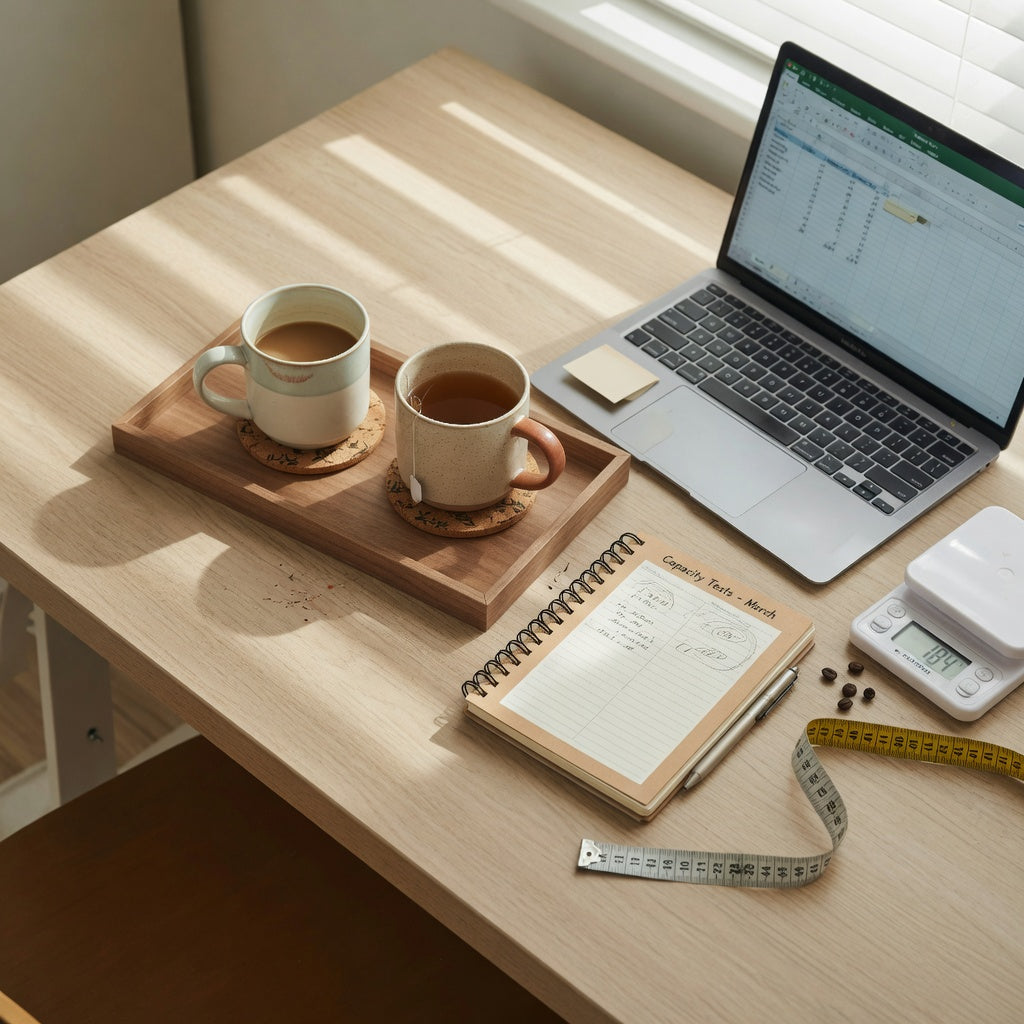
Somewhere around mid-morning, a full mug and a wireless mouse end up sharing the same six inches of desk. That is the moment a desk mug proves itself or gets quietly moved to the kitchen shelf. We handle this drinkware daily, and the question that keeps coming up is rarely about colorways — it is about whether the mug holds enough coffee to reach lunch without threatening a laptop. 15 oz ceramic coffee mugs for desk use sit right on that line: large enough to be worth the trip to the brewer, small enough that you still have desk left over.
What the product label will not tell you is the part that decides the purchase. Capacity gets measured to the brim, weight changes the second you fill it, and the handle either fits your hand or it does not. Here is how we think through those trade-offs, and how our three current sizes line up against a real workstation.
What a 15 fl oz label actually pours once the mug is on your desk
Fifteen US fluid ounces converts to roughly 444 milliliters. That figure comes from the fluid-ounce definition itself, not from any drinkware standard — because no standard defines a "15 oz mug." For context, the FDA's own plain-language description of a ceramic cup or mug uses about 240 ml (roughly 8 fl oz) as its example. A 15 oz vessel is nearly double the reference size regulators had in mind, which is exactly why headspace matters more here than on a standard cup.
Almost every listed capacity is brim-full capacity. Pour 15 fl oz into a 15 fl oz mug and the liquid sits level with the lip — fine for a photo, bad for a desk with a keyboard on it. In practice we suggest leaving roughly half an inch to three-quarters of an inch of headroom. That drops the usable pour into the neighborhood of 12.5 to 13.5 fl oz, which changes who the mug suits:
- Pod and capsule brewers: an 8 to 10 oz brew leaves comfortable room for two or three ounces of milk or cold foam without reaching the rim.
- Drip and pour-over: a 12 oz pour plus a small splash fits with headroom left; a 14 oz pour plus cream does not.
- Latte-style drinks: foam collapses, so you need vertical buffer — a brim-full milk drink is a spill waiting for a mouse reach.
- Iced coffee: ice displaces volume fast; a 15 oz mug with a full scoop of cubes holds noticeably less liquid than the number suggests.
If you routinely pour 14 oz of black coffee and still want cream, treat a 15 oz label as too tight and step up. Our guide to how many ounces are actually in a mug of coffee walks through the same arithmetic with everyday brewers.
Desk footprint, foot rings, and why a wide base wins on a crowded workstation
Height and base diameter get published far less often than capacity, yet they decide whether a mug survives a Monday. A tall, narrow body puts the liquid's center of gravity high, so a forearm brush sends it tipping; a shorter, wider body keeps that weight low and skids instead of topples. Before ordering, compare the base to whatever the mug will sit on — a coaster, a desk mat, a tray — because a base that overhangs the coaster edge by even a quarter inch turns a stable mug into a wobbly one.
| Body profile | How it behaves on a desk | What to verify before buying |
|---|---|---|
| Straight-sided cylinder | Predictable balance, easy to grip, sits flat on a coaster | Base diameter and overall height |
| Tapered (narrow foot, wider rim) | Looks slimmer, but a small foot concentrates weight and tips more easily | Foot ring diameter, not the rim diameter |
| Wide, low bowl | Lowest tip risk, but takes up more surface area next to a mouse | Width footprint and handle projection |
One detail that almost never appears in listings: the unglazed foot ring. That bare clay band under the base is slightly abrasive and can dull a lacquered or veneer desktop over months of small slides, and it transfers heat more directly than a glazed surface. We keep a stack of felt pads in the office for exactly this reason. If your desk has a real wood finish you care about, that is a two-dollar fix worth making.
Handle clearance and full-mug weight across an eight-hour workday
The mug is light until it is not. Thirteen fluid ounces of coffee weighs roughly 400 grams — call it fourteen ounces — before you add the ceramic. So the grip matters far more than the empty weight you felt in the store.
Three things we check on any handle, in order:
- Finger purchase. Can three fingers pass through comfortably, or is this a two-finger pinch? A pinch grip on a heavy mug means the load hangs off your fingertips, and that gets old by the second refill.
- Knuckle standoff. There should be visible daylight between the inside of the loop and the mug wall. If your knuckles brush the body, you will feel the heat through the ceramic on a full mug.
- Thumb rest. A flattened top curve or a wide upper anchor gives you leverage against the forward tilt when you lift a full mug off a low coaster.
Who should skip 15 oz? Anyone with smaller hands, a wrist or grip issue, or a habit of sipping slowly and letting coffee go cold. A full large ceramic mug is a real weight to lift a dozen times an hour, and ceramic is not insulated — thick walls slow heat loss somewhat, but they do not hold temperature the way a vacuum-sealed tumbler does. If hot-for-two-hours is the priority, an insulated cup is the better tool and we will say so plainly.
How 15 oz ceramic coffee mugs for desk use map to our 400 ml, 440 ml, and 480 ml sizes
We list exact milliliter capacities because "large" means nothing across brands. Three current profiles in our unique coffee mugs collection cover most desk setups:
- Tight desk, moderate pour: The Flow Coffee & Tea Mug holds 400 ml (about 13.5 fl oz). That is close to the usable pour of a nominal 15 oz mug once you account for headspace — a sensible pick if a 10 oz brew plus milk is your normal, or if surface area is contested by a tablet and a second monitor.
- Closest to a true 15 oz experience: Morning and Night Coffee & Tea Mug holds 440 ml (about 14.9 fl oz). This is the one to choose if a 12 oz drip pour with room for creamer is the routine you want to protect.
- Long sessions, tea, and iced drinks: The Rock Coffee & Tea Mug holds 480 ml (about 16.2 fl oz). Extra volume helps when a tea bag needs full submersion or when ice is going in, but it is also the most mug to lift — check the current listing for dimensions if clearance under a monitor riser or brew basket is tight.
Two honest caveats. None of these are insulated, so none will keep coffee hot for hours; that is the nature of ceramic, not a defect. And if your desk is genuinely cramped, a smaller vessel you refill is often more pleasant than a large one you have to steer around. Our comparison of ceramic versus porcelain and how current sizes compare covers that trade-off in more depth.
Crazing, chips, and dishwasher haze: care details that decide year two
Year one is easy. Year two is where desk mugs reveal themselves. Three failure modes show up again and again in this category, and all three are visible if you know what to look for.
- Crazing. Fine hairline cracks across the glaze, often from thermal shock — pouring boiling water into a cold mug, or running a hot mug under cold water. The glaze is still intact as a layer, but those cracks trap coffee oils and stain brown. Plain white glazes hide it best; light glazes show it first.
- Rim chips. Rims take the hit from stacking in office cabinets and from the dishwasher rack. A chipped rim is a lip-level defect, not a cosmetic one — retire the mug.
- Dishwasher haze. Repeated hot cycles with heavy detergent gradually dull a glossy glaze, and printed or sublimated decorations fade faster than the body does. Harsh institutional machines are harder on finishes than a home unit.
Which brings us to the point most care guides skip: care is finish-specific, not category-wide. Metallic luster trim — real gold or platinum accents — must never go in a microwave; it arcs. Some printed decorations are hand-wash only even when the ceramic body itself is dishwasher tolerant. Read the care line on the specific listing rather than assuming "ceramic" covers it.
Lead, cadmium, and what a "microwave safe" badge does not tell you
Coffee and tea are acidic, and acidic drinks are precisely what pull trace metals out of a poorly fired or improperly glazed piece. That is why fired ceramic foodware gets tested rather than eyeballed.
FDA guidance for ceramic cups and mugs sets an extractable lead limit of 0.5 micrograms per milliliter of leaching solution, judged on any one of six units, with methods such as ASTM C738 listed among the acceptable test procedures. The parallel cadmium guidance sets 0.5 micrograms per milliliter for small hollowware under 1.1 liters.
Two limits are worth understanding. The FDA notes that ceramicware with extractable lead in that test should not be labeled "Lead Free," and it has documented imported pottery carrying a lead-free label that still leached lead. California's Department of Public Health adds the practical layer: lead is invisible in glaze and paint, coffee and tea leach it faster than non-acidic drinks, heating or microwaving a contaminated dish speeds the process, and dishwasher cycles can damage a glaze in ways that make later leaching more likely. The same department notes lead is rarely found in plain white dishes. Separately, under 21 CFR 109.16, decorative ceramicware that looks like foodware must carry a conspicuous warning unless it is clearly unusable for food — which is why a novelty cup with a warning label should never become your daily desk mug.
Here is the part we will not dress up: a microwave-safe mark is not a lead or cadmium test. The two claims come from different processes, and a label saying one tells you nothing about the other. We do not publish finished-mug leach results on every listing, and we are not going to imply otherwise in a blog post. If documented food-contact testing matters for a specific mug you are considering, ask us before you order and we will tell you exactly what documentation exists for that item.
The five-minute desk-fit check before you add to cart
- Measure your real pour. Fill your current mug the way you actually drink, then measure it. A 12 oz habit and a 16 oz habit lead to different purchases.
- Check headroom. If you brew under a machine or a monitor riser, measure the gap. Tall mugs sometimes need the drip tray pulled.
- Test the coaster. The base should sit fully inside it with no overhang.
- Compare the handle to one you like. Trace the opening of a mug that already feels right and match it. If it is not published, ask.
- Note the empty weight question. Most listings omit it. Heavier bodies feel sturdier and hold heat a little longer; lighter ones are easier to lift all day.
- Read the care line and the decoration type. Metallic trim means no microwave; hand-wash-only prints exist.
If you want to shortcut the search, start with the 440 ml Morning and Night Coffee & Tea Mug for a standard desk routine, or browse the full unique coffee mugs collection and compare exact milliliter capacities side by side.
Frequently asked questions
How much coffee does a 15 oz ceramic mug actually hold?
About 444 ml at the brim, but plan on roughly 12.5 to 13.5 fl oz of usable liquid once you leave half an inch to three-quarters of an inch of headroom. That is why 15 oz ceramic coffee mugs for desk use work best with a 10 to 12 oz brew plus room for milk.
Is 15 oz too big for a desk with a laptop and a second monitor?
It depends on base footprint more than capacity. A tall mug with a narrow foot is the risk; a shorter, wider body is easier to live with. If surface area is tight, the 400 ml Flow mug gives you a similar usable pour in a smaller footprint.
Will a full 15 oz ceramic mug feel heavy to lift?
The liquid alone is about 400 grams at 13 fl oz, before the ceramic is counted. If that sounds like too much to lift repeatedly, look for a three- or four-finger handle opening and keep the mug on a coaster at desk level rather than reaching up to a shelf.
Does a microwave-safe label mean the glaze is lead-free?
No. Microwave suitability describes how the piece handles heating; lead and cadmium limits come from separate extraction testing under FDA guidance such as CPG Sec. 545.450 and CPG Sec. 545.400. Ask the seller for food-contact documentation rather than relying on an appliance badge.
Should I pick 400 ml or 440 ml for a 12 oz drip brew?
A 12 oz pour plus creamer is more comfortable in 440 ml, where headroom stays generous. The 400 ml Flow mug suits a 10 oz brew with milk, or a 12 oz black coffee you drink without additions.
More from our blog
Read more

Latte Mugs Tall for Desk Use: Capacity, Footprint, and Fit
A desk mug has to survive keyboard space, handle reach, and your actual pour volume. We compare our 400 ml, 440 ml, and 480 ml mugs by capacity, then list the measurements that decide whether a tal...
Read more
Wide Based Coffee Mugs for Desk Use: Capacity, Footprint, Fit
Wide based coffee mugs for desk use solve one problem and create two more: footprint and refill math. Here is how 250, 400 and 480 ml bodies actually behave beside a keyboard, and which measurement...
Read more
Leave a comment
This site is protected by hCaptcha and the hCaptcha Privacy Policy and Terms of Service apply.