




15 oz Ceramic Coffee Mugs Compact Kitchen Practical Purchase Checklist
Reading time: about 12 minutes
In our store, the mugs that come back are rarely the wrong colour. They are the ones that held exactly the right amount and still would not sit under the cabinet, or that felt fine empty and like a small dumbbell by the last inch of a full pour. A 15 fl oz mug is a genuine upgrade for a drip-coffee drinker and a genuine nuisance in a kitchen with a four-inch shelf gap.
So here is the order this 15 oz ceramic coffee mugs compact kitchen practical purchase checklist follows: verify the usable pour, measure the shelf, judge the full weight, then read the glaze and care lines. Our team packs and photographs these mugs every week, and the eight checks at the end are the ones we actually walk shoppers through before they commit.
What does the 15 fl oz label actually measure?
Fluid ounces measure volume, so 15 fl oz works out to roughly 444 ml. That number describes a brim-full pour and nothing beyond it. No US standard defines a "15 oz coffee mug"; FDA's own description of cups and mugs uses a much smaller reference of about 240 ml, or 8 fl oz, while noting these vessels usually have a handle. The 15 oz figure on a listing is one seller's measurement of one shape, taken one way.
Brim capacity and drinking capacity are different numbers, and only one of them shows up at 7 a.m. A mug filled flush with the rim spills on the first step toward the table. It is also why 15 oz vs 12 oz ceramic coffee mugs looks like a three-ounce gap on paper and a thinner one at the pour line — headroom takes a bigger share out of a small mug than a large one.
How much of that 15 oz survives cream, foam, and stirring?
Every drink loses volume to headroom; the amount depends on what you pour. In our own cups, black coffee gets about half an inch of clearance, and a latte we intend to top with foam gets closer to an inch and a quarter, because foam needs somewhere to sit and a spoon needs somewhere to go.
Calibrate before you shop. Fill the mug you use now to the level you genuinely pour, tip it into a measuring cup, and read the number. Plenty of people who assume they drink 15 oz are pouring 10 to 12. If that is you, a 15 oz mug will live its life half full — fine for heat, wasteful for shelf space in a kitchen where every inch is contested.
Will it clear the shelf? Measure gap height, handle depth, and door swing
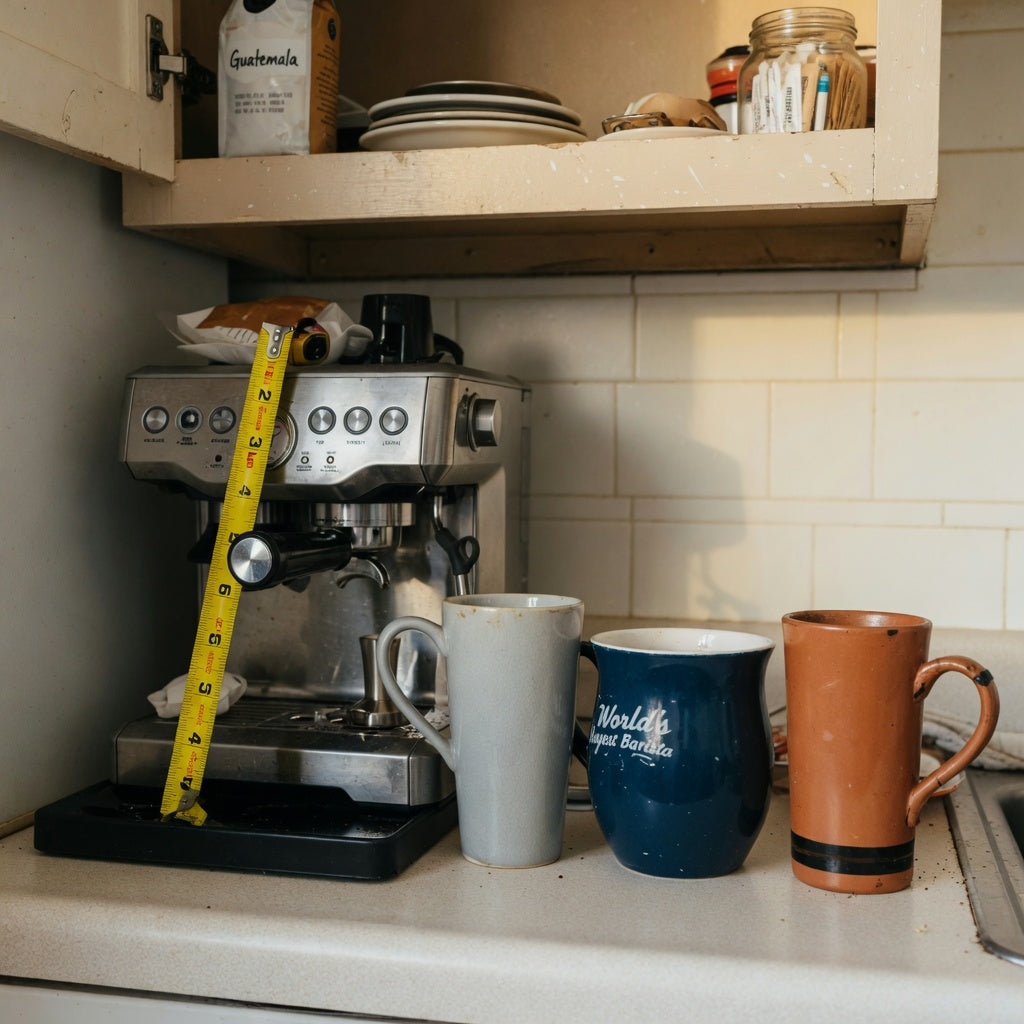
Take the tape measure to the cabinet, not to the product photo. Three numbers decide whether a large mug lives comfortably or fights the door.
- Shelf clear height. Measure the gap front and back; cabinets are rarely square, and the lowest point is the one that counts. Compare that to the mug's height, including any handle that rises above the rim.
- Handle protrusion. This is total depth with the handle attached, not body diameter. The handle adds distance at exactly the height where a door, a microwave wall, or the next mug sits.
- Door swing and stacking. A deep handle can catch a closing door. If you stack, check whether one foot nests inside the rim below — wide, flat bases stack poorly and eat shelf length fast.
The cardboard test beats arithmetic. Cut a rectangle to the mug's listed height and depth, stand it on the shelf, and shut the door. If it topples or blocks the swing, the mug will too. Repeat inside the microwave if you reheat: turntable diameter and interior height both count, and a mug that fits only at an angle is a mug you stop reaching for.
Four compact-kitchen buyer scenarios — and where each one lands
Most shoppers who arrive looking for a 15 oz mug are one of four people. Find your line before you start comparing glazes.
- The one-mug drinker in a studio kitchen. You pour 10 to 12 oz of drip coffee, you have one shelf, and you want the counter back. The Flow coffee and tea mug at 400 ml (~13.5 fl oz) keeps the smallest footprint and is the honest pick if the 15 oz label was aspirational.
- The shopper who really does want 15 oz. Closest match in our lineup: Morning and Night at 440 ml (~14.9 fl oz). It is where we point anyone who arrives with that exact number in mind and drinks drip coffee or tea.
- The latte and cappuccino maker. Foam needs rim room, so The Rock at 480 ml (~16.2 fl oz) is the better fit — and the one to check hardest against a tight shelf, since extra volume usually arrives as extra height or width.
- The gift or desk-mug buyer. Shelf clearance usually stops mattering, a large mug reads generous in a box, and a heavyweight 15 oz ceramic coffee mug feels substantial on a desk. Start with the unique coffee mugs collection and sort by capacity before style.
Notice what is missing from that list: a winner. No single size is right for every counter, and the answer changes with your pour and your shelf rather than with the label.
What does a full 15 oz mug weigh in the hand?
Empty weight is the spec shoppers ask for last and should ask for first. A full mug weighs its empty weight plus the drink, and a water-based pour adds roughly a gram per millilitre — so 400 ml of coffee adds about 400 g before the mug itself is counted, and a 450 ml pour adds about 450 g.
- Ask for empty weight in grams or ounces if the listing omits it. That number, not capacity, predicts how heavy the mug feels full.
- Check the handle opening. You want room for three or four fingers with the knuckles clear of the body. Thick stoneware pushes fingers outward, so a wide-looking handle on a heavyweight mug can still feel cramped.
- Judge the balance point. A top-heavy empty mug gets worse with 450 ml in it. A broad, flat foot is steadier than a narrow one, though it costs shelf space.
Size down if you carry coffee one-handed up stairs, if arthritis limits your grip, or if you drink 8 to 10 oz at a sitting. And be clear about what a 15 oz ceramic mug is not: it is not a commuter mug. No lid, an open top, real mass. If the mug is going in a car or a bag, insulated travel drinkware is the correct purchase.
Which CoffeifyMug capacity lands closest to 15 fl oz?
We list capacities in millilitres because it keeps the comparison honest. Three current shapes bracket the 15 fl oz target.
| Mug | Listed capacity | Approximate fl oz | Choose it when |
|---|---|---|---|
| Morning and Night | 440 ml | ~14.9 fl oz | You want the nearest match to 15 oz without stepping up in size. |
| The Rock | 480 ml | ~16.2 fl oz | You add milk or foam and want extra headroom at the rim. |
| The Flow | 400 ml | ~13.5 fl oz | You pour 10 to 12 oz and would rather keep the footprint small. |
Morning and Night at 440 ml (~14.9 fl oz) is the closest thing we sell to a 15 oz mug. The Rock at 480 ml (~16.2 fl oz) is the pick when a foam layer needs rim room. The Flow at 400 ml (~13.5 fl oz) suits a smaller pour and a tighter counter. Dimensions, empty weight, and care instructions are published per product, so open the current page for the shape you are considering instead of assuming the three share a footprint.
Glaze, prints, and the first dishwasher cycle
Care advice is finish-specific, yet many pages state dishwasher and microwave safety for "ceramic" as a whole category. Treat that as a starting point, not a guarantee.
- Metallic rims and gold trim are the classic hand-wash-only items. If the care line does not address them, ask before the first cycle.
- Exterior prints and textured finishes wear differently from a plain glaze, and a printed surface on the inside of the mug deserves a direct question to the seller.
- Crazing — the fine web of cracks that develops in an older glaze — is a good reason to retire a mug from daily coffee duty, since coffee oils settle into those lines and stain them.
- Rim chips are the most common failure we see. A thicker rim resists chipping better than a thin one, but it also adds weight exactly where you grip.
One thing we will not claim: that thick ceramic walls keep coffee hot longer than thin ones. Shoppers say so in reviews, but we have not seen a cited laboratory comparison at this size, and an open-topped mug sheds heat regardless of wall thickness.
Is "microwave safe" the same claim as "lead free"?
No — and merging them is how buyers get surprised. Keep three separate boxes: microwave behaviour, dishwasher durability, glaze chemistry.
On chemistry, the numbers are public. FDA's compliance policy guide for cups and mugs sets a lead guideline of 0.5 micrograms per millilitre of leaching solution, judged on any one of six units, with methods such as ASTM C738 among those listed. Cadmium guidance is 0.5 micrograms per millilitre for small hollowware, defined as under 1.1 litres — a bracket that covers every mug in this size class. Those are test thresholds, not words printed on a retail box.
The California Department of Public Health supplies the practical half: lead cannot be seen in a glaze, coffee and tea are acidic enough to pull it from contaminated ware faster than non-acidic drinks, heat or microwaving speeds that leaching, and repeated dishwashing can damage a glaze and make later leaching more likely. CDPH also notes that plain white dishes rarely test positive. FDA has documented imported pottery labelled "Lead Free" that still released extractable lead, so when a listing claims lead free cadmium free ceramic coffee mugs, it is fair to ask what the claim rests on. Decorative ware that only looks like drinkware is handled separately under 21 CFR 109.16.
When a 15 oz mug is the wrong buy for a small kitchen
- Your shelf clearance is genuinely tight and the mug is tall rather than wide.
- You pour 8 to 10 oz and dislike lukewarm leftovers.
- You need to carry coffee one-handed, or pack it in a bag.
- Two or more people share one narrow shelf and you need stackable mugs that nest.
- The drinker has a small grip, or the mug doubles as a child's cocoa cup.
None of that makes 15 oz a bad size. It makes it a bad size for your counter. If you are unsure how your usual pour compares to standard sizes, our guide to how many ounces in a mug of coffee is a five-minute calibration, and the ceramic vs porcelain capacity comparison covers the material trade-off at this size without repeating this checklist.
15 oz ceramic coffee mugs compact kitchen practical purchase checklist
Eight checks, in the order that saves returns.
- Measured capacity. Confirm ounces or millilitres from the listing text, not from a photo of a mug beside a scoop of beans.
- Usable fill. Subtract headroom for cream, foam, and a spoon. Brim capacity is a warehouse number, not a pour size.
- Shelf clear height. Measure the gap at its lowest point, front and back.
- Handle protrusion and door swing. Cardboard template, door closed, microwave turntable checked.
- Empty weight. Ask if missing. Add roughly the weight of your pour for the full-mug figure.
- Handle opening. Three or four fingers, knuckles clear, comfortable in the hand you actually use.
- Glaze and decoration. Note metallic trim, interior prints, and textured finishes, then match them to the care line item by item.
- Safety statements. Keep microwave, dishwasher, and lead or cadmium claims in three separate boxes.
If 15 oz is your number, start with Morning and Night at 440 ml (~14.9 fl oz). Want rim room for foam, step up to The Rock at 480 ml (~16.2 fl oz). Pour smaller and want the counter back, drop to The Flow at 400 ml (~13.5 fl oz). Still weighing handle shape or finish? Browse the full range of unique coffee mugs and sort by capacity before anything else.
Frequently asked questions
Does a 15 oz mug actually hold 15 oz of coffee?
Only to the brim. Once you leave working headroom for cream, foam, or a spoon, you will pour less than the stated capacity, and how much less depends on how much room your drink needs at the top. Measure your normal pour once and you will know your real number instead of the label's.
Will a 15 oz ceramic mug fit under an upper cabinet?
Often, but not reliably. Shelf gaps vary more than people expect, and a tall body plus a raised handle is what fails first. Measure the gap at its lowest point, then compare it to the mug's listed height and handle protrusion — or stand a cardboard template on the shelf and shut the door.
Is a 15 oz ceramic mug too heavy to hold with one hand?
That depends on empty weight and handle size, not capacity alone. A full pour adds roughly 400 to 450 g on top of the mug, so ask for empty weight when a listing omits it and confirm the handle takes three or four fingers with the knuckles clear of the body.
Which CoffeifyMug mug is closest to 15 oz?
Morning and Night at 440 ml (~14.9 fl oz). The Rock at 480 ml (~16.2 fl oz) adds headroom for milk or foam, and The Flow at 400 ml (~13.5 fl oz) suits a smaller pour and a tighter counter.
What do most shoppers get wrong about 15 oz mugs?
They buy the number instead of the fit. The 15 oz ceramic coffee mugs compact kitchen practical purchase checklist above starts with usable fill, then moves to shelf height, handle clearance, and empty weight — because a mug that holds the right amount but will not sit on your shelf is still the wrong mug.
More from our blog
Ready to pick your mug? Two ways to save on today's order:
Ordering 1–3 mugs? Get an extra 10% off your 1st order with code 10_OFF Apply 10% Off & Shop Wooden-Handle Mugs →
Gifting 4+ mugs? Buy 3, Get the 4th Free applies automatically at checkout (no code needed; offers do not stack) · Free standard shipping (Nov pre-Christmas delivery: 15–20 calendar days US) · Free replacement if chipped in transit.
Popular mug buying guides: Ceramic Tea Cups & Infuser Mugs · Ceramic Mugs with Lids Compared · Wooden-Handle Tea Infuser Mugs Compared · Christmas & Secret Santa Mugs 2026 · Espresso & Cortado Cups Guide · Cup & Saucer Gift Sets · All 25 Mugs Spec Table · Mug Size Guide · Shipping & Promo FAQ
FIRST ORDER 10% OFF (CODE: 10_OFF) · OR BUY 3, GET THE 4TH FREE


Read more
Latte Mugs Tall Compact Kitchen Product Shortlist Guide
A compact-kitchen shortlist built around listed capacities, brim versus fill, and the measurements shoppers forget: spout clearance, shelf height, and handle room. We compare 400, 440, and 480 ml v...
Read more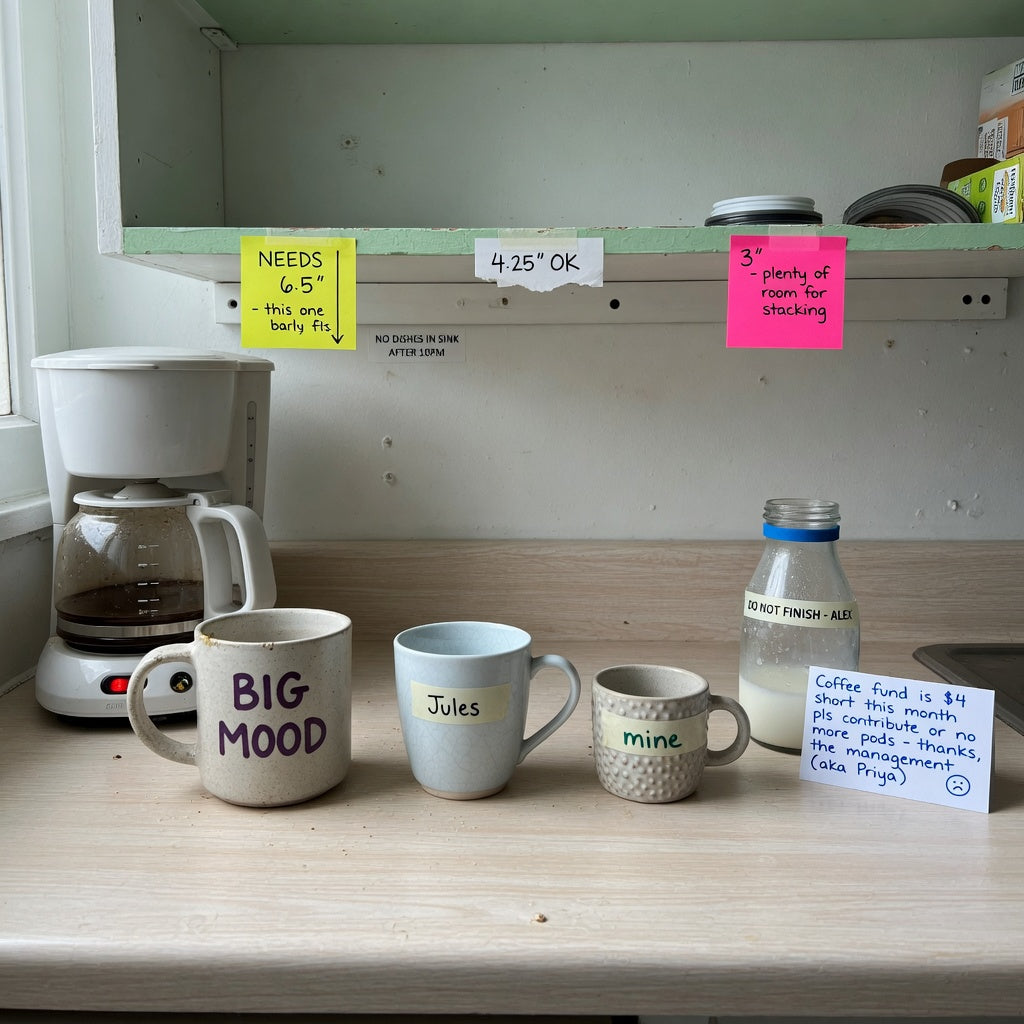
Coffee Mug Gifts Ideas Shared Household Practical Purchase Checklist
A mug turns into cupboard clutter when it ignores the drink, the shelf, and the sink routine. Here is how we filter capacity, handle fit, care claims, and glaze safety before a shared-household gif...
Read more
Leave a comment
This site is protected by hCaptcha and the hCaptcha Privacy Policy and Terms of Service apply.