
Coffee Mug Display Ideas That Actually Work in Real Kitchens
Reading time: about 9 minutes
A coffee mug display looks simple until the shelf is crowded, the handle spacing is awkward, or the prettiest mug is the one that chips every time someone reaches past it. In our store, we see the same pattern again and again: buyers want mugs that look good on open shelving, but they still need to survive daily use, dishwashing, and the occasional rushed grab before work.
If you are building a coffee mug display for a kitchen, office nook, or gift shelf, the right approach is not just about style. It is about mug shape, shelf depth, handle clearance, and whether the pieces you choose still make sense after the first week of real use. For a closer look at shelf fit and layout basics, our Coffee Mug Display Guide for Kitchens, Offices, and Small Spaces covers the practical side of planning a layout before you buy.
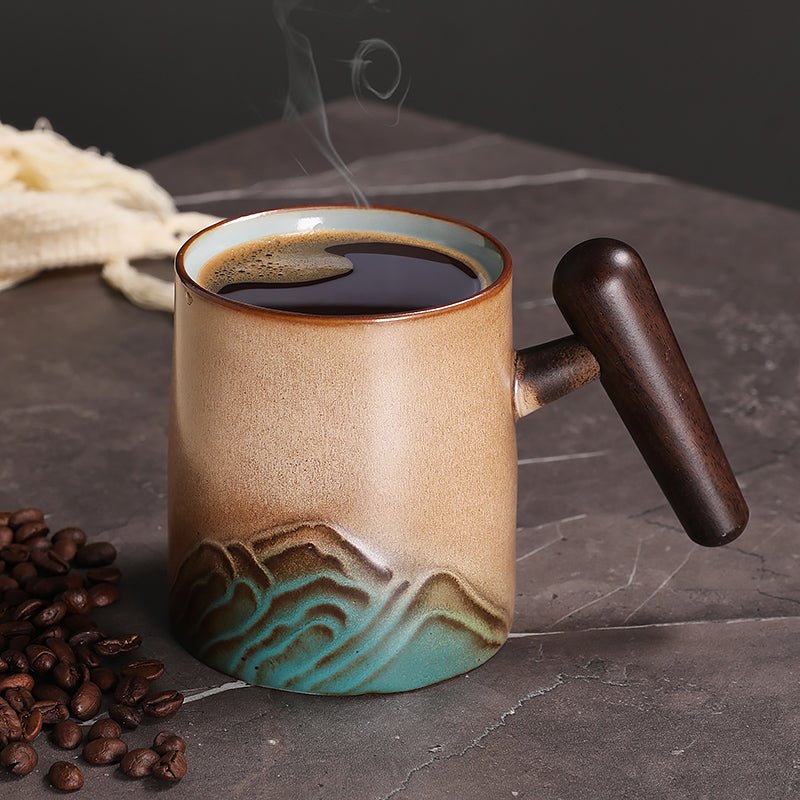
We also recommend starting from the mugs themselves. A display only works if the mugs you put on it look consistent as a group. If you want a few display-friendly options to compare, start with the Great Mountain Coffee Tea Mug, the Emerald Coffee Tea Mug, and the Landscape Tall Coffee Tea Mug. Those three give you different silhouettes, which matters more than most shoppers expect.
If you want to browse everything in one place, the full collection is the fastest way to compare shapes and colors before committing to a display set.
What makes a coffee mug display look intentional instead of crowded?
The difference usually comes down to spacing and repetition. A strong coffee mug display does not try to show every mug you own. It shows a small, readable group that feels chosen on purpose.
We usually look for three things:
- Consistent visual weight: mugs that share a similar height, base width, or color family sit better together.
- Clear handle clearance: handles should not knock into the wall, the shelf lip, or the mug beside them.
- Easy reach: a display that forces you to remove two mugs just to reach the third will not stay tidy for long.
That is why a tall mug like the Landscape Tall Coffee Tea Mug can work well as a focal point, while a rounder piece like the Emerald Coffee Tea Mug helps balance the arrangement. In practice, one taller piece, one medium-height mug, and one mug with a stronger color often create a better display than three nearly identical cups lined up side by side.
We have found that a display looks best when it leaves a little breathing room. If every shelf inch is filled, the setup starts to feel like storage instead of display.
Which mug shapes work best on open shelves?
Shape matters more than decoration. A mug can have a nice graphic or colorway and still fail on an open shelf if it is too bulky, too tall for the shelf gap, or too narrow at the base.
Here is how we think about common display-friendly shapes:
| Shape | What it does well | Where it can fail |
|---|---|---|
| Standard round mug | Feels stable and easy to stack visually | Can look plain if the color palette is flat |
| Tall mug | Adds height and breaks up a horizontal shelf line | May brush the shelf above if clearance is tight |
| Wide, low mug | Feels sturdy and suits deeper shelves | Can make a shelf look heavy if every mug shares the same profile |
For a layered look, we like mixing the Great Mountain Coffee Tea Mug with a more vertical piece such as the Landscape Tall Coffee Tea Mug. That combination gives the eye a clear rhythm instead of a flat row.
One practical detail shoppers overlook: the base. A mug with a slightly wider foot sits more securely on narrow shelves, especially if the shelf surface is smooth wood, painted MDF, or glass. Narrow bases can still work, but they are less forgiving if the shelf gets bumped during daily use.
How much space do you need for a mug display shelf?
The shelf has to fit the mug and the hand that reaches for it. We advise buyers to think in terms of depth, vertical clearance, and side clearance, not just total shelf length.
Three measurements matter most:
- Shelf depth: deep enough for the mug body without letting the handle hang into a walkway or cabinet door.
- Vertical clearance: enough room above the mug so you can lift it out without scraping glaze against the shelf above.
- Front clearance: room to see the mug and grab the handle without knocking into neighboring pieces.
If your shelf is shallow, a tall mug may be the wrong choice even if it looks great in photos. That is one reason we suggest checking display fit before buying, not after. Our Coffee Mug Display Shelf Buying Guide for Real Kitchen Use goes deeper on shelf selection, especially for buyers deciding between open shelving, wall-mounted rails, and tiered racks.
For small kitchens, the best coffee mug display is often the one that uses fewer mugs more intelligently. A clean row of four well-chosen mugs usually beats a crowded line of eight. You still get a display, but you also keep the shelf usable.
Which mugs are worth putting on display first?
Not every mug deserves front-row placement. We think display-worthy mugs usually do one or more of the following: they hold their own visually, they are comfortable to use every day, and they stay looking good after regular washing.
In our experience, these are the mugs shoppers tend to keep on open shelves:
- Statement mugs with a strong color or silhouette, such as the Emerald Coffee Tea Mug.
- Shape-led mugs that bring variation to the shelf, such as the taller Landscape Tall Coffee Tea Mug.
- Graphic or scenic mugs that read clearly from a short distance, like the Great Mountain Coffee Tea Mug.
There is also a practical side. A mug that looks beautiful but feels awkward in the hand is a bad long-term display piece because nobody wants to use it. And if it is never used, it becomes clutter with a price tag. We would rather place the durable daily mug at the front and save the fragile-looking piece for a protected shelf.
That trade-off matters in gift sets too. A display-ready mug should survive real handling, not just an unboxing photo. If you are comparing shapes and sizes for gift buying, our 10 oz Coffee Mug: Size, Fit, and What to Check Before You Buy and 11 oz Coffee Mug: Size, Fit, and What to Check Before You Buy are useful if you want a mug that displays well and still feels practical in daily use.
How do you keep a coffee mug display clean and usable?
The setup only stays attractive if it is easy to maintain. Dust, fingerprints, and water spots show up fast on open shelves, especially on glossy ceramic glaze and darker finishes.
We recommend a simple maintenance routine:
- Wipe shelves weekly with a dry or lightly damp microfiber cloth.
- Rotate mugs occasionally so the same handle and glaze spots do not take all the wear.
- Leave one empty space on the shelf if possible, so adding a new mug does not force a full reshuffle.
For care, check the finish on each mug. Most ceramic mugs handle routine washing well, but repeated harsh cycles can wear down printed details or make the surface show fine marks sooner. That is not a reason to avoid using the mug; it is a reason to decide whether your display set is meant for everyday rotation or for a more protected showcase.
Open shelving also comes with one limitation we mention honestly: it is not the best choice if your kitchen gets greasy from nearby cooking or if you do not want to dust items regularly. In those cases, a closed cabinet with a glass front may suit you better than an exposed coffee mug display.
What are the most common display mistakes we see?
The mistakes are usually predictable, and they are fixable.
- Too many similar mugs: a shelf full of near-identical cups looks accidental, not curated.
- No height variation: if every mug is the same profile, the display reads flat.
- Ignoring handle direction: mismatched handle placement can make a shelf feel visually noisy.
- Buying for looks only: a mug that chips easily or feels awkward in the hand will not stay in the display long.
One other issue we see in smaller kitchens is overfilling. Shoppers buy a full set, put all of it on the shelf, and then realize there is no room for daily movement. The better approach is to display a smaller edited group and keep the rest in backup storage.
If you want more layout ideas before buying new pieces, the Coffee Mug Shelf Display Ideas for Real Kitchens and Small Spaces article is a good companion read. It focuses on real shelf constraints rather than styled photos that ignore how people actually use their kitchens.
How do you choose between style and function?
You do not have to choose one or the other, but you do have to decide which matters most for the space. A display shelf in a breakfast nook can lean more decorative. A shelf next to a coffee machine needs easier access and tougher day-to-day use.
Here is the simplest way to decide:
- For daily kitchen use: prioritize grip, easy stacking, and a stable base.
- For open display: prioritize shape, color contrast, and handle spacing.
- For gifting: prioritize first impression, packaging feel, and whether the mug will still be practical after the unboxing.
If your goal is a display that also gets used every morning, we would start with a balanced mug like the Emerald Coffee Tea Mug and then add one contrasting shape for visual interest. That gives you a shelf that looks curated without becoming precious.
Our own rule in the store is straightforward: if a mug only works as decor, it is not a strong display candidate for most shoppers. The best pieces earn their shelf space by doing both jobs.
Frequently asked questions
What is the best way to arrange a coffee mug display on open shelves?
Group mugs by height, color, or shape, then leave a little empty space between them so the shelf does not feel packed. A mix of one taller mug and two medium-height mugs usually reads better than a perfect row of identical cups.
Are tall mugs harder to display than standard mugs?
Sometimes, yes. Tall mugs need more vertical clearance and can look crowded if the shelf above sits too low, but they also add height variation that makes a display feel more intentional. They work best on deeper or more open shelving.
Can a coffee mug display still be practical for everyday use?
Yes, if you keep the arrangement simple and easy to reach. The mugs at the front should be the ones you actually use most often, and the shelf should leave enough room to grab a mug without knocking the others over.
What should I avoid if I want my mug display to stay neat?
Avoid overfilling the shelf, mixing too many unrelated colors, and choosing mugs that chip easily or feel awkward to hold. A display that is hard to maintain will usually end up looking cluttered within a week or two.
Is open shelving a good choice for every kitchen?
No. Open shelving is a poor fit if your kitchen collects grease quickly, you do not want to dust often, or you need to hide everyday clutter. In those cases, a closed cabinet or glass-front storage may be a better option.
If you are ready to build a coffee mug display that looks clean and still works on a busy counter, compare the shapes in our collection, then shortlist one tall mug, one standard mug, and one color-forward piece before you buy.
Read more
Brown Coffee Mugs: What to Check Before You Buy
Brown coffee mugs work best when the glaze, handle, and size match how you actually drink coffee. We break down the details that matter so you can pick a mug that feels right at home, at work, or a...
Czytaj dalej
Coffee Mug Drawings: What Buyers Should Check Before They Buy
Coffee mug drawings can look great online and feel underwhelming in person if the print placement, contrast, or mug shape is wrong. This guide shows what to check before you buy and which mugs are ...
Czytaj dalej
Zostaw komentarz
Ta strona jest chroniona przez hCaptcha i obowiązują na niej Polityka prywatności i Warunki korzystania z usługi serwisu hCaptcha.