
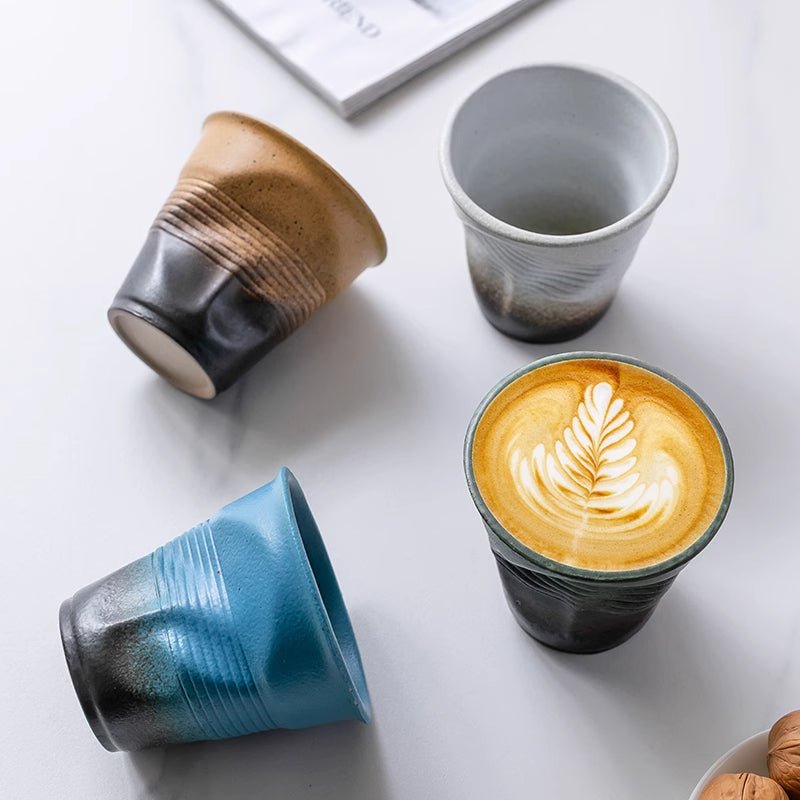
Ceramic Cortado Cup Shape and Handle Guide: Current Options
Reading time: about 9 minutes
A cup can look compact in a front-facing photo and still take up more room than expected once its handle and full side profile are considered. Our ceramic cortado cup shape and handle guide focuses on that practical comparison: the visible silhouette, the handle shown in the listing, the stated capacity, and any dimensions published on the current product page. Those details are more useful than assuming every ceramic cup associated with a short coffee will have the same proportions.
We currently have three relevant capacity points in our store: 170 ml, 200 ml, and 270 ml. None of these products should be treated as purpose-built, tested, or certified cortado vessels. They are ceramic coffee and tea options that shoppers can compare for their own intended pour. We also do not infer heat retention, extraction performance, commercial cafe suitability, or appliance safety from their shape.
Why do the side profile and handle matter as much as capacity?
Capacity tells you how much liquid a vessel is listed to hold. It does not tell you the cup's height, rim diameter, base width, wall angle, or total width with the handle. Two ceramic cups can have similar capacities while feeling visually and spatially different on a kitchen counter or office desk.
Start with the complete side-view images for the Retro Coffee Tea Cup, the Pleated Coffee Tea Cup, and the Emerald Coffee Tea Mug. The product titles themselves distinguish two cups from one mug, but naming is not dimensional evidence. Use the photographs and current measurements to confirm the actual proportions.
We use the same visual checks when helping shoppers narrow the options in our unique coffee mugs collection:
- Rim and opening: Compare how broad the opening looks relative to the body, without treating a photograph as an exact measurement.
- Body profile: Look for straight, tapered, rounded, or visibly textured areas in the current listing images.
- Base: Check the apparent contact area and any transition between the body and foot.
- Handle projection: View how far the handle extends from the body because this affects total shelf and desk space.
- Handle opening: Inspect the space shown inside the handle rather than assuming a particular finger fit.
A listing photograph can help you compare form, but perspective and image scale can distort size. Published dimensions, where available, should settle close calls.
Using our ceramic cortado cup shape and handle guide
The cleanest comparison starts by separating verified facts from visual judgment. The verified capacities are 170 ml for Retro, 200 ml for Pleated, and 270 ml for Emerald. Shape and handle preferences should then be judged from the current product photographs, while physical fit should be checked against the dimensions shown on each product page.
| Current option | Verified capacity | Buyer situation | What to inspect before ordering |
|---|---|---|---|
| Retro Coffee Tea Cup | 170 ml | You want the least nominal capacity of the three and do not need generous extra volume. | Current rim, body, base, handle opening, total profile, and listed dimensions. |
| Pleated Coffee Tea Cup | 200 ml | You want a middle capacity with 30 ml more listed volume than Retro. | The visible pleated treatment, side silhouette, handle form, and current dimensions. |
| Emerald Coffee Tea Mug | 270 ml | You want the most nominal headroom among these options. | The mug profile, handle projection, opening, base, and current dimensions. |
This comparison deliberately avoids assigning unverified comfort or performance claims. A handle that looks open in one image is not guaranteed to fit every hand, and a broader-looking body is not proof of better stability. If grip is your deciding factor, compare several product images and check the measurements instead of relying on one angled photograph.
How much practical headroom do 170 ml, 200 ml, and 270 ml provide?
Headroom is the difference between the listed vessel capacity and the amount you intend to pour. It can reduce the chance of filling close to the rim, but the useful amount depends on your own drink volume. The listed capacity is not a prescribed recipe or a fill line.
For a simple example, a 120 ml total pour leaves the following nominal difference:
- Retro, 170 ml: 50 ml between the intended pour and listed capacity.
- Pleated, 200 ml: 80 ml between the intended pour and listed capacity.
- Emerald, 270 ml: 150 ml between the intended pour and listed capacity.
Those figures are arithmetic comparisons, not usable-volume guarantees. The inner shape, rim geometry, and where you personally stop pouring affect the real result. Measure your complete drink, including milk or other additions, rather than comparing cup capacity only with the espresso portion.
For a deeper volume-first breakdown, see our ceramic cortado cup capacity guide for 170 ml, 200 ml, and 270 ml. It is the better starting point if overflow margin matters more to you than silhouette or handle styling.
Which current option fits your counter, desk, or gift box?
The right next step depends on where the cup will be used and what the recipient values. In our experience selling this category, buyers sometimes focus on the front of the cup and overlook the handle's contribution to the overall footprint. That becomes noticeable on a crowded desk, in a shallow cabinet, or inside a fitted gift box.
- For a smaller intended drink: Start with the 170 ml Retro cup. It has the lowest verified capacity in this group. It is not the best choice if your completed pour approaches 170 ml or you prefer substantial nominal headroom.
- For a middle capacity: Consider the 200 ml Pleated cup. It provides 30 ml more listed capacity than Retro while remaining 70 ml below Emerald. Choose it because that middle volume suits your measured drink and you prefer the form shown in its listing, not because of an assumed performance difference.
- For more room above a smaller pour: Review the 270 ml Emerald mug. It has the largest verified capacity here and therefore the greatest nominal headroom for the same pour. It is not ideal if you specifically want the lowest-capacity option or if its current listed dimensions exceed your storage space.
For gifting, check the product dimensions against the interior of the box, including the handle projection. During an unboxing, a ceramic piece also benefits from enough packaging clearance around the rim and handle. We do not claim a particular box fit unless the measurements have been checked directly.
How should you assess handle form from product photos?
Handle preference is personal. Hand size, grip style, and whether you hold the vessel by the handle alone or support its body all affect what feels suitable. A photo can reveal the visible form, but it cannot confirm comfort for every buyer.
- Find a true side view. This gives the clearest view of the handle opening and how far it projects.
- Compare opening height and width with published dimensions. Do not estimate finger clearance from capacity alone.
- Inspect both attachment points. The top and lower handle joints should be visible where possible.
- Account for total width. Add the handle to your cabinet, shelf, desk, or gift-box planning.
- Check scale consistency. Product photos may use different crops, so compare measurements rather than apparent image size.
A tight-looking handle may suit someone who pinches or supports the cup body, but it may not suit a shopper seeking a roomy multi-finger grip. Conversely, a more projecting handle can require extra storage width. If handle clearance is non-negotiable and the current listing does not provide enough visual or dimensional evidence, a different cup style with clearly documented measurements is the safer purchase.
What should you verify about dimensions, care, and condition?
Capacity should never be used as a substitute for dimensions. Before ordering, check the current listing for height, opening width or diameter, body width, base dimensions, and total width with the handle if those measurements are provided. If a needed dimension is not listed, treat it as unknown rather than calculating it from the milliliter capacity.
The same boundary applies to care. Ceramic material alone does not establish microwave or dishwasher safety. Review the product page and any supplied care instructions before placing a cup in either appliance. If machine washing is essential to your routine and the listing does not explicitly address it, choose an option with clearly stated care guidance instead of assuming compatibility.
On arrival, use a basic ceramic receiving check before the first drink:
- Inspect the rim and base for shipping chips.
- Look over the ceramic surface under direct light for visible cracks.
- Check both handle attachment points for a hairline separation.
- Place the empty vessel on a level surface and confirm that it sits as expected.
- Follow the current seller or manufacturer care directions before washing.
These are general checks for a delivered ceramic item, not reports of known defects in the three products. If you are comparing short-drink vessels across several capacities, our 170 ml, 200 ml, and 270 ml ceramic cortado cup comparison provides another routine-based view without treating one volume as universally correct.
Frequently asked questions
Which ceramic cup has the smallest current capacity?
The Retro Coffee Tea Cup has the smallest verified capacity in this comparison at 170 ml. Pleated is listed at 200 ml, and Emerald is listed at 270 ml. Smaller capacity does not automatically mean smaller external dimensions, so check the current measurements as well.
What does this ceramic cortado cup shape and handle guide recommend for more headroom?
For the same intended pour, the 270 ml Emerald option provides the greatest nominal difference between the drink volume and listed capacity. That does not make it the best choice for every shopper; it may be more capacity than you want, and its current dimensions still need to suit your storage space.
Can I tell whether the handle will fit my fingers from the photos?
Photos can show the handle form and opening, but they cannot guarantee fit for every hand. Use a clear side view together with listed handle or overall dimensions. If those details are unavailable and grip is critical, select a different style with more complete measurements.
Are these cups tested specifically for cortado drinks?
We are not claiming that Retro, Pleated, or Emerald was purpose-built, tested, or certified for cortado. They are ceramic coffee and tea vessels with verified listed capacities that can be compared against your own completed drink volume.
Can these ceramic options go in a microwave or dishwasher?
Do not infer microwave or dishwasher safety from the ceramic material or product shape. Check the current product listing and supplied care instructions for an explicit statement. If appliance compatibility is a requirement and it is not confirmed, another clearly documented product is a better fit.
Use this checklist before selecting a current option
Measure your usual completed drink first, then compare it with 170 ml, 200 ml, and 270 ml. Check the current product page for height, opening, base, and overall width with the handle; inspect the full side profile; confirm the care guidance; and decide how much nominal headroom you actually want. Then revisit the current unique coffee mugs collection and choose the capacity and visible form that match your counter, desk, storage space, or gift plan without relying on unverified performance assumptions.
More from our blog
Read more
Macchiato Cup Shape and Handle Guide: Current Options
Compare our 170 ml, 200 ml, and 250 ml ceramic options by visible profile, handle form, compactness, and practical headroom. Includes checks for cabinet fit, grip, care, gifting, and everyday drink...
Czytaj dalej
Thick Ceramic Coffee Mugs Shape and Handle Guide: Current Options
Compare The Rock, The Flow, and Spittoon mug designs by visible silhouette, listed dimensions, capacity, handle clearance, storage fit, and everyday use before choosing.
Czytaj dalej
Zostaw komentarz
Ta strona jest chroniona przez hCaptcha i obowiązują na niej Polityka prywatności i Warunki korzystania z usługi serwisu hCaptcha.