
Affogato Cup Buying Guide: Capacity, Shape, and Serving
Reading time: about 8 minutes
A scoop that looked modest in the carton can sit surprisingly high once it is in a cup. Add hot coffee, and a vessel with no spare room turns a simple dessert into a sticky saucer and countertop cleanup. That is why an affogato cup should be selected around the combined serving, not the coffee portion alone.
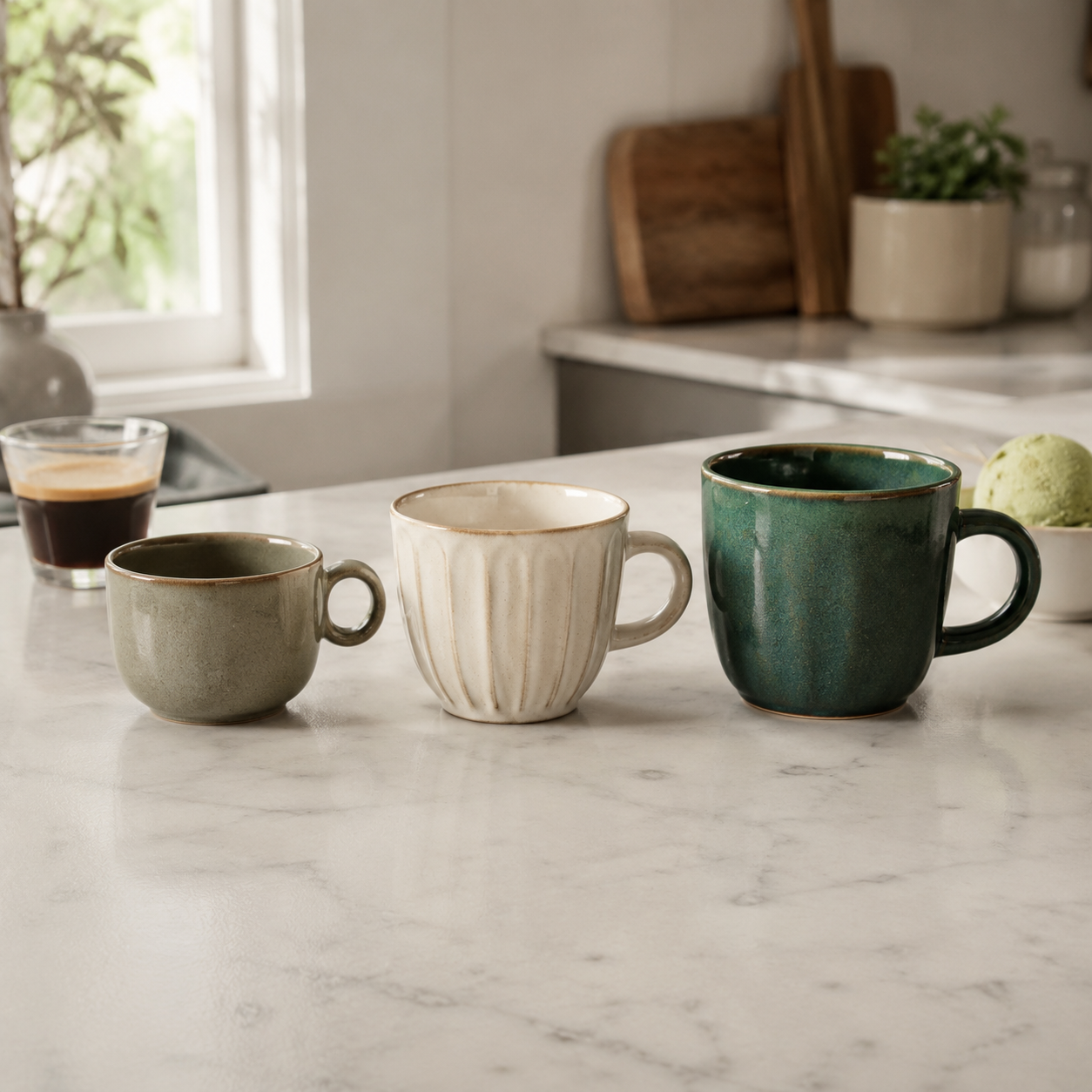
In our store, we start with two facts shoppers can compare reliably: listed capacity and visible shape. CoffeifyMug currently has three relevant sizes in this compact dessert-coffee range: 170 ml, 200 ml, and 270 ml. Each gives the same dessert a different amount of breathing room and a different visual proportion. You can compare the wider range of designs in our unique coffee mugs collection, but the guide below keeps the decision focused on those measurable and visible differences.
What affogato cup capacity leaves enough serving room?
The printed capacity is the total listed volume of the vessel. It should not be treated as a recommended fill line. Gelato or ice cream displaces space, coffee raises the liquid level, and a melting serving can move when the cup is carried from the kitchen counter to the table.
| Option | Listed capacity | Best fit | Main trade-off |
|---|---|---|---|
| Retro Coffee Tea Cup | 170 ml | Restrained, compact dessert portions | Least margin for a large scoop or generous pour |
| Pleated Coffee Tea Cup | 200 ml | Moderate portions with a little more room | Less compact-looking than the 170 ml option |
| Emerald Coffee Tea Mug | 270 ml | Larger portions or extra clearance above the dessert | A small affogato may look undersized in it |
The 170 ml Retro Coffee Tea Cup is the most compact of the three. It makes sense when the serving is intentionally small and the person preparing it controls both the frozen portion and coffee pour. Its limitation is straightforward: it offers 30 ml less total capacity than the 200 ml option and 100 ml less than the 270 ml mug.
The 200 ml Pleated Coffee Tea Cup is the middle choice. That extra 30 ml over the Retro can be useful when portions vary slightly between servings, but it does not move into the substantially larger presentation of the 270 ml option.
The 270 ml Emerald Coffee Tea Mug provides the most capacity. Choose it for a larger dessert or when minimizing the chance of filling close to the rim matters more than creating a compact presentation. It is not the strongest choice for a tiny, restaurant-style serving because the empty space can make a small scoop and short pour look sparse.
How do the Retro, Pleated, and Emerald shapes change presentation?
Capacity tells you how much room exists. Visible shape tells you how the dessert will read on the table. Those are related decisions, but they are not interchangeable. Two servings with the same ingredients can feel quite different when one is framed by a compact cup and the other sits inside a larger mug format.
- Retro, 170 ml: The product has a compact cup presentation and a visibly retro style. It suits a deliberately small dessert course where the cup should not visually overpower the serving.
- Pleated, 200 ml: The pleated exterior adds visible surface detail. This is a useful choice when the cup itself should contribute texture to a place setting without moving to the largest capacity.
- Emerald, 270 ml: This is the mug-format option and has the largest listed capacity. It gives a larger serving more surrounding room, but the presentation is less compact.
Do not use capacity alone to infer opening width, base diameter, height, or spoon clearance. Milliliters describe volume, not exact proportions. Review the current product photographs for those visible details before ordering, especially if the cup needs to coordinate with an existing saucer, dessert spoon, tray, or tightly arranged place setting.
How much room should you allow for gelato and coffee?
There is no universal fill level because scoop size and coffee volume vary. A dense, rounded scoop can occupy more of the cup than expected, while a smaller scoop begins melting as soon as coffee is added. The practical goal is to leave enough unused capacity that the pour does not reach the rim immediately.
A quick portion rehearsal with cups you already own is more reliable than guessing from a product photograph:
- Use the same scoop or spoon you normally use for the frozen portion.
- Measure your usual coffee pour separately rather than estimating by eye.
- Place the frozen portion in a current cup with a known capacity.
- Add the measured coffee slowly and observe the final level after the first melt.
- Compare that known capacity with 170 ml, 200 ml, and 270 ml before choosing.
This check is especially useful for households where different people prepare dessert. One person may make a tight single-scoop serving, while another adds a larger scoop and a longer pour. In that situation, 200 ml or 270 ml provides more tolerance than 170 ml. If consistency and a compact appearance matter most, the 170 ml cup can still be the better fit, provided the portion is controlled.
Which cup fits your usual dessert-serving situation?
For a restrained after-dinner affogato: Start with the Retro. Its 170 ml capacity fits a smaller presentation, and the retro profile gives the serving a distinct table presence. It works best when you already know your usual scoop and pour fit within that volume with room left at the top. If your portions regularly vary, it may feel restrictive.
For a practical middle size: Choose the Pleated cup. The 200 ml capacity adds some flexibility without jumping to 270 ml, while the pleated exterior gives the vessel visible detail. This is the clearest option for shoppers who find 170 ml too tight but do not want a larger mug presentation.
For a generous dessert or more open space: Consider the Emerald mug. Its 270 ml capacity is useful when the dessert includes a larger frozen portion, a more generous coffee pour, or simply more clearance below the rim. The trade-off is scale: a minimal serving can appear lost inside it.
For everyday coffee beyond dessert: Decide whether affogato is the primary use. A compact dessert cup may not hold the volume you prefer for a regular morning drink. Our coffee cup and mug buying guide covers broader size and shape decisions if daily coffee matters as much as dessert service.
For milk drinks and pouring practice: An affogato vessel should not be assumed to have the same geometry as a cup selected for pouring patterns. If latte presentation is the real priority, use our latte art cup buying guide as the more relevant starting point.
What should you verify beyond capacity and visible shape?
This comparison is intentionally limited to the verified capacities and visible product shapes. It does not establish material, exact dimensions, care instructions, dishwasher suitability, microwave suitability, resistance to sudden temperature changes, or drink-specific engineering. Those details should come from the current product listing rather than assumptions based on the words cup or mug.
The product links also represent the vessels themselves. Do not assume that gelato, coffee, spoons, saucers, trays, or any other serving accessories shown in styled photography are included. Check the current listing contents before purchase or before planning a gift unboxing around a complete dessert set.
If a specific care routine is essential in your kitchen, confirm it before ordering. For example, a household that relies exclusively on dishwasher cleaning should not make a decision from this capacity comparison alone. The same applies if you plan to move a cup directly between sharply different temperatures; no temperature-change performance claim is being made here.
A three-size decision checklist
Before adding a cup to your cart, reduce the choice to the variables that affect the serving you actually make:
- Choose 170 ml if your affogato is compact, portion-controlled, and intended to look deliberately small.
- Choose 200 ml if you want a middle capacity, modest extra room, and the visible detail of a pleated exterior.
- Choose 270 ml if you serve a larger dessert or prioritize more space below the rim over a compact presentation.
- Check the photographs for the opening, height, base, and overall silhouette instead of inferring dimensions from capacity.
- Check the listing for current material, care, dimensions, and package contents if any of those details will determine your purchase.
Frequently asked questions
What size affogato cup should I buy?
A 170 ml cup suits a restrained, controlled serving, 200 ml offers a middle amount of room, and 270 ml is better for a larger portion or more clearance. Measure your normal coffee pour and test it with your usual scoop in a known-capacity cup before deciding.
Is a 170 ml cup large enough for affogato?
It can be, provided you serve a compact frozen portion and a measured coffee pour. It is not ideal for oversized scoops, variable portions, or anyone who prefers substantial unused space below the rim.
Is a 270 ml affogato mug too large?
Not for a generous dessert, but it can be visually oversized for a minimal serving. The Emerald mug is the best fit of these three when capacity and clearance matter more than a tight, compact presentation.
Does an affogato cup come with a spoon or saucer?
Do not assume serving accessories are included unless the current product page explicitly says so. Styled photographs may show food, coffee, spoons, saucers, or other props for context, but this guide does not make any claim that those items come with the cup.
Can I put these cups in a dishwasher or microwave?
This guide does not claim dishwasher or microwave suitability for these products. Review the current care information on the relevant product page before using either appliance or exposing the cup to rapid temperature changes.
Compare the serving before choosing the style
Set out your usual scoop, measure the coffee you normally pour, and decide how much open room you want after the two meet. Then match that result to 170 ml Retro, 200 ml Pleated, or 270 ml Emerald. Once the capacity is settled, use the visible profile to choose the presentation that belongs on your table.
For a final side-by-side style check, return to the CoffeifyMug unique coffee mugs collection and compare the current product photographs and listing details before ordering.
More from our blog
Read more

Hot Toddy Mug Buying Guide: Capacity, Handle, and Ceramic Options
Compare 400 ml and 480 ml ceramic mugs by usable capacity, handle comfort, counter space, and care needs. This guide also explains which CoffeifyMug option fits a moderate serving, a roomier pour, ...
Weiterlesen
Ceramic Cortado Cup Buying Guide: Size, Headroom, Daily Use
Compare 170 ml, 200 ml, and 270 ml ceramic cup capacities using practical headroom calculations, then match the cup to your drink volume, desk habits, and care checks.
Weiterlesen
Hinterlasse einen Kommentar
Diese Website ist durch hCaptcha geschützt und es gelten die allgemeinen Geschäftsbedingungen und Datenschutzbestimmungen von hCaptcha.