
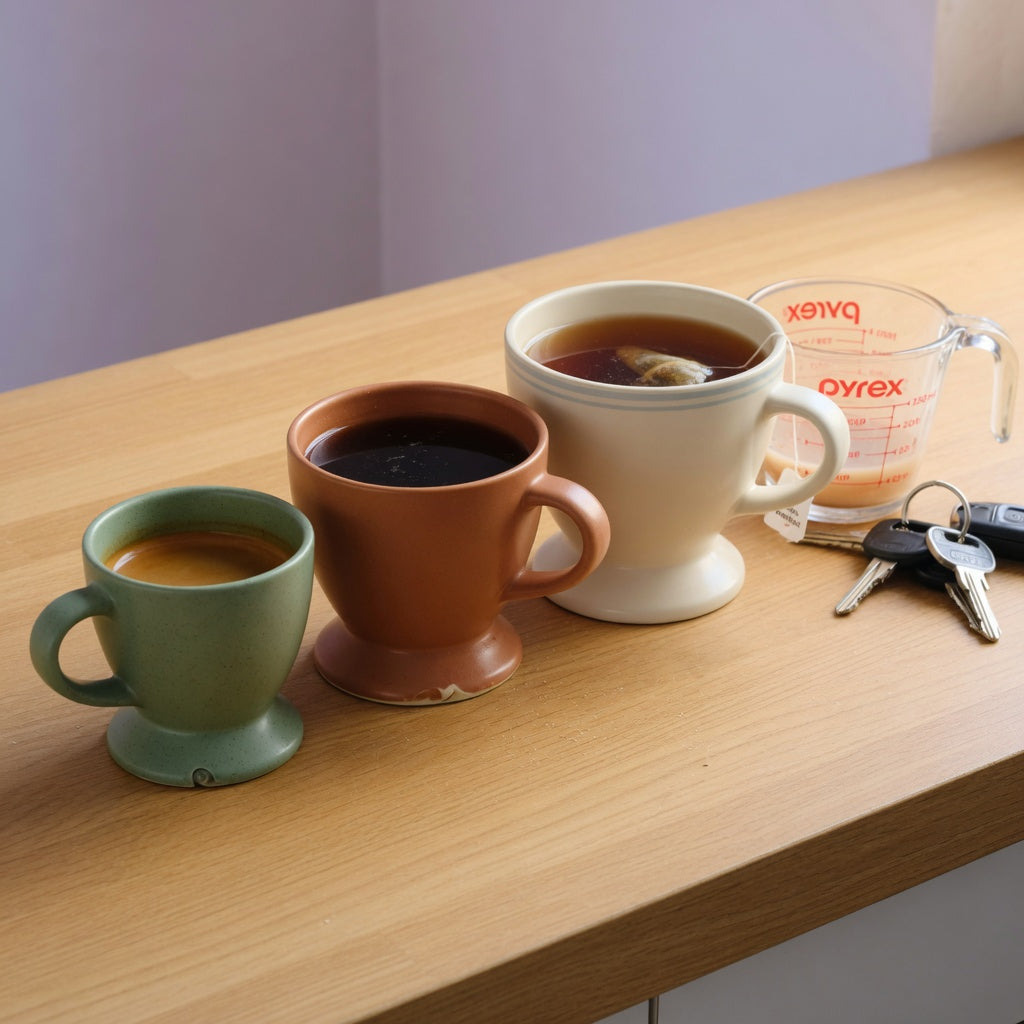
Wide Based Coffee Mugs Capacity Guide: 250 vs 400 vs 480 ml
Reading time: about 9 minutes
A wide foot, a wide mouth, and a tall body are three different things
Two mugs can share the same wide footprint on your desk and still pour very different mornings. One is empty before the stand-up meeting ends. The other is still half full at lunch. That gap is what this wide based coffee mugs capacity guide is built around — listed capacity, refill count, and which of our current sizes matches how you actually drink.
We stock three capacities in this wide-based family: the Ball Handle at 250 ml, The Flow at 400 ml, and The Rock at 480 ml. The messages we answer in our store are rarely "which one is biggest." They are "is 250 ml a real coffee," "will 400 ml survive a two-hour block," and "is 480 ml too much to finish while it's still hot."
Start by untangling the vocabulary, because "wide base" gets attached to three different shapes:
- A wide foot. The contact patch on the counter is broad relative to the body. This is the stability feature.
- A wide mouth. The opening is broad. That changes aroma, sipping angle, and how quickly the drink cools.
- A tall, heavy body. More volume sitting higher up. This is the shape that feels top-heavy when full.
A stable foot can sit under a narrow rim, and a wide rim can still balance on a small foot. Base width alone does not make a mug tip-proof either — height, mass distribution, fill level, handle position, and whether the foot is genuinely flat all move the tipping point. We keep that boundary in our listings instead of promising a mug that cannot fall over. For the footprint-and-surface side of the question, our ceramic wide bottom mugs shape and fit guide covers coaster size and desk fit separately.
250 ml, 400 ml, and 480 ml: what each listed capacity actually pours
Listed capacity is a volume, not a brim-full laboratory measurement. Whether a given mug leaves headroom below the rim — which matters if you take milk — is worth confirming on the product page rather than assuming from a photo.
| Mug | Listed capacity | Approx. US fl oz | Refills in a morning | What it reads as |
|---|---|---|---|---|
| Ball Handle | 250 ml | about 8.5 | 2 to 3 | A small cup you keep returning to |
| The Flow | 400 ml | about 13.5 | 1, sometimes none | A standard desk mug |
| The Rock | 480 ml | about 16.2 | 0 to 1 | A large mug or an iced vessel |
Two notes on that table. The fluid-ounce column is a straight conversion of the listed millilitres and nothing more. And the refill column assumes a normal pour with room for a splash of milk — pour closer to the rim and every row shifts up.
Refill math: the part of a wide based coffee mugs capacity guide most charts skip
Most people can describe their drinking volume without ever knowing it in millilitres. Do the division once and the choice usually makes itself.
- Roughly 450 ml before lunch? The 400 ml The Flow covers it in one pour plus a small top-up, and the 480 ml The Rock covers it in a single fill with room to spare.
- Two short cups instead of one long one? Two 250 ml pours equal 500 ml — more than the 400 ml mug holds, but also two trips to the kettle and two chances for the second cup to go lukewarm.
- Iced coffee or iced tea? Ice displaces volume. A 480 ml mug packed with ice holds far less liquid than its listed figure suggests, which is exactly why the largest size is the forgiving one for cold drinks.
There is a handling variable capacity charts ignore too. A mug filled near the rim puts more mass higher up than the same mug half full, so the tallest of the three is at its most forgiving when you stop pouring at a sensible point. That is a handling note, not a safety guarantee. A full 480 ml also means roughly 480 g of liquid before you count the mug itself — noticeable if you carry it one-handed across a room.
Desk, gift, or iced drink: which listed capacity fits your routine?
Match the habit first, then confirm the numbers on the listing.
- Espresso-length coffee, flat whites, small teas. The Ball Handle coffee and tea mug at 250 ml is built for the refill habit rather than the marathon. It is the weakest of the three if you like to carry one mug around for two hours, because you will be reheating it.
- One pour to cover a long desk block. The The Flow coffee and tea mug at 400 ml is the middle size, and in our experience it is the safest starting point for a gift when you do not know the recipient's habits.
- One fill that has to last, or a cold drink. The The Rock coffee and tea mug at 480 ml is the practical pick — with the caveat that a full 480 ml is a lot of liquid to move one-handed.
If none of those sound like your routine, size is the wrong variable rather than the wrong number. Start from the silhouette instead and browse our full collection of unique coffee mugs to compare profiles before you commit to a capacity.
Handle clearance, foot flatness, and the details product photos hide
Capacity is the easy spec. The details that decide whether you reach for a mug every day are the ones that never show up in a studio shot.
Handle clearance. A wide body pushes the handle outward, and that changes how many fingers actually fit. If you hold a mug with three fingers and a thumb rather than two, check the inner opening on the listing, not the outer span.
Foot flatness. Set a new mug on a granite counter or a glass hob and press one edge. A mug that rocks is a defect — usually a foot that warped in firing — not a design choice. Deep grout lines and thick rugs will make a broad foot wobble even when the mug itself sits perfectly flat.
Recessed versus flat feet. A concave base can trap water in the dishwasher and leave a ring on the shelf. Flat feet dry faster but show scratches sooner. Neither is wrong; just know which one you are buying.
Rim thickness and opening width. A thick rim sips differently from a thin one, and a wider opening cools the drink faster. Volume and shape interact here, which is why we treat silhouette and capacity together rather than as separate specs.
Where a wide base stops helping: cup holders, brewers, and bumpy surfaces
A broad foot solves one problem and creates others. Three that land in our inbox every week:
- Cup holders are not one standard size. Measure the narrowest point of the holder, not the top opening. Some manufacturers list specific wide-bodied mugs as not cup-holder compatible, so check the listing instead of judging from a photo.
- Brewer clearance is measured two ways. A wide foot may not sit on a small drip tray, and a tall body may not clear a Nespresso spout, an AeroPress, or a pour-over dripper. Check base diameter against tray width and rim height against spout height.
- Stability is a system, not a spec. Base of support, center of gravity, fill level, and a flat contact surface all contribute. On a boat console or a car dashboard you still want a non-slip mat underneath — we do not make a non-slip claim on these mugs, and we would treat any brand that does without evidence carefully.
If your worry is knocking a mug over at a desk, a wide foot genuinely helps. If your worry is a mug staying upright through a bumpy drive, a mug is the wrong vessel and a lidded travel tumbler is the right one. On heat retention, we stay just as careful: a wide ceramic base is not an insulation feature. How long coffee stays hot depends on wall construction, starting temperature, fill level, and whether there is a lid, and we have not found standards-body testing that isolates base width — so we do not market it that way.
Lead glaze and food-contact checks before you pour hot coffee
This applies to ceramic drinkware generally, not just wide mugs. FDA guidance notes that some ceramic foodware can leach lead from food-contact surfaces, and continued food use of lead-leaching ware can cause adverse health effects, including chronic lead poisoning. For cups and mugs, the action level is 0.5 micrograms of lead per millilitre of leaching solution in any one of six units, tested with methods that include ASTM C738.
The same guidance flags improperly fired traditional pottery glazes as a leaching risk and points out that washing, boiling, or other household processes do not remove lead from pottery. Handmade, antique, damaged, or brightly orange-, red-, or yellow-decorated pieces are called out as higher concern, while ordinary commercial factory tableware is described as much less likely to have the problem. Anything labelled not for food use should stay out of the kitchen.
Our practical takeaway: read the material and food-contact notes on the individual product page rather than inferring them from a shape family or a photograph. If you are buying handmade or vintage mugs elsewhere, ask whether the piece is rated for food use before you pour hot coffee into it.
Frequently asked questions
Does a wider base mean the mug holds more coffee?
No. Base width and interior volume are separate measurements, and a broad foot can sit under a modest 250 ml body just as easily as a 480 ml one. That is why we built this wide based coffee mugs capacity guide around refill counts instead of base diameter.
Is 250 ml too small for a normal coffee?
It depends on how you drink. 250 ml is about 8.5 US fl oz, which works well for espresso-length drinks, flat whites, and small teas taken in two or three pours. If you expect one mug to carry you through a long meeting, 400 ml or 480 ml will suit you better.
Will a wide based mug fit my car cup holder?
Measure the holder at its narrowest point first. Cup holders vary between vehicles and there is no agreed standard, so a mug that drops into one car can sit crooked in another. Some manufacturers list wide-bodied mugs as not cup-holder compatible — check the listing for the exact mug you are buying.
Can I put these mugs in the dishwasher and microwave?
Check the individual product page for care and appliance guidance for that exact mug rather than assuming all three behave the same way. If the base is recessed, tip the mug mouth-down at an angle afterwards so water does not pool in the foot.
Why do the 400 ml and 480 ml mugs look so similar in photos?
Because silhouette distorts perceived volume. A broad, low body reads as roomier than a narrow one even when the millilitre difference is small. Compare the listed capacities and the refill pattern, not the outline.
Pick your size by counting the pours you actually make between breakfast and lunch — two small ones, one long one, or one that has to last all morning — then confirm the listed capacity, base diameter, handle opening, and care notes on the individual product page. If you are still torn between The Flow and The Rock, our unique coffee mug collection is the fastest way to see both silhouettes next to the rest of the range.
More from our blog
Read more

Latte Mugs Tall Comparison: 3 Current Options by Routine
A current-catalog latte mugs tall comparison of The Flow 400 ml, Morning and Night 440 ml, and The Rock 480 ml, with the fill-line, latte-art, clearance, and care questions that actually decide whi...
Read more
Coffee Mugs With Big Handles Comparison: 250, 400 & 480 ml Picks
Three mugs, three handle shapes, one decision. We compare our 250 ml Ball Handle, 400 ml Flow and 480 ml Rock by finger clearance, pour size and where each one gets awkward in a real kitchen.
Read more
Leave a comment
This site is protected by hCaptcha and the hCaptcha Privacy Policy and Terms of Service apply.