
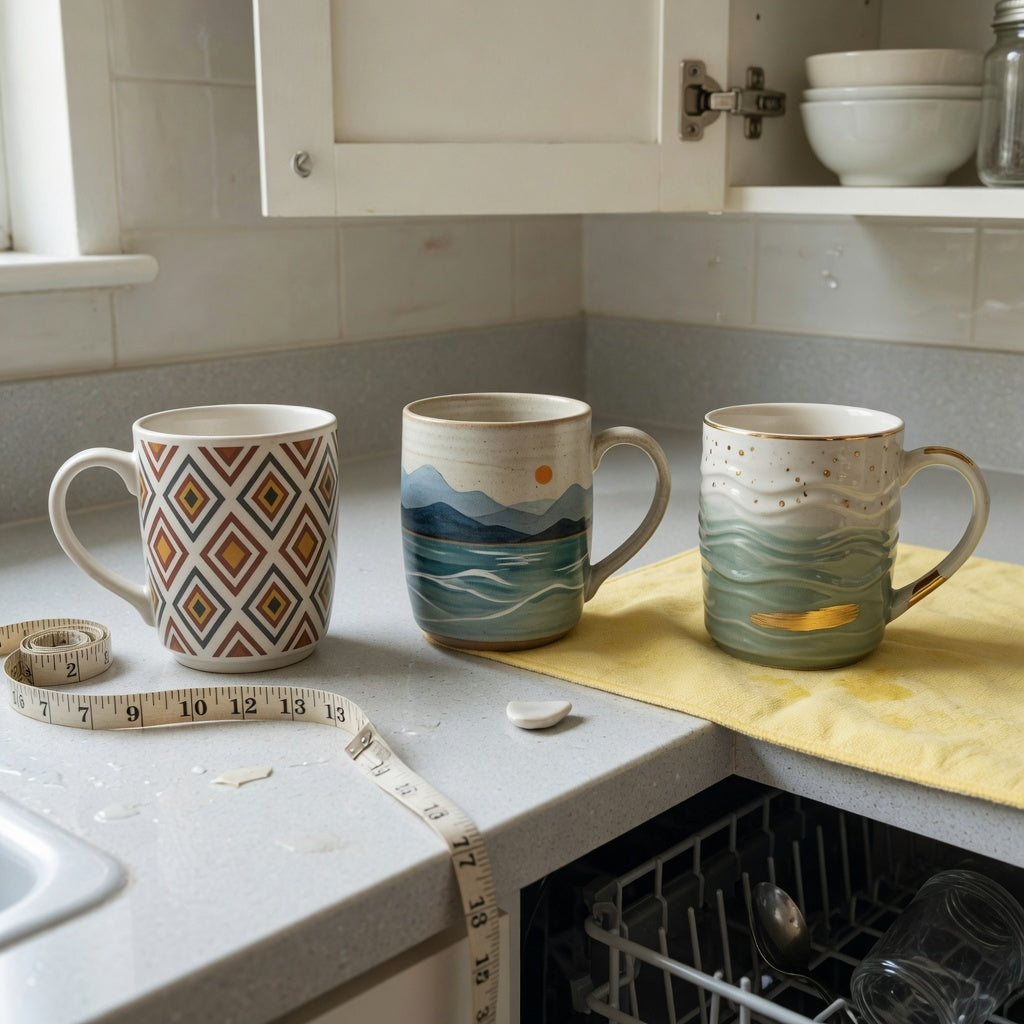
Unique Pottery Coffee Mugs Shared Household Practical Purchase Checklist
Reading time: about 9 minutes
A mug can suit one person's morning pour and still fail a shared kitchen: the handle catches a cabinet divider, the owner cannot identify it on a crowded drying mat, or the only person who likes the decoration refuses its care routine. Our unique pottery coffee mugs shared household practical purchase checklist starts with those ordinary points of friction, then turns them into a decision each roommate or family member can make before ordering.
At our packing table, we pay attention to details shoppers often discover too late: the drinking rim, the handle joints, the foot ring, the mug's widest point, and any decoration that could change its care needs. We also keep listed facts separate from assumptions. The linked product pages are the authority for current material, capacity, dimensions, and care instructions. If a detail is not stated there, this checklist treats it as unknown.
How should you use the unique pottery coffee mugs shared household practical purchase checklist?
Give every regular coffee or tea drinker one row on the household shortlist. Do not start by choosing a matching appearance. Start with the way each person actually drinks, stores, carries, and cleans a mug.
- Name the primary user and drink. Record black coffee, tea, latte, iced coffee, or another normal serving. Include milk and ice rather than measuring only the base drink.
- Measure the usual serving. Fill the person's current favorite mug to its normal level, then pour that liquid into a measuring cup. This gives you a useful target without relying on a brim-full capacity.
- Record the preferred grip. Note one-handed use, two-handed cradling, the number of fingers that need to fit through the handle, and any reduced hand strength.
- Measure the storage route. Check cabinet shelf height, door opening, dishwasher clearance, and the space on the office desk or bedside table.
- Agree on care tolerance. Decide whether that person will hand-wash, use only a stated dishwasher-safe option, or reject anything without clear microwave guidance.
- Assign a visual identity. Geometric, landscape, and decorative wave designs are easier to distinguish than three near-identical mugs.
Keep this unique pottery coffee mugs shared household practical purchase checklist beside the product pages. A missing measurement or care statement is not permission to guess from a photograph. Mark it as unknown and decide whether that uncertainty matters for the intended user.
Which visual style prevents mix-ups without forcing a matching set?
Shared households rarely need every mug to perform the same job. Clear visual differences can establish ownership while still allowing each person to choose around grip, serving size, and care habits. Treat the following products as individual options to compare, not as a bundled set.
- For the person who prefers structured geometric design: The geometric Rhombus Coffee Tea Mug uses a repeating faceted pattern that can be recognized quickly in a full cabinet. It is a logical page to inspect for someone who wants a distinct design without a landscape or metallic-looking accent. Confirm its listed measurements and care details before adding it to that person's row.
- For the tea drinker or guest who likes scene-led decoration: The Mountain Sea Coffee Tea Mug provides a landscape-based visual identity. That makes it easier to separate from plain dishes and geometric mugs on a drying rack. Use the product page to verify whether its stated capacity and proportions suit the actual serving.
- For the person who accepts a more decorative piece: The Golden Waves Kio Coffee Tea Mug combines wave texture with gold-tone detailing. It has a stronger gift or weekend-coffee presence, but appearance alone does not establish whether an accent is metallic or what care it requires. Follow the current product-page instructions rather than assuming microwave or dishwasher compatibility.
If none of those designs answers both the practical and visual requirements, compare other individually listed options in our unique coffee mugs collection. A household does not need one of every style. It needs one suitable, recognizable choice for each regular user.
Will the mug fit the hand, cabinet, and dishwasher rack?
Online shoppers often focus on capacity and overlook the dimensions that create daily friction. A mug can hold the right drink yet still be awkward because its handle projects beyond the cabinet shelf or its body does not sit securely between dishwasher tines.
- Measure full width, not body width alone. Include the handle at the widest point. Compare that measurement with the cabinet opening as well as the shelf depth.
- Check height under real obstructions. Cabinet lips, shelf supports, and a dishwasher's upper rack or spray arm can reduce usable clearance.
- Compare base and body diameter. The foot ring needs to sit flat on the intended coaster or desk, while the widest part of the body must clear nearby dishes.
- Look for handle-opening measurements. Overall mug width does not reveal how many fingers fit comfortably inside the handle. If that detail is absent and grip is critical, leave it marked as unknown.
- Allow working headroom. An iced drink, tea bag, milk, or a walk from the kitchen to an office desk all require space above the normal liquid level. Brim capacity is not the same as comfortable carrying capacity.
We also suggest checking the route the mug travels. A large decorative mug may fit the shelf but clip a narrow cabinet door or feel crowded beside a laptop. For someone who carries a drink upstairs every morning, listed empty weight and handle dimensions matter more than they do for a mug that stays beside the coffee machine.
Which material and care details must the product page confirm?
Pottery is a useful shopping category, but it is not a sufficiently precise material specification. Ceramic, stoneware, porcelain, glaze type, and applied decoration can lead to different weights and care instructions. Use the exact wording on each linked page rather than assigning a material from the product photograph.
| Detail to verify | Why a shared household needs it | Decision rule |
|---|---|---|
| Listed material | Material can affect weight, wall thickness, surface feel, and care. | Record only the material explicitly stated on the page. |
| Capacity and dimensions | Different drinkers need different usable volume, grip space, and cabinet clearance. | Compare stated figures with the household's measured serving and storage space. |
| Microwave guidance | One person may reheat coffee while another never does. | Treat microwave use as approved only when the current instructions say so. |
| Dishwasher guidance | A hand-wash-only mug often becomes a source of conflict in a kitchen that runs a daily load. | Assign it only to someone who accepts the stated routine. |
| Decorative-surface care | Texture, matte areas, or gold-tone details may need gentler cleaning. | Use the listed cleaning method and avoid assuming an abrasive pad is suitable. |
General ceramic care still helps: avoid sudden temperature changes, do not let the rim or handle knock against heavy cookware, and load a dishwasher so pieces cannot strike each other during a cycle. Those habits do not replace the instructions for a specific mug. Product-page or packaging guidance controls whenever it is more restrictive.
What should you inspect at unboxing and after repeated use?
Gift unboxings and first washes are the best time to catch an unsuitable piece before it disappears into the household rotation. From handling mugs in our store, we use the same inspection points each time because damage often appears at edges and joints rather than across the center of the body.
- Place the empty mug on a flat counter and check for persistent rocking or an unstable base.
- Run a fingertip carefully around the drinking rim and look for chips, sharp spots, or exposed rough areas.
- Inspect both handle attachment points under direct light for a hairline crack or separation.
- Check the foot ring for a rough edge that could mark a wood desk or table.
- Compare the surface and decoration with the product photos. Accept variation only where the page explains that variation should be expected.
- Read the current care instructions before the first microwave or dishwasher cycle.
Repeat the rim, handle, and base check after a hard knock or if a new line appears in the glaze. A growing crack, a loose handle, or a chip at the drinking edge is a reason to retire the mug from beverage service. This matters even more in a shared kitchen, where the person who notices damage may not be the next person who uses it.
When is pottery the wrong choice for a shared household?
A distinctive pottery-style mug is not automatically the best everyday vessel. The household should choose another category if the main requirement is unrelated to appearance or table use.
- A leak-resistant insulated travel mug is better for commuting or carrying coffee in a bag.
- A verified lightweight cup is a better starting point for limited grip strength if mug weight and handle measurements are unavailable.
- A simple stackable shape suits a cabinet with very little vertical or horizontal space.
- A clearly labeled microwave- and dishwasher-compatible mug is more practical for someone who accepts no care exceptions.
- A plainer, easily replaceable style may suit a household that needs exact visual uniformity.
Unique designs earn their place by matching a real user and reducing mix-ups. If a sculptural profile, textured exterior, or decorative detail creates more storage and cleaning work than the household accepts, choose a simpler style.
Frequently asked questions
What belongs on a unique pottery coffee mugs shared household practical purchase checklist?
Record each person's normal drink volume, preferred grip, storage space, cleaning routine, microwave needs, and visual preference. Add the mug's listed material, capacity, full dimensions, and care instructions. Treat any missing product detail as unknown instead of filling the gap with an estimate from the photos.
Can the Rhombus, Mountain Sea, and Golden Waves Kio mugs all go in the dishwasher or microwave?
This article does not make one care claim for all three products. Check the current instructions on each individual page before using a dishwasher or microwave. Gold-tone appearance is a visual description, not proof of the decoration's composition or appliance compatibility.
What mug capacity works for a household member who drinks iced coffee?
Measure that person's usual coffee, milk, and ice in the current mug, leaving enough headroom to carry it without spilling. Compare that usable serving with the capacity stated on the product page. If the page does not explain whether its capacity is brim-full, keep that limitation in the shortlist.
Should roommates buy matching pottery mugs?
Matching mugs are not necessary and can make ownership less obvious. A geometric design for one person, a landscape design for another, and a more decorative option for a third can reduce mix-ups while respecting different serving and care preferences. Buy only the individual styles that pass each person's practical checks.
What should I do if a product page does not list a dimension I need?
Do not estimate a critical measurement from a styled product photo. Keep the dimension marked as unknown and ask for clarification before ordering, or choose a page that provides enough information for the decision. This is especially relevant for handle openings, cabinet clearance, and accessibility needs.
Give each regular drinker one completed checklist row, then reopen the linked products or the full unique coffee mugs collection. Keep only the options with clear answers for drink volume, grip, storage, ownership, and care. A mug that wins on appearance but leaves a daily-use requirement unresolved should stay off the household shortlist.
More from our blog
Read more

Ceramic Espresso Cup Gift Choice Practical Purchase Checklist
Compare the Retro 170 ml, Pleated 200 ml, and Ball Handle 250 ml ceramic cups against the recipient's pour size, form preference, care needs, and must-have features. The checklist also shows when a...
Read more
Wassail mug shared household product shortlist guide: 3 capacities
Compare The Flow 400 ml, Morning and Night 440 ml, and The Rock 480 ml by serving habits and handle-fit checks. See who should choose or skip each mug without treating the products as a set.
Read more
Leave a comment
This site is protected by hCaptcha and the hCaptcha Privacy Policy and Terms of Service apply.