

Thick ceramic coffee mugs size decision guide: Small or large?
Reading time: about 9 minutes
A mug can hold your usual pour and still be the wrong size for the place where you use it. We see this most often with office setups: a shopper chooses extra capacity, then realizes that the mug, handle, coaster, keyboard, and notebook all compete for the same narrow strip of desk. This thick ceramic coffee mugs size decision guide starts with that daily constraint, then works backward to the most practical capacity.
In our store, we separate three details that shoppers often blend together: the capacity listed on the product page, the amount they actually pour, and the mug's outside footprint. Thick ceramic introduces additional considerations because the wall profile, handle, and empty mug weight all affect how a given capacity feels in use. Product-specific capacity and care details should always come from the live product pages; the general sizing guidance below applies across the category.
Thick ceramic coffee mugs size decision guide: measure your real pour
The quickest way to choose a size is to measure the drink you already make. Do not start with an assumed coffee or tea serving. There is no useful universal number for a shopper who adds ice, leaves room for milk, uses a tea infuser, or stops filling well below the rim.
- Fill your current mug to the level you normally use, not to the brim.
- Transfer that drink into a measuring jug and record the volume.
- Repeat with any milk, ice, or other additions included.
- Add the headroom you need for carrying the mug without spilling.
- Compare that total with the capacity displayed on each CoffeifyMug product page.
Treat the published capacity as a comparison figure unless the listing explains exactly how it was measured. A mug's maximum internal volume is not necessarily the amount you will want to carry across a room. If your normal drink sits close to the listed limit, the next larger option may be more comfortable. If a large part of the mug would remain empty, the smaller option is usually the cleaner fit.
Which routines favor a smaller or larger capacity?
Capacity should solve a repeatable problem. It should not create a new one. Use the situations below to identify the direction that matches how you drink most days.
| Reader situation | More practical direction | Reason |
|---|---|---|
| You make short pours and can refill nearby | Smaller | Less unused capacity and a more compact daily setup |
| You work through long, uninterrupted sessions | Larger | More room for one pour, provided the filled mug remains comfortable to lift |
| Your desk or bedside table is crowded | Smaller | Capacity is less valuable if the body and handle obstruct other items |
| You regularly add milk, an infuser, or ice | Larger | Additions occupy space and require practical headroom |
| You carry the mug between rooms several times a day | Smaller | Less liquid generally means less filled weight to manage |
| You want a visually substantial gift | Compare both | Presence matters, but the recipient's grip, shelf space, and drinking routine still decide usability |
A larger mug is not automatically the better office choice, and a smaller mug is not limited to short drinks. A smaller option can suit someone who enjoys frequent fresh pours. A larger option earns its space when the buyer regularly uses the additional capacity rather than choosing it only because it looks generous in a product photo.
How do The Rock, The Flow, and Spittoon fit the shortlist?
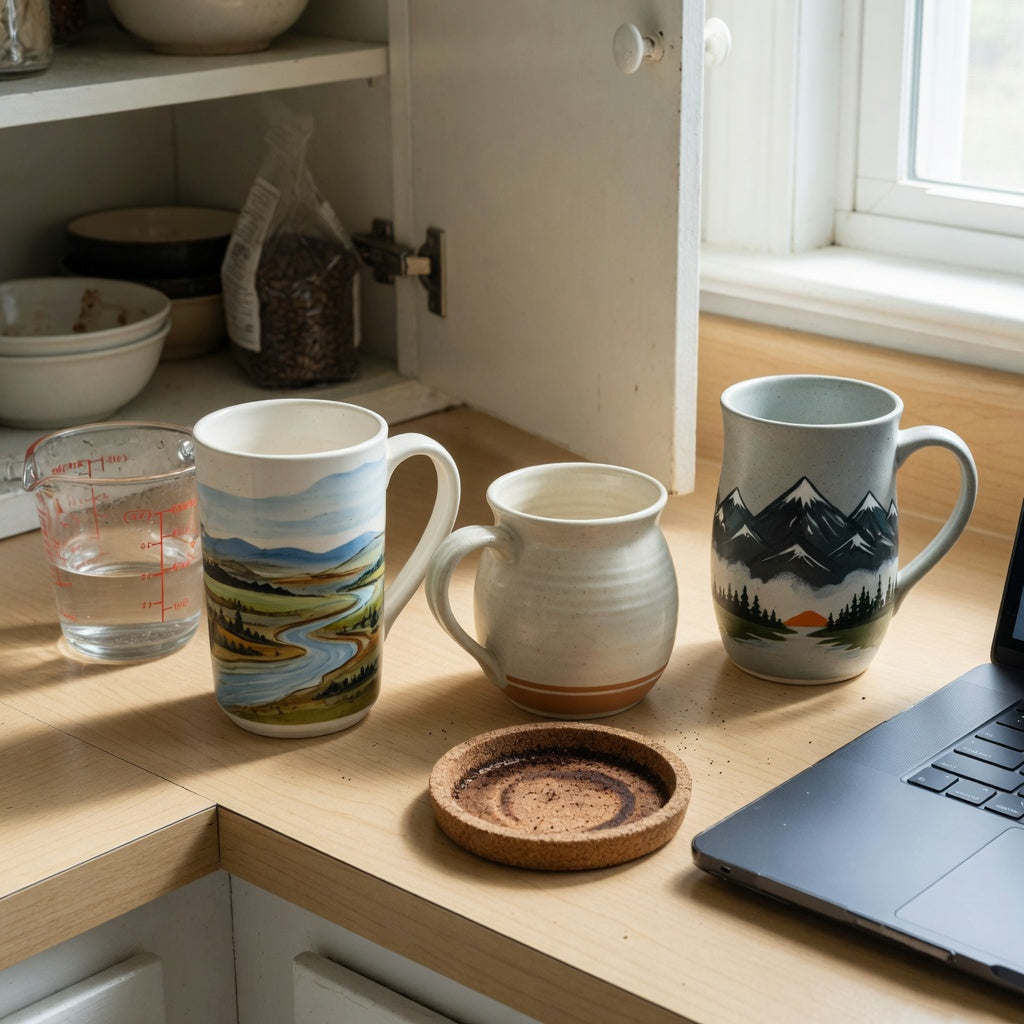
We use the listed capacities on the live pages as the hard comparison points. Write each figure beside the measured pour from the first section, then check the product photos for body width, height, handle clearance, and opening shape. Those exterior details matter because capacity alone does not tell you how much desk, cabinet, or dishwasher-rack space a mug requires.
For frequent refills or a compact setup: Start with The Rock coffee and tea mug. It is the first current option we would compare for a shopper whose decision points smaller: limited desk space, a modest normal pour, or several trips to a nearby coffee pot. Confirm that the capacity shown on the page leaves enough carrying headroom. It is not the practical direction for someone whose measured drink already approaches that listed figure.
For a buyer caught between the two size directions: Open The Flow coffee and tea mug and compare its current listed capacity directly with your measurement. This is the useful next step when a compact mug looks restrictive but the roomiest option would occupy space you rarely use. Check the full dimensions and handle in the product images rather than relying on capacity alone.
For more headroom or a more substantial presence: Consider the Spittoon coffee and tea mug when your measured routine points toward the larger current option. That situation includes drinks with ice or additions, longer periods between refills, and gift buyers who know the recipient prefers a more prominent mug. It is a weaker fit for a narrow desk, a tightly packed cabinet, or anyone who already finds a full ceramic mug tiring to carry.
If none of those three pages produces a close match, scan our collection of unique coffee mugs. Compare the listed capacities first, then use the photos and option details to narrow the shapes. This keeps style from overriding the practical size decision.
How much desk, shelf, and hand space does a thick mug need?
Internal capacity and external size are different specifications. The ceramic body, base profile, rim, and handle all sit outside the liquid volume. Two mugs can therefore list similar capacities while occupying different amounts of space or feeling different in the hand.
Measure the surface you actually use. On a desk, include the coaster and the full handle extension, not just the circular body. In a cabinet, check shelf height and the width available between neighboring cups. If you use a dishwasher, first verify that the product's care instructions permit it, then consider whether the mug can sit without contacting nearby items or interfering with the rack.
Filled weight deserves a practical test. Fill your existing mug to the target volume and carry it from the kitchen to your usual chair with one hand. If that already feels cumbersome, a larger thick ceramic option will not improve the routine. A lighter mug style or a smaller capacity may suit reduced grip strength, frequent room-to-room carrying, or high shelves better.
Thick ceramic is also not the obvious choice for every setting. A lidded travel mug is more appropriate for a moving vehicle, a bag, or any location where spill resistance matters. A less breakable material may be the better option for camping or other impact-prone use. We do not use ceramic thickness alone to promise heat retention, chip resistance, or durability without product-specific support.
Which care and condition details should you check?
Do not assume that every ceramic mug has identical microwave or dishwasher instructions. Read the care information on the individual listing before ordering and follow the label supplied with the product. Size affects convenience here: a roomier mug may require more clearance in a sink, drying rack, cabinet, or dishwasher even when its care method is otherwise straightforward.
- At unboxing: Inspect the drinking rim, handle joints, body, and base in good light.
- At the rim: A chip where your mouth touches the mug is a functional problem, not a harmless cosmetic detail.
- At the handle: Look for a visible structural crack where the handle meets the body.
- On a flat counter: Confirm that the base sits securely without excessive rocking.
- Before machine washing or reheating: Verify the product-specific care instructions instead of treating ceramic as automatic approval.
Glaze color or finish variation is different from a crack, sharp edge, or loose handle. If you receive a mug with apparent structural damage, stop using it and contact our store with clear photos. That check matters for every size, but larger mugs can be more awkward to handle in a crowded sink, making adequate washing space part of the buying decision.
A 60-second size check before checkout
Use this sequence after opening the product pages. It keeps the decision tied to facts rather than the apparent scale of a styled photograph.
- Record the volume of your normal drink, including additions.
- Allow enough empty space for comfortable carrying.
- Compare that total with each live listed capacity.
- Measure your desk, coaster area, cabinet shelf, and washing space.
- Test the expected filled volume in your current mug for carrying comfort.
- Read the selected product's current dimensions, options, and care information.
The thick ceramic coffee mugs size decision guide comes down to one useful rule: choose the smallest current option that comfortably holds your real drink and fits your routine. Move larger only when the added capacity solves a problem you actually have.
Frequently asked questions
Does the thick ceramic coffee mugs size decision guide help when two listed capacities are close?
Yes. Use external dimensions, handle clearance, and expected filled weight as the tie-breakers. The better option is the one that fits your normal surface and remains comfortable to carry, not automatically the one with slightly more capacity.
Is a larger thick ceramic mug always better for iced coffee?
No. Ice occupies internal space, so extra headroom can be useful, but a larger mug also takes up more surface area and becomes heavier when full. If you need a lid or plan to carry the drink outside, a travel tumbler may be more suitable than an open ceramic mug.
Should I choose a smaller ceramic mug for an office desk?
A smaller option often makes sense for a crowded desk or for someone who can refill nearby. Choose a larger option only if the additional capacity is useful during uninterrupted work and you have enough space for the mug body, handle, and coaster.
Can I assume these ceramic mugs are dishwasher and microwave safe?
No. Check the care instructions on the specific product page and the information supplied with the mug. Material category alone is not enough to confirm appliance compatibility because finishes, decorations, and construction details can differ.
Which current CoffeifyMug option should I compare first?
Start with The Rock when your measured routine points smaller, compare The Flow when you need an in-between reference, and open the Spittoon page when added headroom is the priority. Use the live capacity and product details as the final specifications before ordering.
Take one last measurement at the desk or counter where the mug will live, then compare your pour with the three linked product pages. If the match is still unclear, use the unique coffee mugs collection to find a capacity and shape that fit without forcing a larger mug into a routine that does not need it.
More from our blog
Read more
12 oz ceramic coffee mugs buying priorities: Capacity, Shape, Space
Compare measured drink volume, tall versus round profiles, handle clearance, and cabinet or desk space. We map those checks to CoffeifyMug's Landscape Tall, Round, and Mountain Tall options while f...
Read more
Coffee Mug Gift Idea Size Decision Guide: 400, 440 or 480 ml?
Compare current 400, 440 and 480 ml gift mugs by pour habits, storage constraints, grip comfort, iced-drink headroom, care checks and the trade-offs each size brings.
Read more
Leave a comment
This site is protected by hCaptcha and the hCaptcha Privacy Policy and Terms of Service apply.