

Red Ceramic Coffee Mug Morning Routine Product Shortlist Guide
Reading time: about 11 minutes
At 6:40 a.m., the mug on the kitchen counter has a simple job: hold the amount you actually drink before the first refill. A 300 ml first pour followed by a 7:05 refill creates a different buying problem from a 450 ml pour that sits beside an open laptop. This red ceramic coffee mug morning routine product shortlist guide starts with timing and volume, then adds two visual filters shoppers often underestimate: a red finish and a seasonal form.
At CoffeifyMug, we handle ceramic drinkware with the practical handoff in mind: shelf to counter, counter to desk, or product box to gift recipient. The source listing for the Christmas Coffee Tea Mug product page identifies a Red variant and lists a 460 ml ceramic capacity. Those facts establish the material, color option, and listed size. They do not establish microwave safety, dishwasher compatibility, insulation, or temperature retention, so this shortlist does not infer any of those features.
What do your first pour and refill tolerance say about mug size?
Capacity becomes useful only when it is compared with your actual morning drink. A listed 460 ml describes the vessel, not a recommendation to fill it to the rim. Milk, cream, sugar, and ice all use space; with iced coffee, the ice counts toward the mug's room even though it is not liquid. Headroom also matters if you carry the mug from the kitchen to a nearby desk.
- 250 to 300 ml first pour, no refill: Choose the 460 ml size if you like room for additions or a slower drink at the table. Skip it if a visibly underfilled mug feels awkward and compare smaller listings in the unique coffee mugs collection.
- 300 to 400 ml first pour, zero or one light refill: This is the clearest fit for the listed capacity. Choose the red product if the visible seasonal form also suits your counter or desk.
- 400 to 460 ml first pour: It may work as a one-pour routine, but there is less room for movement or additions. Choose only after checking the rim and visible form; skip it if you regularly fill a mug right to the lip.
- More than 460 ml or two full refills before leaving: Skip this listed size. Browse the collection and compare any alternative that explicitly lists a larger capacity rather than assuming every mug there is bigger.
Our team asks shoppers to measure the first pour with a kitchen measuring cup on three ordinary mornings. Record the refill time as well. That small exercise is more reliable than choosing by the word large or by a photo that gives no scale.
Does a red ceramic finish suit your counter, desk, and gift plans?
Red earns its place through visibility and character, not through a performance claim. Against wood, white tile, stainless appliances, papers, and laptop cables, a red mug is easy to identify. That can help during a rushed grab, but it can also feel too strong in a workspace built around muted colors. The finish is a daily visual decision.
The Christmas Coffee Tea Mug name and visible seasonal styling give this option a more occasion-led feel than a plain cylindrical mug. That can be a good match for a December breakfast or a gift unboxing, yet a year-round buyer should ask a less festive question: will the design still look right in March? Check the product images for the actual decoration, handle shape, rim, and base rather than relying on the name alone.
- Kitchen counter: Red is useful if you want one mug to stand apart from appliances and other drinkware.
- Office desk: Red can make the mug easy to spot among papers, but a quieter color may suit a shared or minimalist workspace better.
- Gift box: Seasonal form can make the unboxing feel purposeful for someone who enjoys holiday drinkware; it is a weaker choice for a recipient who prefers neutral basics.
If the color red appeals but an obvious Christmas cue does not, start with the unique coffee mugs collection. Confirm the color, listed capacity, and visible form on each individual listing before treating it as an alternative.
Red ceramic coffee mug morning routine product shortlist guide: which shopper scenario fits the 460 ml option?
A useful shortlist ends in a clear choose or skip decision. These are the situations we use when helping shoppers narrow the red ceramic option without turning the comparison into a long feature checklist.
- The single-pour breakfast: You pour about 300 to 400 ml, sit at the kitchen table, and rarely return to the pot. Choose the Red variant on the Christmas Coffee Tea Mug product page; the listed 460 ml capacity gives the drink some room, and the seasonal form adds visual interest. Skip it if your tableware is strictly plain or you dislike holiday styling outside December.
- The kitchen-to-nearby-desk routine: You make one drink at home, carry it a short distance, and may add a small refill after the first email or meeting. Choose the same red ceramic mug if it remains a stationary kitchen or office mug and its visibility is useful. Skip it for a daily train, bus, or outdoor commute; ceramic is not a sealed travel cup, and the available source facts make no insulation claim.
- The seasonal gift unboxing: The recipient already likes red, ceramic drinkware, and coffee or tea, and a festive object is part of the appeal. Choose the product page option because its name and visible form support that occasion-led choice while the listed 460 ml capacity remains a concrete size reference. Skip it for someone who wants a completely neutral daily driver, then compare plainer visible forms in the unique collection.
- The red minimalist: You want a red mug but no overt Christmas association. Skip the seasonal product even if the capacity works. Use the collection as the next step and select only a listing whose images and stated capacity match the simpler look you want.
- The high-volume morning drinker: You pour more than 460 ml at once or finish two full mugs before leaving home. Skip the listed 460 ml option because refill frequency, not color, is the main problem. Browse the collection for a listing that explicitly gives you more capacity, or choose another style designed for that volume.
The best match is therefore conditional. The red ceramic option is strongest for a moderate first pour, no refill or one light refill, and a buyer who enjoys seasonal visual detail. It is a poor match for sealed travel, repeated full refills, or strict minimalism.
What should you inspect on a ceramic mug before the first coffee?
Ceramic is a material category, not a complete quality description. Two mugs with the same listed capacity can feel different because of rim opening, handle geometry, foot ring, and surface decoration. We do not have unlisted measurements for this mug, so the product images and listing should do the work of confirming its visible form.
When our team handles ceramic drinkware for packing, these are the practical inspection points:
- Rim: Look for a clean, even edge without a chip, sharp spot, or rough patch. This is especially noticeable when you drink black coffee or tea directly from the mug.
- Handle junction: Check where the handle meets the ceramic body for a hairline crack, uneven finish, or visible gap. These are common ceramic inspection points, not a claim that this product has a defect.
- Foot ring and base: Set the mug on a flat counter or desk and check that it sits without rocking. Do not guess the base dimensions from the capacity number.
- Surface finish: Look for pinholes, glaze crawling, fine crazing lines, or uneven red coverage if those details matter to you. A small visual variation may be acceptable to one buyer and a reason to reject a gift to another.
- Capacity reference: Treat 460 ml as the listed capacity and compare it with your measured pour. It is not proof of a particular fill line or usable serving volume.
For a gift, make these checks before wrapping rather than after the recipient opens the box. For a desk mug, inspect the base and rim especially carefully because small imperfections become annoying when the mug is used beside a keyboard every morning.
What care questions matter if your routine includes dishwasher cycles?
Care can decide the purchase before color does. Ceramic alone does not answer whether a specific mug is suitable for dishwasher cycles or microwave use. If either feature is essential in your household, look for explicit instructions on the product page, packaging, or care label before ordering.
- Check the stated care method: Do not infer dishwasher or microwave compatibility from the word ceramic. If the information is absent and the feature is non-negotiable, treat that uncertainty as a skip signal.
- Clean coffee residue promptly: Rinse out milk, sweetener, or coffee residue and use mild dish soap with a non-abrasive sponge unless the maker gives different instructions. Avoid metal scouring tools that can mark a finished surface.
- Avoid sudden temperature changes: As a conservative ceramic-care practice, do not move a mug directly from a very cold rinse into very hot liquid. Let it reach a normal indoor temperature first.
- Recheck after washing: Look at the rim, handle junction, foot ring, and surface after repeated use. Stop using any mug with a new chip or crack and contact the seller about the appropriate next step.
The listed product details for the red Christmas Coffee Tea Mug should remain your reference for any care claim that matters to your routine. A careful decision here is more trustworthy than assuming every ceramic mug handles the same wash cycle.
Which morning routines should skip this red 460 ml ceramic mug?
A shortlist earns trust by naming the mismatches. Skip this option, or move to another style, when one of these conditions controls your morning:
- You need a sealed vessel: A mug intended to sit on a counter or desk is a poor substitute for a travel cup with a closure.
- You drink more than the listed capacity: A large first pour or multiple full refills will make 460 ml feel restrictive regardless of how much you like red.
- You want a completely neutral silhouette: The Christmas-linked form may stay visually festive longer than you want. Compare plain forms in the collection instead.
- Dishwasher or microwave use is required: Do not order until the listing or packaging explicitly answers that care question.
Those are not flaws in the red ceramic concept. They are signs that another capacity, form, material, or care specification deserves priority.
How do the decisive morning variables compare side by side?
| Morning variable | Likely fit | Choose or skip signal |
|---|---|---|
| First pour of 300 to 400 ml | Good starting range for the listed 460 ml capacity | Consider the product if the seasonal form appeals |
| First pour above 460 ml | Little or no room for headroom | Skip and compare a larger listed capacity |
| No refill or one light refill | Lower routine friction | Product page is worth checking |
| Two or more full refills | Frequent return to the pot | Move to another size in the collection if listed |
| Red seasonal styling | Visible and occasion-led | Check product images before choosing |
| Plain red styling | Seasonal form may miss the brief | Compare individual collection listings |
| Required dishwasher or microwave use | Not established by ceramic material alone | Verify explicit care information first |
Use the table to remove mismatches quickly. It keeps the decision tied to your morning instead of treating color or capacity as an automatic answer.
What should you confirm on the product page before ordering?
Take ten minutes and make the comparison measurable:
- Measure your first pour and write down the amount in milliliters.
- Count your refills and distinguish a small top-off from a full second mug.
- Confirm that the listing shows the Red variant and the listed 460 ml ceramic capacity.
- Review the visible form and decide if the seasonal styling belongs on your counter, desk, or gift list year-round.
- Read the care information instead of assuming microwave or dishwasher use.
- Choose the red Christmas Coffee Tea Mug when the volume and styling fit. If they do not, compare the unique coffee mugs collection and verify each alternative on its own product page.
Frequently asked questions
How much coffee should I pour into a 460 ml ceramic mug?
A red ceramic coffee mug morning routine product shortlist guide should start with your actual pour, not a generic cup label. Measure the liquid you normally drink and leave room for milk, ice, or safe carrying. A 300 to 400 ml first pour is a practical starting comparison for the listed 460 ml size.
Does the listed 460 ml capacity mean I should fill the mug to the rim?
No. The listing gives a capacity reference, but it does not establish a fill line or the amount of headroom you will prefer. Compare the number with your usual drink volume and how far you carry the mug.
Is the red Christmas Coffee Tea Mug practical on an office desk?
It can suit a stationary desk routine when a moderate first pour, one light refill, and visible red styling match your habits. Skip it for a sealed commute or any use that requires insulation, because those features are not established by the available product facts.
Can I assume a ceramic mug is dishwasher-safe or microwave-safe?
No. Ceramic material alone does not confirm either care feature. Check the product page, packaging, or care label for explicit instructions, and treat missing information as a reason to verify before buying.
What should I choose if I like red but not a Christmas design?
Skip the seasonal product and browse the unique coffee mugs collection for a plainer visible form. Confirm the individual listing's color, capacity, and care details rather than assuming the collection shares one specification.
Tomorrow morning, measure the first pour, count the refills, and decide how much seasonal character you want on the counter. Then open the red ceramic mug product page or compare the collection. The right shortlist is the one that matches your routine before the first sip, not the one with the most tabs open.
More from our blog
Read more
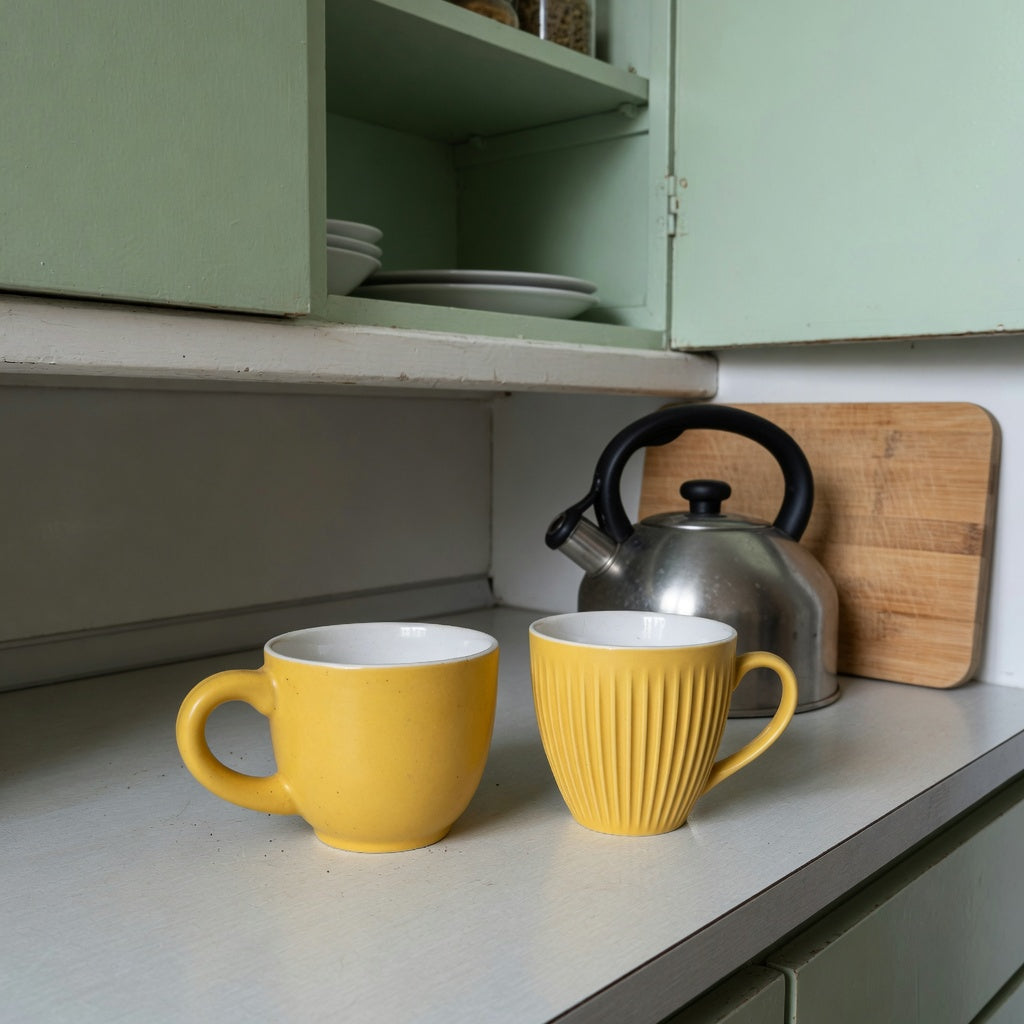
Yellow Ceramic Coffee Mug Compact Kitchen Product Shortlist Guide
Compare CoffeifyMug's listed 170 ml Retro and 200 ml Pleated yellow ceramic cups against shallow cabinets, narrow counters, office desks, and gift displays. Get explicit choose-or-skip guidance wit...
Read more
Red ceramic coffee mug shared household practical purchase checklist
Compare the listed 460 ml ceramic capacity, red visibility, and Christmas form against different coffee, tea, cocoa, iced coffee, office, and gifting habits. This checklist also flags care details ...
Read more
Leave a comment
This site is protected by hCaptcha and the hCaptcha Privacy Policy and Terms of Service apply.