
Macchiato Cup Size: Compare 170 ml, 200 ml, and 250 ml
Reading time: about 9 minutes
A double shot and a spoon of foam can crowd the lip of a 3 oz cup, yet the same drink looks stranded in a breakfast mug. That mismatch is why macchiato cup size should be judged by usable headroom, not simply by the biggest number printed on a listing.
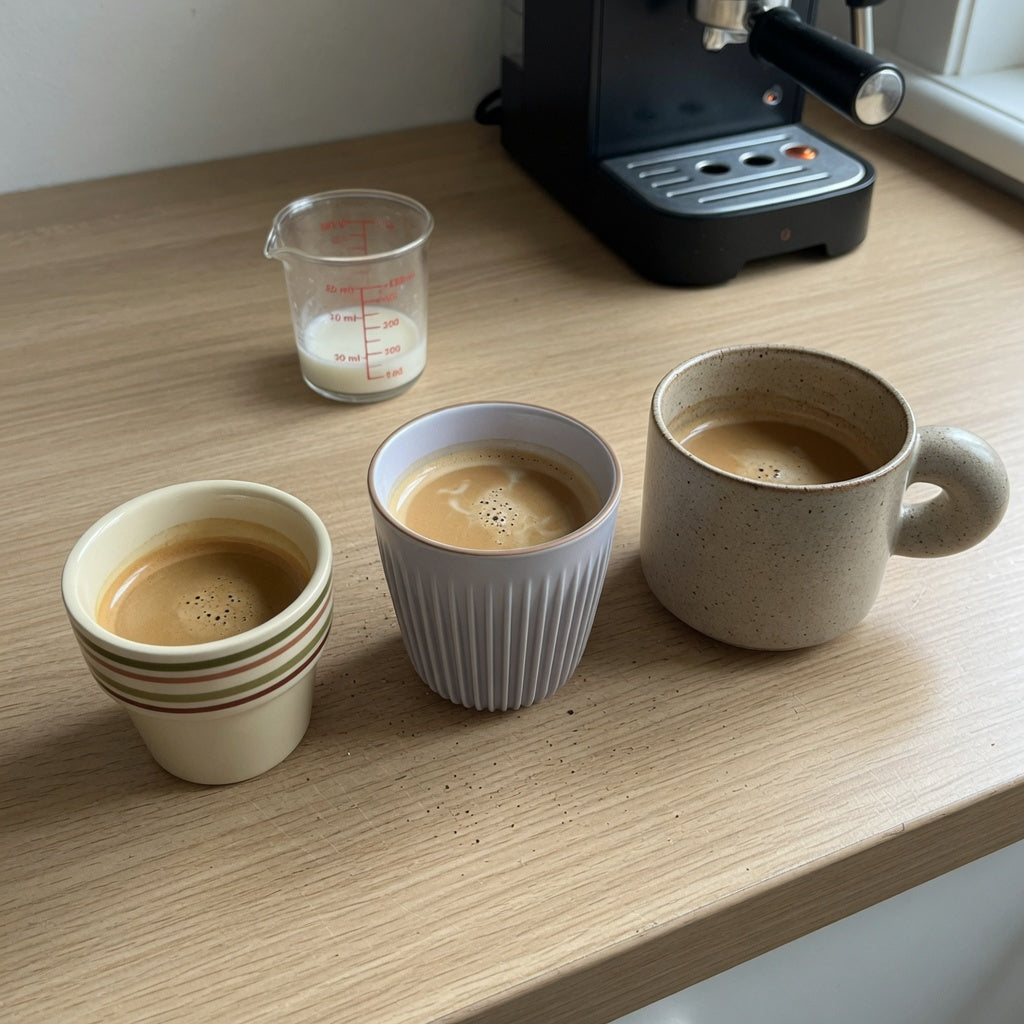
At CoffeifyMug, our team starts with the drink the buyer actually prepares. The catalog options covered here are 170 ml, 200 ml, and 250 ml. Each offers more room than a traditional-style 60 ml reference cup, so we do not present any of them as an exact demitasse replacement. They are compact choices for shoppers who want practical space above the espresso and milk.
Espresso macchiato or latte macchiato: which vessel are you matching?
An espresso macchiato is generally an espresso-forward drink marked with a small amount of milk or foam. A latte macchiato puts more emphasis on milk and is often served in a taller vessel so the layers remain visible. Recipes differ across cafés, regions, and home setups, so the following volumes are useful shopping references rather than universal standards.
- About 60 ml or 2 oz: a close-fitting demitasse reference for a very short espresso macchiato.
- 3 oz or about 89 ml: more room than a 60 ml cup, but still tight for a double shot with wetter foam.
- 4 oz or about 118 ml: a more forgiving short-cup reference without moving into regular mug territory.
- Around 220 ml or 7.4 oz: a common comparison point for a taller, milk-forward latte macchiato vessel.
A large flavored café drink carrying the macchiato name may require much more capacity. Buy for your recipe, not the menu label. If you make a short home drink but want more spill protection than a demitasse allows, the 170 ml Retro Coffee & Tea Cup is the smallest option discussed here. You can also compare the available silhouettes in our unique coffee mugs collection.
Macchiato cup size chart: what do 170 ml, 200 ml, and 250 ml mean?
Capacity is a ceiling, not a serving instruction. A 250 ml cup does not require 250 ml of coffee and milk. The useful comparison is how much empty wall remains once your normal drink is inside.
| Reference or listed capacity | Likely use | Headroom trade-off | Closest catalog match |
|---|---|---|---|
| 60–120 ml about 2–4 oz |
Short, espresso-forward service | Close visual fit, but less room for foam or carrying | No direct match; choose a true demitasse if this fit is essential |
| 170 ml about 5.7 oz |
Home double with a modest mark of milk | Smallest listed option, though still roomy around a 60 ml drink | Retro cup |
| 200 ml about 6.8 oz |
Longer macchiato or a compact milk-forward drink | Middle ground between a short cup and a small mug | Pleated cup |
| 250 ml about 8.5 oz |
Generous milk addition or maximum spare rim | Most forgiving, but least like a close-fitting demitasse | Ball Handle mug |
A capacity figure does not identify the comfortable fill line. Rim shape, wall taper, and foam height all affect where you should stop. We avoid assigning an exact working volume without measured interior dimensions because two cups with the same listed capacity can feel different in use.
- Measure your usual espresso and added milk once in a graduated vessel. Foam makes an exact final volume difficult, so observe its finished height too.
- Choose enough capacity for the drink to sit below the lip. A gap of roughly 10–15 mm is a practical starting test, not a fixed café rule.
- Add more spare wall if you carry the cup from the kitchen counter to a desk or serve it on a crowded tray.
- If the drink looks lost, use a smaller vessel rather than adding milk solely to make the cup appear full.
Which listed cup fits a short pour, a longer pour, or a desk drink?
We limit these product comparisons to listed capacity and visible form. Check each live product page for its current material, dimensions, and care information before ordering.
Smallest listed option for a short home pour: Retro 170 ml
Reader situation: you pull an espresso, add a restrained amount of milk or foam, and want the smallest of the three catalog capacities. The 170 ml Retro cup gives you less unused space than the 200 ml and 250 ml choices while retaining practical room above a double-shot recipe.
The trade-off is visual. A strict 60 ml serving will still leave substantial empty space, so this is not the right purchase for someone trying to recreate a close-fitting Italian bar presentation. Its retro form suits buyers who value that visible style more than a minimalist demitasse shape.
Middle ground for a longer mark of milk: Pleated 200 ml
Reader situation: your home macchiato often receives a longer splash of milk, or you alternate between an espresso-forward drink and a small milk drink. The 200 ml Pleated Coffee & Tea Cup adds 30 ml over the Retro and remains 50 ml below the Ball Handle option. Its visible pleated form also gives it a more textured appearance.
This capacity is not automatically the best choice for a layered latte macchiato. Layer visibility depends on the cup material, height, and transparency as well as volume. If seeing distinct milk and espresso bands is the priority, compare the listing details with a tall clear glass before buying.
Most headroom and a distinctive handle: Ball Handle 250 ml
Reader situation: you add more milk, dislike pouring close to the rim, or carry the drink to an office desk. At 250 ml, the Ball Handled Coffee & Tea Mug is the largest of the three. The ball-shaped handle is its defining visible form.
Do not assume that a distinctive handle will suit every hand or espresso-machine tray. Check the listing photos and any available measurements for lateral clearance. This is also the least suitable option for a two-sip, close-fitting macchiato, and it should not be treated as a lidded travel cup unless the listing specifically states compatibility.
Ceramic, porcelain, or clear glass: what changes in a small drink?
Material matters, but the label alone does not settle the comparison. Wall thickness, starting temperature, exposed surface area, and how quickly you drink all influence temperature in the cup. We would not promise that every ceramic cup stays hotter than every glass cup.
| Construction or form | Why a shopper may choose it | Main trade-off | Practical care check |
|---|---|---|---|
| Thick ceramic or porcelain | Traditional opaque appearance for a short hot drink | Does not display milk and espresso layers | Pre-warm with warm water if the care guidance permits it; keep rims separated during washing |
| Single-wall clear glass | Shows crema, milk, and layered pours | The outer wall may become hot, and abrupt temperature changes can be hard on glass | Avoid pouring a very hot drink into refrigerator-cold glass; verify dishwasher guidance |
| Double-wall glass | Displays layers while separating the hand from the inner wall | Outside dimensions may be larger than expected for the stated capacity | Follow the maker’s cleaning instructions and inspect any base seal used in the construction |
| Pleated or sculptural handle forms | More visual character for open shelving or gifting | Projections can require extra cabinet and dishwasher-rack space | Prevent handles and raised details from knocking against neighboring pieces |
Never infer dishwasher or microwave suitability from appearance alone. Glaze, decoration, joints, and construction can change the care requirements. In daily handling, the usual contact points to inspect are the drinking rim, the handle connection, and the foot. Rim-to-rim stacking can cause chips, while a projecting handle often takes the first side impact in a crowded rack.
Will the cup clear your espresso machine and handle daily use?
A capacity number tells you nothing about cup height or footprint. On a compact home machine, those measurements can decide the purchase before color or style enters the discussion. In our experience, a quick check with a ruler prevents more frustration than trying to estimate scale from a product photo.
- Vertical clearance: lock in the portafilter and measure from the lowest spout to the drip tray. Leave enough room to slide the filled cup out without tipping it.
- Two-cup width: if you use a dual spout, measure the combined width of both cup bodies and handles. A ball-shaped handle deserves extra attention here.
- Cabinet space: check shelf height, depth, and the room needed around the handle. Do not assume a decorative cup is designed to stack.
- Dishwasher loading: verify the listed care instructions, then place approved pieces so rims and handles cannot strike each other during the cycle.
- Saucer and tray fit: a saucer catches drips at the table but occupies valuable room on a small drip tray.
For a home espresso bar, choose according to your most frequent recipe rather than an occasional oversized pour. For an office desk, extra headroom may be more useful, but none of these capacities guarantees a lid or leak-resistant carry. For café use, confirm commercial dishwasher suitability, stackability, replacement availability, and saucer fit; capacity and appearance alone do not establish commercial-grade performance.
Gift buyers face a different trade-off. A retro profile, pleated exterior, or ball handle can make an immediate impression during unboxing, but the recipient still needs machine clearance and cabinet space. Takeaway buyers should also treat 4 oz and 8 oz paper cups as part of a separate lid-and-cup system rather than assuming a reusable cup will accept those lids. For ice-heavy drinks, choose a larger vessel because cubes consume much of a compact cup’s usable room.
Frequently asked questions
What macchiato cup size should I buy for a double shot at home?
No single size fits every double shot because espresso yield and milk additions vary. A 3–4 oz cup gives a close café-style fit but leaves limited spare wall; among our listed choices, 170 ml is the smallest and most compact. Choose a true demitasse instead if you want a traditional-style short drink to fit the vessel closely.
Is a 3 oz cup large enough for a double-shot macchiato?
It can be large enough for a controlled double shot with only a small spoon of foam. It becomes crowded if the extraction runs longer or the milk addition is wetter and more generous. A 4 oz cup provides more margin, while a 170 ml cup prioritizes easy carrying and unused headroom over close visual fit.
Should latte macchiato go in a 200 ml cup or a taller glass?
A taller clear glass is the more direct choice if visible layers are central to the presentation, with roughly 220 ml serving as a useful market reference rather than a rule. A 200 ml cup may suit a smaller milk-forward recipe, but material, transparency, and height matter as much as capacity.
Will a 250 ml cup fit under my home espresso machine?
Not necessarily. Millilitres measure capacity, not height or outside width. Measure from the portafilter spout to the drip tray, then check the product page for any listed dimensions and allow room for the handle.
What should I check before ordering a macchiato cup online?
Measure your finished recipe, preferred rim gap, group-head clearance, and available cabinet space; then verify the current material, care notes, and any listed dimensions. If you want a close-fitting 60 ml service, buy a demitasse rather than one of these three capacities. If compact headroom is the priority, compare the 170 ml, 200 ml, and 250 ml forms in our unique coffee mugs collection and open the relevant product page before checkout.
More from our blog
Read more
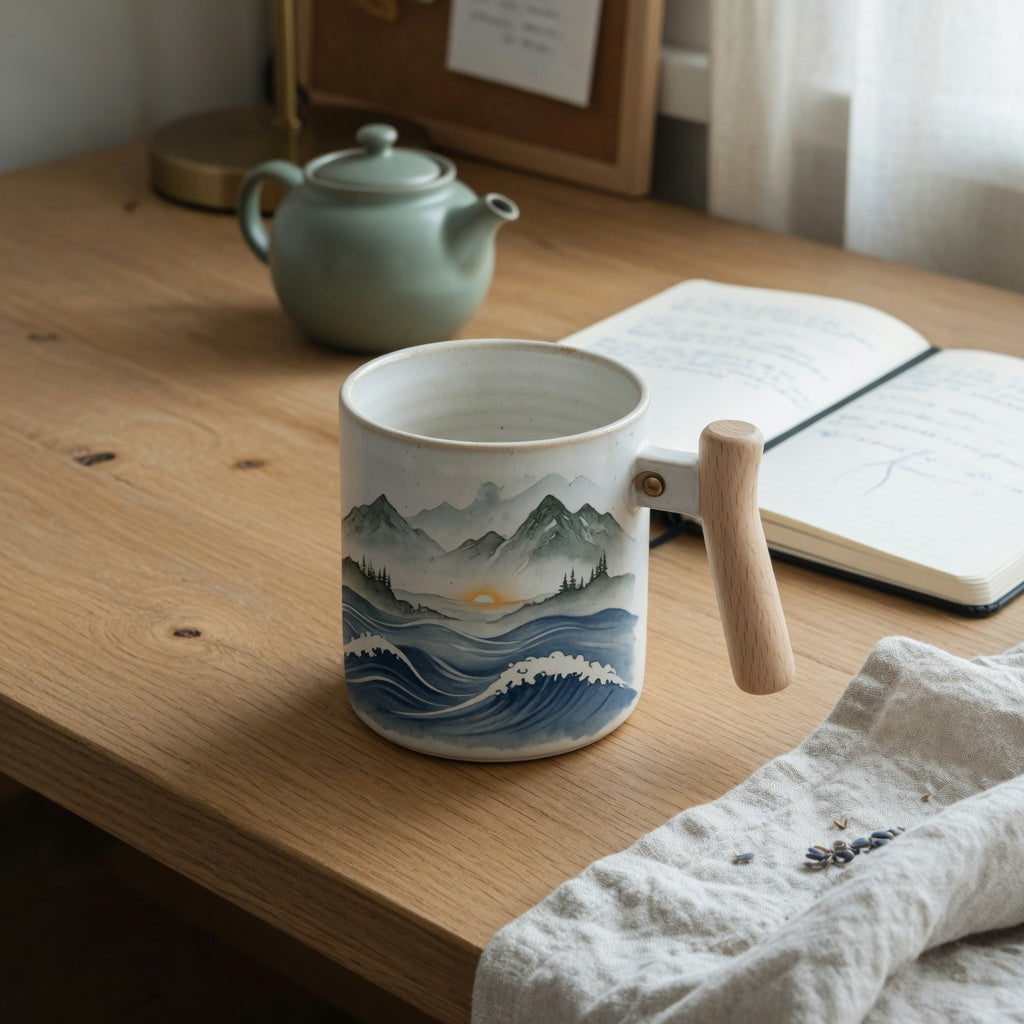
Mountain Sea Ii Coffee Tea Mug With Wooden Handle: Buyer Checks
Compare the listed 450 ml ceramic body and wooden handle against your real routine: full-cup weight, hand clearance, washing, reheating, and storage. We also flag the listing details shoppers shoul...
Read more
The best coffee mug wedding gift ideas: A practical comparison
Compare wedding mugs by usable capacity, handle clearance, ceramic safety, care limits, personalization, and matching versus mixed pairs. We map three CoffeifyMug styles to specific couple routines...
Read more
Leave a comment
This site is protected by hCaptcha and the hCaptcha Privacy Policy and Terms of Service apply.