
Herbal Tea Mug Buying Priorities: Capacity, Shape, Grip, Space
Reading time: about 9 minutes
A mug can look perfectly manageable on an empty kitchen counter, then become awkward once it shares space with a kettle, spoon, phone, or laptop. The mismatch often appears during the first full carry: the pour sits closer to the rim than expected, the handle feels different under load, or the mug occupies more working space than the product photo suggested. Those are the practical herbal tea mug buying priorities that determine whether a mug becomes a daily choice.
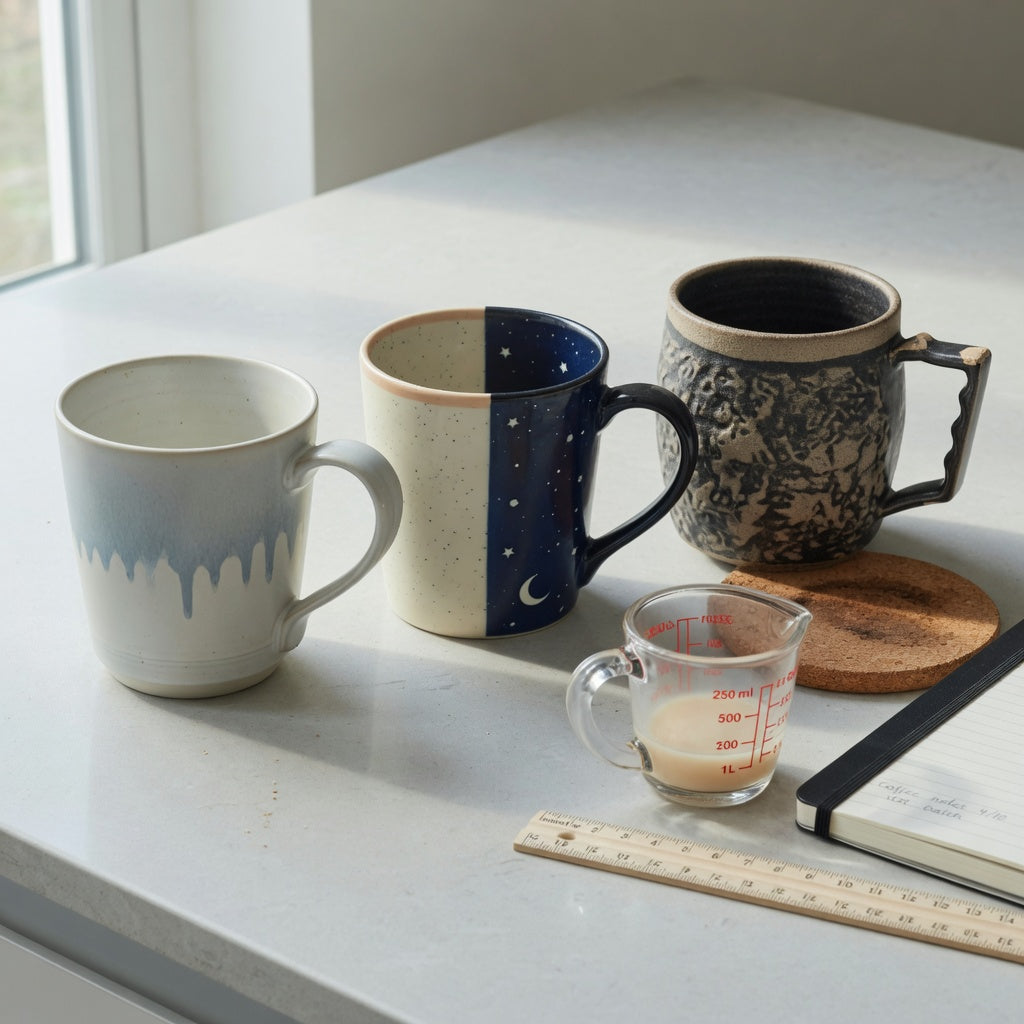
In our experience selling and handling this category, shoppers make a more dependable decision when they separate capacity, handle comfort, and physical space instead of treating size as one vague feature. The catalog facts we can verify are specific: The Flow holds 400 ml, Morning and Night holds 440 ml, and The Rock holds 480 ml. Their catalog descriptions support tea use. Exact dimensions, material details, and care claims are not part of the verified comparison information used here, so we will not guess at them; the current product page should settle any detail that is essential to your purchase.
Which listed capacity matches the amount you actually pour?
Start with the liquid, not the mug. A listed capacity tells you how the three options compare, but it does not mean you will want to fill a mug to its edge. Your normal pour plus your preferred amount of headroom must fit within the stated capacity.
| Current mug | Listed capacity | Capacity difference | Best starting situation |
|---|---|---|---|
| The Flow coffee and tea mug | 400 ml | Smallest of the three | Your measured pour fits within 400 ml while leaving the headroom you normally prefer. |
| Morning and Night coffee and tea mug | 440 ml | 40 ml more than The Flow | A 400 ml limit feels too close, but you do not need the full 480 ml option. |
| The Rock coffee and tea mug | 480 ml | 40 ml more than Morning and Night; 80 ml more than The Flow | Your usual single serving needs the most room available in this three-mug comparison. |
A quick measurement is more useful than estimating from your current mug's appearance:
- Fill your current mug with the amount of cool water that matches a normal serving.
- Transfer that water to a marked measuring jug and record the milliliters.
- Notice how much empty space you usually leave below the rim, then choose a listed capacity that preserves comparable headroom.
Bigger is not automatically better. The 480 ml option is a poor fit if you regularly leave part of a large serving unfinished or dislike carrying a fuller mug. The 400 ml option is equally unsuitable if your measured pour already approaches its listed capacity. Capacity also does not establish the mug's outside dimensions, so do not assume that the lowest-volume option has the smallest footprint.
Herbal tea mug buying priorities for desks and small counters
On a crowded surface, the useful measurements are body height, base diameter, widest body diameter, and total width including the handle. Handle projection is easy to overlook because a product photo may emphasize the mug body. At an office desk, that extra width can occupy the same area needed for a mouse, notebook, or charging cable.
- For a desk: measure the open rectangle beside your keyboard or notebook, including the space your hand needs to approach and lift the handle.
- For a kitchen counter: check the mug's intended position with the nearby appliances and utensils in place, not after clearing the surface.
- For a cabinet: record shelf height and usable width. Two handles can prevent mugs from sitting as close together as their bodies suggest.
Use the current product images to compare visible outlines, but do not convert visual impressions into exact measurements. Camera angle and image scale can make separate products look more alike than they are. If a required dimension is not currently listed, ask before ordering rather than assuming. Our unique coffee mugs collection is the useful next step for comparing visible shapes across the range, but an exact shelf, coaster, or desk fit still requires dimensions.
What does handle comfort mean once the mug is filled?
Handle comfort is personal, which is why we do not label one shape universally comfortable. When we assess a handle, we look at the opening, the number of fingers a grip uses, knuckle clearance from the mug body, and how the hand carries the combined mug and liquid. A handle can appear generous in a close photograph without providing enough scale to judge those points.
- Check whether you normally use one, two, or three fingers inside the handle of your favorite mug.
- Notice whether your knuckles touch the mug body and whether that contact bothers you.
- Measure the opening of a handle you already find comfortable, then compare it with any current dimensions or scaled images on the product page.
- Consider the mug while filled. The largest capacity allows up to 80 ml more liquid than the smallest option in this group.
That last distinction needs care. A 350 ml pour contributes the same liquid load in any mug; the vessels' own weights are not verified in this comparison. We therefore would not claim that The Flow is lighter to hold or that The Rock has a more secure handle based on capacity alone. If grip is your deciding factor, use the current handle photos and any listed measurements before choosing. Visual shape can narrow the options, but it cannot guarantee in-hand comfort.
Which current mug fits a measured pour, desk routine, or gift?
Each recommendation should begin with a situation and end with a product fact we can support:
- Your measured serving fits comfortably below 400 ml: start with The Flow at 400 ml. It provides the lowest listed capacity of the three, which makes it the logical first check when you do not need an extra 40 or 80 ml. Confirm the handle and outside dimensions if desk space is tight.
- Your pour makes 400 ml feel restrictive: consider Morning and Night at 440 ml. Its position in the range is precise: 40 ml above The Flow and 40 ml below The Rock. It suits a shopper whose measured routine falls between the two endpoints, but the middle capacity is not automatically the safest choice for every hand or shelf.
- You want the largest verified capacity in this group: move to The Rock at 480 ml. The reason to choose it is the additional room for a larger measured serving. It is not the right choice merely because a bigger mug seems more generous, especially if you prefer modest pours or need an exact compact footprint.
- You are buying a gift: look at the recipient's current daily mug before choosing. Estimate or measure its capacity, note how many fingers they place through the handle, and observe where they use it. Then select the closest current product rather than assuming that the 480 ml mug will create a better gift unboxing experience.
A desk shopper who needs a guaranteed narrow footprint cannot choose from capacity alone. Likewise, someone who requires a sealed lid, cup-holder compatibility, or stackable storage should select a style that explicitly lists those functions. The verified facts for these three products establish capacity and tea use, not travel-vessel performance.
What can visible shape tell you without listed dimensions?
Visible shape is useful for judging design preference and identifying which handle outline deserves a closer look. Within a single product image, you can examine the relationship between the body, rim, base, and handle. Across separate images, however, perspective and cropping can hide the true size difference.
- Shape can help you shortlist a design that suits the recipient or the room.
- Shape cannot prove exact desk footprint, cabinet clearance, or handle opening size.
- Capacity cannot substitute for any of those outside measurements.
For a gift, appearance may create the first reaction, but routine fit decides whether the mug keeps getting used. We recommend settling capacity first, checking the visible handle second, and verifying exact spatial requirements last. That sequence keeps an attractive outline from overriding a practical mismatch.
Which details need a product-page check before checkout?
Run this short check against the current listing for the mug you are considering:
- Capacity: confirm 400 ml for The Flow, 440 ml for Morning and Night, or 480 ml for The Rock.
- Tea use: check that the current catalog description still identifies the product for coffee or tea use.
- Outside dimensions: if listed, look for body height, base or body diameter, and maximum width including the handle.
- Handle information: inspect clear side views and use listed handle measurements if available. Do not infer finger clearance from capacity.
- Material and care: rely on the current product listing. Do not assume dishwasher, microwave, or other appliance compatibility from appearance.
- Special functions: confirm any lid, insulation, stacking, or cup-holder requirement explicitly. None should be inferred from the facts in this comparison.
This boundary matters because capacity does not prove care compatibility or brewing performance. The three catalog descriptions support tea use, but we are not claiming that one changes steeping results or performs better with a particular herbal blend. If those functions matter more than the mug's listed volume and handle fit, a different, purpose-specific style will serve you better.
Frequently asked questions
What are the most practical herbal tea mug buying priorities?
Measure your normal pour first, then preserve the headroom you prefer. After capacity, compare handle comfort and the space available on your desk, counter, or cabinet shelf. Exact outside dimensions should decide any close spatial fit.
Is 400 ml, 440 ml, or 480 ml better for herbal tea?
No capacity is universally better. The Flow offers 400 ml, Morning and Night offers 440 ml, and The Rock offers 480 ml, so the right option is the smallest one that accommodates your measured serving and preferred headroom. Move up only when the extra 40 or 80 ml solves a real limitation.
Does a 400 ml mug automatically take up less desk space?
No. Internal capacity and external footprint describe different things, and a handle can determine the mug's maximum width. Verify current dimensions before choosing The Flow solely for a narrow desk or shelf.
How can I judge mug handle comfort while shopping online?
Start with a mug you already find comfortable and note its handle opening, finger count, and knuckle clearance. Compare those details with product photos and any listed measurements, but recognize that a photograph cannot guarantee grip comfort. We would not rank these three handles without verified dimensions or an individual shopper's grip preference.
Can I assume these mugs are dishwasher or microwave safe?
No. Capacity, appearance, and a general tea-use description do not establish care compatibility. Check the current listing for the exact product before using a dishwasher, microwave, or other appliance.
Before buying, write down your normal pour in milliliters, the maximum space available, and the handle dimensions of a mug you already like. Then compare those notes with our current unique mug collection and choose the listed capacity that fits your routine without relying on unverified assumptions.
More from our blog
Read more
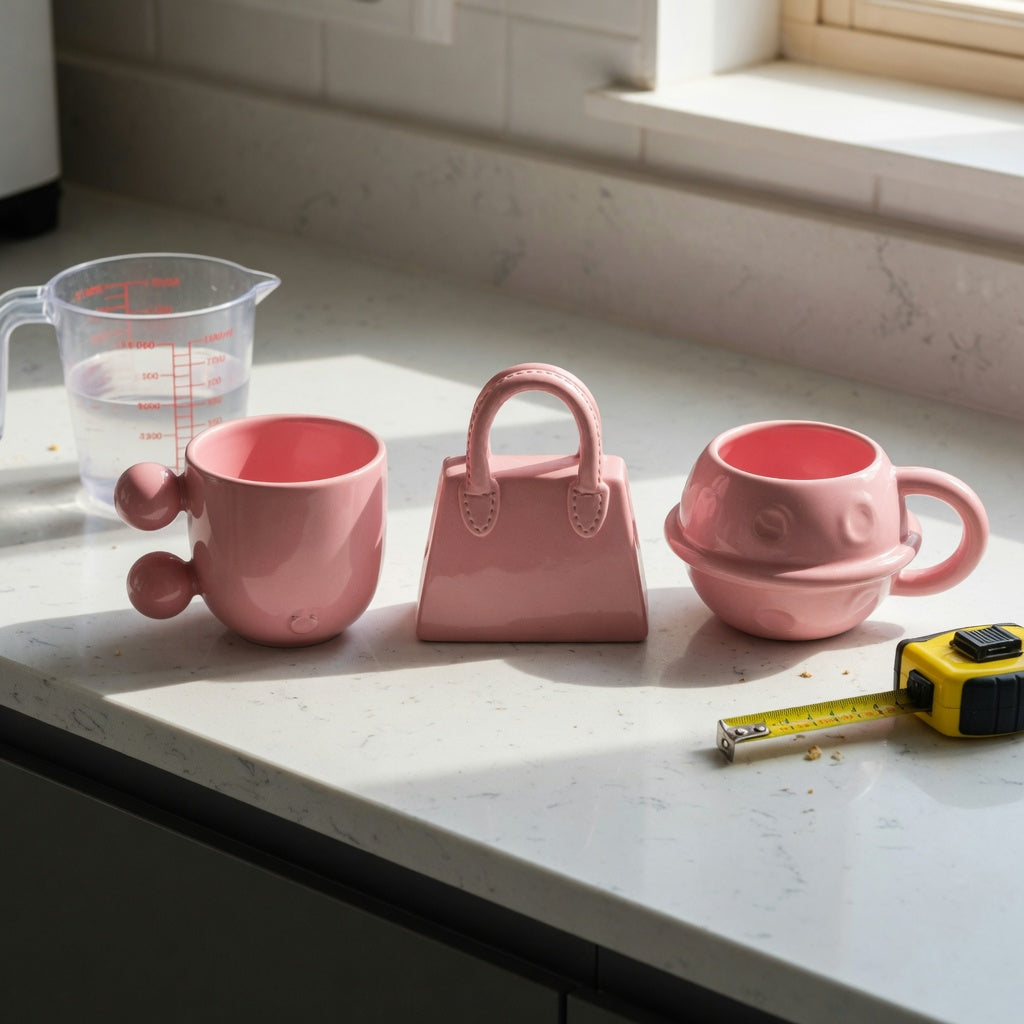
Pink Ceramic Coffee Mug Buying Priorities: Capacity, Shape, Space
Compare CoffeifyMug's currently listed Pink Ball Handle, Handbag, and Planet mugs by 250 ml, 310 ml, and 380 ml capacity, visible form, and measured space. Learn what to verify before ordering.
Read more
Heavy Ceramic Coffee Mugs Buying Priorities: Capacity, Shape, Space
Choose by hard constraints first: comfortable filled weight, usable capacity, handle and base footprint, storage clearance, and care. We map those checks to The Rock, Spittoon, The Flow, and the wi...
Read more
Leave a comment
This site is protected by hCaptcha and the hCaptcha Privacy Policy and Terms of Service apply.