
Green Tea Mug Home Coffee Station Product Shortlist Guide: 3 Picks
Reading time: about 10 minutes
A grinder, scale, kettle, and dripper can leave only one clear patch of kitchen counter for a cup. A green tea mug selected by color alone may still hold less than you expect, prompt more refills than you want, or look out of place beside the coffee tools already there. That tight-counter decision is the purpose of this green tea mug home coffee station product shortlist guide.
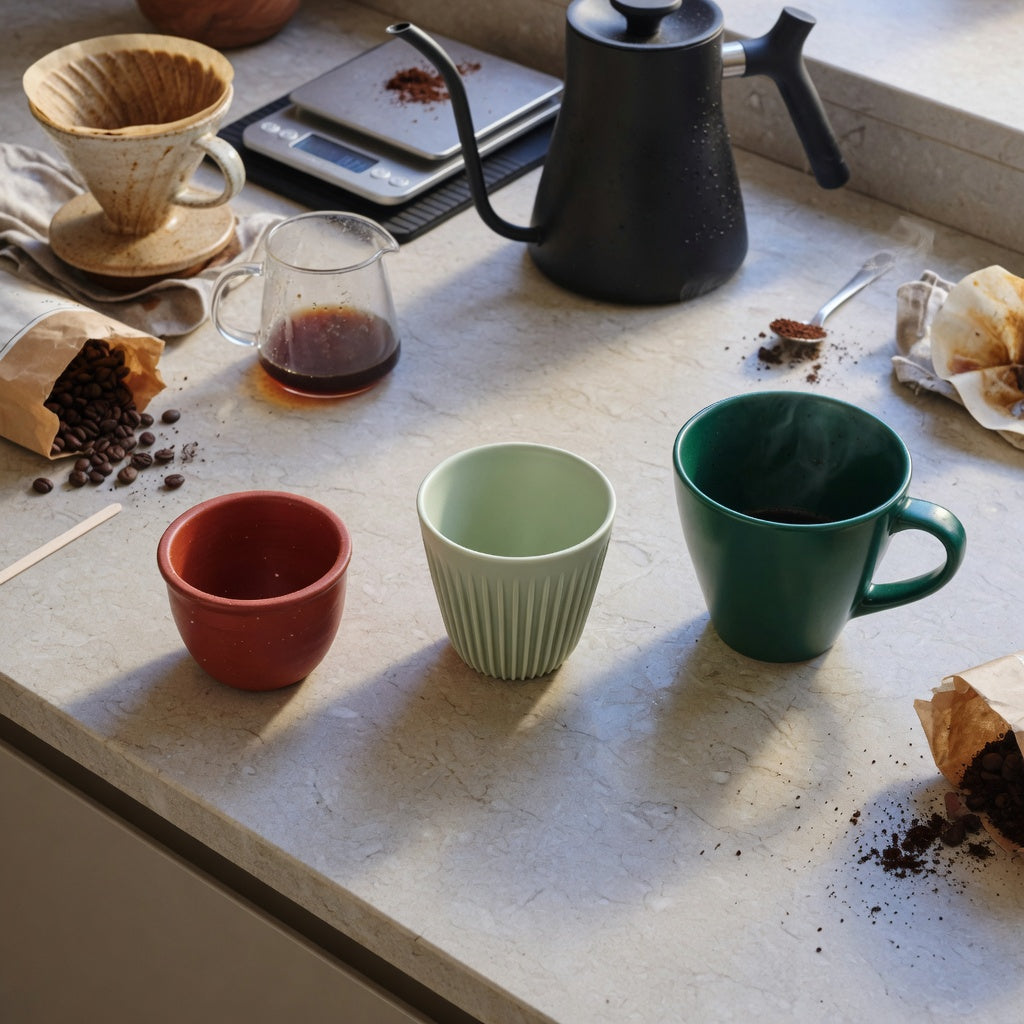
We compare three CoffeifyMug options: the Retro coffee tea cup at 170 ml, the Pleated coffee tea cup at 200 ml, and the Emerald coffee tea mug at 270 ml. In our store, we handle these as three distinct choices rather than interchangeable green cups. The comparison stays within facts we can support: listed capacity, visible shape, and the refill habit each capacity suits. You can also view them alongside other designs in our unique coffee mugs collection.
What does a green tea mug home coffee station product shortlist guide compare?
A useful shortlist separates the details shown in the listing from assumptions based on a photograph. For these three mugs, we use three filters:
- Listed capacity: 170 ml for Retro, 200 ml for Pleated, and 270 ml for Emerald.
- Visible shape: a classic rounded profile, a vertically pleated exterior, or a smoother and more open silhouette.
- Refill preference: smaller repeated pours, a middle-ground serving, or the greatest listed volume per fill among these options.
We do not treat capacity as an external dimension. A 270 ml listing does not tell you the mug's base width, overall height, or clearance under a brewer. We also do not assign origin, authenticity, heat-retention performance, or unlisted care and appliance compatibility. Those limits matter because a practical station choice needs to be based on information that can actually be checked.
170 ml, 200 ml, or 270 ml: which refill rhythm fits?
The three capacities are close enough to serve the same general green tea use, but the differences are large enough to affect daily rhythm. Pleated holds 30 ml more than Retro. Emerald holds 70 ml more than Pleated and 100 ml more than Retro. For the same total amount of tea and a similar fill level, the larger listed capacity can reduce the number of returns to the kettle.
| Mug | Listed capacity | Capacity relationship | Refill fit |
|---|---|---|---|
| Retro | 170 ml | 30 ml below Pleated | Deliberate smaller pours |
| Pleated | 200 ml | 30 ml above Retro and 70 ml below Emerald | Middle-ground refills |
| Emerald | 270 ml | 100 ml above Retro | Most listed volume per fill of the three |
Capacity should match what you actually pour, not an imagined ideal routine. If your usual serving is modest and you enjoy returning to the kettle, 170 ml may feel intentional. If interruptions break your concentration at a kitchen table or office desk, 270 ml gives you more listed capacity in one vessel. The 200 ml option makes sense when neither extreme describes your day.
Leave room for your own preferred fill level as well. A listed capacity is a comparison figure, not a promise that every shopper will fill a mug to the same point. Measuring one normal serving in a marked kitchen jug gives you better evidence than guessing from a product photo.
Rounded, pleated, or smoother: which shape suits your station?
Visible shape affects how a mug relates to the equipment and cups around it. Retro has the most traditional rounded cup profile of the three. Pleated is identified by its vertical ridges, making it a more visually distinct piece. Emerald has a smoother, more open silhouette that reads differently beside straight-sided scales, metal pitchers, and modern coffee tools.
Our team uses shape as a visual sorting cue, not as proof of performance. Pleats may help a green tea cup stand apart from the coffee cups in a shared cupboard, but appearance alone does not establish grip, durability, or cleaning ease. A smoother-looking exterior does not establish dishwasher suitability either. Those are separate questions that require current product or care information.
If your station uses matching, understated drinkware, compare the Retro and Emerald profiles first. If you want the tea cup to be easy to identify at a glance, Pleated provides the clearest visible contrast. This is a style decision, so compare the listing images with the pieces already on your counter rather than relying on a generic label such as modern or traditional.
Three station habits: which mug should you choose or skip?
Each recommendation below starts with a real use pattern, explains the relevant fit, and includes a clear reason to pass. This keeps the shortlist commercial without pretending one mug is best for every buyer.
Small tea pours between coffee prep: Retro 170 ml
Choose it when: You alternate between coffee preparation and short green tea pours, or you actively enjoy returning to the kettle. Retro has the lowest listed capacity in this group, and its rounded cup profile fits a shopper seeking a more traditional visual shape.
Skip it when: Refill frequency already irritates you or your measured serving is clearly above 170 ml. Its capacity is 100 ml below Emerald, which is a meaningful difference if your priority is keeping more tea in one cup.
Next step: Open the Retro 170 ml coffee tea cup page and compare its visible rounded profile with your existing cups. Check external measurements separately before assigning it a tight space.
A middle capacity with visible texture: Pleated 200 ml
Choose it when: You do not want the smallest or largest listed capacity and you like a mug that can be identified by its shape. Pleated sits 30 ml above Retro and 70 ml below Emerald. Its vertical ridges also make it visually distinct in a mixed coffee-and-tea setup.
Skip it when: You want a fully understated exterior or expect a major capacity increase over the 170 ml option. The extra 30 ml is a modest step, so shoppers seeking clearly fewer refills may prefer to compare Emerald instead.
Next step: Review the Pleated 200 ml coffee tea cup from several listing angles. The visible texture should be a deliberate choice, not a detail discovered after unboxing.
The highest listed capacity here: Emerald 270 ml
Choose it when: Your first filter is getting the greatest listed volume per fill among these three mugs. Emerald offers 270 ml, paired with a smoother and more open visible silhouette than the Pleated option.
Skip it when: You prefer intentionally small tea servings or want the lowest-capacity cup in the lineup. Do not select it solely because you assume capacity proves counter fit; this comparison does not provide the external dimensions needed to make that claim.
Next step: Inspect the Emerald 270 ml coffee tea mug and compare its profile with the exact place where it will sit. Confirm any dimension or care requirement from current product information before ordering.
How do you test counter fit without inventing dimensions?
We use a quick station check whenever listed capacity is available but full external measurements are not part of the comparison. It takes the decision out of abstract product language and puts it into the shopper's actual routine.
- Use the station during a normal morning. Place your current cup in the intended spot, lift the kettle, move the dripper, and open any nearby drawer or cupboard that could conflict with it.
- Measure the available zone. Record the maximum width, depth, and height your setup permits. Compare those numbers with current product information rather than estimating from capacity.
- Measure one normal serving. Use a marked measuring vessel to see how your usual pour relates to 170 ml, 200 ml, and 270 ml.
- Count your acceptable refills. Decide if another kettle trip feels like part of the tea ritual or an interruption.
- Choose the visual role. Decide if the mug should blend with existing cups or remain visibly distinct as the dedicated green tea option.
This process also prevents a common comparison error: asking one specification to answer two questions. Listed capacity helps with serving and refill preference. It does not confirm a mug's external footprint, storage clearance, or fit beneath an appliance.
Which needs fall outside this three-mug shortlist?
This shortlist cannot settle every purchasing requirement. It does not compare material, weight, exact external dimensions, handle clearance, included accessories, insulation, lids, or brewing performance. It also does not guarantee microwave or dishwasher suitability. If one of those details controls your decision, verify the current product listing or care information before buying.
A different drinkware style may suit you better if the mug must travel in a bag, remain covered near office electronics, fit beneath a specific appliance, or hold a substantially larger serving. Gift buyers should also avoid assuming that the 200 ml middle option is automatically safest. The recipient may strongly prefer repeated small pours, more volume per fill, a smooth profile, or visible texture.
Care requirements deserve their own check. Do not transfer dishwasher guidance from another mug merely because the two pieces look similar. Follow the information supplied for the specific product before its first wash, especially if automated dishwasher cycles are essential to your household routine.
A one-minute decision check before ordering
- Choose Retro 170 ml if smaller pours and a rounded profile match your routine.
- Choose Pleated 200 ml if you want the middle listed capacity and visible vertical texture.
- Choose Emerald 270 ml if the greatest listed capacity of these three matters most.
- Pause if you still need exact dimensions, material details, care confirmation, or appliance clearance.
- Compare your measured serving and available counter zone with current product information before checkout.
The point of this green tea mug home coffee station product shortlist guide is not to force a winner. It is to remove options that conflict with your refill habit or visual preference, leaving one or two products worth inspecting closely.
Frequently asked questions
What should a green tea mug home coffee station product shortlist guide compare?
It should compare details that affect the station routine and can be verified. This shortlist uses the listed 170 ml, 200 ml, and 270 ml capacities, each mug's visible shape, and the shopper's refill preference. It does not use unsupported origin, care, compatibility, or brewing claims.
Which mug should I choose if I want fewer refills?
Emerald has the highest listed capacity of these three at 270 ml, so it offers the most volume per fill within this shortlist. That can mean fewer refills for the same total amount of tea if you use a similar fill level. Confirm that 270 ml aligns with your measured serving rather than choosing by capacity alone.
Does the Emerald 270 ml capacity prove it takes more counter space?
No. Capacity measures internal volume, while counter fit depends on external width, depth, height, and shape. This guide does not provide those dimensions, so measure your available area and verify current product measurements separately.
Is the Pleated 200 ml cup automatically the best gift choice?
No single capacity is automatically safest for every recipient. Pleated occupies the middle position by listed volume and has visible vertical texture, but the recipient may prefer Retro's smaller capacity or Emerald's larger one. Ask about refill habits and style before relying on the middle number.
Can I assume these mugs are dishwasher or microwave compatible?
No compatibility assumption should be made from shape, color, or capacity. This article does not assign dishwasher or microwave suitability to any of the three products. Check the current product details or supplied care instructions for the specific mug before use.
Your next step: Choose your refill lane first: 170 ml, 200 ml, or 270 ml. Then compare the corresponding product shape with your measured counter space, or review all three through the CoffeifyMug unique coffee mugs collection with your measurements beside you.
More from our blog
Read more
Apple Cider Mug Home Coffee Station Product Shortlist Guide
Compare The Gradient and The Flow at 400 ml with The Rock at 480 ml. This practical shortlist uses serving size, handle clearance, ceramic care, and honest skip reasons to match a mug to a working ...
Read more
Coffee Mugs Unique Shape Home Coffee Station: Practical Buying Checklist
A measurement-led checklist for matching handbag, rhombus, and ball-handled mugs to a home coffee station. Compare footprint, grip, listed capacity, care, storage, and gift fit without assuming bre...
Read more
Leave a comment
This site is protected by hCaptcha and the hCaptcha Privacy Policy and Terms of Service apply.