
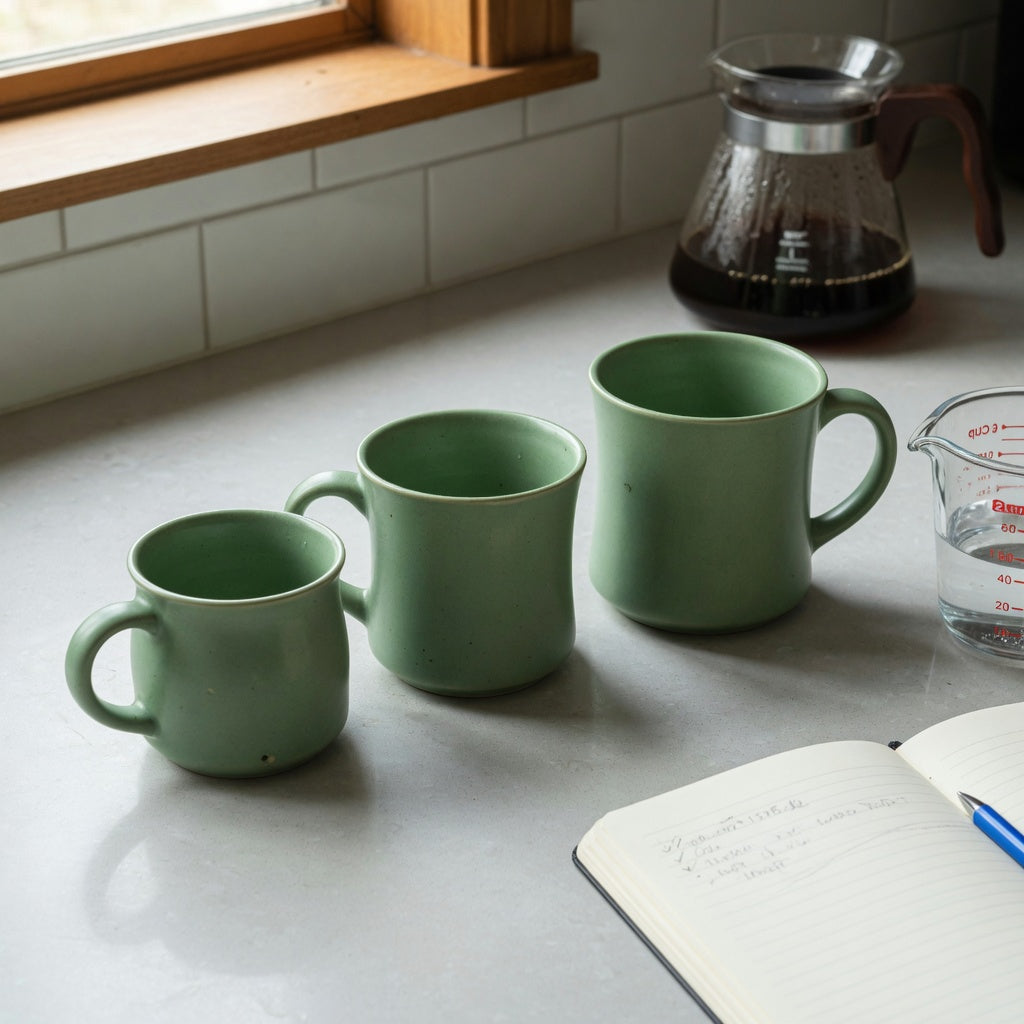
Green Ceramic Coffee Mugs Size Decision Guide: 400 to 480 ml
Reading time: about 10 minutes
A 480 ml mug can look only slightly larger than a 400 ml mug in a product photo, yet it offers 80 ml more listed capacity. That difference may reduce refills during a long desk session, or it may leave you carrying more drink than you normally finish. This green ceramic coffee mugs size decision guide compares the current 400, 440, and 480 ml options around actual pours, additions, carrying, storage, and care.
In our store, size questions are rarely solved by calling one mug small and another large. We ask shoppers to measure the finished drink they make at home, including milk, cream, or ice, and then leave enough headroom to carry it without filling to the rim. That produces a more useful answer than applying an invented coffee or tea serving standard.
The capacities discussed here come from the current green ceramic options represented by the linked listings. You can start with the Emerald Coffee Tea Mug product page, then compare its specifications and photography with the wider unique coffee mugs collection.
Product names and listed capacities are product-specific facts. The use cases below are general buying guidance, not performance claims. Confirm the exact capacity, outer measurements, care directions, included pieces, and availability on the individual product page before ordering.
Green ceramic coffee mugs size decision guide: what changes at each capacity?
The capacity steps are straightforward: 440 ml adds 40 ml over 400 ml, and 480 ml adds another 40 ml. Across the full range, the difference is 80 ml. The right question is not which number looks more generous; it is whether that extra volume solves a problem in your routine.
| Listed capacity | Practical reason to choose it | Trade-off to check |
|---|---|---|
| 400 ml | Your measured finished pour fits with comfortable carrying headroom. | Regular ice, milk, or larger pours may lead to earlier refills. |
| 440 ml | A 400 ml mug feels tight, but you rarely use the full room of a 480 ml mug. | The extra 40 ml may be too small a change if your usual drink already exceeds 440 ml. |
| 480 ml | You regularly need more room for liquid, ice, or additions and prefer fewer refills. | Filling it means carrying more liquid, and a smaller pour may leave substantial unused space. |
Capacity describes internal volume. It does not establish the mug's outer height, body diameter, handle projection, empty weight, dishwasher fit, or heat retention. Those details depend on the individual design and must be checked separately.
Is 400 ml practical for shorter pours and repeat refills?
The 400 ml option makes sense when your complete drink fits below that limit without crowding the rim. It is especially practical for someone who would rather make a fresh second pour than keep one larger drink on an office desk for a long stretch.
- Your measured coffee or tea, including additions, remains comfortably below 400 ml.
- You normally refill during breakfast, work breaks, or trips through the kitchen.
- You want to limit the maximum amount of liquid carried from room to room.
- Ice is occasional, so it does not regularly displace a large part of the available volume.
The limitation is simple: 400 ml is not a good fit if your usual finished drink already approaches that amount. Filling close to the rim reduces carrying headroom, and adding ice or milk can force you to reduce the main pour. Also, do not assume the 400 ml mug has the smallest outside footprint or the lowest empty weight. Shape and ceramic thickness can change both.
If this capacity matches your measured routine, confirm which current green listing shows 400 ml rather than choosing by appearance alone. A shopper who likes the Emerald design, for example, should verify the listed capacity and care details on the Emerald mug listing before treating it as the smaller option.
Does 440 ml solve a real problem, or just split the difference?
The 440 ml capacity is the mathematical midpoint of the current range, but that does not make it a universal default. It is useful when 400 ml leaves too little headroom after milk or another addition, while 480 ml would add space you do not expect to use.
This middle option is most convincing when an extra 40 ml fixes a specific issue. Perhaps your current pour sits uncomfortably close to the rim, or a few ice cubes leave less liquid room than you want. If your usual drink is already well below 400 ml, moving to 440 ml adds little practical value. If it regularly exceeds 440 ml, the middle size only postpones the same capacity problem.
Shoppers interested in the wave-themed appearance can review the Green Waves Coffee Tea Mug and confirm whether its current listed capacity matches this middle-ground decision. The style should be the second filter, after volume.
When does 480 ml earn the extra 80 ml?
The 480 ml option earns its place when the full 80 ml increase over 400 ml is genuinely useful. Measure first. If your finished drink regularly needs the room, the larger capacity is a practical choice rather than unused volume.
- Your normal pour exceeds what fits comfortably in 400 or 440 ml after leaving carrying headroom.
- You use ice often enough that displacement is part of the everyday calculation.
- You add milk or another ingredient after pouring the main drink.
- You work through long calls, reading sessions, or focused tasks and want fewer trips back to the kitchen.
A full 480 ml mug has the potential to hold more liquid than a full 400 ml mug, so carrying load is part of the trade-off. Empty mug weight can still vary by design, and capacity alone cannot tell you how a handle will feel. The larger size is also a poor choice for someone who regularly leaves half a drink behind or dislikes holding a fuller ceramic vessel.
Extra capacity does not prove that a drink will remain hot longer. It also does not solve a need for a sealed lid or spill-resistant bag transport. For commuting, rough outdoor use, or carrying a drink inside a backpack, a purpose-built travel vessel is a better category than an open ceramic mug.
Can capacity predict desk, cupboard, or dishwasher fit?
No. This is one of the most common errors we see in size comparisons. A 400 ml rounded mug can occupy more shelf width than a taller design with greater capacity, while a prominent handle can determine whether two mugs sit comfortably beside each other. Capacity and external dimensions answer different questions.
- Measure a mug that already fits your space. Record its outer height, widest body diameter, and total width including the handle.
- Measure the target location, including cupboard shelf clearance, space beside the keyboard, and clearance under a brewer if that is where the mug will be filled.
- Compare those numbers with the product-page dimensions when they are supplied. If a required measurement is not shown, do not infer it from capacity or photography.
- Read the exact care statement on the listing. Ceramic material alone does not establish microwave or dishwasher suitability for every finish and construction.
When our team handles ceramic mugs, we visually check the rim, both handle attachment points, and the foot ring. A chip at the drinking edge, a hairline crack around a handle join, or a base that rocks on a flat counter deserves attention before regular use. These are standard inspection points for ceramic drinkware, not claims that a particular CoffeifyMug product has those defects.
If the specific listing permits dishwasher use, give the mug enough rack clearance that the rim and handle cannot knock against nearby dishes during the cycle. That spacing matters more than whether the capacity label says 400 or 480 ml.
Which current green mug page should you open after choosing capacity?
Choose the volume first, then use design as the tie-breaker. This keeps an attractive shape or finish from pushing you toward a capacity that creates daily refills or unused space.
- You prefer the Emerald appearance: open the Emerald Coffee Tea Mug, verify its currently listed capacity, and continue only if that number matches your measured pour.
- You are drawn to the wave-led design: review the photography and specifications for the Green Waves Coffee Tea Mug, then check the care directions before ordering.
- You prefer a rounded profile: use the Round Coffee Tea Mug page to confirm its capacity and exterior details rather than assuming round means smaller or larger.
- You are flexible about the exact silhouette: compare the current choices in the collection of unique coffee mugs and eliminate any listing that does not fit your capacity range.
This conditional approach keeps the recommendation honest: the product fits only when both its listed specifications and its appearance suit the buyer's situation.
How should gift buyers choose without knowing the recipient's pour?
Gift buyers often know the recipient's color preference but not the volume of the mug used every morning. At a gift unboxing, the green ceramic finish and shape create the first impression. Capacity determines whether the mug remains useful after that first day.
- Check the mug the recipient uses most often and estimate its capacity with a measuring jug if you have access to it.
- Notice whether they make one large drink or return to the kitchen for smaller refills.
- Consider regular additions such as milk and ice, which occupy part of the listed volume.
- Look at cupboard height and desk space instead of assuming the smaller capacity has smaller outer dimensions.
If you have no usable clues, 440 ml is a defensible midpoint because it sits 40 ml from either end of the current range. Treat that as a fallback, not a claim that 440 ml is the standard gift size. If the recipient carries drinks in a bag, needs a lid, or wants impact-resistant outdoor drinkware, these ceramic mug options are not the right gift category.
Frequently asked questions
How do I use this green ceramic coffee mugs size decision guide if I add milk or ice?
Measure the complete drink, not just the initial coffee or tea pour. Add the usual milk and ice, note the final volume, and leave room below the rim for carrying; move from 400 to 440 or 480 ml only if the measured result requires it.
Is a 400 ml green ceramic mug too small for coffee and tea?
There is no universal coffee or tea volume that makes 400 ml too small. It works when your finished drink fits comfortably and you do not mind refilling; it is less practical when additions regularly push the drink close to the rim.
Does a 480 ml ceramic mug keep coffee hot longer than a 400 ml mug?
Capacity alone does not establish heat retention. Mug shape, wall construction, starting temperature, room conditions, and the amount poured all affect cooling, so do not choose 480 ml based on an unlisted thermal-performance assumption.
Are larger ceramic mugs always heavier?
A 480 ml mug can carry more liquid when filled than a 400 ml mug, but its empty weight cannot be inferred from capacity alone. Ceramic thickness, handle construction, and overall shape differ, so check any listed weight and dimensions on the specific product page.
Can these green ceramic mugs go in a dishwasher or microwave?
Follow the care directions on the exact product listing you plan to buy. Do not assume dishwasher or microwave suitability from the word ceramic alone, because finishes and construction details can require different care.
Your next step: Fill your current mug with the drink you actually make, transfer it to a marked measuring jug, and record the finished volume. Add carrying headroom, measure the storage space, and then compare those results with the specifications in the unique coffee mugs collection.
More from our blog
Read more
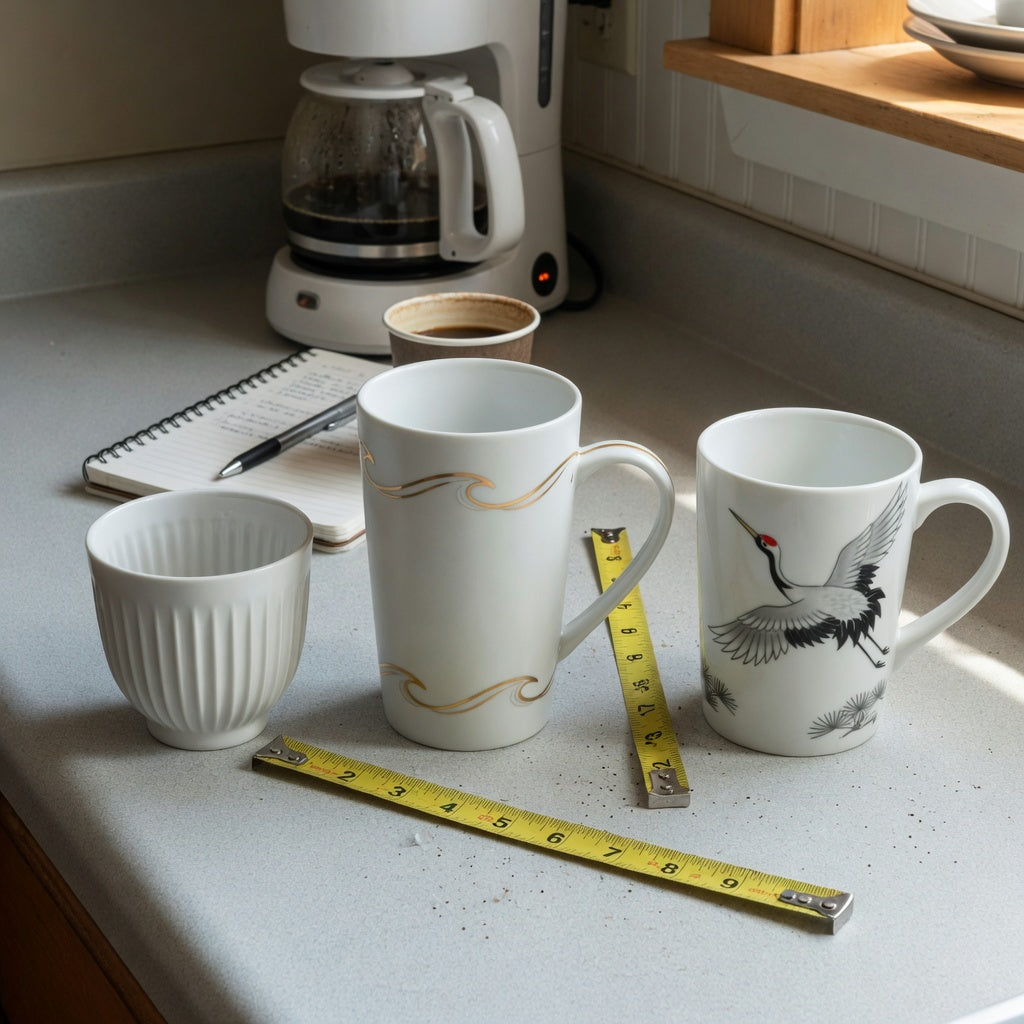
Plain White Ceramic Coffee Mugs Size Decision Guide: Small vs Large
Compare smaller, taller, and design-led white ceramic mugs by listed capacity, physical fit, filled weight, care needs, and daily setting. This guide also explains when decorative details make anot...
Read more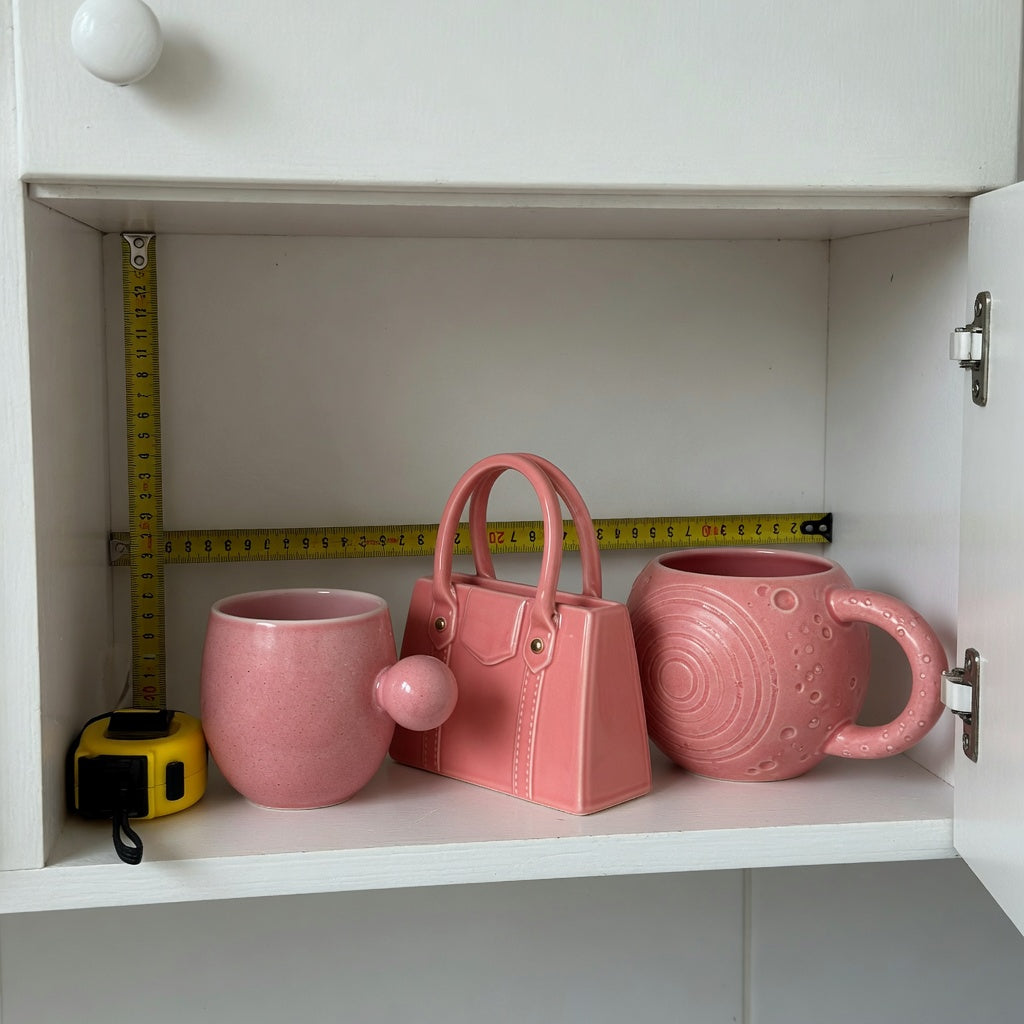
Pink Ceramic Coffee Mug Storage Fit Guide: Compare 3 Shapes
Compare the current pink Ball Handle (250 ml), Handbag (310 ml), and Planet (380 ml) mugs by visible shape, handle form, and the shelf measurements that matter. This guide also explains what capaci...
Read more
Leave a comment
This site is protected by hCaptcha and the hCaptcha Privacy Policy and Terms of Service apply.