
Geometric Coffee Mug Home Coffee Station Product Shortlist Guide: 3 Fits
Reading time: about 10 minutes
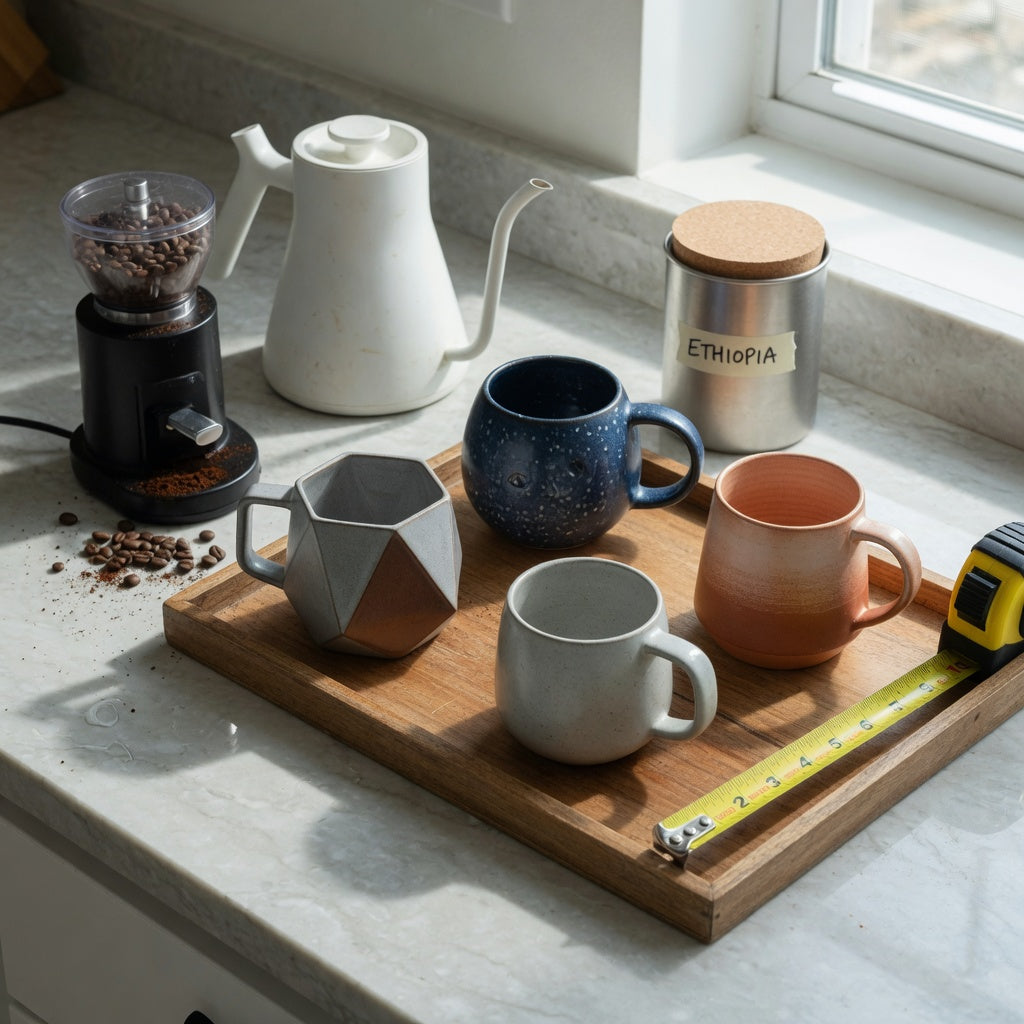
A mug can look perfectly proportioned on a product page and still be awkward in the narrow strip between a grinder, kettle, and coffee canister. In our store, we usually hear about that mismatch after the station is already crowded: the handle reaches into nearby equipment space, the mug cannot be lifted cleanly from under a shelf, or its form adds more visual clutter than the shopper expected. This geometric coffee mug home coffee station product shortlist guide starts with the counter you actually use, then narrows three ceramic options by visible form, current listed capacity, storage, and care.
Our team treats shape as an observable comparison point, not a performance promise. A faceted body does not automatically guarantee better stability, and a rounded body does not prove a more comfortable grip. Product dimensions, handle clearance, capacity, and stated care directions decide those questions. Keeping that boundary clear produces a shortlist that is useful at checkout and after the first week of daily coffee.
Counter width, handle swing, and shelf clearance come before color
We evaluate a home coffee station with a dry setup before focusing on the mug's finish. Put the brewer, grinder, scale, canisters, and spoon cup in their normal positions. The leftover rectangle is the mug's real home, and it is often smaller than the open counter suggested in a room photo.
- Measure the clear counter width and depth to the nearest 1/4 inch or 5 mm after the brewing equipment is in place.
- Measure from the counter or tray to the shelf above it. Include the straight-up space needed to lift the mug rather than comparing mug height alone.
- Rotate a mug you already own into your usual handle position. Note how much side clearance your fingers and knuckles require without moving nearby equipment.
- Write down your normal serving volume in ounces or milliliters and compare it with the capacity currently listed on each product page.
Capacity tells you how much liquid the mug is intended to hold; it does not establish the external diameter, base size, wall thickness, or handle opening. If a needed exterior measurement is not listed, compare the product with a mug that already fits or contact our store before ordering. Do not convert a capacity number into a guessed footprint.
Geometric coffee mug home coffee station product shortlist guide by scenario
The three options below are ceramic mugs with different visible forms. Confirm the current capacity, variant, and care information on the linked product page before checkout because those listing details are more reliable than a generalized assumption about the shape.
| Option | Visible current form | Material and capacity check | Best-fit station | Reason to remove it |
|---|---|---|---|---|
| Rhombus | Angular, faceted profile | Ceramic; compare the current listed capacity with your usual serving and verify exterior clearance | Open shelf or uncluttered counter that needs one strong geometric focal point | Stacked storage or tight side clearance is more important than display presence |
| Planet | Rounded, sphere-led profile | Ceramic; verify the current listed capacity and handle opening for your routine | Visually busy station that already contains rounded equipment and canisters | You want pronounced angular contrast or need an exterior size that has not been confirmed |
| Gradient | Tapered profile with a visible color transition | Ceramic; confirm the current listed capacity and selected color or variant | Neutral or mixed-material station where color helps organize the setup | Strict monochrome matching or easy replacement with identical-looking pieces is the priority |
Use this geometric coffee mug home coffee station product shortlist guide as an elimination table. It does not claim that one form holds heat longer, fits a particular appliance, or survives more dishwasher cycles. Those conclusions would require specifications or testing beyond visible shape, material, and listed product information.
Rhombus for an open shelf that needs angular contrast
Reader situation: Your mug stays on an open shelf or tray, the surrounding setup is relatively simple, and you want the mug to act as a visible focal point. Why it fits: The current Rhombus form has a clearly faceted, angular profile that separates it visually from cylindrical canisters and rounded equipment. Review the current capacity and product details on the Rhombus coffee and tea mug page before adding it to the shortlist.
- Choose it: The station has enough open space around the mug for the angular outline to remain visible.
- Choose it: You store one mug at a time rather than relying on a tightly packed stack.
- Skip it: Corners would touch a shelf upright, another ceramic mug, or nearby equipment in the intended position.
- Skip it: You need confirmed stackability or a compact exterior footprint that is not stated on the product page.
The trade-off is visual strength versus flexibility. A faceted mug can give a plain station a deliberate anchor, but the same profile may make an already busy counter feel more crowded. We do not infer base stability or chip resistance from the Rhombus name; check the actual product information and keep visible corners separated from other ceramic pieces during storage.
Planet for a busy counter built around rounded forms
Reader situation: Your station already includes rounded canisters, a curved kettle body, or other circular forms, and you want the mug to feel integrated rather than sharply contrasted. Why it fits: The visible Planet profile is softer and more rounded than the Rhombus option. Check its current material, capacity, and available selection on the Planet coffee and tea mug page.
- Choose it: You prefer a cohesive group of curved shapes on a compact station.
- Choose it: The mug regularly moves from the coffee station to a breakfast table or office desk, and the listed handle dimensions suit your hand.
- Skip it: You want the mug to provide a strong angular focal point on an open shelf.
- Skip it: You are assuming that a rounded appearance means a smaller footprint or easier grip without checking dimensions.
We see shoppers confuse visual softness with ergonomic certainty. They are not the same. For a mug carried from the kitchen to a desk, handle opening, total filled weight, and listed capacity matter more than the name or silhouette. Use the rounded form as a style filter, then verify the practical details.
Gradient for a neutral station where color organizes the shelf
Reader situation: The station uses neutral counters, wood, metal, or plain ceramic, and you want one visible color transition to identify the everyday mug. Why it fits: The current Gradient mug combines a tapered geometric profile with a noticeable shift in color. The Gradient coffee and tea mug page is the next step for confirming current capacity, material, and selection.
- Choose it: The mug remains on display and the gradient helps it stand apart from plain canisters or cups.
- Choose it: You prefer shape and color contrast without the pronounced corners of the Rhombus option.
- Skip it: Your station follows a strict single-color scheme or you need future pieces to look identical.
- Skip it: You are relying on the taper to save counter space without checking the mug's maximum exterior width.
A taper can look lighter on a shelf, but appearance does not prove a smaller footprint or greater capacity. Measure against the widest point listed, if that measurement is available. Color is also central to this option, so it is not the practical choice for a shopper who wants the mug to disappear into an all-white or all-black setup.
Listed capacity, ceramic care, and unboxing checks
Material stays consistent at ceramic across this three-item shortlist, but ceramic alone does not establish dishwasher, microwave, freezer, or oven suitability. Follow the current product listing and the directions supplied with the mug. If a use is not stated, do not assume approval from the material name.
Match listed capacity to the drink you actually make. A person who drinks straight coffee needs less headroom than someone adding milk, foam, or ice. Do not plan to fill a mug to the rim during daily use, and do not assume two mugs with the same listed capacity have the same exterior shape.
- At unboxing, inspect the rim and interior under side light for chips, cracks, or unexpectedly sharp glaze spots.
- Look closely at both handle-to-body joints. A visible hairline crack is a reason to pause before washing or filling the mug.
- Set the empty mug on a dry, level counter and check for noticeable rocking.
- Follow the stated care directions. For hand washing, use a soft, non-abrasive sponge and keep the ceramic from striking the faucet, sink wall, or other dishes.
- If dishwasher use is expressly permitted, load the mug with enough separation that its rim, handle, and visible corners cannot knock against another item during the cycle.
- Dry the mug before returning it to a crowded shelf, and avoid storing ceramic pieces with their rims or handles pressing against each other.
These checks catch common defect modes before a mug enters daily use. If you find a chip, crack, sharp spot, or clear base wobble at unboxing, contact our store before using it. A shape-led purchase still has to pass the same basic inspection as a plain everyday cup.
Gift unboxings and office desks need a stricter fit test
A geometric mug can make a strong gift unboxing, but appearance is only the first filter. Ask about the recipient's usual drink volume, cabinet or shelf height, color preferences, and reliance on a dishwasher. Rhombus is the display-led option, Planet suits someone who favors rounded forms, and Gradient makes sense only when its visible color treatment works with the recipient's station.
For an office desk, measure the available space beside the keyboard, monitor stand, and notebook. None of these options should be treated as a lidded travel mug, insulated tumbler, or drop-resistant outdoor cup unless the product listing explicitly states those features. A different style is more appropriate for commuting, camping, or a desk where spill protection is the first requirement.
Which option should leave the shortlist first?
- Remove Rhombus first if you lack open side clearance, store mugs in a tight stack, or do not want an angular focal point.
- Remove Planet first if the goal is pronounced geometric contrast rather than a rounded visual match.
- Remove Gradient first if exact color matching, monochrome styling, or easy replacement is more important than a visible color transition.
- Remove all three if your non-negotiables are a lid, insulation, outdoor drop resistance, or confirmed stackability that is not present in the listing.
If none survives those filters, browse our unique coffee mugs for home coffee stations and restart with the same measurements. Keep a mug that already fits in the intended spot while comparing. Looking at the old mug from the front and above gives you a more reliable reference than judging a new silhouette in isolation.
Frequently asked questions
How do I use the geometric coffee mug home coffee station product shortlist guide on a small counter?
Measure the remaining width and depth after your brewing equipment is in its normal position, then check overhead lift space and handle swing. Remove any option whose exterior clearance cannot be confirmed. Do not use listed capacity as a substitute for outside dimensions.
Are the Rhombus, Planet, and Gradient mugs dishwasher safe?
Use the current product listing and supplied care directions as the authority for each mug. Ceramic material alone does not confirm dishwasher approval. If dishwasher use is permitted, separate the mug from other items so the rim, handle, and geometric details do not make contact during a cycle.
Does a higher listed capacity always require more counter space?
No. Capacity describes liquid volume, while counter fit depends on exterior width, depth, height, base, and handle projection. Two ceramic mugs can list a similar capacity and still occupy different spaces because their walls and visible forms differ.
Which geometric coffee mug is best for an office desk?
Start with the option whose listed capacity and handle opening match your daily drink, then compare its exterior footprint with the free desk area. Planet provides a rounded visual option, Rhombus gives stronger angular contrast, and Gradient adds visible color. Choose a different mug category if you need a lid, insulation, or spill resistance.
What should I check before buying a geometric coffee mug as a gift?
Confirm the recipient's normal serving size, available shelf height, preferred colors, and care routine. Use a photo of their coffee station to decide if angular, rounded, or tapered geometry fits best. Then open the relevant product page and compare the remaining candidate with our broader unique coffee mug collection before ordering.
More from our blog
Read more

Ceramic Mug With Wooden Handle: Replacement Purchase Shortlist
Use the mug you are replacing as the filter. This shortlist compares two current ceramic mugs with wooden handles by listed capacity, visible vessel form, and handle shape, with clear reasons to ch...
Read more
White & Gold Coffee Mug Home Coffee Station Practical Purchase Checklist
Measure shelf clearance, tray space, pour volume, pattern density, and care requirements before comparing the Tall and Kio forms. This checklist separates verified listing details from assumptions ...
Read more
Leave a comment
This site is protected by hCaptcha and the hCaptcha Privacy Policy and Terms of Service apply.