
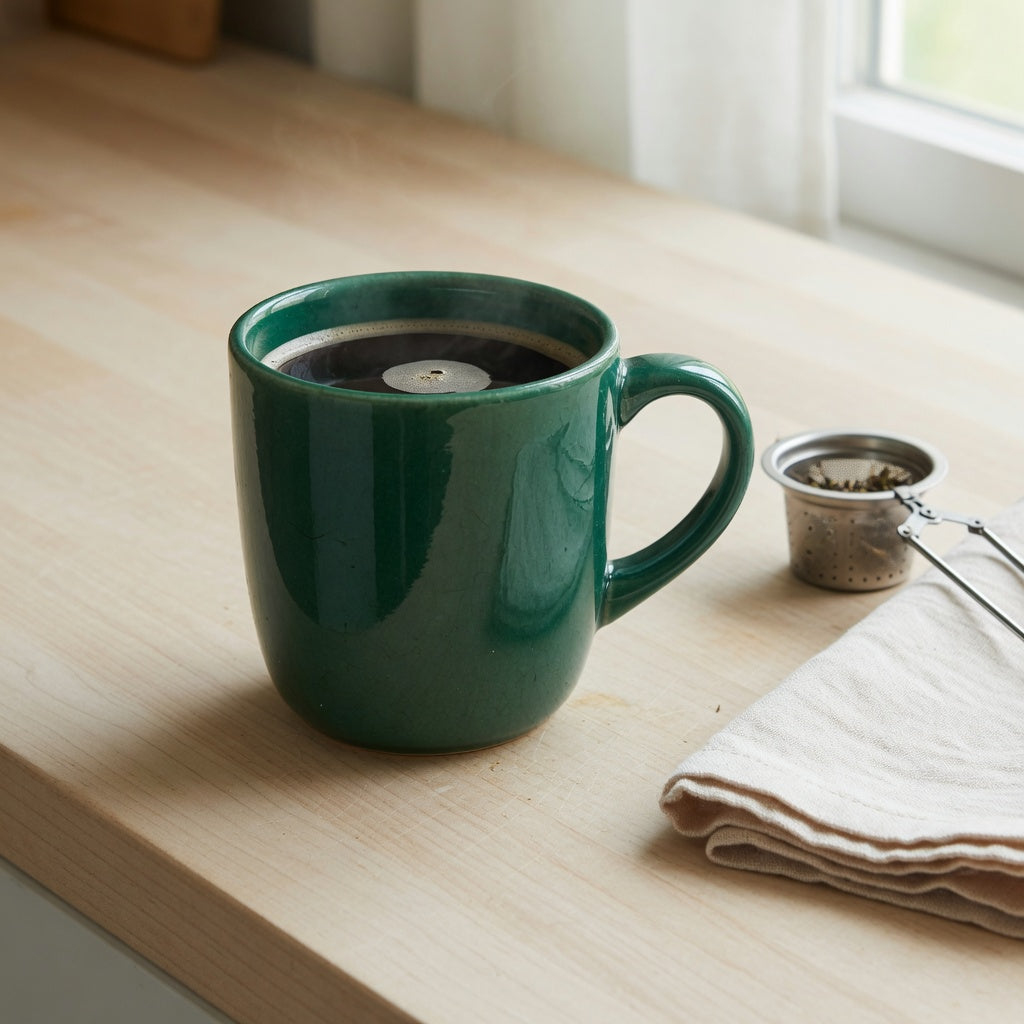
Emerald Ceramic Coffee Tea Mug: 7 Details to Compare
Reading time: about 10 minutes
A mug can look perfect in a product photo and still feel wrong on the first Monday morning. The handle pinches when it is full, the rim feels bulky, or the emerald finish turns almost forest green under office lights. An emerald ceramic coffee tea mug is a color-led purchase, but daily fit depends on capacity, grip, glaze condition, and care labels.
We sell and handle this category, so we compare the details that show up at kitchen counters, office desks, and gift unboxings. Keep the current Emerald Coffee Tea Mug product listing open as you read. Exact capacity, dimensions, material wording, and appliance compatibility must come from that listing. If the page does not state something, we treat it as unknown rather than infer it from a photo.
1. Which emerald shade will you see away from the product photo?
Emerald is not one standardized ceramic color. A mug can read as jewel green in daylight, blue-green beside a cool monitor, or deep forest under warm kitchen bulbs. Screen brightness, camera white balance, surface gloss, and the thickness of the visible finish can all change how the color appears.
Read the listing for words such as handmade, reactive glaze, or natural variation. Those descriptions prepare you for differences between pieces. If the listing does not use them, do not assume the mug is handmade or that every color variation is intentional.
- Compare several photos: Check the exterior wall, interior, rim, handle, and base rather than judging one front-facing image.
- Separate variation from damage: Color pooling around a contour may be part of the finish. A sharp glaze bead on the drinking rim, a chip, or exposed ceramic inside the cup needs attention.
- Think about matching: A varied finish can make a single mug feel distinctive, but it may frustrate someone building a uniform set.
If character matters more than identical color, compare the emerald option with other unique coffee mugs in our collection. Shoppers who need four nearly identical cups should prioritize listings that explicitly describe a consistent factory finish or matched set.
2. Does the capacity match the drink you actually pour?
Capacity is easy to underestimate because listing photos rarely show scale. Across this category, buyers commonly compare mugs in the 8 to 16 oz range. That is a meaningful spread: a compact tea pour and a large coffee with milk do not need the same cup.
Measure the mug you already reach for. Fill it to your normal level, then pour that drink into a measuring cup. This gives you a more useful target than choosing by appearance. Also check whether a stated capacity appears to be a comfortable serving volume or a measurement taken close to the rim. You need headspace to carry hot coffee without spilling it across a desk.
| Drinking routine | Useful comparison range | Detail to check |
|---|---|---|
| Short tea or smaller coffee | About 8 to 10 oz | Enough room for an infuser, tea bag, or splash of milk |
| Everyday home or office coffee | About 10 to 12 oz | Comfortable grip and room below the rim |
| Large coffee with milk | About 14 to 16 oz | Filled weight, handle leverage, and cabinet clearance |
| Regular pours above 16 oz | A larger mug category | Do not rely on a photo to make a smaller cup seem suitable |
Ceramic is also an umbrella term. If a listing specifies stoneware or porcelain, use that information alongside the dimensions. Stoneware mugs often have a thicker, more substantial build, while porcelain is often thinner and lighter. Those are tendencies, not guarantees; wall thickness, handle design, and overall shape can matter more than the material label.
Before ordering the emerald mug, compare its currently listed capacity and measurements with your own cup. A beautiful finish cannot correct a size mismatch.
3. Will the rim, handle, and base still feel good at 8 a.m.?
The parts that affect daily comfort are rarely the parts shoppers notice first. In our experience, grip problems appear once the mug is full: a small handle presses into the knuckles, a top-heavy shape twists in the hand, or a narrow base feels risky beside a laptop.
Use this inspection list when the mug arrives:
- Run a clean finger gently around the drinking rim. It should feel smooth, without a sharp drip, chip, or rough patch.
- Look at both handle joins. Contact the seller if you see a crack running from the handle into the body.
- Set the empty mug on a flat counter. A stable mug should not rock under light pressure.
- Check the foot ring before placing it on finished wood. An unglazed or rough foot may need a coaster.
- Inspect the interior under direct light. Deep pinholes, blisters, exposed ceramic, or a chipped food-contact surface are reasons to pause before use.
Handle comfort is personal, so compare the opening with a favorite mug if dimensions are provided. A one-finger handle can suit a small tea cup. A heavier mug is usually easier to control when the handle allows a more secure grip. Buyers with limited hand strength should give this detail more weight than color.
4. What does food-safe glaze language actually prove?
A ceramic mug intended for coffee or tea should be presented as food-contact drinkware. Color alone cannot establish whether a glaze is suitable, and an attractive green finish does not replace clear safety information from the seller or manufacturer.
The FDA explains that improperly made lead-glazed pottery can release lead into food or drink, with acidic contents creating particular concern. Its action level for extractable lead in cups and mugs is 0.5 micrograms per milliliter in any one of six tested units under the specified testing approach. Ceramicware above applicable action levels may be considered adulterated under federal law.
This does not mean an emerald color is inherently unsafe. It means buyers should avoid using color, price, or appearance as a substitute for food-use labeling. The FDA also advises caution with traditional or handmade-looking pottery from unknown sources when it has not been manufactured and fired properly by a reliable producer.
- Look for explicit food-use or food-contact wording on the current listing.
- Do not treat the word ceramic as a safety certification.
- Do not assume that a general lead-free statement means independent test reports are available. If testing matters to your decision, ask what documentation supports the claim.
- Avoid using unknown decorative, vintage, cracked, or badly worn pottery for regular hot coffee or tea.
If a safety detail is missing, the honest answer is unknown. Our team would rather have a shopper ask before ordering than turn an unstated feature into an assumption.
5. Is the emerald ceramic coffee tea mug microwave and dishwasher safe?
Only the current product listing can answer that for the specific mug. Microwave-safe and dishwasher-safe are separate claims, and one does not automatically include the other.
Dishwasher compatibility addresses repeated exposure to detergent, heat, water, and contact with the rack or other dishes. Microwave compatibility also depends on the ceramic body, decoration, and how the piece responds while heating. Metallic rims, lusters, or accents require particular caution and should never be microwaved unless the manufacturer explicitly says they are suitable.
- You reheat coffee at work: Require a clear microwave-safe statement. An unlabeled mug is a poor fit for that routine.
- You run every cup through the dishwasher: Confirm dishwasher compatibility rather than assuming all glazed ceramic can handle the cycle.
- You care most about the surface appearance: Hand-washing reduces contact with racks and heavy utensils, even if dishwasher use is permitted.
- The listing is silent: Hand-wash the mug and reheat your drink in a vessel with confirmed microwave instructions.
Microwave-safe also does not promise that the handle will remain cool. Use normal care when removing any heated ceramic. Check the exact appliance wording on the product page before making it your office reheating mug.
6. How do you protect the emerald finish from chips, haze, and stains?
Most visible wear starts at contact points: the drinking rim, handle joins, interior floor, and foot. A spoon dropped into the cup, a heavy bowl touching it in the dishwasher, or another mug stacked directly on the rim can leave damage that ordinary coffee use would not cause.
Follow the product's stated care instructions first. These general steps also reduce avoidable wear:
- Inspect the mug before its first use and wash away packing dust with mild dish soap and a soft sponge.
- Rinse out coffee or tea after drinking instead of leaving residue to dry inside the cup.
- Avoid abrasive powders or scouring pads on a glossy surface. They can change how the finish reflects light.
- Do not move a very cold mug directly into extreme heat. Sudden temperature changes can stress ceramic, especially if it is already chipped or cracked.
- Place a soft separator between stacked mugs if a rough foot ring would rest on the glazed interior below.
A dull-looking area is not always faded color. It may be dried coffee film, mineral residue, or fine surface scratching. Start with gentle cleaning rather than aggressive scrubbing. There is no category-wide long-term durability result that applies to every emerald glaze, so we do not promise that all green finishes will age the same way through years of dishwasher cycles.
Fine lines confined to the glaze are often called crazing. If new lines appear, begin holding stains, or cross the drinking surface, stop using the mug and contact the seller for product-specific guidance. A chipped rim or damaged interior should not remain in daily rotation.
7. Is this the right choice for a desk, a gift, or a matching set?
An emerald ceramic mug fits best where color and tactile ceramic matter more than drop resistance. It is a sensible candidate for a kitchen counter or office desk once the listed size, grip, and care instructions match the user's routine.
| Buyer situation | Fit and trade-off | Next step |
|---|---|---|
| One personal mug for home or a desk | Good fit if the capacity and appliance labels suit the daily pour | Review the current emerald mug details |
| Gift for someone who likes distinctive green drinkware | Strong visual choice, but confirm their preferred size and tolerance for finish variation | Inspect the mug before wrapping, especially the rim, handle joins, and base |
| Perfectly matched set | Potential mismatch if the listing discloses handmade or glaze variation | Ask about matching or compare the unique coffee mug collection |
| Backpack, commute, or car cup holder | Poor fit if you need leak resistance, drop resistance, or a lid | Choose a purpose-built travel vessel instead |
| Very large morning drink | Poor fit if the listed capacity is below your measured pour | Compare larger dimensions rather than overfilling a smaller cup |
This category is not ideal for someone who regularly drops cups, needs a sealed lid, wants exact batch matching, or microwaves drinks without checking labels. It is better suited to a shopper who appreciates ceramic, wants emerald color in a visible place, and is willing to follow the stated care instructions.
Frequently asked questions
Is an emerald ceramic coffee tea mug safe for hot coffee and tea?
Use it for hot drinks only when the current listing identifies it as drinkware or suitable for food contact, and inspect the interior before use. Emerald color by itself proves neither safety nor risk. Avoid using unknown decorative, vintage, chipped, or heavily worn ceramic for regular hot coffee and tea.
Why can a ceramic mug be dishwasher safe but not microwave safe?
The two appliances place different demands on a mug. A dishwasher label relates to detergent, water, heat, and repeated rack contact, while microwave suitability also depends on the ceramic body and decoration. Follow both labels separately and never infer microwave compatibility from dishwasher compatibility.
Why does an emerald mug look darker in person than online?
Lighting, screen settings, camera white balance, and surface gloss can shift the visible green. Warm bulbs often make deep greens appear darker, while daylight may reveal cooler tones. If the listing mentions handmade or reactive-glaze variation, expect individual pieces to differ within the seller's stated range.
What mug size works for both coffee and tea?
A 10 to 12 oz range is a practical comparison point for many everyday pours, but your existing routine is the better guide. Measure the drink you normally make and allow headspace below the rim. Tea drinkers using an infuser should also check the opening diameter and interior room.
What should I check before ordering from CoffeifyMug?
Confirm the listed capacity, dimensions, food-use wording, microwave and dishwasher instructions, and any notice about finish variation. Start with the Emerald Coffee Tea Mug if those details fit your routine. If the size, shape, or care requirements do not line up, compare the unique coffee mug collection before choosing.
More from our blog
Read more
Gift Ideas Landscape Coffee Mug: Compare Size, Print, and Care
Compare scenic mug formats, 11 oz versus 15 oz capacity, print placement, care claims, ceramic safety, and recipient routines. Includes clear cases where a travel mug is the better gift.
Read more
Elk and Moon Ceramic Mug: Compare Size, Care, and Use
Compare the current 420 ml ceramic mug against your usual pour, hand size, care routine, desk setup, and gift recipient. This guide also identifies the dishwasher, microwave, dimension, and testing...
Read more
Leave a comment
This site is protected by hCaptcha and the hCaptcha Privacy Policy and Terms of Service apply.