
Cute Ceramic Coffee Mugs Buying Priorities: Size, Shape, Space
Reading time: about 10 minutes
A mug can look perfectly sized beside a coffee maker in a product photo, then catch under the spout, crowd the coaster, or refuse to fit on the usual cabinet shelf. We see the same mismatch at desks: the drink volume is right, but a wide handle competes with the mouse and notebook. That is why our cute ceramic coffee mugs buying priorities start with the pour, the mug's maximum dimensions, and the space where it will actually live.
Style still matters. A handbag silhouette, pleated surface, or gradient finish can be the reason a shopper chooses one ceramic mug over another. It just should not conceal a poor routine match. In our store, we compare the listed product details with real placement constraints before treating any design as a daily-use recommendation.
Product fact boundary: The linked product pages are the source of truth for current capacity, dimensions, variants, and care instructions. Product-specific comments below are limited to the ceramic material, product names, visible forms, and details presented on those pages. If a measurement is not listed, we do not estimate it from a photograph.
Cute ceramic coffee mugs buying priorities: what should come first?
Start with the parts of the routine that cannot easily change. Your cabinet height, coffee-maker clearance, and available desk area are fixed. The amount you normally pour is usually consistent too. Color and decorative detail should be considered after a mug clears those practical gates.
- Working capacity: Match the mug to the coffee or tea you actually prepare, including milk, foam, or ice and the empty space you leave below the rim.
- Maximum shape: Check the tallest and widest points, including the handle and any sculpted decoration. Base diameter alone does not describe a novelty mug's footprint.
- Placement space: Measure the opening under the brewer, the cabinet shelf, the dishwasher rack, and the clear area beside a keyboard or sink.
- Care demand: Compare a smooth glazed exterior with pleats, recesses, or sculpted edges that may need more deliberate washing and inspection.
- Use frequency: Decide whether the mug will be used every morning, kept at a desk, brought out for guests, or given as a design-led gift.
This order keeps the cute ceramic coffee mugs buying priorities tied to buyer decisions rather than appearance alone. A statement mug can be an excellent choice, but only for a shopper whose routine accommodates the statement-making shape.
Listed capacity versus your pour: where do milk, ice, and headspace go?
Capacity numbers are useful only if you compare them with your own drink. Fill the mug you currently use to your normal stopping point, then pour that water into a marked measuring jug. Record the result in ounces or milliliters. This gives you a working volume based on your routine instead of a vague idea of a small, regular, or large mug.
Leave room for the way you prepare the drink. Milk, creamer, and foam require space above the coffee. Ice occupies part of an iced drink's listed volume, while tea drinkers may want enough room to remove an infuser without spilling over the rim. A capacity stated on a product page may be a nominal volume; unless the page defines how it was measured, do not assume it represents a comfortable fill level for carrying the mug.
We also avoid transferring a capacity from one decorative mug to another just because their photos appear similar in height. Ceramic wall thickness, taper, rim width, and interior shape can change usable volume. Open the individual page for the mug and use its own listed information. If capacity is absent or unclear, that option is a weaker fit for a shopper with a strict single-serve setting or a precisely measured tea recipe.
Handbag, pleated, or gradient: which shape fits the space you have?
Handling decorative ceramic mugs makes one point especially clear: the base is not always the widest part. Measure the full silhouette. For brewer clearance, measure vertically from the drip tray in its normal position to the underside of the spout. For cabinet storage, include any shelf lip and the space needed to lift the mug in and out without striking the shelf above.
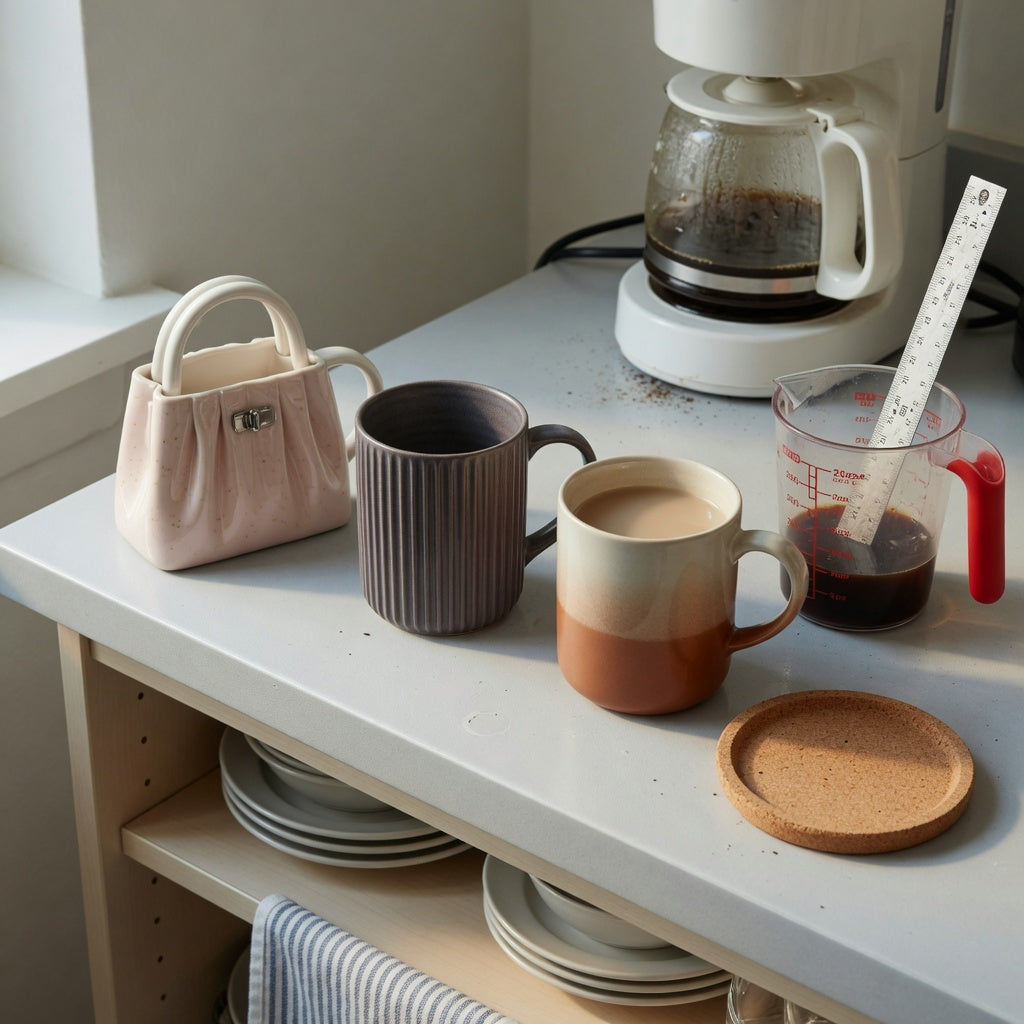
The visible handbag form of the Handbag Coffee Tea Mug makes the silhouette the main feature. It is a logical product page to inspect for a gift recipient who likes novelty tableware or for a mug displayed on an open shelf. The trade-off is that a sculpted outline should never be assumed to fit the same space as a straight-sided mug. Compare its maximum listed height and width, when provided, with the narrowest part of the intended storage area.
The Pleated Coffee Tea Cup places its visual detail across the exterior surface. That suits someone who wants texture without choosing a recognizable object-shaped mug. Pleats also create recesses, so inspect them after coffee drips or dishwasher cycles rather than assuming a quick exterior wipe reached every area.
The Gradient Coffee Tea Mug is the first page we would check for a shopper who prefers a color transition over the handbag form or pleated texture. Its visible profile is less sculptural than the handbag design, but that does not guarantee appliance, coaster, or shelf fit. Confirm the listing's current dimensions and capacity before treating it as the compact option.
- Novelty-first shape: Start with the handbag design, then verify its maximum dimensions.
- Surface texture: Start with the pleated cup, then decide whether the exterior detail suits your cleaning routine.
- Color-led styling: Start with the gradient mug, then confirm that its listed volume and profile fit the intended space.
Desk, compact cabinet, or gift box: which current product fits?
A useful recommendation connects a specific person and place to a product, while keeping unverified assumptions out of the decision. Here is how we would narrow the current options based on the visible design direction and the checks each buyer still needs to complete.
| Reader situation | First product to inspect | Why it belongs on the shortlist | What to verify before buying |
|---|---|---|---|
| A design-focused gift for someone with open shelving | Handbag Coffee Tea Mug | The recognizable handbag form gives the gift a clear visual identity at unboxing. | Listed capacity, maximum width and height, recipient's shelf space, and current care instructions. |
| A coffee or tea station where tactile detail matters | Pleated Coffee Tea Cup | The visible pleated exterior provides texture without relying on an object-shaped silhouette. | Listed volume, handle and rim clearance, and whether the care directions suit frequent use. |
| A work desk where color is preferred over a novelty form | Gradient Coffee Tea Mug | The gradient treatment supplies the decorative element while keeping attention on a more familiar mug profile. | Maximum footprint including the handle, coaster fit, capacity, and distance from the keyboard. |
| A small kitchen with non-negotiable measurements | Compare the full collection | A strict cabinet or brewer limit should control the selection instead of a style-first recommendation. | Only choose a listing whose stated dimensions and capacity satisfy your measurements. |
If one of these three directions does not satisfy your constraints, compare the broader collection of unique coffee mugs. Keep the same sequence: eliminate options that miss the required volume or dimensions, then compare shape, color, and surface detail among the remaining choices.
Ceramic, glaze, and dishwasher cycles: how much care will the mug need?
Ceramic is rigid and can chip when the rim or handle strikes a sink, tile counter, dishwasher tine, or another mug. Before first use and after a hard knock, inspect the rim, the junctions where the handle meets the body, and any raised decorative areas. Look for a chip, a hairline crack, or unexpected crazing, which appears as a fine network of lines in the glaze. A growing crack or leaking body is a reason to stop using the mug.
Do not infer dishwasher or microwave compatibility from the word ceramic. Follow the care instructions on the individual product page and for the selected variant. If dishwasher use is allowed, position the mug so it cannot knock against a plate or another cup during the cycle. For hand washing, use a soft sponge or brush and check sculpted edges and pleated recesses for dried coffee or tea residue.
Avoid abrupt temperature changes unless the product guidance specifically supports them. Moving very cold ceramic directly to an extremely hot fill can stress the material. This matters for anyone who stores a mug in a cold area, pre-chills it for iced coffee, or pours immediately after a hot dishwasher cycle.
- Smooth or color-led exterior: Better for a shopper who wants fewer contours to inspect during washing.
- Pleated exterior: Better for someone who values texture and accepts cleaning along the recesses.
- Sculpted silhouette: Better for careful handling, display, or gifting than for a crowded sink where pieces regularly knock together.
Where does each decorative style become the wrong choice?
The handbag mug is not the cautious choice for an unknown cabinet opening, tight brewer clearance, or a recipient who only uses straight-sided mugs. Its distinct shape is the reason to buy it, but that same feature requires a more careful space check.
The pleated cup is not ideal for a shopper whose top priority is the smoothest possible exterior or the quickest visual inspection after washing. The texture has aesthetic value; it also gives drips and residue more contours to follow. Do not assume it nests with other cups unless the product page explicitly shows or states that it does.
The gradient mug is not the strongest fit for a gift buyer seeking an object-shaped conversation piece. Its appeal is more color-led. It may be the more restrained design direction of the three, but its capacity and dimensions still need independent verification.
A different mug style is the better purchase if you need exact stackability, travel-safe construction, a sealed lid, or resistance to frequent drops. A decorative ceramic coffee mug should not be treated as a travel tumbler or an unbreakable vessel.
A two-minute counter-and-cabinet check before checkout
Use a tape measure, your current mug, and a measuring jug. This short check catches most mismatches that isolated product photos cannot show.
- Measure your normal drink volume, including milk or other additions and the headspace you prefer.
- Measure from the coffee maker's drip tray to the spout with the tray positioned as you normally use it.
- Measure the cabinet's usable height and width, including hinges, shelf lips, and room to grasp the handle.
- Mark the clear desk or counter footprint with paper, then check whether your coaster and the mug's full width will fit.
- Read the selected product page for current capacity, dimensions, variant information, and care directions.
- Choose the handbag, pleated, or gradient design only after it passes those fixed constraints.
If a listing does not provide a specification that your routine depends on, do not fill the gap with a guess based on photography. Continue comparing options until the available product details support the decision.
Frequently asked questions
What are the cute ceramic coffee mugs buying priorities for a small kitchen?
Start with working capacity, maximum height, full width including the handle, and the cabinet or counter space available. Then compare care needs and decorative style. In a small kitchen, an unverified novelty silhouette is a risk even if its base looks compact in a photo.
How do I compare listed mug capacity with the amount I actually drink?
Fill your current mug to your normal level and decant the water into a marked measuring jug. Add the room you usually need for milk, foam, an infuser, or ice. Compare that result with the capacity stated on the product page, without assuming the listed number represents a comfortable brim-free fill.
Will the Handbag Coffee Tea Mug fit under my single-serve coffee maker?
That depends on the mug's maximum height and the distance from your machine's drip tray to its spout. Use current dimensions from the product page when available and measure the machine in its normal setup. The handbag silhouette alone is not enough to confirm clearance.
Are pleated ceramic coffee cups harder to clean than smooth mugs?
Pleated surfaces have recesses that deserve attention after drips or repeated use. A soft brush or sponge can reach those contours, but the product page's care instructions should determine whether hand washing or dishwasher use is appropriate. Choose a smoother exterior if minimal cleaning effort is your first priority.
Should I choose a handbag, pleated, or gradient mug as a gift?
Choose the handbag style for a recipient who enjoys recognizable novelty forms and has room to store them, the pleated cup for someone who values exterior texture, or the gradient mug for a more color-led look. Confirm capacity, dimensions, and care on the linked product page first; if the recipient's routine is unclear, use the unique coffee mug collection to compare shapes before placing the order.
More from our blog
Read more
Oversized Ceramic Coffee Mugs Buying Priorities: Capacity, Shape & Fit
Compare listed capacity, visible shape, total width, brewer clearance, and filled weight before choosing an oversized ceramic mug. We map three current CoffeifyMug designs to specific desk, counter...
Read more
Dandelion Coffee Mug Buying Priorities: Capacity, Shape, Space
Compare the 400 ml Gradient and Flow with the 480 ml Rock through the priorities that matter after purchase: loaded handle feel, visible shape, desk footprint, cupboard clearance, and care. Each re...
Read more
Leave a comment
This site is protected by hCaptcha and the hCaptcha Privacy Policy and Terms of Service apply.