

Coffee Mugs With Big Handles for Desk Use: Capacity, Footprint, Fit
Reading time: about 11 minutes
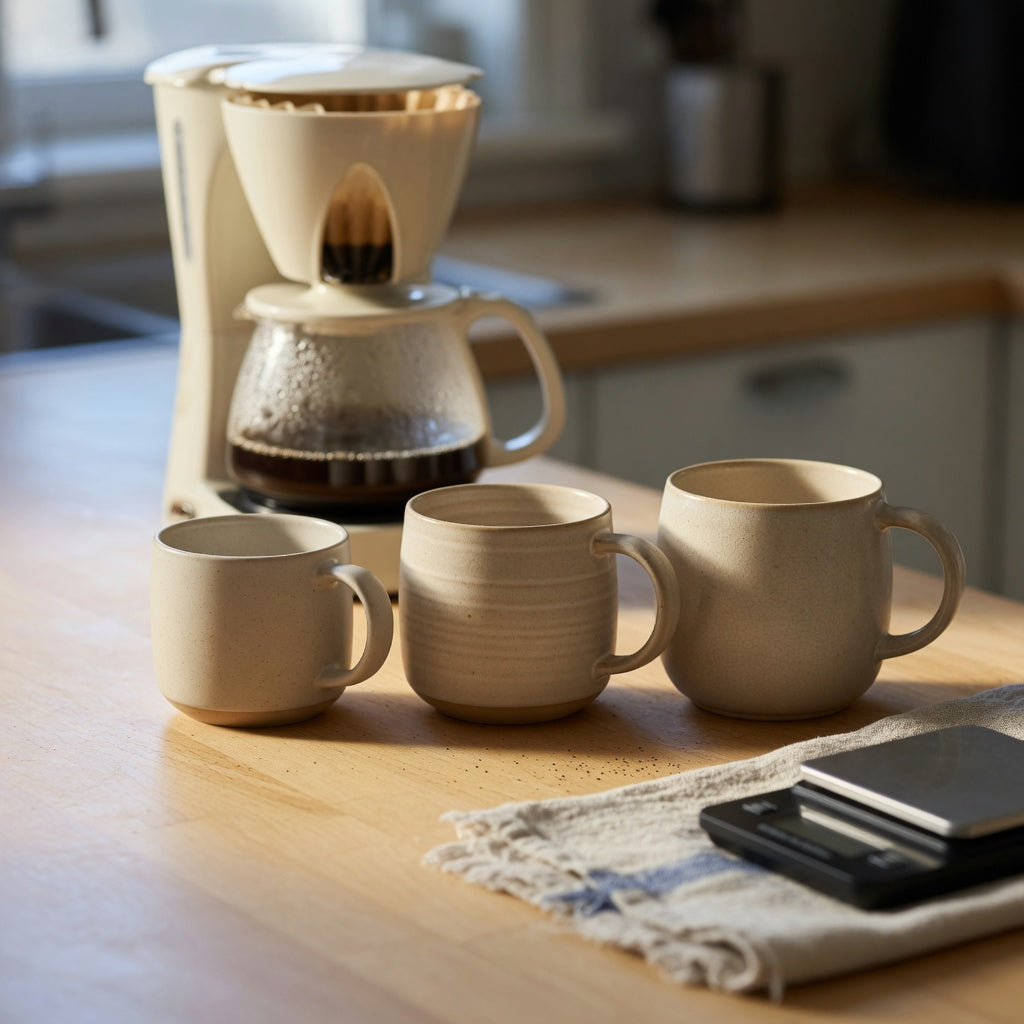
Three mugs sit on the desk across from ours: a 250 ml ball-grip, a 400 ml curve, and a 480 ml chunk. Only one of them gets refilled before lunch. That gap is the real story behind coffee mugs with big handles for desk use — the handle is what you notice in a product photo, but refill frequency, footprint beside the mouse, and the way a full cup hangs off your fingers decide whether a mug keeps its place.
We sell three single-handle mugs at 250 ml, 400 ml, and 480 ml, and the questions that reach our store inbox keep circling the same three numbers that almost never appear on a listing: interior handle clearance, outer footprint, and filled weight. Here is how we work through them, and how to match a mug to the desk you actually sit at.
Coffee mugs with big handles for desk use: three numbers the photos hide
“Big handle” is a photo caption, not a fit. At a workstation, three narrower measurements do the real work.
- Interior opening. The clear space inside the loop, as height × width or as area. This decides whether two, three, or four fingers pass through without pinching.
- Outer span. The distance from the outside of the handle to the far wall of the mug. This is the dimension that actually occupies desk space, and it is the one listings skip most often.
- Filled mass. Liquid is the heavy part. Water sits near one gram per millilitre, so a 480 ml mug carries roughly a pound of coffee before the mug itself is counted.
Those three fight each other. Widen the opening and the handle usually grows longer, which pushes the load further from your wrist. Raise the capacity and you add weight at the end of that longer lever. The comfortable middle is a loop your fingers enter cleanly, mounted close enough to the body that the cup still hangs level when you lift it one-handed over a keyboard.
A big handle is a clearance question, not a size adjective.
How much finger room does a “big” handle actually give you?
Published ergonomics work beats retail copy for numbers. A 2023 study of cups for care-home residents found participants preferred the lighter cups with larger handles, and identified cup mass, diameter, handle length, and handle opening area as the dimensions that matter most for people with reduced strength and dexterity. The best performers were lower-mass cups whose opening took at least two fingers while still letting the thumb and ring finger steady the cup and keeping the wrist from twisting.
The same paper, citing earlier hand-clearance work, put the minimum mean cross-sectional opening at roughly 650 mm² for two fingers and roughly 950 mm² for three. There is no equivalent published threshold for four fingers — which is exactly what most shoppers mean when they search for a large handle.
Two details matter more at a desk than at a dining table. First, mass is not a side issue: a big loop on a heavy cup can be harder to use than a smaller loop on a light one. Second, the gap between the inside of the loop and the hot wall is its own dimension. If your fingertips have to press against the body to keep the cup level, the handle is not doing its job. Test it that way — knuckles clear of the wall, not just fingertips inside the loop.
Handle-diameter research points the same direction. A biomechanics study of people with rheumatoid arthritis using spoons found larger handle diameters were associated with less finger-joint flexion than a slender standard handle, and most participants chose a 1.50-inch built-up handle over a 1.00-inch option. That is spoon research, not mug research, and we would rather flag the limit than oversell it — but the underlying principle, that a thicker grip reduces how tightly fingers must curl, carries across to drinkware.
What none of it tells you is whether a specific mug is big enough. Only the maker can answer that, which is why the checklist further down asks for a measurement rather than a description.
250 ml, 400 ml, or 480 ml — which capacity survives your afternoon?
Capacity is the easiest thing to compare and the easiest thing to overbuy. Our three sizes line up like this, with one honest caveat: a name describes a shape, not a guarantee about your hand.
| Mug | Listed capacity | What the name points to | Desk situation it suits | Confirm before buying |
|---|---|---|---|---|
| Ball Handled Coffee Tea Mug | 250 ml (about 8.5 fl oz) | A ball-style grip rather than a long C-loop | Tight keyboard zones, espresso or tea sessions, short breaks | How the grip suits your hand; interior clearance |
| The Flow Coffee Tea Mug | 400 ml (about 13.5 fl oz) | A flowing, contoured form | A standard workday and one large pour | Handle opening size; empty weight |
| The Rock Coffee Tea Mug | 480 ml (about 16 fl oz) | A chunkier, more substantial build | Long focus blocks and larger, stable desks | Filled weight; height under your brewer |
Start with our smallest option, the Ball Handled mug, if your desk is genuinely tight or you drink small, strong coffee. At 250 ml it holds a little over eight ounces — a cortado plus a splash, or a small pour-over. A ball grip changes the hold: instead of sliding fingers through a loop, you close your hand around the form. Some hands find that a relief first thing in the morning when knuckles are stiff. Others find it the wrong answer, because it asks for a firmer squeeze than a loop does. If your hands tire easily, weigh that trade-off before you commit.
The Flow, our 400 ml mid-size, is the one we point most desk workers to first. About 13.5 ounces is a typical large drip serving: enough to carry you through a call without a refill, small enough that a full cup still feels controllable. If you have unusually large hands, ask for the interior opening before you order — 400 ml says nothing about finger clearance.
The Rock, the 480 ml choice, goes to about 16 ounces in a more substantial form. It suits people who genuinely drink that much and resent the kitchen trip mid-task. Be honest about the trade: a full 480 ml is roughly a pound of liquid carried at the end of a handle. We would not suggest it as a first big-handle mug for anyone with wrist weakness, a lap tray, or a desk that already feels crowded. It is the mug for a generous desk and a confident grip. You can see all three shapes in our unique coffee mugs collection.
When one big loop is the wrong tool
If the goal is a comfortable hold rather than a bigger pour, a loop is only one answer. The alternatives are worth knowing because they solve problems a larger loop cannot.
- One large loop. Best when your fingers pass through cleanly and you lift with one hand. Weakest when the loop is wide but the mug is heavy — you get a long lever and a tighter grip than the size suggests.
- Two handles. Useful for two-handed carries and for hands that cannot close around a loop at all. The cost is real: one-handed sipping gets awkward and the mug takes more perimeter space.
- T-handle or rotating handle. Good for a vertical pinch grip and for anyone who finds a horizontal loop hard to enter. Usually the least stable option if you set a mug down hard or nudge it with an elbow.
Our lineup is built around the first option, so be clear about what it is not. If your hands cannot reliably close around a handle, or you need to carry a full mug two-handed across a room, a two-handle cup will serve you better than a bigger loop. A large single handle improves comfort; it does not fix grip weakness on its own.
Hot walls, handle seams, and the first dishwasher cycle
Most big-handle desk mugs are ceramic or stoneware, and those materials hold heat well — the point, until you notice where the heat goes. A thick body stays warm for a long while and stays hot against the wall too, which is why the standoff between the inside of the loop and the body matters more than overall handle size.
When we open a new carton of stock, the first thing our team inspects is the joint where the handle meets the wall. That seam is where a loop cracks if it is going to, and it is the part a product photo never shows. Run a thumb around it when your mug arrives; you want a smooth, continuous join with no visible gap or glaze pooling.
Care guidance is a listing fact, not a category rule. For our three mugs, check the current product page for material, microwave, and dishwasher instructions rather than assuming — we do not treat those details as interchangeable across sizes or finishes.
Two safety points are worth more than any generic care claim. First, metallic finishes and microwaves do not mix. In March 2024 the U.S. Consumer Product Safety Commission announced a recall of about 440,500 Starbucks-branded holiday gift-set mugs with a metallic coating, which the agency said can overheat or break when microwaved or filled with extremely hot liquid; CPSC recorded 12 incidents and 10 injuries, including burns, blisters, and one cut. The lesson is narrow: a metallic trim or luster glaze is the feature to keep out of the microwave, not ceramic as a material.
Second, lead is a manufacturing question. FDA guidance on lead-glazed traditional pottery explains that lead in glazes or decorations can leach into food and drink when a piece is not properly manufactured and fired, and that washing or boiling will not remove it. The same guidance describes everyday commercial factory ware as much less likely to be a problem than handmade, antique, damaged, or brightly orange, red, or yellow pieces of uncertain origin. FDA also states that ceramicware with extractable lead above its action levels should not be labeled “lead free” — so when you see that phrase on an imported mug, ask what testing stands behind it.
A desk-fit checklist you can run against any listing, ours included
- Ask for the opening, not the adjective. Request interior opening height and width, or the opening area, and compare it against the roughly 650 mm² and 950 mm² benchmarks for two and three fingers. A seller who cannot answer has told you something.
- Mark the footprint on your own desk. Set a coaster where the mug will live and check that the handle side clears your mouse arc and any loose cables.
- Measure height against your brewer and riser. A tall mug with a tall handle can foul a single-serve spout or a monitor shelf. Measure the gap before you buy, not after.
- Check the warmer plate. If you use a desktop warmer, compare the mug’s base diameter to the heated plate and make sure no part of the handle hangs below the foot.
- Plan for the full weight. If empty weight is not stated, treat it as unknown and use two hands for the first fill. A mug that feels fine empty can feel very different at 480 ml.
Frequently asked questions
Will coffee mugs with big handles for desk use actually fit four fingers?
Not automatically. Published ergonomics work gives minimum openings of about 650 mm² for two fingers and about 950 mm² for three, and there is no standard published figure for four. Most listings never state interior opening at all, so ask for the measurement or check the return policy before ordering.
Is a 480 ml mug too heavy to lift one-handed at a desk?
Check the listed empty weight first — it is often missing. What we can say is that 480 ml of coffee is roughly a pound of liquid on its own, carried at the end of a handle. If your wrists tire easily, fill it two-thirds and lift with two hands until you know how it behaves.
Can I microwave a big-handle mug?
Only if the maker’s listing says it is microwave safe. The documented hazard is a metallic coating or trim, which CPSC has linked to overheating and breakage in the microwave. Plain undecorated ceramic is a different case, but follow the stated guidance instead of assuming.
Do wide handles make a mug easier to knock over?
The handle does not raise the centre of gravity, but a loop that protrudes further creates a bigger target for a sweeping forearm, a mouse cable, or a headphone cord. Give a big-handle mug a coaster zone outside your active mouse area and it is far less likely to be clipped.
Should I pick a bigger loop or a two-handle mug for arthritic hands?
A bigger loop helps when your fingers pass through it and the mug is light enough to lift. If gripping rather than clearance is the problem, a two-handle or T-handle cup is often the better tool, even though it is less convenient for one-handed sipping. Our three mugs are single-handle designs, so they suit comfort and clearance better than severe grip weakness.
If you are replacing one mug, choose by capacity before handle size: 250 ml if you drink small and often, 400 ml for a standard desk day, 480 ml if avoiding refills is the point. Then verify the opening against your own hand. All three sit side by side if you browse the full unique coffee mugs lineup, and if long unbroken sessions are the goal, start with The Rock Coffee Tea Mug at 480 ml.
More from our blog
Read more
Large Round Coffee Mugs Comparison: Which Option Fits Your Routine?
A routine-first look at our three rounded mugs — The Flow 400 ml, Morning and Night 440 ml, and The Rock 480 ml — including the brewer-clearance, filled-weight, cooling, and glaze checks that actua...
Read more
Latte Mugs Tall for Desk Use: Capacity, Footprint, and Fit
A desk mug has to survive keyboard space, handle reach, and your actual pour volume. We compare our 400 ml, 440 ml, and 480 ml mugs by capacity, then list the measurements that decide whether a tal...
Read more
Leave a comment
This site is protected by hCaptcha and the hCaptcha Privacy Policy and Terms of Service apply.