
Coffee Mug Hooks: Fit, Materials, and What Actually Works
Reading time: about 9 minutes
A hook rail looks tidy right up until a thick handle misses the hook and the mug swings into the cabinet door. That is why we always look at the mug first. If you like a handled cup with some personality, compare our Christmas Coffee Tea Mug and Green Waves Coffee Tea Mug against the rest of our collection before you pick a hook layout.
In our store, we see the best results when the mug, the cabinet, and the hook all match in plain practical ways. A good setup keeps cups off the counter, stays out of the way of doors and hands, and does not turn into a daily balancing act. If you are using coffee mug hooks for a kitchen, office nook, or gift display, the details below are the ones that matter.
What should coffee mug hooks do in a real kitchen?
At the simplest level, coffee mug hooks should hold a mug securely, make it easy to grab one-handed, and leave enough room so the cup does not knock into the backsplash or cabinet face. That sounds basic, but it is where most poor setups fail. The hook is not just for storage. It also changes how fast a mug is taken down, dried, and put away.
We have found that the best setups solve three everyday problems:
- They free up cabinet space that would otherwise get crowded by stacked mugs.
- They keep a daily mug visible, which makes morning use faster.
- They make it easier to air-dry a mug after hand washing without balancing it on a towel.
That said, coffee mug hooks are not the answer for every kitchen. If your mugs are oversized, unusually heavy, or have wide handles that sit far from the body, a hook rail can feel awkward. If you are storing a full set of matching mugs for formal display, open shelving may look cleaner. If you want a deeper fit breakdown, our Coffee Mug Hooks Under Cabinet: Fit, Materials, and Buyer's Guide covers the cabinet-side questions we ask before recommending a layout.
Which materials and finishes hold up best?
The material matters more than most buyers expect. The same hook shape can feel solid or annoying depending on the metal, coating, and mount. In practice, we look for a finish that resists chips and a body that does not flex when a mug is removed with one hand.
| Hook style | Best use | Trade-off |
|---|---|---|
| Stainless steel | Daily-use kitchens that need easy wiping and a clean look | Can look utilitarian if you want a warmer display |
| Coated steel | Cabinet rails where finish consistency matters | Coatings can chip if mugs are dragged on and off |
| Wood with metal pegs | Display-forward kitchens and coffee stations | Less forgiving if the mug is heavy or the install is uneven |
| Adhesive-backed hooks | Light-duty use, rentals, and temporary setups | Not a strong choice for textured cabinet bottoms or heavier mugs |
A few defect modes show up again and again. Coatings chip at the tip if mugs are yanked off at an angle. Screw-mounted rails strip if the pilot holes are too loose or the cabinet material is weak. Adhesive units fail fastest when they are stuck to dusty, oily, or slightly textured surfaces. None of those are hard to avoid, but they do matter if you are buying for daily use rather than decoration.
If you are deciding between an open hook style and a more traditional mug size guide, the details in 10 oz Coffee Mug: Size, Fit, and What to Check Before You Buy and 11 oz Coffee Mug: Size, Fit, and What to Check Before You Buy are useful because hook fit is often a mug-size problem first, and a hardware problem second.
How do you check fit before you buy?
Fit is the part buyers skip and then regret. The good news is that you only need a few measurements before ordering. We recommend checking the cabinet bottom, the handle opening, and the way the mug hangs when it is actually loaded.
- Measure the clearance under the cabinet where the hooks will hang.
- Measure the inside depth of the hook and compare it with the mug handle thickness.
- Check how far the mug body sits from the wall so it does not hit the backsplash.
- Look at the mug weight and wall thickness, especially for thicker ceramic pieces.
- Make sure the hook spacing leaves enough room for your hand to lift the mug out cleanly.
That last point is where a lot of people get tripped up. A mug may technically hang from a hook and still be annoying to use every day. If the handle barely fits, the mug twists when you remove it. If the hook is too shallow, the mug swings. If the hook is too deep, the mug body sits too close to the cabinet face and can chip over time.
Our practical rule: if the mug needs a two-handed rescue during setup, the hook is probably the wrong match for that mug.
If you want a more detailed buying checklist, our Coffee Mug Hooks Under Cabinet: What to Check Before You Buy lays out the same points in a faster format for shoppers who want a quick yes-or-no answer.
Which mug shapes actually hang well?
Not every mug behaves the same on a hook. Straight-sided ceramic mugs are usually easy. Taller mugs with slim handles are often fine too. The harder cases are the ones with chunky handles, irregular shapes, or decorative details that move the balance point outward.
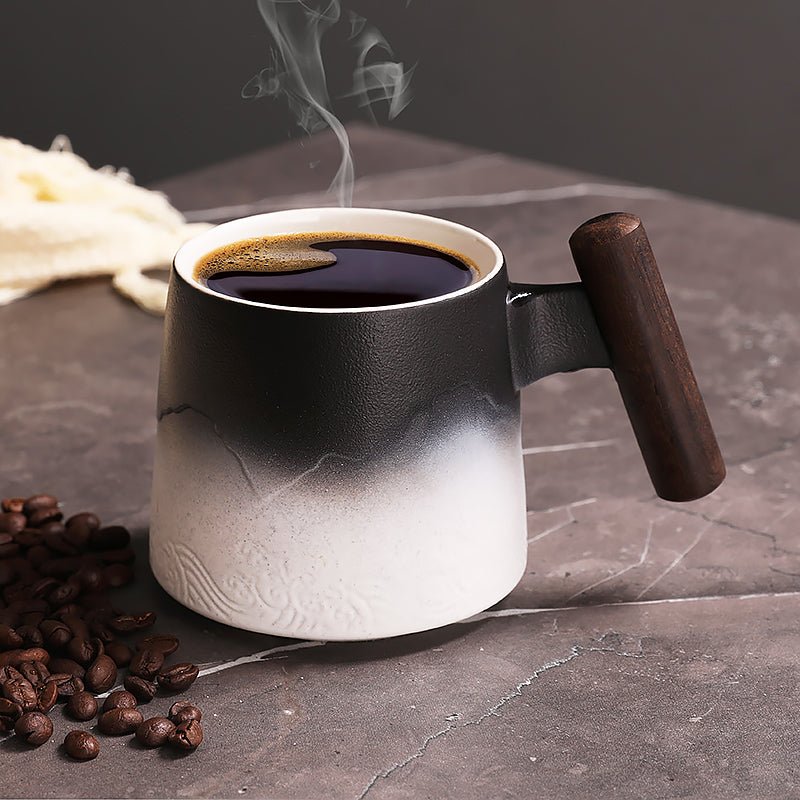
A mug like our Mountain Sea II Coffee Tea Mug with Wooden Handle is a good example of why shape matters. The handle feel, weight balance, and visual profile are different from a standard all-ceramic mug. That can be attractive on a hook rail, but it also means the hook depth and spacing need a closer look.
For day-to-day use, these mug types usually pair best with coffee mug hooks:
- 11 oz and 12 oz handled mugs with a clean, rounded handle opening.
- Standard ceramic mugs with balanced weight and a flat base.
- Display mugs that you reach for often but do not stack with the rest of the set.
These mug types are usually a worse fit:
- Very large soup-style mugs that sit too far from the cabinet.
- Mugs with handles that are too thick for the hook lip.
- Travel cups and insulated tumblers without a true hanging handle.
If you are shopping by use case rather than by look, the full collection is a better place to compare styles than choosing a hook setup first and hoping every mug works with it.
What usually goes wrong during installation?
Most bad installs are not dramatic. They are small issues that become annoying after a week of use. The mug scrapes the cabinet door. The hook row is too close together. The adhesive slowly loosens because the surface was not fully clean. The screws are fine, but the rail sits slightly crooked, so the mugs all lean the same way.
We also see a common pattern in kitchens that get a lot of steam. The hooks are mounted correctly, but the owner never wipes the rail dry after dishwashing or kettle use. Over time, the finish dulls or spots, especially on coated metal. The fix is simple: dry the hardware after a humid cooking session and do a quick monthly check for loosened screws or adhesive lift.
Use this quick install checklist:
- Clean and dry the mounting surface fully before attaching anything.
- Check cabinet-door clearance with an empty mug before loading the rail.
- Leave enough space between hooks for the mugs you actually use, not just the smallest ones in the drawer.
- Test one mug at a time before filling the whole row.
- Recheck the mount after the first few days of use, especially on adhesive setups.
For buyers who want the more cautious version of that checklist, Coffee Mug Hooks: What to Check Before You Buy is the shortest path through the practical questions.
Which setup makes sense for kitchens, offices, and gifts?
The right answer changes with the room. A small apartment kitchen usually needs storage efficiency first. An office coffee station needs quick access and a clean visual line. A gift setup needs the mug and hardware to look intentional the moment the box is opened.
Here is how we would match them in practice:
- Apartment kitchen: choose a simple screw-mounted rail if you use the mugs daily and want less counter clutter.
- Office desk or break room: choose a finish that wipes clean easily and does not clash with appliances or shelving.
- Gift display: use a single row with some visual spacing so the mugs look curated instead of crowded.
- Rental space: consider a lighter-duty setup only if the mugs are not heavy and the surface is smooth and compatible.
This is also where trade-offs matter. Coffee mug hooks are not the best choice if you need to store very fragile mugs that you rarely use. They are also not ideal if you want every cup hidden behind a cabinet door. For those cases, closed storage is simpler and safer. Hooks make the most sense when access matters and the mug shape cooperates.
Frequently asked questions
Do coffee mug hooks work with 11 oz mugs?
Usually, yes, if the handle opening is generous and the mug body does not hit the cabinet face. The exact fit depends more on the handle shape and hook depth than the ounce size alone. A standard 11 oz mug can hang well, but a bulky handle can make it awkward.
Can I use adhesive coffee mug hooks under painted cabinets?
You can, but only if the surface is smooth, fully cleaned, and the mugs are light enough for that style of mount. Adhesive is much less forgiving on textured, dusty, or slightly oily cabinet bottoms. For daily use, a screw-mounted rail is usually the safer choice.
What material is best for coffee mug hooks in a kitchen?
Stainless steel and coated steel are the most practical choices for everyday kitchen use. They wipe down easily and handle routine use better than decorative finishes that chip or stain. If you want a warmer visual look, wood can work, but it needs more careful matching to the mug weight and cabinet layout.
How much space do I need under the cabinet?
You need enough clearance for the mug to hang without hitting the backsplash, cabinet face, or the counter area below. The exact number depends on the mug height and the hook drop, so measure the actual mug you plan to use rather than guessing from the box. If the mug swings when you lift it, the setup is probably too tight.
Are coffee mug hooks safe for heavy ceramic mugs?
They can be, if the hook is sturdy and the mount is secure, but heavy mugs are where weak hardware shows its limits. If the hook flexes, the coating chips, or the screw mount feels loose, move to a stronger setup. For oversized or unusually thick mugs, closed storage may be the better option.
If you are ready to compare actual mug shapes against a hook setup, start with the measurements above, then browse our collection and pick the mugs you would realistically hang every day. The fastest way to avoid a bad buy is to match the hook to the mug you already own, not the other way around.
Read more

Espresso Coffee Mug Sets for Daily Use, Gifts, and Small Kitchens
Compare espresso coffee mug sets by size, handle comfort, stability, and style so you do not end up with cups that look good but sip poorly. We cover the trade-offs we check in our store and point ...
Read more
Ohio State Coffee Mug Buying Guide: Size, Fit, and Gift Picks
A practical guide to choosing an Ohio State coffee mug by size, shape, and everyday fit. We compare daily-use trade-offs, gift value, and the mug styles we carry in our store.
Read more
Leave a comment
This site is protected by hCaptcha and the hCaptcha Privacy Policy and Terms of Service apply.