

Ceramic Tea Mug Buying Priorities: Capacity, Shape, and Space
Reading time: about 8 minutes
A 400 ml mug sounds noticeably larger than a 390 ml mug until you measure the difference: 10 ml is about two teaspoons. Using the US fluid-ounce conversion, 12 oz is about 355 ml, so the step from 12 oz to 400 ml is roughly 45 ml, or about three tablespoons. Those gaps matter only if they match the amount you actually pour. Practical ceramic tea mug buying priorities start there, then move to body shape, handle form, and the clear space beside your keyboard or under your cupboard shelf.
At CoffeifyMug, we compare our current listings only on facts we can stand behind: ceramic material, listed capacity, visible body form, and visible handle shape. We handle this category, and we know that similar volume does not guarantee a similar experience in the hand or on the desk. We also know a product photo cannot prove exact dimensions, empty weight, grip clearance, care compatibility, or thermal performance. This comparison keeps those limits clear while helping you narrow the right mug for ordinary coffee or tea serving.
Does 12 oz, 390 ml, or 400 ml match your usual pour?
The largest number is not automatically the best purchase. A mug that stays partly empty still takes up its full physical space, while a smaller mug may suit a routine built around shorter servings and regular top-ups. Putting all three capacities in the same unit makes the difference easier to judge.
| Mug | Listed capacity | Useful comparison |
|---|---|---|
| Round Coffee Tea Mug | 12 oz, approximately 355 ml | The smallest listed capacity of the three |
| Morning Night Coffee Tea Mug | 390 ml, approximately 13.2 US fl oz | About 35 ml more than 12 oz and 10 ml less than the Flow |
| Flow Coffee Tea Mug | 400 ml, approximately 13.5 US fl oz | The largest listed capacity, with a 10 ml lead over Morning Night |
The supplied product facts do not provide a separate comfortable-fill measurement, so use these figures as consistent listing comparisons rather than assuming every milliliter represents the amount you would pour below the rim. A practical check is to fill your current mug to its normal level, transfer that liquid to a measuring jug, and record the result. A pour near 350 ml points toward the Round. A routine closer to 390 or 400 ml puts the other two in range. If you usually pour less than 300 ml, body and handle shape may matter more than the capacity difference.
Do ceramic tea mug buying priorities change when capacity is close?
They should. The 10 ml difference between the Flow and Morning Night is too small to make capacity the only deciding factor for most routines. Their visible forms provide a clearer way to separate them, while the Round offers both a lower listed capacity and a visibly different silhouette.
- Round form: The Round Coffee Tea Mug shows a broad, bowl-like body with a broad open handle. Start here if you prefer a rounded visual profile and an open-loop handle shape. Confirm actual width before treating it as a fit for a narrow desk.
- Classic cylinder: The Morning Night Coffee Tea Mug shows a cylindrical body and familiar C-shaped handle. Its conventional mug outline makes it a sensible visual starting point for a shopper or gift recipient who already favors standard cylindrical mugs.
- Vertical curved form: The Flow Coffee Tea Mug shows a taller, gently curved body with a handle that sits closer to the vessel and has a contoured outline. Consider it when that more vertical, sculpted appearance is the priority, but do not assume it has the smallest footprint without measurements.
From handling mugs in our store, we use listing photos to identify geometry, not to promise universal ergonomics. Hand size, finger position, mug weight, and how full the vessel is can all change the grip. A broad-looking handle is not proof of a specific finger clearance, just as a curved handle is not proof that every wrist will prefer it.
How do desk width and cupboard height change the shortlist?
A mug can match your preferred capacity and still be wrong for the place where it will live. The usual problem areas are the narrow strip beside a keyboard, the gap between a monitor stand and notebook, and the vertical opening below a cupboard shelf. Product images help identify which measurement deserves attention, but they are not a reliable scale reference.
- Measure the clear rectangle where the mug will sit, including room for the handle rather than measuring the body alone.
- Measure vertical clearance if the mug will be stored below a shelf or inside a short cupboard tier.
- Leave enough surrounding room to lift the mug without catching a mouse, pen cup, cabinet edge, or another mug.
- Compare those numbers with dimensions on the current product page when available. If a required measurement is not listed, do not estimate it from the photograph.
The Round's visible breadth makes overall width the first measurement to verify. The Flow's taller-looking form makes height the obvious check. The Morning Night cylinder still requires both measurements; a familiar shape is not a guarantee of fit. If you have a fixed shelf opening or a very narrow desk zone, none of the three should be approved on appearance alone.
Which current CoffeifyMug mug fits each buying priority?
Once your pour and available space are clear, the recommendation becomes more specific:
- You want the largest listed capacity: Start with The Flow Coffee Tea Mug. Its 400 ml listing leads this group, although the advantage over Morning Night is only 10 ml. Choose it because the capacity and visible curved form work together for your preference, not because 10 ml will transform the serving.
- You want nearly the same capacity in a classic cylindrical form: Consider the Morning Night Coffee Tea Mug. The listed 390 ml capacity stays close to the Flow, while the cylindrical body and C-shaped handle provide a more conventional visual profile.
- You prefer a 12-ounce serving and a broad round silhouette: Inspect the Round Coffee Tea Mug. Its listed capacity is about 35 ml below Morning Night and 45 ml below the Flow after conversion. Its bowl-like body and open handle are the stronger reasons to choose it.
- You have a non-negotiable size limit: Keep browsing until you can confirm the necessary width, depth, height, and handle projection. The unique coffee mugs collection is the relevant next step if none of these visible forms suits the space you measured.
Used this way, ceramic tea mug buying priorities become a short matching exercise. The situation identifies the capacity range, the visible form narrows the style, and confirmed measurements decide whether the mug belongs in the intended space.
What does ceramic tell you, and what remains unverified?
All three products are listed as ceramic coffee and tea mugs. That supports a material-level comparison, but ceramic is a broad category. We would not relabel a mug as porcelain or stoneware, or make claims about wall thickness, glaze composition, chip resistance, or empty weight, unless the current listing explicitly supplied those details.
- Do not infer care compatibility from material alone. Confirm any required microwave or dishwasher guidance on the current product listing before making it part of your decision.
- Do not infer insulation or holding time. These listings support an ordinary serving comparison, not a performance claim about how long a drink remains at a particular temperature.
- Do not infer stability from silhouette alone. A bowl-like mug may look more planted, but base diameter, total height, and weight would be needed for a defensible comparison.
- Do not infer hand comfort from handle style alone. Shoppers who need a specific opening size, empty weight, or accessibility fit should confirm those measurements rather than rely on photos.
These mugs are also the wrong comparison set for someone whose first requirement is a sealed commuting vessel, verified insulation, exact cup-holder compatibility, or a documented lightweight design. In those cases, a product explicitly listed for that function is a better match. For a gift, inspect the rim, ceramic body, and both handle attachment points after unboxing so any visible transit damage is found before the mug is used.
A six-point check before you order
- Measure the amount you normally pour rather than choosing the largest capacity by default.
- Convert ounces and milliliters into the same unit before comparing.
- Choose between a broad round, classic cylindrical, or taller curved visible form.
- Measure desk width, shelf height, and the room needed around the handle.
- Decide whether handle appearance is enough or exact grip clearance is required.
- Verify current dimensions and care information on the product page instead of filling gaps with assumptions.
Frequently asked questions
Which ceramic tea mug buying priorities matter most for a small desk?
Start with your normal pour volume, the maximum space available for the body and handle, and any height limit from a shelf or monitor stand. The visible shape can tell you which dimension to investigate first, but confirm actual measurements before ordering for a tight space.
Is a 400 ml ceramic mug much larger than a 390 ml mug?
The listed difference is 10 ml, which is about two teaspoons. That is a small capacity gap, so the Flow's curved form and closer handle or the Morning Night mug's cylinder and C-shaped handle will usually provide a more meaningful distinction.
How many milliliters are in a 12 oz ceramic tea mug?
Twelve US fluid ounces converts to approximately 355 ml. That puts the Round Coffee Tea Mug about 35 ml below the listed 390 ml Morning Night mug and about 45 ml below the 400 ml Flow mug.
Can I judge ceramic mug handle comfort from product photos?
You can compare visible handle types, such as an open loop, a standard C shape, or a closer contoured form. You cannot confirm finger clearance, loaded balance, or comfort for a particular hand without measurements and personal use, so buyers with specific grip needs should verify those details first.
Which CoffeifyMug ceramic tea mug should I choose?
Choose the Flow as the starting point for the largest listed capacity, Morning Night for 390 ml with a classic cylindrical form, or the Round for a 12-ounce capacity and broad bowl-like profile. Write down your target capacity and maximum available dimensions first, then compare the current mug range against that short checklist.
More from our blog
Read more

Tall Ceramic Coffee Mugs Buying Priorities: Capacity, Shape, Space
Compare your normal pour, listed measurements, visible handle and body shape, and real shelf or desk clearance. We map those checks to the Landscape, White Golden Waves, and Mountain designs withou...
Read more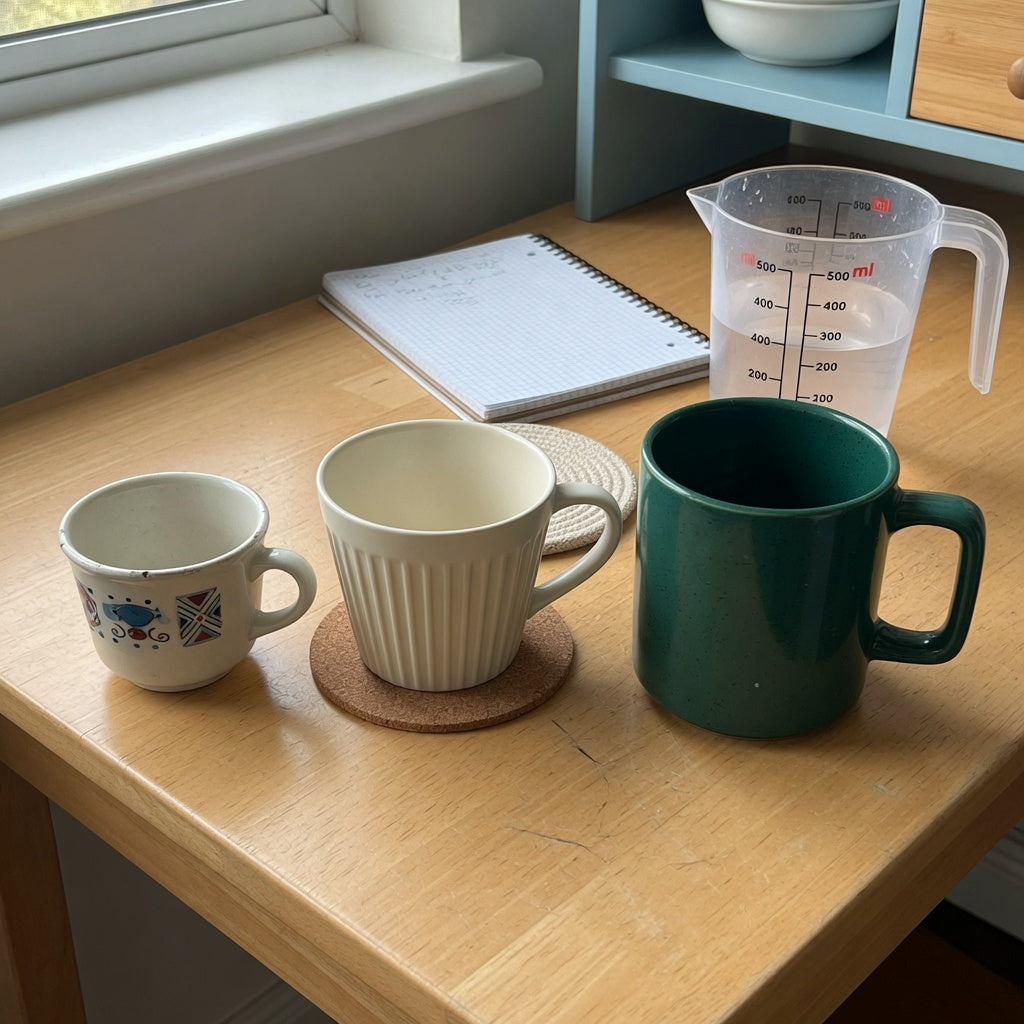
Decaf Coffee Cup Buying Priorities: Capacity, Shape, and Space
Compare verified 170 ml, 200 ml, and 270 ml cup capacities against your normal pour, handle preference, desk or counter space, and care needs. This guide also flags what photos and listings cannot ...
Read more
Leave a comment
This site is protected by hCaptcha and the hCaptcha Privacy Policy and Terms of Service apply.