
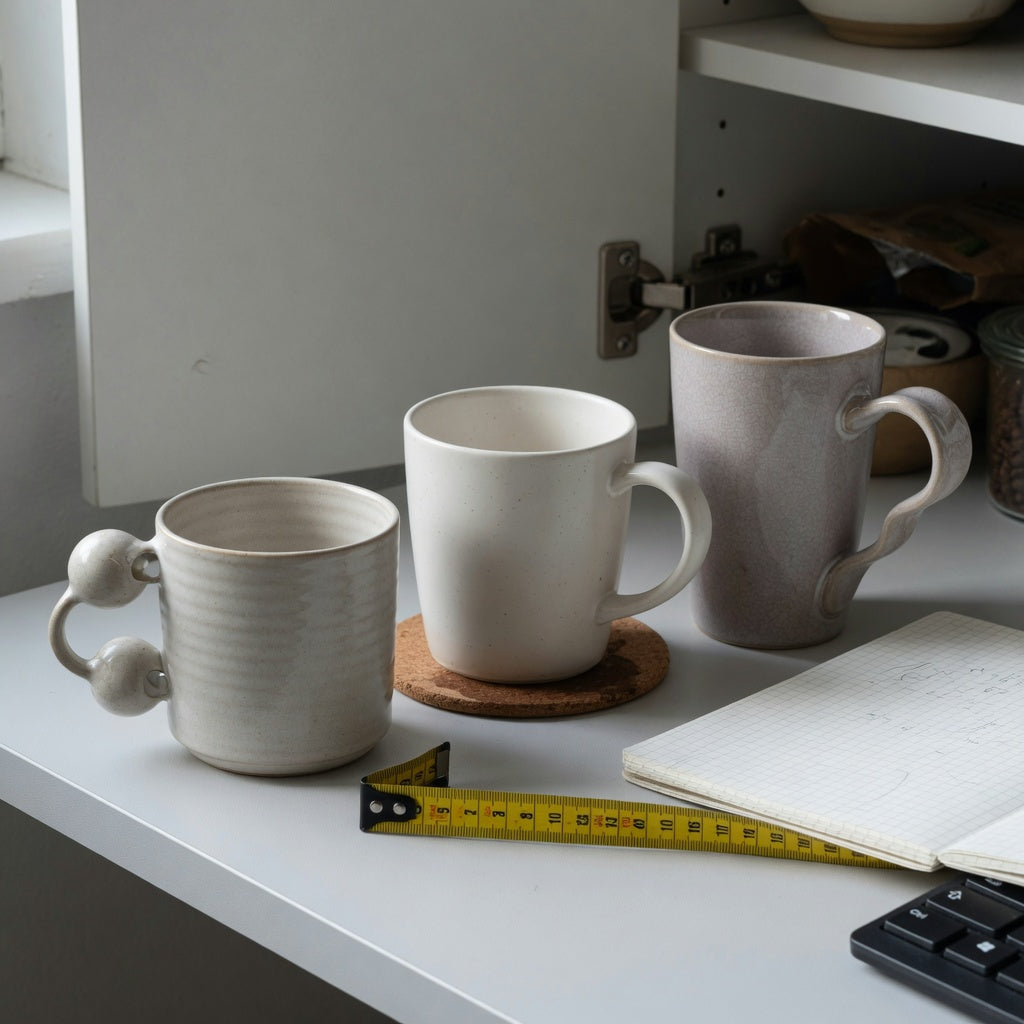
Ceramic Coffee Mug With Handle Buying Priorities: Capacity, Shape, Space
Reading time: about 9 minutes
A mug can fit the drink yet fail the room around it. On a home-office desk, the handle can intrude into mouse space; beside a coffee maker, a wide body can take the only clear patch of counter; in a cupboard, the handle can force the whole row to turn. For us, ceramic coffee mug with handle buying priorities start with those physical constraints, then move to style.
We sell, handle, and pack this category, so we compare details that can actually be checked: listed ceramic material, current listed capacity, dimensions when supplied, visible vessel shape, and handle form. We do not infer hand comfort, durability, heat retention, care compatibility, or appliance suitability from a photograph or from the word ceramic. That boundary matters because a sculptural mug can be an excellent match for one routine and an awkward choice for another.
Our ceramic coffee mug with handle buying priorities: which comes first?
Use the same order you follow during a normal drink break. Start with what goes into the mug, move to where it sits, and finish with where it is stored. Style should decide between suitable options, not rescue an option that is already too large for the space.
- Finished drink volume: Measure the coffee, tea, milk, or ice that is normally in the mug at one time.
- Use-area dimensions: Check the clear width, depth, and overhead clearance on the desk or counter.
- Storage envelope: Count the body and handle together when measuring a cupboard row, shelf, or mug hook.
- Visible shape: Choose the round, ball-handled, or flowing profile only after the first three checks work.
This sequence is especially useful online. Product photography shows design clearly, but it can make a mug appear smaller or larger depending on the lens, camera angle, and nearby props.
How much listed capacity matches your actual pour?
Measure the finished drink rather than relying only on a brewer setting or a familiar recipe name. If you add milk after brewing, include it. If you make iced coffee, allow for the space occupied by the ice. A mug filled close to the rim may also be less practical to carry from the kitchen to a desk, so your preferred working fill can be lower than the vessel's stated capacity.
- A short coffee or modest tea serving does not automatically require the largest available mug.
- A longer coffee with milk needs enough stated capacity for the complete drink, not only the brewed portion.
- A drink made with ice needs room for both liquid and displaced volume.
- Frequent small refills may make moderate capacity more useful than one oversized pour.
Use the current product listing as the source for capacity. A photo cannot confirm volume, and similar-looking vessels can carry different listed amounts. Capacity also does not reveal the complete footprint: two mugs with the same stated volume may distribute it through different heights, body widths, and openings.
Which measurements prevent desk and cabinet surprises?
The most useful measurement is often not the one shoppers check first. Body diameter, base diameter, and total width including the handle are different dimensions. A rounded wall can be widest above the base, while the handle creates an exterior projection that matters even though it holds no liquid.
| Placement | Measure at home | Compare with the listing |
|---|---|---|
| Office desk | Clear width and depth beside the keyboard, notebook, and mouse path | Total visible width including the handle and the widest part of the body |
| Kitchen counter | Counter depth and clearance below cabinets or shelves | Listed height when supplied, body profile, and handle projection |
| Cupboard row | Shelf height, shelf depth, and side-to-side spacing | Full vessel shape rather than base width alone |
| Coaster or warming surface | Usable top diameter | Base diameter when listed, not the wider upper body |
If a page does not provide a particular dimension, treat the photos as shape references rather than a precise ruler. Nearby spoons, books, or coffee equipment can help you understand proportion, but they do not establish an exact measurement.
Which CoffeifyMug shape fits each type of routine?
The useful recommendation is conditional: start with the reader's situation, identify the visible feature that answers it, and then verify capacity and dimensions on the relevant page.
A distinctive mug on an open counter or display shelf
If the handle itself should be the visual focal point and there is room around the mug, inspect the Ball Handled Coffee Tea Mug. Its closed ball handle is the defining reason it fits this situation. Before choosing it, compare the current listed capacity and the complete exterior shape with your available surface; a decorative handle should not be assumed to work with tight cabinet rows or mug hooks.
A rounded silhouette for a familiar kitchen setup
If you prefer a rounded vessel and a recognizable loop-style handle, start with the Round Coffee Tea Mug. It suits a shopper who wants the rounded profile to lead the design rather than a closed ball handle. The word round does not guarantee a compact footprint, so include the handle and widest body point in your comparison.
A sculptural contour for a clear desk or gift
If the vessel and handle should read as one flowing design, review The Flow Coffee Tea Mug. That visible contour makes it relevant for a clear desk, open shelf, or gift recipient who favors less conventional mug shapes. Check its stated capacity and any listed dimensions instead of assuming the sculptural profile will fit standardized stacking or tightly spaced storage.
None of these three should be declared universally more comfortable, stronger, or easier to care for based on shape alone. If their current capacities or exterior forms do not match your measurements, browse the broader unique coffee mugs collection rather than forcing a poor fit.
What should a gift buyer check before the mug is wrapped?
A distinctive handle gets noticed during a gift unboxing, but the mug still has to work after it reaches the kitchen. In our experience, the recipient's current mug offers better clues than guessing from color or personality alone.
- Estimate how much their usual mug holds at the level they actually fill it.
- Notice whether mugs are kept on hooks, lined in a cabinet, or displayed on open shelves.
- Check whether their desk or side table already has limited space.
- Decide if they favor a familiar rounded outline or visibly sculptural drinkware.
The Ball Handled and The Flow options make sense when a distinctive silhouette is part of the gift and storage space has been checked. The Round option is the more direct match for someone who already chooses rounded vessels and loop handles. If capacity and storage are unknown, asking one practical question is more reliable than presenting any model as a universal gift.
What does the ceramic label confirm, and what must you verify?
The product material is listed as ceramic. That is useful for comparing it with metal, glass, plastic, or porcelain drinkware, but material alone does not establish microwave suitability, dishwasher suitability, impact resistance, or a specific heat-retention result. Check the current product page and any instructions supplied with the mug for care guidance; if a compatibility claim is absent, do not assume it.
We also recommend a simple inspection when a ceramic mug is unpacked. Look around the rim, the foot ring underneath, the vessel wall, and the handle attachment area under good light. Set the mug on a flat counter and confirm that nothing appears damaged before first use. These checks are particularly useful before giving the mug as a gift because the recipient should not be the first person to discover visible shipping damage.
Which routines need a different style of drinkware?
- Commuting with a drink: Choose a travel vessel designed around a lid and transport rather than an open ceramic mug.
- Maximum stacking density: A purpose-made stackable shape or handleless cup may use cabinet space more efficiently.
- Documented appliance compatibility: Select only a product whose current listing or supplied instructions explicitly address your requirement.
- Insulation as the main priority: Compare insulated drinkware rather than assuming a vessel's shape predicts thermal performance.
- Exact hand fit: If handle dimensions are not listed and fit is decisive, online photographs cannot settle that question reliably.
A ceramic mug with a visible handle is also a poor match for someone who wants the handle to disappear within a perfectly straight cabinet row. The design feature that makes the mug interesting may be the same feature that consumes valuable storage space.
A five-minute capacity, shape, and space check
Keep the product pages open and use a ruler or tape measure. The comparison takes only a few minutes if you work from your current favorite mug and its normal location.
- Measure the amount you usually drink, including milk or other additions.
- Record the clear width, depth, and height where the mug will be used.
- Measure the cupboard or shelf separately because storage space may be tighter than desk space.
- Compare current listed capacity and dimensions, counting the handle as part of total width.
- Choose between ball-handled, round, and flowing shapes only among the options that pass those checks.
If a required specification is not listed, pause rather than fill the gap with an assumption. That is especially relevant for appliance compatibility, handle fit, and exact exterior measurements.
Frequently asked questions
Which ceramic coffee mug with handle buying priorities matter most for a small desk?
Start with total width including the handle, then compare the body depth with the clear area beside your keyboard or notebook. Listed capacity still needs to cover your normal pour, but a larger volume is not useful if the mug occupies your mouse path. Use dimensions when provided and treat photos only as proportional evidence.
Is listed capacity enough to compare two ceramic mugs?
No. Listed capacity tells you how much the vessel is stated to hold, but it does not show how that volume is distributed. Compare height, widest body point, base size when listed, and the handle's exterior projection before deciding which mug fits your space.
Does a ball handle take more cabinet space than a loop handle?
Handle form changes the mug's exterior envelope, but the name alone does not provide an exact width comparison. Include the complete ball or loop in your cabinet measurement and use listed dimensions where available. Do not assume either style will fit a hook or tight row without checking its visible geometry.
Can I assume a ceramic coffee mug is dishwasher or microwave compatible?
No. The ceramic material label by itself does not confirm either type of compatibility. Use only care and appliance guidance stated on the current product page or supplied with the mug, and do not turn an absent claim into a promise.
Which current CoffeifyMug option should I choose as a gift?
Choose the Ball Handled mug when the closed ball form matches the recipient's taste and there is room for it, the Round mug for someone who prefers a rounded vessel and loop profile, or The Flow for a more sculptural outline. In every case, verify the current listed capacity and likely storage fit first. There is no single best gift shape for every kitchen or desk.
Set your current mug in its usual spot, measure the pour and the available space, then compare those numbers with the three product pages. If none passes all three checks, return to the unique coffee mugs collection and choose a different silhouette instead of compromising on the routine that matters most.
More from our blog
Read more
Heavy Ceramic Coffee Mugs Buying Priorities: Capacity, Shape, Space
Choose by hard constraints first: comfortable filled weight, usable capacity, handle and base footprint, storage clearance, and care. We map those checks to The Rock, Spittoon, The Flow, and the wi...
Read more
Large Decorative Coffee Mugs Buying Priorities: Capacity, Shape & Space
Compare comfortable pour volume, visible silhouette, brewer clearance, handle projection, and storage space before choosing a decorative mug. We map three CoffeifyMug designs to specific routines a...
Read more
Leave a comment
This site is protected by hCaptcha and the hCaptcha Privacy Policy and Terms of Service apply.