
Cappuccino Coffee Mug Everyday Mug Rotation Practical Purchase Checklist
Reading time: about 10 minutes
A new cup usually loses its place in the rotation for an ordinary reason: it holds less than the morning pour, occupies space that was never measured, or requires care that does not match the household routine. In our store, the useful selection conversations start with actual milliliters and the place where the cup will live. Our cappuccino coffee mug everyday mug rotation practical purchase checklist applies that same discipline before another cup reaches the kitchen counter or office desk.
We can compare three verified catalog facts: the Retro Coffee Tea Cup is listed at 170 ml, the Pleated Coffee Tea Cup is listed at 200 ml, and the Emerald Coffee Tea Mug is listed at 270 ml. Those capacities support a useful shortlist, but they do not establish exterior dimensions, material, stackability, usable fill level, heat retention, or care compatibility. We also do not claim that any of these products was designed, tested, or certified for cappuccino, foam performance, or professional barista use.
Which listed capacity matches the drink you actually finish?
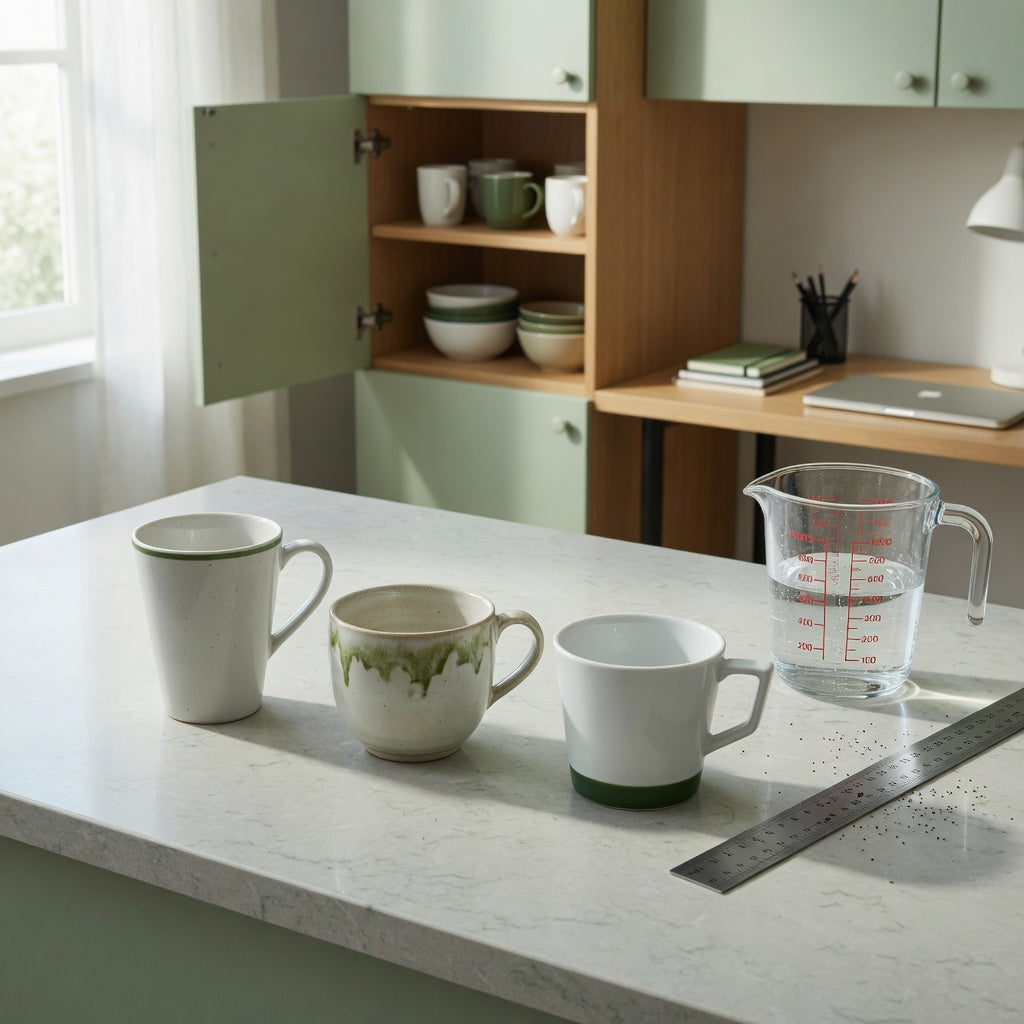
Measure the serving before comparing cup names. With your current cup empty and cool, use a graduated kitchen jug to add water to the line where your finished drink normally sits. Record that amount in milliliters. Measure the full coffee-and-milk serving line, not just the coffee base, and repeat the check for two or three normal mornings if your pours vary.
Leave your preferred amount of space below the rim in the calculation. A listed 200 ml capacity does not automatically mean that a 200 ml finished drink will sit at a comfortable level, because the supplied facts do not state how each capacity was measured. If exact headroom matters, confirm the capacity convention before ordering.
| Verified option | Capacity comparison | Situation that supports a shortlist | Main trade-off |
|---|---|---|---|
| Retro | 170 ml | Your normal fill line is comfortably below 170 ml and you intentionally prefer a smaller serving. | It may require a refill if your usual drink is close to or above that amount. |
| Pleated | 200 ml | You want the middle listed capacity and your measured serving leaves suitable room. | It adds only 30 ml over the Retro, so the difference may be too small for a shopper seeking a substantially longer drink. |
| Emerald | 270 ml | Your measured serving needs more than the Pleated can list, but remains comfortably within 270 ml. | Extra capacity may go unused if you routinely pour a much smaller drink. |
The arithmetic is straightforward: the Pleated lists 30 ml more than the Retro, while the Emerald lists 70 ml more than the Pleated and 100 ml more than the Retro. Capacity is still only one product fact. A shopper searching for a ceramic cappuccino cup should verify the current material statement rather than infer ceramic composition from a product name, photograph, or capacity.
Does a seven-day cup rotation point to a real gap?
Frequency of use tells you whether you need another cup or simply like another design. We suggest a seven-day audit because it captures workdays, washing delays, and at least part of a weekend routine without turning the decision into a project.
- Record which cup you reach for at breakfast, after lunch, and at an office desk.
- Note why your first choice was unavailable: in use, waiting to be washed, drying, or difficult to reach at the back of a shelf.
- Write down any serving that felt too small or left excessive unused space.
- Count cups that were not chosen at all. Another cup with the same capacity may repeat an existing mismatch.
A genuine gap might be a modest 170 ml serving when every current mug is larger, or a need for up to 270 ml when the smaller cups require an immediate refill. A style-only purchase can still be worthwhile, especially for a gift or a mixed display, but capacity evidence cannot prove that it will become a daily favorite. In our experience, separating practical need from visual preference makes both decisions clearer.
How should you use the cappuccino coffee mug everyday mug rotation practical purchase checklist?
The cappuccino coffee mug everyday mug rotation practical purchase checklist works best as a sequence. Do not let an attractive exterior answer a capacity, storage, or care question that remains unresolved.
- Measure the usual fill line. Use cool water and a graduated jug to record the total volume you normally serve.
- Choose the nearest suitable listed capacity. Compare that measurement with 170 ml, 200 ml, and 270 ml while accounting for your preferred room below the rim.
- Measure the storage opening. Record clear shelf height, width, and depth, including any cabinet lip, hinge, or door hardware that narrows access.
- Verify the cup's exterior measurements. Capacity does not reveal total height, base diameter, or widest width including any handle. Obtain those figures from the current listing or our store before treating shelf fit as confirmed.
- Check the secondary destination. Measure the drying area, coaster, cup stand, or clearance beneath a home coffee machine if the cup will regularly go there.
- Resolve material and care requirements. Confirm the current material description and published washing, microwave, and dishwasher guidance. The verified capacity facts alone do not answer those questions.
- Buy for observed frequency. Select only the quantity supported by your weekly use and measured storage plan, especially if you have not handled that shape before.
This process also helps with gifts. The recipient may like the appearance but still need a particular serving volume or care routine. If you cannot check their cabinet and habits, one carefully selected cup creates less storage risk than an assumed full set.
Shelf depth, handle clearance, and drying space
Listed capacity describes volume, not footprint. A 170 ml cup is not automatically narrower, shorter, or easier to stack than a 270 ml mug; wall shape, base profile, and handle projection can change the exterior measurements. We therefore would not promise that the Retro fits a compact shelf or that the Emerald requires more shelf space without verified dimensions.
- Closed cabinet: measure the usable opening as well as the shelf interior. A cup can fit behind the door yet catch on a hinge or cabinet frame while being removed.
- Open shelf: compare the cup's widest point with the available width. Include enough clearance to lift one cup without striking its neighbor.
- Drying area: check base diameter and the spacing of rack supports if you hand-wash and air-dry cups. Do not assume dishwasher compatibility because a cup appears similar to another one you own.
- Office desk: measure the coaster or clear area away from the keyboard. The Emerald has the largest verified liquid capacity of these three, but that fact does not establish its exterior footprint or stability.
- Stacked storage: plan for each cup to stand separately unless the current product information explicitly confirms stackability. Similar-looking rims do not establish safe nesting.
If storage measurements are unavailable, keep that item marked as an unknown. Choosing the lowest listed capacity does not resolve it. The practical next step is to obtain exterior dimensions or select a product whose current listing supplies the measurements you need.
Which verified option belongs on your shortlist?
Each recommendation should start with a measured situation, not a presumed cappuccino recipe.
- For an intentionally smaller serving: shortlist the 170 ml Retro Coffee Tea Cup because it has the lowest verified capacity of the three. It is not a good match if your finished drink approaches or exceeds 170 ml, and its exterior storage fit still needs separate verification.
- For a middle-capacity gap: consider the 200 ml Pleated Coffee Tea Cup when 170 ml is insufficient but 270 ml would add capacity you do not use. Confirm room below the rim and do not assume its pleated name establishes material, grip, or care performance.
- For the largest serving among these options: review the 270 ml Emerald Coffee Tea Mug. It fits the shopper whose measured drink needs more than 200 ml, provided 270 ml offers suitable room and the unknown exterior dimensions work in the intended space.
- For a drink above 270 ml: none of these three verified capacities is an evidence-based match. This often matters for iced coffee, added milk, or a long desk drink whose measured total exceeds 270 ml. Browse the unique coffee mugs collection for another shape, then verify that listing's capacity and care details.
These options are also a poor basis for a purchase driven primarily by heat retention, foam geometry, microwave use, dishwasher use, or a required material. We do not have verified facts here for those criteria. Resolve any non-negotiable requirement before choosing by capacity.
What should happen at unboxing and before the first wash?
Check physical condition and fit before putting a new cup into service. Review the current return terms first, then inspect the rim under good light for chips, examine any handle attachment for visible cracks, and place the empty cup on a flat, dry counter to check for obvious rocking. These are sensible receiving checks for drinkware, not a claim that a particular defect is common in these products.
Next, place the empty cup in its planned cabinet position. Close the door, remove the neighboring cup, and confirm that neither piece has to be forced past the other. If it will live at a desk, test the empty cup on the intended coaster with the normal keyboard and notebook arrangement in place.
Read the current care instructions before the first wash. We cannot infer dishwasher or microwave safety from appearance, capacity, or product naming. After you decide to keep the cup and begin using it, track how often it is chosen for a week before ordering multiples; repeated use is better evidence for building a rotation than an untested assumption.
Frequently asked questions
What should a cappuccino coffee mug everyday mug rotation practical purchase checklist include?
Include your measured serving volume, preferred room below the rim, weekly use frequency, clear storage dimensions, and any non-negotiable material or care requirements. Compare those facts with the verified 170 ml, 200 ml, and 270 ml capacities. Mark exterior dimensions, stackability, material, and dishwasher or microwave guidance as unresolved until the current product information confirms them.
Is a 170 ml cup too small for an everyday cappuccino?
That depends on the total volume you actually serve, including coffee and milk. The 170 ml Retro is a reasonable capacity shortlist only if your normal fill line sits comfortably within that listed amount. Choose a higher capacity if your measured drink would leave too little room or require a refill.
Does the 270 ml Emerald necessarily take up more cabinet space?
No. Its listed capacity is larger than the Retro and Pleated capacities, but volume does not establish exterior height, width, base diameter, or handle projection. Compare verified product dimensions with your cabinet measurements before making a storage claim.
Are the Retro, Pleated, and Emerald cups ceramic and dishwasher safe?
The verified information used for this comparison establishes only their listed capacities: 170 ml, 200 ml, and 270 ml. It does not establish material composition or dishwasher safety. Check the current product page or ask our store for confirmation before buying if either point is essential.
Which option is suitable for iced coffee or a long office drink?
Measure the complete drink after accounting for coffee, milk, and ice displacement. If the amount you plan to serve exceeds 270 ml, none of these three capacities is a suitable match on the verified evidence. For a smaller measured serving, choose by capacity and then confirm desk footprint, care instructions, and any other required feature separately.
Take three numbers to the next comparison: your usual fill volume, clear shelf opening, and maximum exterior width. Then review the CoffeifyMug unique coffee mugs collection, shortlist the capacity that fits your routine, and resolve every remaining material, dimension, and care question before ordering.
More from our blog
Read more
Mocha Mug Everyday Mug Rotation Practical Purchase Checklist by Capacity
Compare The Flow 400 ml, Morning and Night 440 ml, and The Rock 480 ml against your measured pour, wash cadence, storage, and verified care details. The checklist also flags what the catalog facts ...
Read more
Wassail Mug Replacement Purchase Practical Purchase Checklist
A replacement mug should correct the old mug's capacity or grip problem, not repeat it. Compare verified 400, 440, and 480 ml options, screen handle comfort, and flag unknown care or fit details be...
Read more
Leave a comment
This site is protected by hCaptcha and the hCaptcha Privacy Policy and Terms of Service apply.