
Cafe Au Lait Mug Everyday Mug Rotation Practical Purchase Checklist
Reading time: about 11 minutes
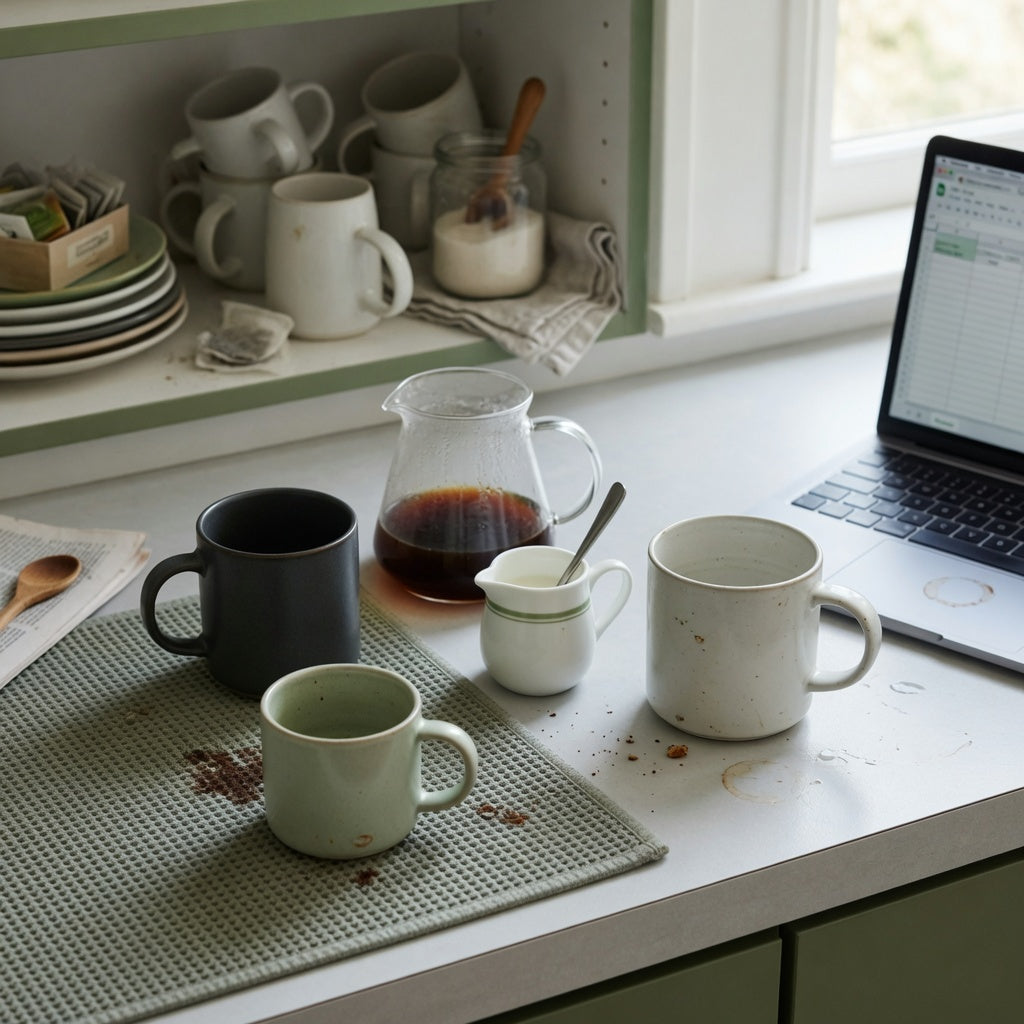
At 8 a.m., one mug is beside the coffee maker. By lunch, another is on the office desk, and the first is waiting by the sink. Add an evening drink and a three-mug rotation can occupy a cabinet shelf, a drying rack, and two work surfaces in the same day. That is why the cafe au lait mug everyday mug rotation practical purchase checklist starts with frequency, grip, and storage rather than appearance alone.
In our store, we compare mugs using the details we can verify and the practical questions shoppers can answer at home. For this shortlist, the confirmed catalog facts are the listed capacities: The Flow is 400 ml, Morning and Night is 440 ml, and The Rock is 480 ml. We do not infer material, exterior dimensions, care compatibility, heat retention, origin, or drink authenticity from a product name or photo. Those details need listing-specific confirmation.
How many mugs actually leave your cabinet each day?
An everyday rotation is not the number of mugs you own. It is the number that move through your kitchen, desk, sink, and drying area on a normal day. Before comparing products, track two representative days and assign each mug a job.
- First-pour mug: Used during breakfast or while getting ready, then returned to the kitchen relatively quickly.
- Desk mug: Kept within reach through a longer work block, where handle comfort and the amount of liquid being carried matter more.
- Evening mug: Used for a later coffee or tea and added to the same washing cycle as the earlier mugs.
- Guest or gift mug: Selected less often, so it must justify the cabinet space even when it is not in the active rotation.
If you use one mug all day, prioritize a grip you are willing to repeat and a capacity close to your normal serving. If you switch three times, shelf width, drying-rack space, and care requirements become just as relevant. In our experience selling this category, mismatches often begin when a shopper chooses a mug for one attractive pour without considering the other vessels already in use.
400 ml, 440 ml, or 480 ml: which role is missing?
Capacity is the firmest comparison point among these three products. Treat each number as a listed product capacity, not as an instruction to fill the mug to the rim. A practical pour needs enough space for milk, stirring, and carrying the drink without spilling.
| Option | Verified capacity | Reader situation | Why it fits the shortlist | Check before buying |
|---|---|---|---|---|
| The Flow | 400 ml | You already own larger mugs or want the lowest listed volume in this group. | It is 40 ml below Morning and Night and 80 ml below The Rock, giving it a distinct lower-capacity role. | Confirm the current shape, handle opening, exterior measurements, and care details on the listing. |
| Morning and Night | 440 ml | You want one mug between the lowest and highest capacity rather than either end of the range. | It sits exactly 40 ml above The Flow and 40 ml below The Rock by listed volume. | Check whether the body profile and handle suit your grip and available shelf space. |
| The Rock | 480 ml | You make the largest serving in this comparison or want more nominal room for coffee and milk. | It has the highest listed capacity, 80 ml above The Flow. | Account for the additional liquid weight when filled and verify the actual exterior dimensions. |
The two 40 ml steps are useful because they let you adjust volume without jumping to a completely different category. They do not settle the entire decision. A 480 ml mug is not automatically wider than a 400 ml mug, and a lower-capacity mug is not automatically more comfortable. Capacity measures liquid volume; storage fit depends on height, body profile, rim diameter, base footprint, and handle projection.
How should the handle feel on the fourth pickup?
Handle comfort is personal, and we cannot rank it honestly from capacity alone. The useful comparison terms are handle opening, which determines finger clearance; handle projection, which affects storage width; and balance, which changes as the mug is filled. A person who uses a two-finger pinch grip may prefer a different opening than someone who puts three or four fingers through the handle.
- Start with your current favorite. Count how many fingers fit comfortably, note whether your knuckles touch the mug body, and observe whether your thumb rests on top of the handle or against the side.
- Compare the current listing photos. Use them to study the handle profile, but do not treat photos as dimensional drawings. Product images may use different scales or camera angles.
- Allow for the loaded mug. The Rock offers 80 ml more listed volume than The Flow. If you use that additional capacity, your hand also carries more liquid.
- Inspect the mug on arrival. Before the first drink, check the rim, both handle attachment points, and the base for visible chips, hairline cracks, or unexpected rocking on a flat counter. Contact our store before use if anything appears damaged.
A larger serving can suit a stationary desk routine while feeling less convenient during repeated trips between rooms. A smaller serving may be easier to finish but require another pour. Neither trade-off is universal, which is why the grip test belongs beside the capacity comparison.
Will it fit the shelf, drying rack, and desk?
A cabinet can hold a surprising number of mugs until their handles begin competing for the same space. Measure the actual landing zones before ordering: shelf width, shelf depth, vertical clearance, and the side-to-side space available once handles are included. Unless a listing explicitly describes a mug as stackable, plan to store it upright and side by side.
- Small upper cabinet: Exterior height and handle projection may matter more than the difference between 400 ml and 480 ml.
- Open coffee station: Trace the space used by your current mug and check whether another handle would block the coffee maker, milk pitcher, or container beside it.
- Drying rack: Account for the body and the handle. A handle extending into the next slot can reduce the number of items the rack holds.
- Office desk: Measure a clear placement area away from the keyboard, charging cable, papers, and the edge of the desk. Do not choose volume without deciding where the mug will sit.
- Gift purchase: Use the recipient's current favorite mug as the reference if possible. The largest option is not automatically the most generous choice if it is awkward for their hand or cabinet.
Care can also determine whether a mug belongs in the rotation. If your routine depends on a nightly dishwasher cycle, verify that the current product listing explicitly confirms dishwasher compatibility. If you reheat drinks at work, check for an explicit microwave statement. This article does not claim either feature for these products, and appearance is not evidence of appliance safety. Confirm the stated material and follow the care guidance attached to the specific listing.
Cafe au lait mug everyday mug rotation practical purchase checklist
We use the cafe au lait mug everyday mug rotation practical purchase checklist in this order because it separates measurable needs from preferences. Complete it with your current mugs still in view.
- Log two normal days. Count each mug that leaves the cabinet, including the one that remains on a desk overnight or waits beside the sink.
- Name the missing role. Decide if the purchase is for a shorter first pour, a flexible middle serving, or the largest drink in your routine.
- Measure one normal drink. Use a measuring jug once, including the coffee, milk, foam, or other additions you normally pour. Leave practical carrying room rather than matching the drink to the mug's rim.
- Compare the three verified capacities. Shortlist The Flow at 400 ml, Morning and Night at 440 ml, or The Rock at 480 ml according to the measured serving and the role you identified.
- Record your preferred grip. Note finger count, knuckle clearance, and whether you usually support the mug body with the other hand.
- Measure every landing zone. Check the cabinet, counter, drying rack, and desk. Use exterior product dimensions if the current listing supplies them; ask our store for clarification if a critical measurement is missing.
- Confirm care compatibility. Look for explicit material and care instructions. Do not assume dishwasher or microwave safety.
- Check for duplication. A mug close to one you already ignore will not improve the rotation merely because its design is different. It needs a defined capacity, grip, or placement role.
- Review the product page again. Confirm that the current photos, specifications, and stated care details still match the decision you made.
A useful result is not necessarily three mugs. A two-mug rotation with distinct jobs can be more practical than three similar capacities competing for the same shelf and the same part of the day.
Which facts are verified, and what still needs checking?
Trustworthy product selection depends on separating catalog facts from assumptions. The capacity comparison below is established for this article. The remaining variables should be confirmed on the linked listing before checkout.
| Decision detail | Status in this comparison | How to use it |
|---|---|---|
| The Flow capacity | Verified at 400 ml | Use as the lowest-capacity reference in this three-product group. |
| Morning and Night capacity | Verified at 440 ml | Use as the midpoint by listed volume. |
| The Rock capacity | Verified at 480 ml | Use as the highest-capacity reference in this group. |
| Exterior height, width, and depth | Not established in this article | Check the current product page or request clarification before planning cabinet fit. |
| Material and finish care | Not established in this article | Follow the current listing rather than inferring material from appearance. |
| Dishwasher or microwave compatibility | Not claimed here | Require an explicit listing statement if either feature is essential. |
| Heat retention | Not compared | Do not use capacity or shape as a substitute for verified performance information. |
We would rather leave a specification unclaimed than turn a product photo into a fact. Shape can be evaluated visually, but dimensions determine fit. Handle design can narrow your shortlist, but your grip determines comfort.
Who should choose a different mug style?
These three products begin at a listed capacity of 400 ml, so they are not the best shortlist for someone whose usual drink is substantially smaller and who wants to minimize unused volume. They are also not a substitute for a vessel explicitly designed and listed for sealed travel. If leak resistance, a lid, or bag transport is essential, choose a product that confirms those features.
A different style may also suit you better if stacking is mandatory, cabinet measurements are extremely tight, or a specific appliance-care statement is non-negotiable and cannot be confirmed. Gift buyers who do not know the recipient's preferred grip or serving size should avoid assuming that the 480 ml option is automatically better. A broader comparison through our unique coffee mugs collection lets you look for another capacity or silhouette while applying the same rotation checklist.
Frequently asked questions
How do I use the cafe au lait mug everyday mug rotation practical purchase checklist?
Track how many mugs you use on two normal days, measure your usual drink once, and assign the new mug a specific role. Then compare 400 ml, 440 ml, and 480 ml against your grip, storage measurements, and required care instructions. Choose only after the product listing confirms the details your routine depends on.
Is a 440 ml mug the safest middle choice?
Morning and Night at 440 ml is the numerical midpoint between The Flow at 400 ml and The Rock at 480 ml. That makes it a sensible shortlist for a shopper who wants neither capacity extreme, but it is not automatically the best grip or storage fit. Check its current shape, handle, and exterior measurements before deciding.
Does a 480 ml mug always take more cabinet space than a 400 ml mug?
No. Capacity describes liquid volume, while cabinet fit depends on the mug's height, width, body profile, base, and handle projection. Compare current exterior dimensions rather than assuming The Rock occupies more shelf area solely because it has the highest listed capacity.
Are The Flow, Morning and Night, and The Rock dishwasher or microwave safe?
This article does not make that claim. Check each linked product page for an explicit care statement, and do not infer appliance compatibility from the mug's appearance or category. If the information is missing and the feature is essential, contact our store before ordering.
Which capacity should I shortlist for an office desk?
Consider The Rock at 480 ml if the largest serving in this group matches your routine, Morning and Night at 440 ml for the middle option, or The Flow at 400 ml if you want the lowest listed volume. Then verify handle comfort and desk footprint, because a capacity match alone does not guarantee a practical workday fit.
Measure one normal drink, one cabinet slot, and your preferred handle grip before opening the three product pages. If none passes all three checks, use the unique coffee mugs collection to compare another silhouette instead of adding a mug that duplicates a role or crowds the counter.
More from our blog
Read more

Coffee Mug Wedding Gift: Everyday Mug Rotation Purchase Checklist
Choose a wedding mug by checking shelf clearance, beverage habits, care instructions, surface details, and unboxing condition. We map common household routines to three CoffeifyMug options without ...
Read more
Large Unique Coffee Mugs: Everyday Rotation Practical Purchase Checklist
A rotation-first checklist for cabinet clearance, grip, usable capacity, care, delivery inspection, and matching CoffeifyMug styles to the way you actually drink.
Read more
Leave a comment
This site is protected by hCaptcha and the hCaptcha Privacy Policy and Terms of Service apply.