Black Ceramic Coffee Cups: Compare 170 ml and 390 ml
Reading time: about 9 minutes
A 170 ml cup can look substantial in a close-up product photo, then seem unexpectedly compact beside a keyboard or coffee maker. A 390 ml mug creates the opposite mismatch: it can be more vessel than a short morning pour needs. For shoppers comparing black ceramic coffee cups, the listed capacity is the detail most likely to change how the cup feels in daily use.
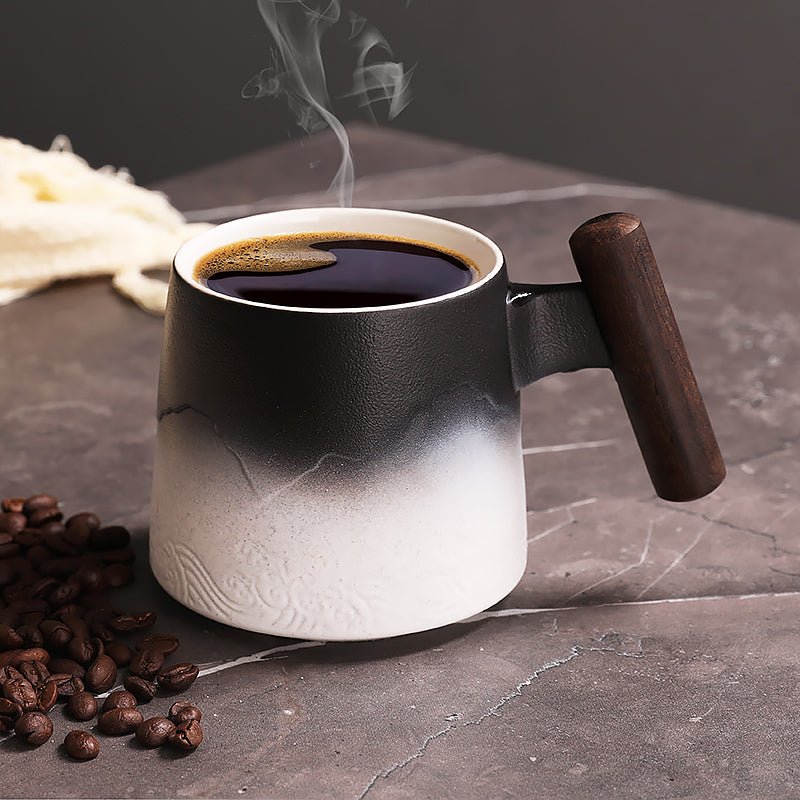
Treat this as a serving-habit decision rather than a contest for one universal winner. In our store, this comparison uses only the capacities and color options shown on the current product listings. Shoppers comparing black coffee mugs should start with listed capacity and the current color option, then check the individual product page before ordering. The Vintage Retro Small Coffee Cup has a listed Black option and a 170 ml capacity. The Round Ceramic Coffee Mug also has a listed Black option, with a 390 ml capacity. This comparison treats both only as ordinary open ceramic cups for a table or desk and does not add claims about exact shade, finish, appliance safety, heat retention, or other specifications not established by the listings.
Black ceramic coffee cups: what changes from 170 ml to 390 ml?
The 390 ml mug has 220 ml more listed capacity than the 170 ml cup. That is about 2.3 times the volume. In approximate US measurements, the two capacities are 5.7 US fl oz and 13.2 US fl oz respectively.
| Current option | Listed color option | Listed capacity | Daily-use fit | Main trade-off |
|---|---|---|---|---|
| Vintage Retro Small Coffee Cup | Black | 170 ml, about 5.7 US fl oz | Short coffee or tea servings and a deliberately compact-volume routine | Little flexibility if the finished drink is close to 170 ml and still needs carrying headroom |
| Round Ceramic Coffee Mug | Black | 390 ml, about 13.2 US fl oz | A more generous drink, additions such as milk, or fewer trips for a refill | May feel oversized for a short pour, and its exact outer dimensions should not be assumed from capacity |
A listed capacity is not the same as a comfortable fill line. Milk, foam, ice, and the movement of carrying an open cup all require room below the rim. The shared Black option also does not establish that these cups have an identical shade or finish, so we do not describe either one as matte, glossy, or an exact match for another black coffee mug.
Which capacity fits your actual coffee or tea pour?
The quickest way to choose is to measure the finished drink you already make. Do not rely on how large a cup looks in a styled image, and do not count only the initial coffee if you routinely add milk or ice.
- Fill your current favorite cup with cool water to the level you normally drink from it.
- Transfer that water to a measuring cup marked in milliliters.
- If your usual drink includes milk or another addition, reproduce the total finished level before measuring.
- Allow some headroom rather than matching your measurement exactly to the maximum listed capacity.
- Decide how much you mind refilling during a work session or meal.
A 150 ml finished drink leaves only 20 ml between that amount and a 170 ml listed capacity, so the smaller cup may feel tight while being carried. A 200 ml drink rules out the 170 ml option on capacity alone. At the larger end, a nominal 12 US fl oz drink is about 355 ml, leaving roughly 35 ml before reaching the 390 ml listing value. These examples make the split clear: choose the Vintage Retro Small Coffee Cup for a genuinely short serving, and the Round Ceramic Coffee Mug when your complete drink exceeds 170 ml or needs more breathing room.
How much desk or kitchen-counter space should you allow?
Capacity is not a footprint measurement and does not reveal exact outer dimensions. A low, wide cup and a taller, narrower cup can hold similar amounts while occupying different areas. Because the verified catalog facts for these options do not include dimensions, this comparison does not supply a diameter or height.
- Crowded office desk: Listed capacity alone cannot establish footprint. Compare the current product details and measure the available desk space; whichever size you choose, keep the open cup away from keyboards and other electronics.
- Roomy coffee station: If one larger drink is preferable to repeated refills, review the 390 ml mug and confirm its current dimensions before assigning it a fixed counter spot.
- Low shelf or coffee-machine clearance: Check the current product details for overall height. Capacity alone cannot confirm that either cup will fit beneath a shelf or dispensing area.
- Vehicle or moving workspace: Neither should be treated as a travel cup or assumed to fit a cup holder. These are ordinary open ceramic vessels without a spill-closing format.
If exact placement is critical, the useful measurements are base diameter, maximum body width, and overall height. A buyer working with a fixed shelf or narrow desk slot should choose a product with those measurements confirmed rather than treating 170 ml as a complete footprint specification.
Does the listed Black option guarantee a matching set?
No. Both current product listings include a color option named Black, but that name does not prove an exact shade or surface finish. Product photography, room lighting, and screen settings can also affect appearance. If you need a precise match for existing dinnerware, these cups are not a dependable match based on the color name alone; a coordinated set with confirmed appearance would suit that requirement better.
For gifting, the recipient's drinking routine gives you a more reliable decision than color alone:
- They prefer short, deliberate coffee servings: Choose the 170 ml Vintage Retro Small Coffee Cup because its listed volume fits that smaller routine.
- They keep one longer drink beside them: Choose the 390 ml Round Ceramic Coffee Mug because it provides 220 ml more listed capacity.
- You do not know their serving size: Measure a cup they already use or ask about their usual pour. The 390 ml option is more flexible by volume, but it can still feel unnecessarily large to someone who prefers small servings.
- Shape and personality matter more than these two capacities: Compare the product details in our unique coffee mugs collection rather than forcing a size that does not fit the recipient.
What should you inspect during gift unboxing?
A cautious visual and stability check before first use is straightforward:
- Confirm that the ordered color selection is Black.
- Visually inspect the rim and ceramic body for chips or hairline cracks.
- Place the empty cup on a dry, level table and check that the base sits steadily without rocking.
- Read any supplied care guidance before putting the cup through a dishwasher cycle or using it in a microwave.
- Do not use or gift a cup that arrives chipped, cracked, or unstable.
What care details matter before the first drink?
Ceramic material alone does not establish dishwasher or microwave safety. Neither current option is described here as safe for those appliances because the verified facts used for this comparison do not confirm it. Follow the current product instructions or supplied care information first.
- If no appliance guidance is provided, hand washing with mild dish soap and a soft, non-abrasive sponge is the conservative approach.
- Rinse the cup after coffee or tea rather than allowing residue to dry for long periods.
- Avoid abrasive pads or cleaners because the exact surface treatment is not established here.
- As a cautious ceramic-handling habit, avoid abrupt changes from an extremely cold cup to a very hot fill unless the product guidance permits it.
- Inspect the rim and body periodically, and retire the cup if a chip or crack develops.
If dishwasher convenience is non-negotiable, do not select either option based on this comparison alone. Confirm the current care instructions before buying, or choose a different style that explicitly lists the appliance compatibility you require.
Who should not choose either open ceramic cup?
- Commuters needing a lid: An open ceramic cup is not a substitute for a closed, spill-resistant travel vessel.
- Shoppers needing verified insulation: No heat-retention performance is claimed for these options, so choose drinkware with that feature explicitly stated.
- Buyers with a drink larger than 390 ml: Neither listed capacity will cover the full serving, particularly after allowing headroom.
- Buyers seeking a specialized cup much smaller than 170 ml: The Vintage option may still be larger than the scale you want.
- Anyone matching an exact black shade or finish: The listed Black option is not enough information for precise set matching.
- Anyone with strict shelf or machine-clearance limits: Confirm external dimensions or select a product that publishes the measurements you need.
These limitations do not make either cup a poor choice. They simply define the situations where another format, such as measured drinkware, a coordinated set, or a lidded travel style, would be more practical.
Frequently asked questions
Which black ceramic coffee cups are the listed 170 ml and 390 ml options?
The Vintage Retro Small Coffee Cup is the listed 170 ml option, while the Round Ceramic Coffee Mug is the listed 390 ml option. Both product listings include Black as a color selection.
Is 170 ml enough for a regular cup of coffee?
It is enough for a small serving of about 5.7 US fl oz, but regular is not a fixed measurement. Measure your complete drink, including milk or other additions; if it approaches or exceeds 170 ml, the 390 ml mug is the more practical option.
Is the 390 ml mug physically twice as large as the 170 ml cup?
Its listed capacity is about 2.3 times as great, but that does not mean every external measurement is 2.3 times larger. Exact footprint depends on the cup's height, width, and shape, and those dimensions are not claimed in this comparison.
Can I put these Black ceramic cups in a dishwasher or microwave?
The verified listing facts used for this article do not confirm dishwasher or microwave safety. Check the current product instructions before appliance use; if no guidance is available, hand washing is the conservative care choice.
Which capacity is better for an office desk?
The 170 ml cup better suits a short drink and a workspace where a lower-capacity vessel is preferred. The 390 ml mug better suits someone who wants a longer drink and fewer refills, but neither is spill-resistant, so placement away from electronics still matters.
Use this 30-second checklist before ordering
- Measure your finished drink in milliliters, not just the initial coffee dose.
- Leave headroom below the listed maximum.
- Choose between a compact serving and fewer refills.
- Confirm external dimensions if desk, shelf, or machine clearance is fixed.
- Select Black on the product page and review the available care guidance.
- Choose a different format if you need a lid, verified insulation, or exact color matching.
If your measurement points to a short serving, review the 170 ml Vintage Retro Small Coffee Cup. If you want 220 ml more listed capacity, compare the 390 ml Round Ceramic Coffee Mug. If neither size or shape settles the decision, browse our current selection of unique coffee mugs and choose using only the specifications confirmed on each product page.
Read more
How Many Ounces in a Typical Coffee Mug? Buyer Guide
Most typical coffee mugs land in the 8 to 12 oz range, but the usable pour is often lower once you leave room for milk, foam, or a comfortable grip. We break down real sizes, what fits, and what to...
Read more
12 oz Coffee Mug: Size, Fit, and What to Check Before Buying
A 12 oz coffee mug is the size many people reach for every day, but the right one depends on handle clearance, wall thickness, and how you actually drink. Here’s what to check before you buy.
Read more
Leave a comment
This site is protected by hCaptcha and the hCaptcha Privacy Policy and Terms of Service apply.