
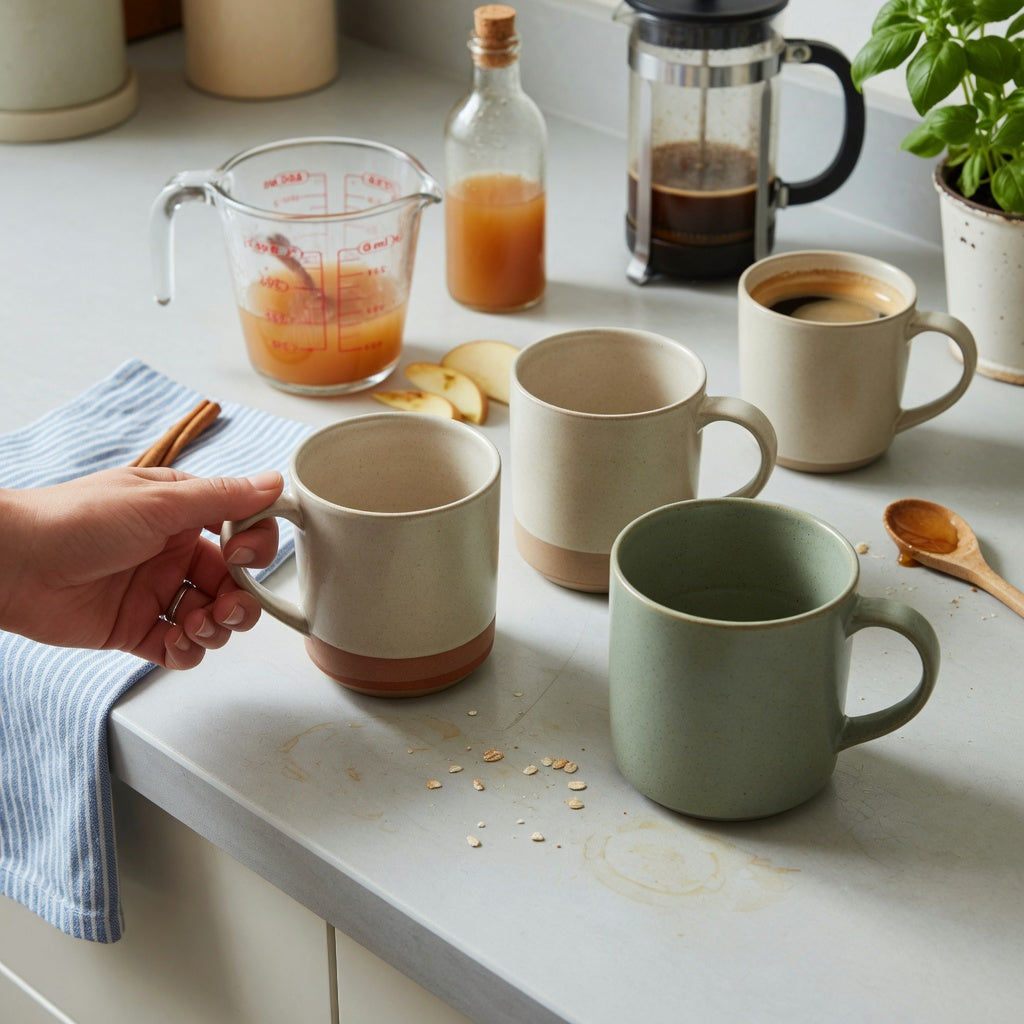
Apple Cider Mug Weekend Coffee Practical Purchase Checklist
Reading time: about 9 minutes
A slow Saturday pour exposes details that a product photo can hide. A mug may look roomy until the drink reaches the rim, while a handle that works for one quick lift may feel awkward through a full chapter or a long conversation. Our apple cider mug weekend coffee practical purchase checklist starts with the facts we can verify: The Gradient holds 400 ml, The Flow holds 400 ml, and The Rock holds 480 ml.
From handling everyday ceramic mugs in our store, we have found that a useful comparison follows the order of the actual routine: measure the pour, study the grip, and check how the mug will be washed and stored. Styling still matters, especially for a weekend mug left beside the coffee maker, but it should come after those practical checks.
Is 400 ml or 480 ml closer to your real weekend pour?
Measure before comparing. Fill your current mug to the level you normally use, then transfer that drink into a kitchen measuring jug. This gives you a useful number without relying on memory or assuming that every listed milliliter should be filled to the rim. Leave enough space for carrying the mug from the kitchen counter to the table without sloshing.
| Weekend routine | Capacity signal | Product starting point |
|---|---|---|
| One measured pour that stays comfortably below 400 ml | A 400 ml mug should be the first size to compare | The Gradient or The Flow |
| A regular pour that pushes close to 400 ml | Compare the usable margin carefully | Check 400 ml and 480 ml options |
| A larger pour or a planned top-up in the same mug | The extra 80 ml may be useful | The Rock at 480 ml |
The Gradient 400 ml coffee and tea mug and Flow 400 ml coffee and tea mug have the same verified capacity, so capacity alone does not separate them. The Rock 480 ml ceramic mug provides 80 ml more room. That extra volume can reduce a return trip to the pot, but it also means more beverage weight when filled.
Bigger is not automatically better. Someone who usually pours 250 to 300 ml may prefer the proportions and handling of a 400 ml option. A shopper who consistently runs out before settling into the weekend paper has a clearer reason to compare the 480 ml Rock.
Which handle details matter during a slow cup?
Handle comfort cannot be judged from capacity. The verified catalog facts used for this guide do not include exact handle-opening measurements, so we will not label one model more comfortable than another without evidence. Instead, compare each current product page with the mug that already fits your hand best.
- Finger opening: Count how many fingers you naturally place through your favorite mug's handle. Look for similar room rather than forcing a four-finger grip into a smaller opening.
- Knuckle clearance: Check whether the handle appears to leave space between your knuckles and the ceramic body.
- Thumb position: Notice whether you support the mug from the top of the handle, its outer curve, or the body itself.
- Handle junctions: On delivery, inspect both points where the handle meets the body. A hairline crack crossing either junction should be reviewed before use.
- Filled balance: Remember that the 480 ml option can carry more liquid. A larger capacity does not prove that the empty mug itself is heavier, but the added drink still affects the grip.
If hand strength, joint comfort, or finger clearance is a deciding factor, do not guess from the product name. Use the photographs and any current dimensions on the listing, then favor the option closest to a handle shape you already use comfortably.
Will everyday ceramic suit your counter, desk, and washing routine?
Everyday ceramic fits a sit-down kitchen or office routine, but it remains breakable drinkware. It is not a sealed commuting vessel, and this article makes no claim about specialized temperature performance. A stable counter or desk, sensible care, and enough cabinet room matter more than decorative language.
- Read the current care instructions before using a dishwasher or microwave. Do not infer compatibility from the word ceramic alone.
- If hand washing is required or preferred, use warm water, ordinary dish soap, and a non-abrasive sponge.
- Rinse soon after sweet or spiced cider so residue does not dry around the rim and inside edge.
- Dry the body and base fully before returning the mug to a cabinet or stacking it with other drinkware.
- Avoid abrupt temperature extremes unless the current product guidance specifically permits them.
We also inspect the rim, handle junctions, body, and foot ring when handling ceramic pieces. Gift buyers should do the same under good light before wrapping the mug. Rim chips are easy to feel with a fingertip, while fine lines around the handle deserve a closer look because that area carries the load every time the mug is lifted.
If every cup in your home goes through a high-use dishwasher cycle, dishwasher compatibility should be a checkout requirement. If the listing does not answer that question, treat it as an unknown rather than assuming the finish will suit your routine.
Apple cider mug weekend coffee practical purchase checklist
Use this order before adding a mug to the cart. It keeps the decision tied to the way you actually drink rather than the way a styled product photo looks.
- Measure one normal pour. Transfer your usual weekend serving into a measuring jug and write down the result.
- Leave carrying room. Do not select a capacity that requires filling to the very edge just to hold your normal drink.
- Choose the capacity tier. Start with The Gradient or The Flow at 400 ml for a moderate pour. Compare The Rock at 480 ml if you need 80 ml more room.
- Copy a proven grip. Check your favorite existing mug for finger count, knuckle clearance, and thumb position, then compare those points with the current product images.
- Check the landing spot. Consider the space beside your coffee maker, on your desk, and inside your cabinet. Verify product dimensions if a shelf or countertop area is tight.
- Match the care routine. Confirm dishwasher and microwave guidance if either feature matters to your household.
- Separate the mug from the serving scene. Do not assume cider mix, coffee, a lid, spoon, coaster, or other bundled item is included unless the product page explicitly says so.
This apple cider mug weekend coffee practical purchase checklist deliberately puts capacity before styling. A beautiful mug that crowds the rim, strains the grip, or conflicts with your washing routine is unlikely to become the weekend regular you intended to buy.
Which CoffeifyMug option fits each weekend routine?
There is no single best choice across all three mugs. The right next step depends on the situation you identified while measuring and checking your grip.
| Reader situation | Why it fits | Next step |
|---|---|---|
| Your usual pour stays below 400 ml and you want a practical single-mug size | The Gradient provides the verified 400 ml capacity without moving into the larger tier | Review The Gradient product page for its current design, handle view, and care details |
| You want 400 ml but prefer The Flow's visible design | The capacity matches The Gradient, allowing the decision to rest on design and grip fit | Compare The Flow page with your existing favorite mug |
| You regularly need more than a 400 ml option can comfortably provide | The Rock increases verified capacity to 480 ml | Check The Rock while accounting for the extra liquid weight when full |
| You have not settled on a shape or handle style | A broader comparison can reveal a closer match for your cabinet, hand, or gift recipient | Browse the unique coffee mugs collection |
For a gift, look at the recipient's current mug before choosing. A person who always refills a smaller cup may appreciate the 480 ml capacity, while someone with a compact desk or a lighter grip may prefer to compare the two 400 ml choices. Capacity is evidence; gift-box appearance is not a substitute for fit.
When is a ceramic apple cider mug the wrong tool?
These recommendations are centered on everyday ceramic mugs used at a table, counter, or desk. A different drinkware style is more practical in several situations.
- Choose a sealed travel tumbler if the drink will be carried in a car, bag, or crowded commute.
- Choose purpose-built insulated drinkware if specialized temperature performance is the main requirement.
- Choose a smaller vessel if a 400 ml capacity already feels excessive or difficult to grip.
- Choose a serving jug or carafe if one container needs to supply several people.
- Choose a lidded tumbler if spill control around children, pets, electronics, or moving workspaces is essential.
Ceramic can chip or crack if dropped on a hard floor. It also does not solve every iced-coffee need; shoppers who want a straw, lid, or highly portable format may be better served by a tumbler.
Frequently asked questions
What should an apple cider mug weekend coffee practical purchase checklist include?
It should include your measured pour, enough margin below the rim, preferred handle fit, available counter and cabinet space, and verified care instructions. It should also distinguish confirmed facts from assumptions about accessories or temperature performance. For CoffeifyMug's three compared options, the confirmed capacities are 400 ml, 400 ml, and 480 ml.
Is 400 ml large enough for weekend apple cider and coffee?
It can be, but your own measured pour is the useful test. If the drink sits comfortably below 400 ml with carrying room left at the top, The Gradient or The Flow is a logical starting point. If your normal serving approaches that limit, compare it with the 480 ml Rock.
What is the practical difference between 400 ml and 480 ml?
The difference is 80 ml of capacity. The larger option gives a little more room for a bigger pour or later top-up, but a full mug also contains more beverage weight. It does not establish better temperature performance or a more comfortable handle.
Which CoffeifyMug model has the most comfortable handle?
The verified information used here does not include handle measurements or an objective comfort ranking. Compare the current photographs and listed dimensions with a mug that already suits your hand. Shoppers with grip limitations should prioritize known finger clearance over capacity or appearance.
Are cider mix, a lid, or other accessories included with these mugs?
No ingredients or bundled items are represented as part of these recommendations. Evaluate the purchase as a ceramic mug, and check the current product listing if a lid, spoon, coaster, or other accessory is essential to your decision.
For the next step, measure your normal pour, decide between the 400 ml and 480 ml tiers, and compare the linked product pages for grip and care details. If none is an immediate match, use the unique mug collection to compare more shapes without relaxing the same checklist.
More from our blog
Read more
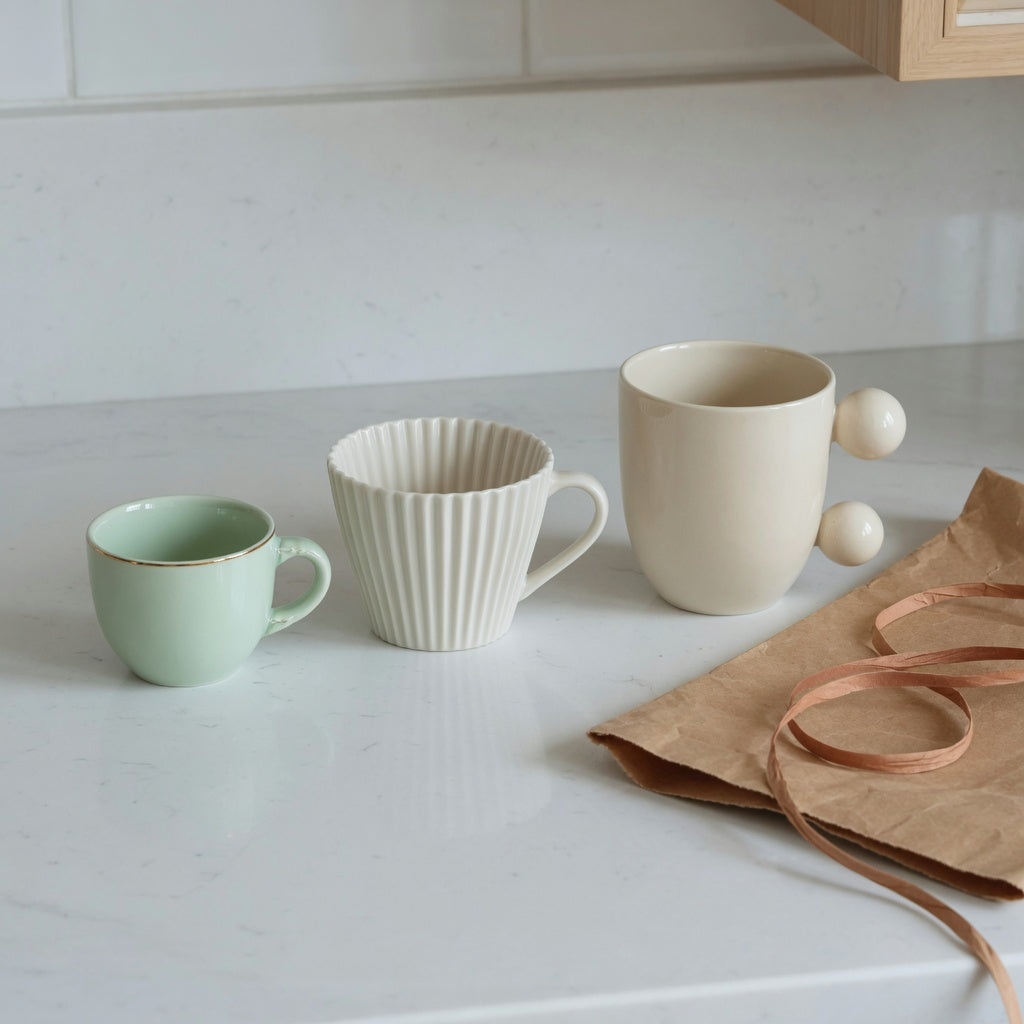
Ceramic Espresso Cup Gift Choice Product Shortlist Guide: 3 Sizes
Compare three ceramic cup sizes by the recipient's actual espresso routine. See who will appreciate the 170 ml Retro, 200 ml Pleated, or 250 ml Ball Handle option, plus clear reasons to skip each one.
Read more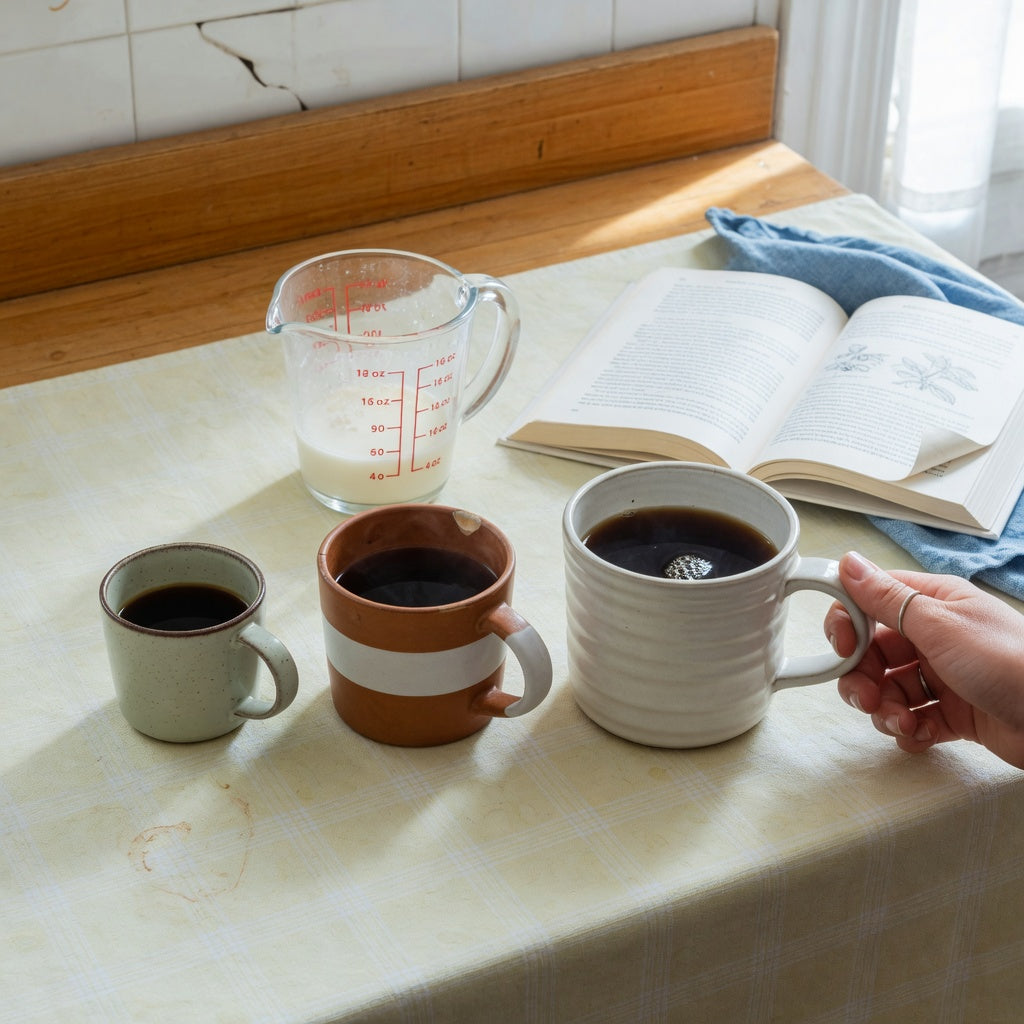
Wassail Mug Weekend Coffee Practical Purchase Checklist
Measure your real weekend pour, then compare The Flow at 400 ml, Morning and Night at 440 ml, and The Rock at 480 ml. This checklist covers capacity headroom, handle testing, verified facts, and th...
Read more
Leave a comment
This site is protected by hCaptcha and the hCaptcha Privacy Policy and Terms of Service apply.