
20oz Coffee Mugs: How to Choose the Right Size and Style
Reading time: about 8 minutes
A 20 oz mug looks simple on a product page. On the counter, it becomes a different question: will it hold enough coffee for a long morning, fit under your machine, and still feel comfortable when it is full? In our store, that is the size people reach for when one cup needs to last through email, breakfast, or a second refill they do not want to make.
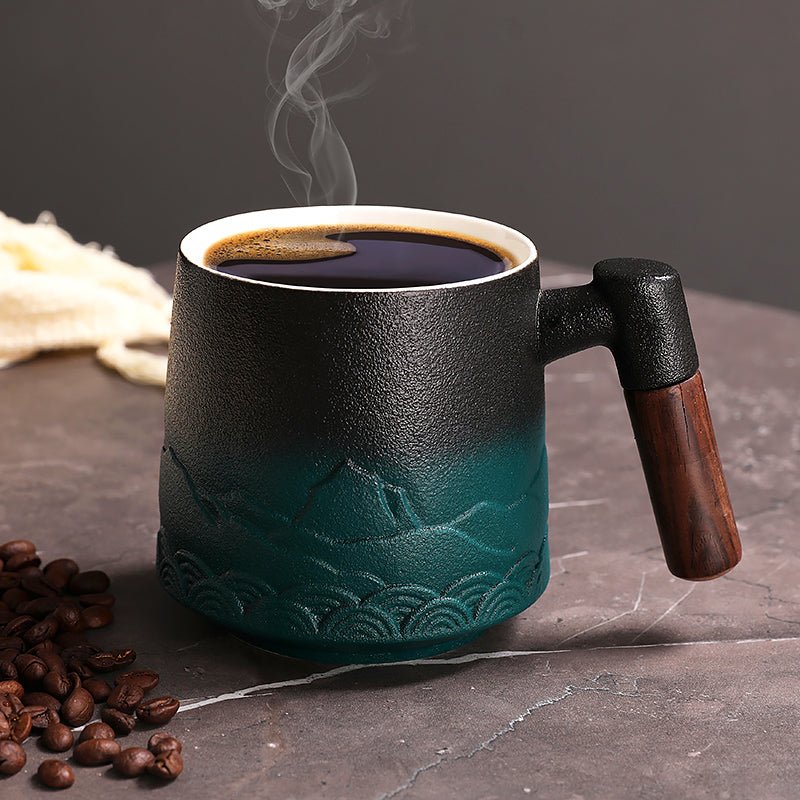
If you are comparing styles, start with our full mug collection and then look at a few shaped options like the Green Waves Coffee Tea Mug, the Mountain Sea II Coffee Tea Mug with Wooden Handle, and The Cloud Coffee Tea Mug Wooden Handle. Those three give a good read on how a 20 oz mug can feel in the hand even before you decide on a look.
What does a 20oz coffee mug actually give you?
Size matters most when you use the mug every day, not when you are browsing. A 20 oz mug gives you room for a generous pour of drip coffee, a big tea service, or coffee with milk and still some breathing room at the top. That extra space can matter on a busy morning because you are less likely to splash the rim while walking from the kitchen to your desk.
It is also the point where weight and balance start to matter more. A mug that feels fine empty can feel bulky when filled, especially if the handle is small or the base is narrow. That is why we treat 20 oz as a size category, not just a number.
Big capacity only works if the mug still feels stable in the hand and on the table.
For shoppers comparing smaller sizes, our guides on 12 ounce coffee mugs and 16 ounce coffee mugs are useful side by side. The jump from 16 to 20 oz is not subtle in daily use. You feel it in the handle, in the cabinet footprint, and in how long the mug stays on your desk before you need a refill.
Who should choose a 20oz mug?
Our team usually sees three buyer types pick 20 oz mugs first:
- People who want one large cup instead of two smaller rounds.
- Tea drinkers who like enough volume for a full steep plus room to add milk or honey.
- Gift buyers who want something that feels substantial when it is unboxed.
This size is a strong fit if your coffee routine starts with a full drip pot, a French press pour, or a long work session at the desk. It is also useful if you do not want to make a second trip back to the kitchen before the cup is empty. In our experience, that is the main selling point. Not novelty. Convenience.
A 20 oz mug is not the best choice for everyone, though. If you only drink espresso, small pour-overs, or a short afternoon coffee, the size can feel excessive. It is also less comfortable for people who want a light mug they can carry one-handed around the house. For that kind of use, the 10 oz, 12 oz, or 14 oz range usually makes more sense, which is why those size guides exist in the first place.
What should you check before buying one?
With 20 oz mugs, the details matter more than the headline capacity. A good-looking mug can still be awkward if the handle is cramped or the base is too narrow for the amount of liquid it carries.
| What to check | Why it matters | What we look for |
|---|---|---|
| Handle clearance | Your fingers need room once the mug is full and hot. | A grip that does not press against the mug body. |
| Base stability | A full 20 oz mug carries more weight, so wobble becomes a real issue. | A flat, even base that sits without rocking. |
| Rim finish | You feel the lip every time you drink. | An even glaze and a smooth drinking edge. |
| Wall thickness | Thicker walls usually hold heat differently and change the hand feel. | A body that feels solid without becoming bulky. |
| Cabinet fit | Large mugs can crowd shallow shelves and small dish racks. | Enough vertical and side clearance for daily storage. |
Those are the places where oversized mugs show their weak points first. A slight handle misalignment is easier to ignore in a 12 oz cup. In a 20 oz mug, it becomes the difference between a mug you use daily and one that stays at the back of the cabinet.
Care is another practical check. Plain all-ceramic mugs are usually easier to maintain through repeated dishwasher cycles, while mixed-material styles and wooden-handle designs deserve more attention. If a listing does not spell out care instructions, treat hand washing as the safer default for anything with a wooden component.
Which styles in our store make sense for daily use?
We prefer to match the mug to the routine, not just the photo. A design that looks great on a shelf may feel wrong next to a laptop, while a cleaner shape may be the one you reach for every morning.
| Style | Best for | Main trade-off |
|---|---|---|
| Green Waves Coffee Tea Mug | Buyers who want a straightforward everyday mug with a calmer look. | Less visual drama if you want a gift piece that feels more decorative. |
| Mountain Sea II Coffee Tea Mug with Wooden Handle | People who like a warmer grip and a more tactile, styled feel. | Wood detail usually asks for more care than a simple all-ceramic mug. |
| The Cloud Coffee Tea Mug Wooden Handle | Shoppers looking for a softer, giftable look that still handles a large pour. | Wood accents are not the best fit if you want a mug you can toss into any wash cycle without thinking. |
If you are comparing looks as much as size, the handle style is often the deciding factor. A wooden handle changes the feel in the hand and on the shelf. It can make the mug feel warmer and more distinctive, but it also shifts the care routine. If you want the easiest everyday path, the simpler mug body is usually the safer choice.
Gift buyers should think about unboxing first. A 20 oz mug with a distinctive shape often looks more deliberate than a generic oversized cup, which is one reason these styles work well as office gifts, housewarming gifts, and desk upgrades. If you need the mug to feel personal without being fragile-looking, that balance matters.
What are the trade-offs of 20oz coffee mugs?
The same things that make 20 oz mugs useful can also make them inconvenient.
- They take up more shelf space than 12 oz or 16 oz mugs.
- They can feel heavy when filled, especially if the handle is small.
- They are less convenient if you drink smaller servings and do not finish a full pour.
- They are not the best choice for tight cup holders, narrow shelves, or very compact desks.
That is the honest trade-off. If you want a large mug for home, office, or a slow weekend routine, the size is a strength. If you need something nimble, stackable, or light enough to carry while moving around the kitchen, a smaller mug is usually a better fit. We would rather point that out than pretend every oversized mug works for every buyer.
Another practical limit: some 20 oz mugs are simply too large for the way people use tea or coffee. If your habit is a quick cup before leaving the house, the extra capacity may never get used. In that case, size is wasted space, not value.
Frequently asked questions
Are 20oz coffee mugs too big for everyday coffee?
Not if you like a large first cup, add milk, or want fewer refills during the morning. They can feel oversized if you usually drink a smaller pour or finish coffee quickly and move on. For that kind of routine, 12 oz to 16 oz is usually the better match.
Will a 20oz mug fit under a standard coffee maker?
Sometimes yes, sometimes no. The capacity alone does not tell you the height, so it is worth checking the mug profile against your machine and the clearance under the brew head. If you use a low-clearance machine or a compact espresso setup, a smaller mug is safer.
Are wooden-handle 20oz mugs hard to care for?
They usually ask for more care than a plain mug body. If a mug has a wooden handle, we recommend checking the care notes before assuming dishwasher or microwave use. If you want the simplest daily routine, a full-ceramic mug is usually easier.
What is the main benefit of choosing 20oz over 16oz?
Room. You get more coffee or tea in one serving, plus more space for milk, cream, or foam without bringing the liquid close to the rim. If you often wish your current mug was just a little bigger, that is the reason to move up.
What should you compare before you buy?
Use this short checklist before you choose a 20 oz mug:
- Check the handle shape with a full pour in mind, not empty in your hand.
- Look at the base and make sure it will not rock on a table or tray.
- Decide whether you want the easiest care routine or a more styled look with wood accents.
- Measure the cabinet or shelf where it will live, since oversized mugs can crowd storage fast.
- Match the mug to the way you actually drink coffee or tea, not the way you imagine using it once a week.
If you want to browse the full range again, start with our collection page and compare it against the three styles above. That is the quickest way to see whether you want a straightforward daily mug, a more tactile wooden-handle piece, or a gift-ready design that still earns its place on the counter.
More from our blog
Read more
Michael Myers Coffee Mug: What to Check Before You Buy
A Michael Myers coffee mug looks simple on the product page, but the handle, print quality, and care instructions decide whether it works for daily use or just display. We break down the details th...
Read more
Microwavable Coffee Mug: What to Check Before You Buy
We focus on the details that matter after the first pour: safe materials, handle comfort, size, and cleanup. Use this guide to compare everyday mugs before you buy.
Read more
Leave a comment
This site is protected by hCaptcha and the hCaptcha Privacy Policy and Terms of Service apply.