
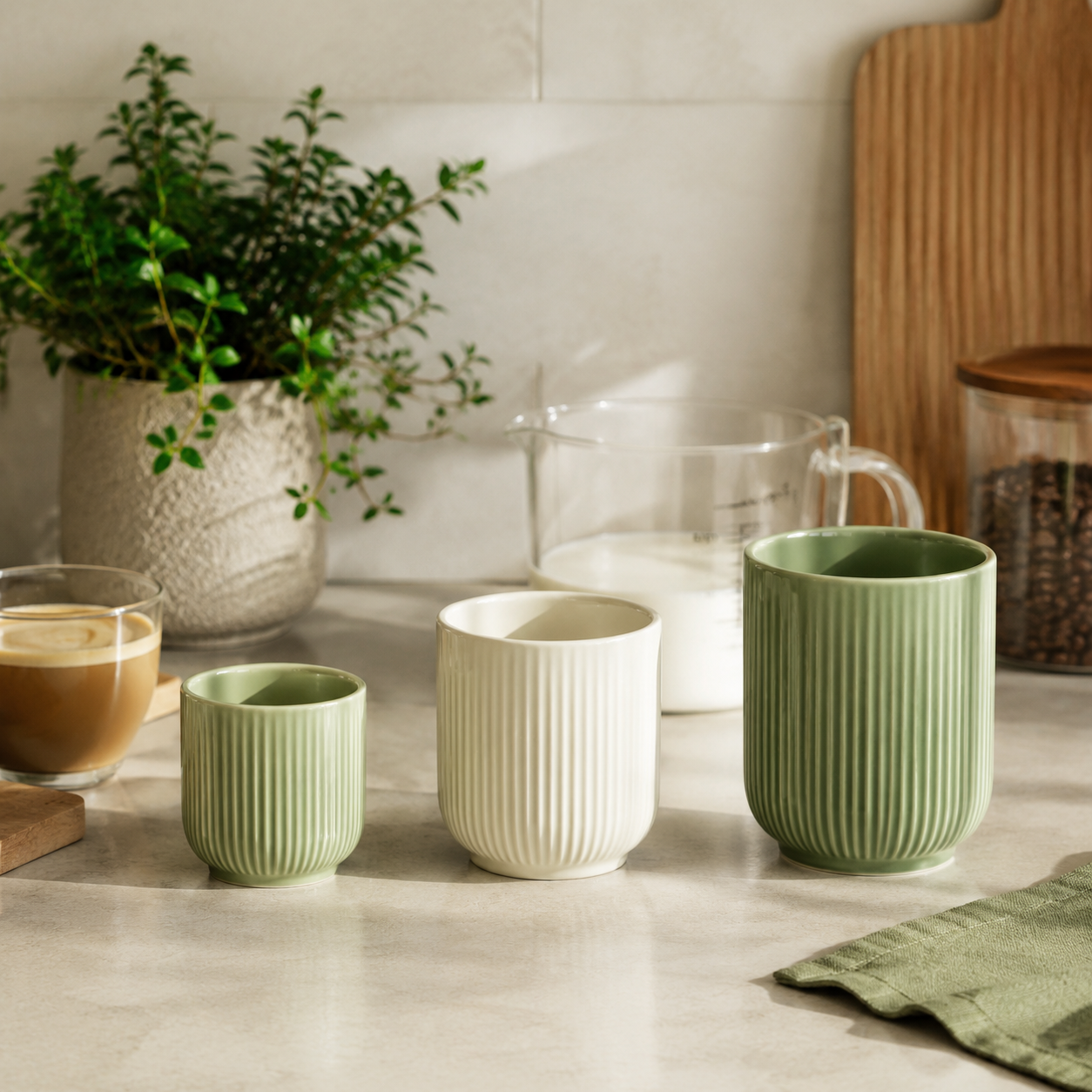
Ceramic Cortado Cup Buying Guide: Size, Headroom, Daily Use
Reading time: about 9 minutes
A small milk coffee can look right at the machine and still be awkward once it is poured. Too little empty space makes the walk to your desk risky, while a much larger vessel leaves the drink sitting low. A ceramic cortado cup is easiest to buy by starting with the final volume you actually pour, then subtracting that amount from the listed cup capacity. The difference is your practical headroom.
At CoffeifyMug, we compare compact drinkware this way because the word cortado does not guarantee one fixed serving volume. For this guide, we are using only the verified catalog capacities: Retro at 170 ml, Pleated at 200 ml, and Emerald at 270 ml. We are not claiming that any of these products was purpose-built, tested, or certified for cortado. Capacity also does not establish extraction performance, heat retention, microwave or dishwasher compatibility, or suitability for commercial service.
What size ceramic cortado cup leaves useful headroom?
Measure the finished drink, not the coffee dose or the amount of milk you intended to add. The liquid that reaches the cup is the number that matters. A measuring vessel suitable for the liquid temperature can help you record your normal finished volume without relying on guesswork.
- Prepare the drink as you normally do, including the milk, foam, sugar, or other additions you actually use.
- Record the approximate final liquid volume. If your pours vary, measure two or three drinks and keep both the smallest and largest result.
- Subtract that volume from the cup's listed capacity.
- Decide whether the remaining margin suits a stationary kitchen drink, a walk to an office desk, or a recipe that changes from day to day.
The calculation is simple: listed capacity minus planned drink volume equals calculated headroom. For example, a 140 ml finished drink leaves 30 ml in a 170 ml cup, 60 ml in a 200 ml cup, and 130 ml in a 270 ml cup.
That number is a comparison tool, not a guaranteed fill line. Unless a listing separately defines comfortable capacity, do not assume the stated capacity represents the level at which you would normally carry the cup. Cup geometry also matters: the same unused volume can sit differently in a wide vessel and a narrow one.
170, 200, or 270 ml: headroom by the numbers
The table below compares two example finished drink volumes. These are planning examples, not rules for how a cortado must be made.
| Option | Verified capacity | Headroom with 120 ml drink | Headroom with 150 ml drink |
|---|---|---|---|
| Retro Coffee Tea Cup | 170 ml | 50 ml | 20 ml |
| Pleated Coffee Tea Cup | 200 ml | 80 ml | 50 ml |
| Emerald Coffee Tea Mug | 270 ml | 150 ml | 120 ml |
For a shopper who consistently pours between 120 ml and 150 ml and wants the least unused capacity among these three options, the 170 ml Retro Coffee Tea Cup is the closest numerical match. It leaves 50 ml above a 120 ml drink but only 20 ml above a 150 ml drink. It is less forgiving if your finished volume sometimes rises toward 170 ml, because the calculated margin quickly disappears.
If the same 120 ml to 150 ml recipe needs more room for carrying or minor day-to-day variation, the 200 ml Pleated Coffee Tea Cup provides 50 ml to 80 ml of calculated headroom. This is the middle capacity in the comparison. It is still compact relative to the 270 ml option, but it does not require the same close-to-capacity pour as the 170 ml cup.
The 270 ml Emerald Coffee Tea Mug fits a shopper whose recipe varies substantially, includes volume-taking additions, or sometimes shifts to a larger drink. A 150 ml pour leaves 120 ml unused. The trade-off is clear: a small drink will sit lower than it would in either of the smaller capacities.
If you have not settled on a capacity yet, browse the unique coffee mugs collection with your measured drink volume in hand. That keeps the comparison tied to how you drink rather than to a product name alone.
How much headroom helps on a counter or office desk?
Headroom does not make a cup spillproof. It simply gives the liquid more room before it reaches the rim. In daily use, the right margin depends on how far the cup moves and what else goes into it.
- Mostly stationary on the kitchen counter: A 20 ml calculated margin may be workable for a careful, consistent pour, but the cup will be relatively full.
- Carried to an office desk: A 50 ml or larger calculated margin is more forgiving around a keyboard or paperwork. It still requires normal care while walking.
- Milk or foam varies each morning: Use the largest finished volume you measured. Foam and other additions occupy cup capacity even if your base coffee amount stays the same.
- Sugar, syrup, or extra milk is added after pouring: Reserve space for it before selecting the cup. A cup that fits the initial drink may become too full after additions.
- Ice is part of the drink: Ice displaces liquid and uses capacity quickly. The 170 ml option is not a practical choice for a large iced drink or several substantial cubes.
Milliliters of headroom should not be confused with millimeters below the rim. Without exact internal geometry, we cannot convert unused capacity into a vertical distance. This is one reason we recommend comparing the capacities numerically without making unsupported claims about how high each drink will sit.
Which capacity fits your actual drinking routine?
A useful recommendation must connect the drink, the setting, and the amount of margin you want. Based on capacity alone, these are the clearest matches:
- A consistent 120 ml to 150 ml drink that stays near the machine: The 170 ml Retro is the tightest capacity match. Choose it only if a 20 ml margin at the upper end of your recipe feels acceptable.
- A compact drink carried across the house or into an office: The 200 ml Pleated gives the same recipe more breathing room. It is the more forgiving choice when daily pours are not identical.
- A recipe that changes or shares the cup with larger drinks: The 270 ml Emerald provides the most unused capacity. It is less suitable if you specifically want a small drink to fill more of the vessel.
If your preferred size sits near an 8 oz label rather than these smaller capacities, our 8 oz coffee mug size and fit guide explains the additional comparisons worth making. Shoppers who regularly switch from coffee to a larger tea serving may also find the capacity discussion in our tea ceramic cup buying guide more relevant.
None of these compact options is ideal for someone who routinely tops up a drink, prepares a large milk-based coffee, or uses a substantial amount of ice. If 270 ml still leaves too little working room, start with a larger category rather than filling a compact cup to its limit. Our huge ceramic coffee mug guide covers the different trade-offs that appear as capacity increases.
What does ceramic tell you, and what must you still verify?
The category name alone does not tell you the ceramic body type, wall thickness, rim thickness, base weight, glaze behavior, or handle clearance. Those details can affect grip, balance, cupboard fit, and the feel of the drinking edge, but they are not established by capacity. We do not infer them for the three products in this comparison.
The same caution applies to care. A ceramic label does not automatically confirm that a cup can go through a dishwasher cycle or into a microwave. Check the current product page and any care information supplied with the item before using either appliance. Capacity is not a safety specification.
From handling drinkware in our store, we find that a short arrival inspection is useful, especially before a gift is wrapped:
- Check the drinking rim and base for chips or unexpected rough areas.
- Look for visible hairline cracks in the body or glaze.
- Place the empty cup on a level counter and check for pronounced rocking.
- Inspect any handle joins and make sure the grip feels suitable for your hand.
- Feel the foot ring before placing the cup on a delicate desk or table surface.
- Read the supplied care instructions before the first dishwasher or microwave use.
These are general ceramic inspection points, not statements that any linked product has these issues. For gift orders, opening and checking the cup before the gifting date also leaves time to address transit damage if it occurs.
Where does each capacity become a poor fit?
The 170 ml cup becomes a poor match when your finished drink regularly approaches 170 ml. At that point, the calculation leaves little or no room for carrying, foam variation, or additions. It is also the least flexible option for iced drinks.
The 200 ml cup is not the tightest match for a 120 ml drink because it leaves 80 ml unused. That extra room is useful on a walk to the desk, but unnecessary if your priority is minimizing empty capacity.
The 270 ml mug provides the widest margin in this group, yet it may feel oversized for a small, fixed recipe. A 120 ml drink uses less than half of its stated capacity. Choose it for flexibility, not because a larger number automatically makes it a better cortado cup ceramic option.
Capacity also cannot confirm cupboard clearance, shelf fit, saucer compatibility, or the space a cup occupies beside a keyboard. Check available dimensions and product images on the live listing if any of those constraints matter in your kitchen or office.
Frequently asked questions
What size ceramic cortado cup should I buy?
Measure your finished drink and add the amount of headroom you want. For a 120 ml to 150 ml drink, the verified options in this guide leave 20 ml to 50 ml in the 170 ml Retro, 50 ml to 80 ml in the 200 ml Pleated, and 120 ml to 150 ml in the 270 ml Emerald.
Is a 170 ml cup big enough for a cortado?
It can be if your finished drink stays clearly below 170 ml. A 150 ml pour leaves only 20 ml of calculated headroom, so this capacity is less suitable for variable recipes, extra milk, or a cup that must be carried far.
Is a 200 ml cortado ceramic cup too large?
Not necessarily. It leaves 50 ml above a 150 ml drink and 80 ml above a 120 ml drink, making it a practical middle option for shoppers who want more margin without moving to 270 ml.
Can I use a 270 ml mug for a small cortado?
Yes, provided you are comfortable with substantial unused capacity. A 120 ml drink leaves 150 ml of calculated headroom, so the drink will use less of the stated capacity than it would in the 170 ml or 200 ml options.
Are these cups microwave and dishwasher safe?
The verified capacities used in this guide do not establish microwave or dishwasher compatibility. Review the current product listing and the care instructions supplied with the cup before placing it in either appliance.
A 30-second checklist before checkout
- Measure the complete drink you normally pour, including milk, foam, and additions.
- Subtract that volume from 170 ml, 200 ml, and 270 ml.
- Choose a smaller margin for a stationary drink or a larger margin for carrying and recipe variation.
- Reject any capacity that reaches or nearly reaches your largest normal pour.
- Check the live listing for dimensions, construction details, and care instructions that capacity cannot confirm.
Once you know your finished volume, compare the 170 ml Retro, 200 ml Pleated, and 270 ml Emerald directly, or use the CoffeifyMug unique coffee mugs collection to find the capacity that gives your daily drink enough room without leaving more empty space than you want.
Read more
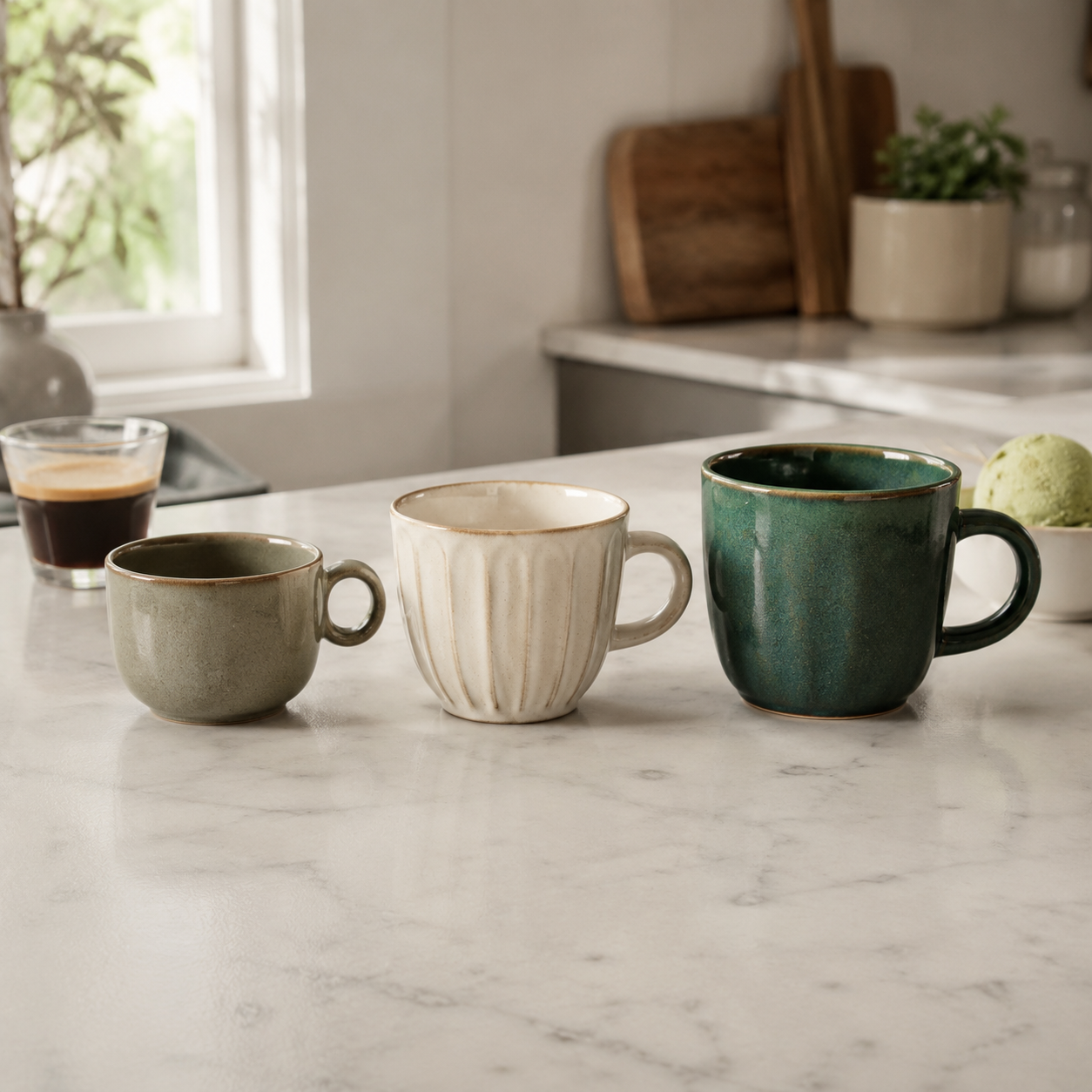
Affogato Cup Buying Guide: Capacity, Shape, and Serving
Compare 170 ml, 200 ml, and 270 ml cups for affogato service. This guide explains portion room, visible shape, presentation trade-offs, and which CoffeifyMug option fits each serving style.
Подробнее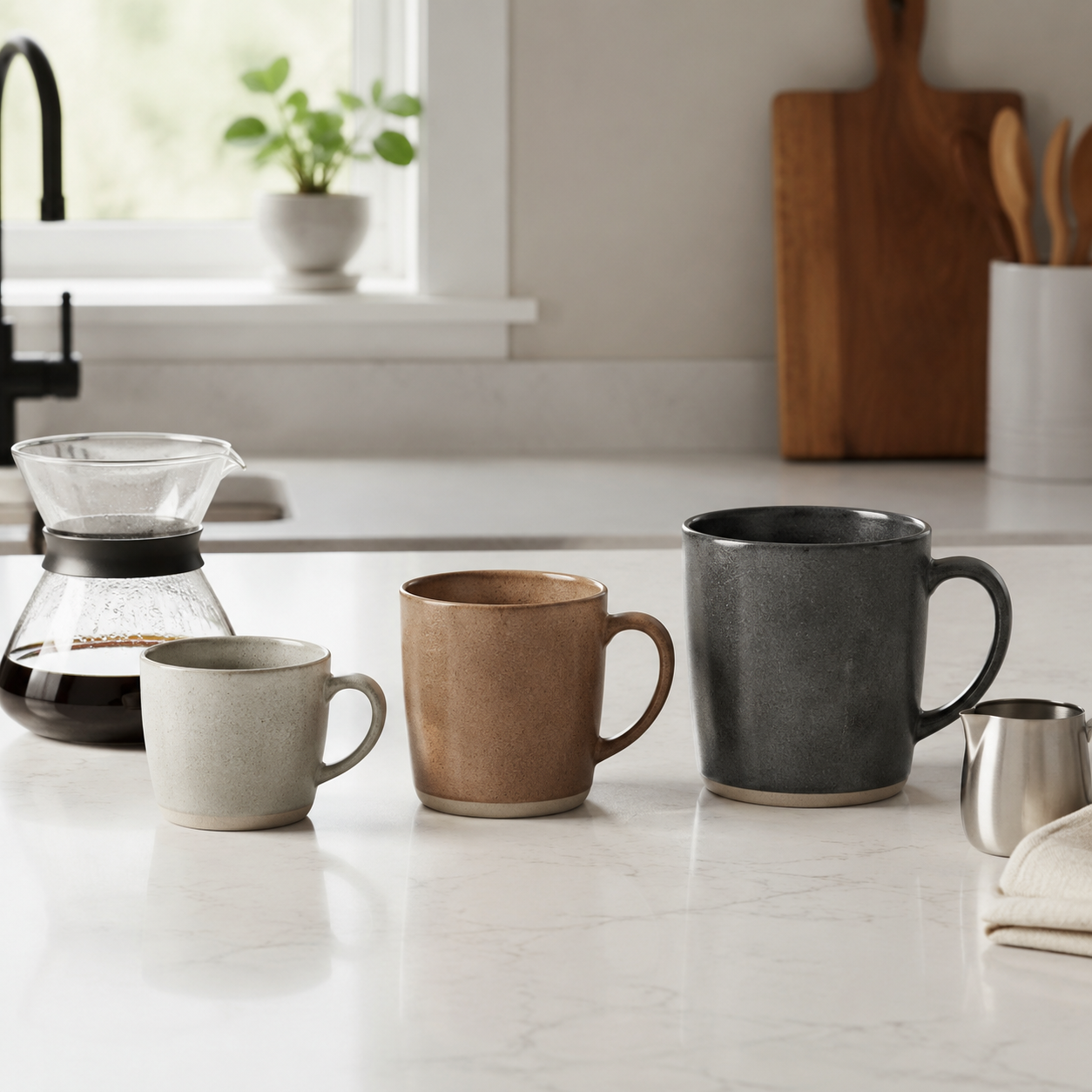
Cafe au Lait Mug Buying Guide: Capacity, Shape, Everyday Fit
Compare 400 ml, 440 ml, and 480 ml mugs using the amount you actually pour, the grip you prefer, and the space available on your desk or counter. This guide also explains what product photos can an...
Подробнее
Оставить комментарий
Этот веб-сайт защищается hCaptcha. Применяются Политика конфиденциальности и Условия использования hCaptcha.