
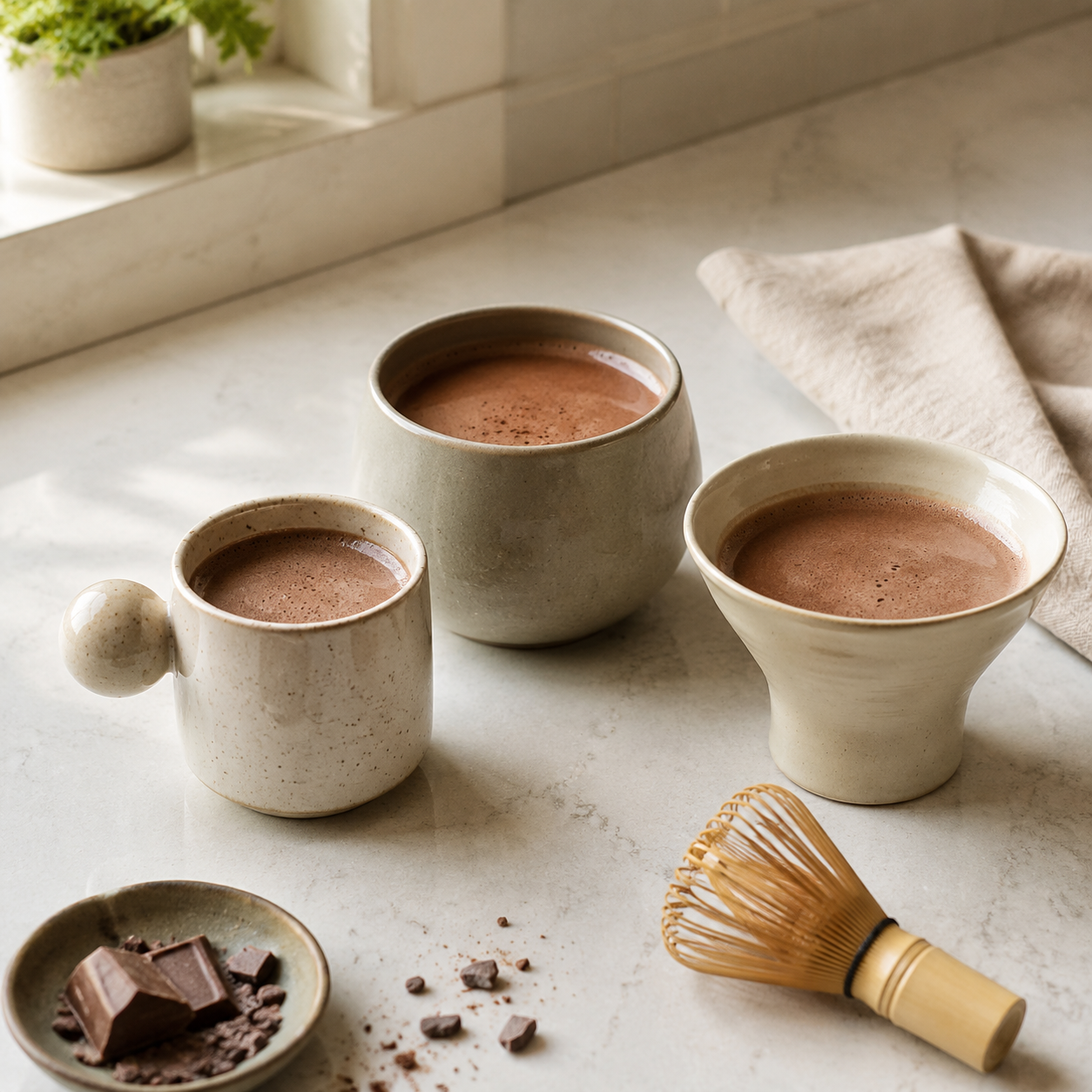
Cacao Cup Buying Guide: Capacity, Opening, and Ceramic Options
Reading time: about 8 minutes
Set a 400 ml mug beside a 250 ml cup and the buying decision looks obvious. Fill both with your normal cacao recipe, carry them to a desk, and let the drink sit for ten minutes, however, and capacity becomes only part of the story. A useful cacao cup also needs an opening that suits stirring and sipping, enough headspace for foam, and a footprint that works where you actually drink.
In our store, we treat these as everyday ceramic drinkware options. We are not presenting them as traditional, ritual, certified, or purpose-built cacao vessels. The practical comparison is between listed capacity, visible opening, cup shape, and daily handling.
Which cacao cup capacity matches your usual serving?
The three options covered here have listed capacities of 250 ml, 390 ml, and 400 ml. That is roughly 8.5, 13.2, and 13.5 US fluid ounces. The Ball Handle 250 ml mug is the smaller choice, while our unique coffee mugs collection lets you compare its shape with larger everyday cups.
| Option | Listed capacity | Practical buyer fit |
|---|---|---|
| Ball Handle | 250 ml | Shorter cacao servings, controlled portions, and compact drink breaks |
| Round | 390 ml | A full everyday mug without moving into oversized drinkware |
| Spittoon | 400 ml | A larger serving with a more visually open, statement-making shape |
Listed capacity should be used as a comparison figure, not as the amount you must pour. A brim-full cup is awkward to carry and leaves no room for whisked foam, milk, marshmallows, or movement between the kitchen and desk. For daily use, plan to leave visible headspace.
How does the visible opening affect cacao?
The opening changes more than the appearance. A broad exposed surface gives you easier access for stirring thicker cacao, adding toppings, or using a small whisk. It can also release heat more quickly. A more contained opening generally feels tidier while walking and may keep the drink warm longer, but it offers less working room.
- Choose a visually broader opening if you stir in the cup, make frothy recipes, or want aroma and toppings to be more noticeable.
- Choose a more contained rim if you sip slowly at a computer, carry the cup between rooms, or value splash control.
- Check the rim shape if you dislike thick drinking edges. Overall body diameter does not tell you how the lip will feel.
The Ball Handle option has a listed diameter of 11.2 cm. We would not automatically treat that number as the exact inner opening because a product diameter can refer to the body or widest measured point. Compare the listing photos with the stated dimensions, especially if the cup must fit a narrow shelf, tray, or cupboard.
Who should buy the 250 ml, 390 ml, or 400 ml option?
Ball Handle 250 ml: for shorter servings and distinctive grip
This is the strongest fit for someone who prepares a modest cacao portion, wants less liquid cooling at the end of a break, or prefers a cup that does not feel like a large coffee mug. The ball-shaped handle is also the main visual feature. It is not the best choice for a long drink with a large milk addition. Check the Ball Handle product page if a 250 ml serving and listed 11.2 cm diameter suit your shelf space.
Round 390 ml: for a full everyday mug
A shopper making a substantial cacao drink with room for milk or foam will usually find 390 ml more forgiving than 250 ml. It also avoids jumping to very large drinkware that can dominate a small desk. The Round 390 ml mug is the practical middle choice for regular kitchen and office use. It is less suitable if you deliberately serve small, concentrated portions.
Spittoon 400 ml: for shape-led buyers who still want capacity
The 400 ml option holds only 10 ml more than the 390 ml Round cup, an amount most people will not notice in a normal pour. Buy it for the visible form rather than the tiny capacity difference. The Spittoon 400 ml mug suits a buyer who wants an open-looking silhouette and a generous serving. Its distinctive shape may be less convenient on a crowded work surface or compact guest tray.
Which cup works on a desk, tray, or small kitchen shelf?
Capacity does not reveal the whole footprint. A short, broad cup may occupy more shelf width than a taller mug with greater volume. We check the widest point, handle projection, base contact area, and rim clearance before recommending ceramic drinkware for a tight setup.
For a small guest tray, measure the usable tray surface and leave space for a spoon, napkin, and safe hand access. Our ceramic cup guest tray guide covers this setup in more detail. On an office desk, prioritize a stable base and enough distance from keyboards or documents. A broad opening is pleasant for stirring, but it also creates a larger exposed area near accidental bumps.
Cabinet fit matters too. The Ball Handle cup's listed 11.2 cm diameter deserves attention if your shelf is narrow. For the Round and Spittoon options, use the product photos and available dimensions to judge side-by-side storage rather than assuming the higher-capacity cup is automatically taller.
What should you inspect in the ceramic, glaze, rim, and handle?
Ceramic is a broad material category, and two cups with similar capacities can feel different in the hand. Wall thickness, glaze coverage, handle geometry, and the finish of the foot ring all affect daily use. If exact ceramic composition matters to you, rely on the individual product listing rather than assuming every cup is stoneware or porcelain.
During handling or gift unboxing, we look for several practical details:
- Rim consistency: The drinking edge should feel even, without an unexpected sharp spot or rough patch.
- Handle joins: Inspect where the handle meets the body for hairline cracks. Decorative handle shapes deserve particular attention because grip comfort varies by hand size.
- Glaze surface: Small visual variations may be part of the finish, but unlisted cracks, flaking areas, or sharp glaze defects are reasons to pause before use.
- Base stability: Place the empty cup on a flat counter and check for rocking. Also inspect the unglazed foot ring for rough areas that could mark a table.
- Opening and spoon clearance: Confirm that your usual spoon or small whisk can move without repeatedly striking the rim.
For a broader comparison of ceramic size and finish, see our tea ceramic cup buying guide. The same rim, glaze, and storage checks apply even if cacao is your main drink.
How should an everyday ceramic cacao cup be cleaned?
Cacao residue is easier to remove before it dries around the inner rim or bottom curve. Rinse after the cup has cooled, then use warm water, mild dish soap, and a nonabrasive sponge. Avoid sudden temperature changes, such as moving a very hot ceramic cup directly into cold water, because thermal shock can stress ceramic drinkware.
- Let the cup cool enough to handle safely.
- Rinse out remaining cacao before the film dries.
- Wash the rim, inner base, handle joins, and foot ring.
- Dry the base before placing the cup on wood or a shelf.
- Inspect periodically for chips or cracks, especially after a dishwasher cycle or a knock against other dishes.
Do not assume microwave or dishwasher compatibility unless the specific product information confirms it. Decorative shapes and finishes can have different care requirements. Hand washing is the conservative choice when the listing does not provide a clear appliance-use statement.
When is a different cup style the better purchase?
These options are not travel mugs, insulated cups, or lidded drinkware. They are a poor match for commuting, tossing a cup into a bag, or keeping cacao hot through a long meeting. A narrow insulated vessel would handle those situations better.
A larger mug may also suit recipes that routinely exceed 400 ml. If you add a large volume of milk, ice, or toppings, compare the dimensions and handling points in our 20 oz ceramic mug guide. Conversely, buyers serving small tasting portions may find even 250 ml larger than necessary. None of the three products should be treated as a traditional or ceremonial cacao vessel solely because you choose to drink cacao from it.
Frequently asked questions
Is a 250 ml cacao cup too small for everyday use?
No, if your normal recipe is a shorter serving without a large milk addition. The Ball Handle option provides roughly 8.5 US fluid ounces of listed capacity, but you should leave headspace rather than filling it to the rim. Choose 390 ml or 400 ml if you regularly add foam, milk, or toppings.
Does a wider cup opening make cacao cool faster?
A broader exposed surface can release heat faster than a more contained opening, although wall thickness, starting temperature, room conditions, and fill level also matter. The trade-off is easier stirring and more space for foam or toppings.
Is there a meaningful capacity difference between 390 ml and 400 ml?
The listed difference is only 10 ml, or about two teaspoons. For most buyers, shape, opening, handle comfort, and footprint should decide between the Round and Spittoon options rather than capacity alone.
Are these traditional cacao vessels?
No. They are everyday coffee and tea mugs that can also hold cacao. We do not describe them as traditional, ritual, certified, or purpose-built vessels.
Can I put a ceramic cacao cup in the dishwasher or microwave?
Only do so when the individual product information confirms compatibility. Ceramic construction alone does not guarantee that a particular glaze, decorative finish, or handle design is suitable for a dishwasher or microwave.
Use this checklist before choosing your cup
- Pick 250 ml for a shorter serving or 390-400 ml for more milk, foam, and headspace.
- Favor a broad visible opening for stirring and toppings; choose a more contained rim for slower sipping and splash control.
- Measure shelf, tray, and desk space, including the handle and widest body point.
- Check the rim, glaze, handle joins, base, and care instructions after delivery.
- Choose the 390 ml versus 400 ml cup by shape, not by the negligible 10 ml difference.
Start with the unique coffee mugs collection, then compare each product page against your usual cacao volume, available surface space, and preferred opening. Those three checks will narrow the choice faster than capacity alone.
Read more
Macchiato Cup Buying Guide: Compact Ceramic Sizes Compared
Compare 170 ml, 200 ml, and 250 ml ceramic cups by practical headroom, visible form, care, and serving habits. See where each compact size works and where a larger cup would be more useful.
Czytaj dalej
Flat White Cup Buying Guide: Capacity, Headroom, Ceramic Options
Compare 200 ml, 250 ml, and 270 ml ceramic cups by usable headroom, grip, care needs, and everyday fit. This guide shows how to match cup capacity to the flat white you actually make.
Czytaj dalej
Zostaw komentarz
Ta strona jest chroniona przez hCaptcha i obowiązują na niej Polityka prywatności i Warunki korzystania z usługi serwisu hCaptcha.