
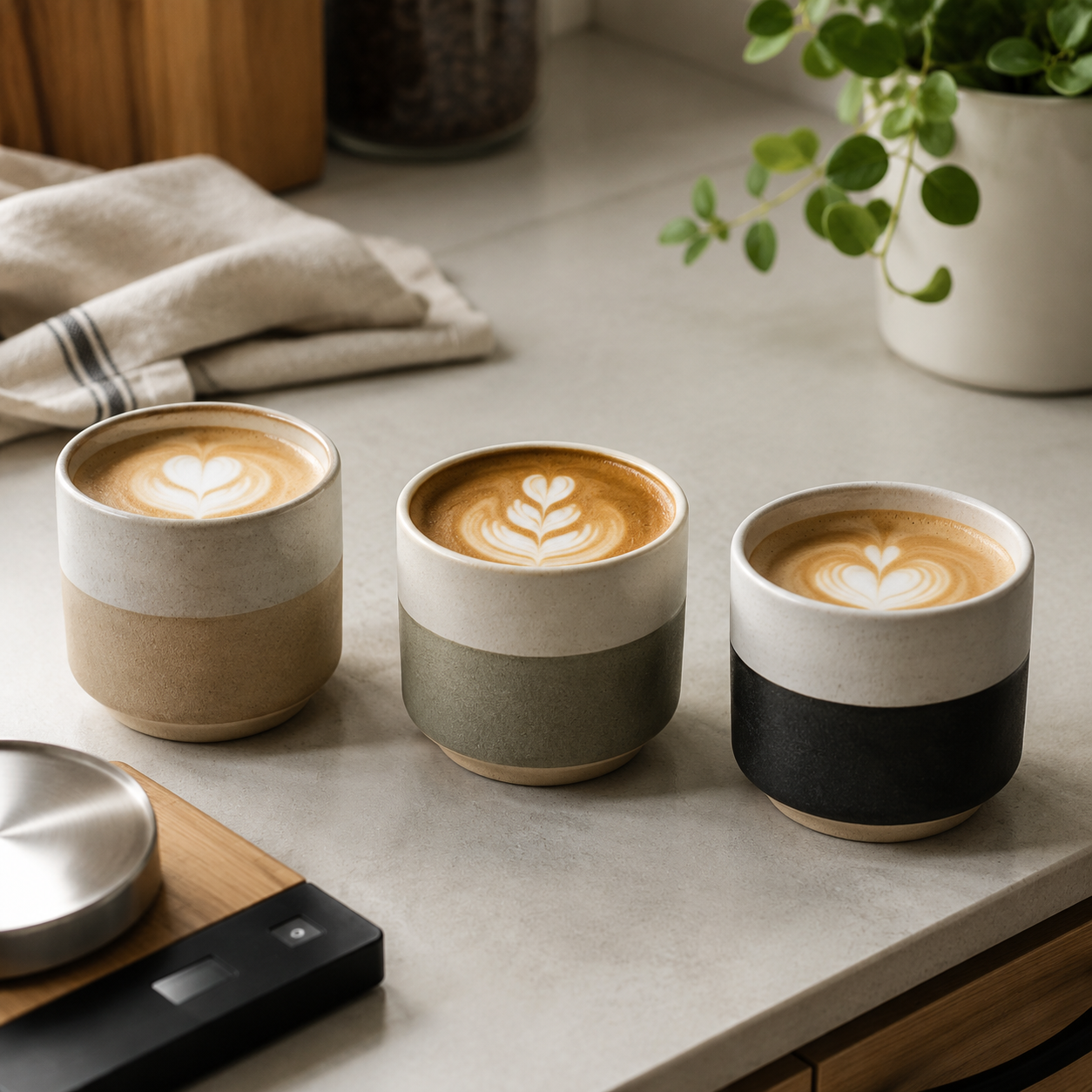
Flat White Cup Buying Guide: Capacity, Headroom, Ceramic Options
Reading time: about 8 minutes
A flat white can be comfortable to drink at the counter yet awkward to carry across the kitchen if the liquid sits close to the rim. The same issue appears on an office desk: one small bump, and a cup that technically holds the drink no longer feels like the right size. Choosing a flat white cup is therefore less about finding one accepted capacity and more about matching the listed volume to the drink you actually prepare.
In our store, we compare compact ceramic cups by capacity, usable headroom, grip, storage footprint, and care needs. We do not treat a particular coffee-to-milk ratio as mandatory. Home machines, pod systems, automatic brewers, and hand-poured milk can all produce different final volumes, so your own measured pour is the most useful starting point.
Which flat white cup capacity fits your usual pour?
Start by measuring the finished drink rather than estimating from the espresso portion alone. Milk and foam determine much of the final volume, and a recipe that looks small in a pitcher can fill a compact cup quickly.
- Place your empty cup on a kitchen scale and zero it.
- Prepare the flat white exactly as you normally would, including the milk and foam.
- Record the finished weight or measure the liquid with a marked vessel. For a practical comparison, water-like liquids are close enough that one gram can be treated as roughly one milliliter.
- Note how much open space you prefer below the rim when lifting and carrying the cup.
Repeat the measurement on two or three normal mornings. A single unusually foamy pour can make your recipe look larger than it usually is. The best cup for flat white use is the one that accommodates your repeatable drink while leaving a carrying margin you find comfortable.
How much headroom do 200 ml, 250 ml, and 270 ml leave?
Headroom is the space between the finished drink and the rim. Listed capacity gives you a comparison point, but it should not be treated as a promise that every milliliter is comfortable to use. Rim profile, foam height, and the way you carry the cup all affect the practical margin.
| Cup option | Listed capacity | Example finished drink | Simple capacity difference | Buyer fit and trade-off |
|---|---|---|---|---|
| Pleated Coffee and Tea Cup | 200 ml | 180 ml | 20 ml | Fits buyers who want the most compact option and make a smaller measured drink. It offers the least tolerance for recipe variation. |
| Ball Handle Coffee and Tea Mug | 250 ml | 220 ml | 30 ml | A middle-capacity choice for a slightly larger pour or more numerical margin. The distinctive handle style needs to suit your grip. |
| Emerald Coffee and Tea Mug | 270 ml | 240 ml | 30 ml | The largest of these three options. It suits buyers whose regular recipe crowds a 200 ml or 250 ml cup, but it is still compact compared with a large coffee mug. |
The examples show arithmetic, not guaranteed usable headroom. A 180 ml drink in a 200 ml vessel has a 20 ml capacity difference, but foam can rise higher than the liquid beneath it. A cup filled on an uneven counter can also feel closer to the rim on one side.
If your measured drink varies significantly from day to day, choose the larger capacity rather than relying on a near-brim fit. You can also browse our unique coffee mug collection if these three compact sizes do not match your usual serving.
Which ceramic shape suits your grip and serving setup?
Capacity alone does not describe the experience of using a ceramic cup. Handle shape, exterior texture, rim form, wall thickness, and base footprint all matter, but buyers should verify those details in the current product photos and specifications rather than assuming two cups with similar capacities will feel identical.
- Smallest serving and textured appearance: The 200 ml Pleated cup is the first option to consider if your measured recipe is compact and you like the pleated exterior shown on its product page. Grooved or textured surfaces can require a little more attention during hand washing than a completely smooth wall.
- Distinctive grip: The 250 ml Ball Handle mug fits shoppers who want a middle capacity and are comfortable with its ball-style handle design. It is not the safest blind purchase for someone who strongly prefers a conventional loop handle or needs generous finger clearance.
- More room without moving to an oversized mug: The 270 ml Emerald mug is the practical next step when a 250 ml cup feels crowded. It provides more nominal capacity, though it is not intended to replace a large mug for long coffees or heavily iced drinks.
Compact cups also work well on small trays because they leave room for a spoon, napkin, and sweetener. Our ceramic cup guest tray guide covers that setup in more detail. If the cup will regularly switch between coffee and tea, compare the serving implications in our tea ceramic cup size and finish guide.
What should you inspect and how should you care for ceramic?
From handling and packing ceramic drinkware, we pay close attention to the rim, handle attachment, base, and interior finish. Decorative variation can be part of a design, but structural damage should not be confused with normal variation.
Checks to make during unboxing
- Run a fingertip carefully around the rim and check for a sharp chip or rough point.
- Inspect both handle joints under good light for a visible crack extending into the cup body.
- Set the empty cup on a level counter and check whether the base sits steadily.
- Look inside for a body crack or a damaged area that was not shown as part of the intended finish.
- Hold the cup as you would when full. Confirm that the handle position and finger space feel controlled, not strained.
A surface color variation may be cosmetic, depending on the finish. A sharp rim chip, unstable base, or crack through the ceramic body is different and should be reported before use.
Daily care that protects the rim and handle
- Check the current product instructions before using a dishwasher or microwave. Do not assume compatibility from the word ceramic alone.
- If care instructions are unclear, hand wash with a soft sponge and mild dish soap.
- Avoid moving a cold cup directly into extreme heat or pouring boiling liquid into a cup that has just come from a very cold location.
- Do not pack cups tightly enough in a dishwasher or cabinet that their rims and handles knock together.
- Dry the base before placing the cup on a wooden shelf or desk.
Textured exteriors and unusual handles may take longer to clean than a plain cylindrical mug. That trade-off matters in a busy shared office or anywhere cups go through frequent wash cycles. Our guide to ceramic cup handling and care mistakes explains why rim contact, stacking, and care-label checks deserve attention.
Which option fits a kitchen, office, gift, or iced drink?
- Kitchen counter: Choose the 200 ml Pleated cup if your recipe consistently stays well below that capacity and you value a compact footprint. Move up if you often adjust milk by eye.
- Office desk: A 250 ml or 270 ml cup can provide more capacity difference for the same measured drink. Confirm that the base footprint works around your keyboard, notebook, and charging cables.
- Gift purchase: The 250 ml Ball Handle option is a middle-capacity choice with a distinctive visual detail. The recipient still needs to like the grip, so review the product images before buying for someone with limited hand mobility.
- Iced or long coffee: These compact options are not the best fit. Ice displaces liquid quickly, and a larger mug will usually be more practical for a drink intended to last through a long meeting or commute.
A flat white coffee cup can also serve tea, hot chocolate, or a small brewed coffee, but capacity remains the limiting factor. Buyers who prefer large refills should choose a different style rather than forcing a compact cup to cover every drink.
Frequently asked questions
What size cup is best for a flat white?
There is no single required capacity for every recipe. Measure your normal finished drink, then choose a cup that leaves enough room for the foam and for carrying it comfortably. In this comparison, the choices are 200 ml, 250 ml, and 270 ml.
Is a 200 ml flat white cup too small?
It can work well if your finished drink stays comfortably below 200 ml. It is less suitable if you pour milk by eye, produce a high foam layer, or regularly reach the rim. Measuring several normal servings will give you a more reliable answer than guessing.
How much headroom should I leave in a coffee cup?
Use the amount that lets you lift and walk with the cup without feeling that it will spill. There is no mandatory headroom figure. Subtract your measured drink volume from the listed cup capacity, then remember that the resulting number is only an estimate because foam and cup profile affect the visible gap.
Can a ceramic flat white cup go in the dishwasher?
Only use a dishwasher if the current product care instructions allow it. Ceramic construction by itself does not confirm that a finish, decoration, or handle design is dishwasher compatible. If you cannot verify the instructions, hand washing is the cautious option.
Is a 270 ml cup large enough for an iced flat white?
It depends on your liquid amount and how much ice you add, but ice consumes capacity quickly. A 270 ml cup may suit a lightly iced, compact drink; it is not a strong choice for a large iced coffee or a drink meant to last for hours.
Compare your pour before you buy
Use this short checklist to narrow the choice:
- Measure the full drink after adding milk and foam.
- Compare that number with 200 ml, 250 ml, and 270 ml.
- Allow extra room if your recipe varies or you carry the cup between rooms.
- Review the handle and rim in the current product photos.
- Confirm care instructions and available cabinet space.
Choose the Pleated 200 ml cup for a reliably small serving, the Ball Handle 250 ml mug for a middle-capacity option with a distinctive grip, or the Emerald 270 ml mug when you need more room. If none matches your measurement, continue with the CoffeifyMug collection of unique coffee mugs and compare the listed capacities against your own finished pour.
Read more
Cacao Cup Buying Guide: Capacity, Opening, and Ceramic Options
Compare 250 ml, 390 ml, and 400 ml ceramic cups by usable serving size, visible opening, countertop footprint, care needs, and everyday fit.
En savoir plus
Mocha Mug Buying Guide: 400 ml, 440 ml, or 480 ml?
Compare 400 ml, 440 ml, and 480 ml mugs by usable headspace, filled weight, desk fit, cabinet space, and drinking pace. Choose a practical size for your coffee-and-cocoa drink without assuming ever...
En savoir plus
Laisser un commentaire
Ce site est protégé par hCaptcha, et la Politique de confidentialité et les Conditions de service de hCaptcha s’appliquent.