
Green Tea Mug Buying Guide: Capacity, Shape, and Ceramic Options
Reading time: about 9 minutes
A 170 ml cup and a 270 ml mug can look nearly interchangeable in a product grid, then feel very different during a workday. One encourages a fresh refill after a small serving. The other keeps more tea beside your keyboard or reading chair. For a green tea mug, that capacity difference is usually more useful than a vague label such as small or standard.
In our store, we start with the serving routine and then compare the visible profile. A shopper who enjoys small, deliberate pours can begin with the 170 ml Retro Coffee Tea Cup. Shoppers who are still deciding between compact cups and fuller mugs can compare the broader unique coffee mug collection before narrowing the choice.
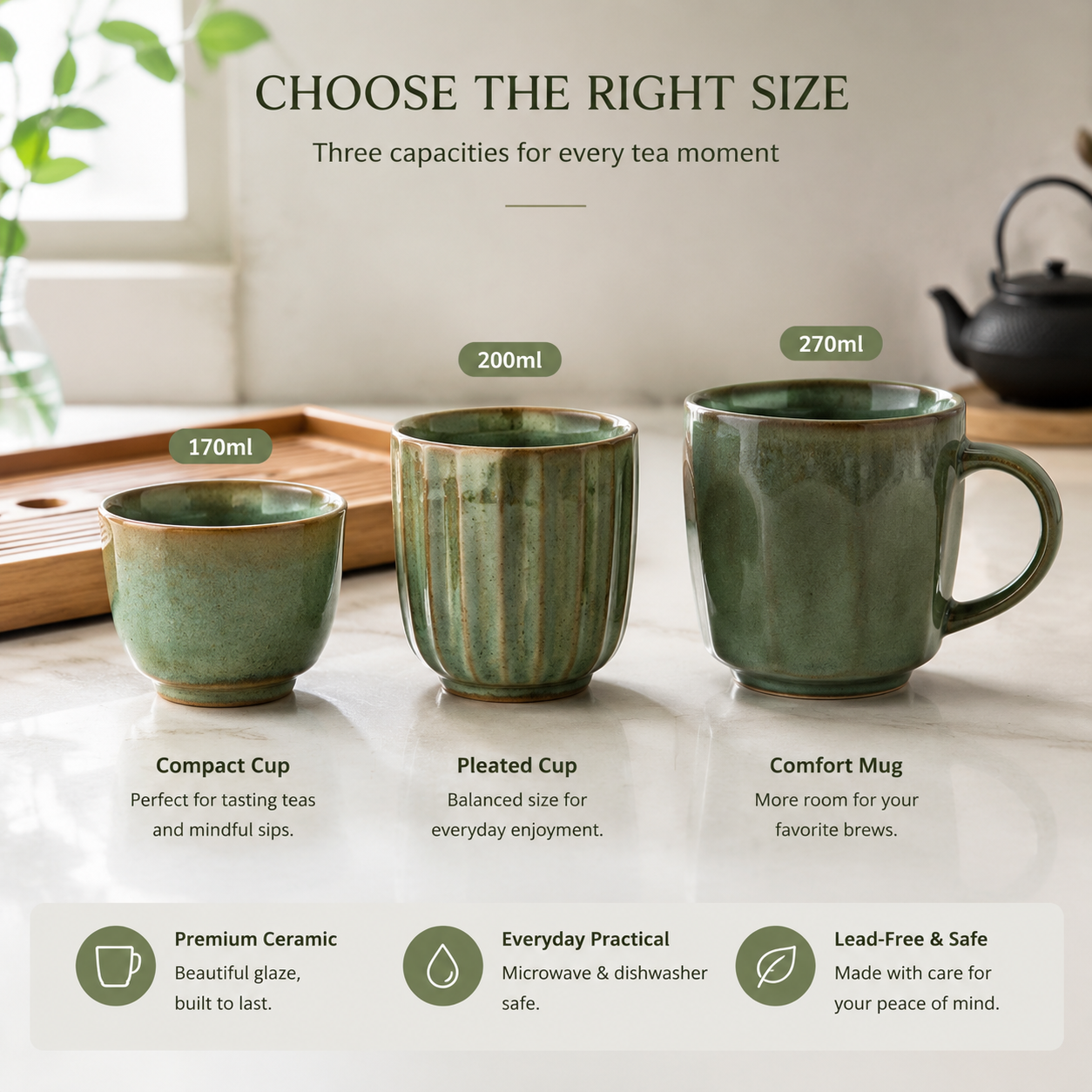
We keep the comparison below deliberately bounded. The catalog facts we can stand behind are the listed capacities: Retro at 170 ml, Pleated at 200 ml, and Emerald at 270 ml. We compare those figures with the shapes visible in the product presentation and the refill habits each size is likely to suit. We do not use styling names as proof of origin, authenticity, brewing performance, or unlisted care properties.
Which green tea mug capacity fits your refill routine?
The three options cover a 100 ml range from smallest to largest. That is enough to change how often you return to the kettle, but none should be mistaken for an oversized mug. The most practical choice depends on whether refilling is part of your tea ritual or an interruption.
| Option | Listed capacity | Likely best fit | Main trade-off |
|---|---|---|---|
| Retro Coffee Tea Cup | 170 ml | Small servings and frequent fresh refills | Least liquid per fill |
| Pleated Coffee Tea Cup | 200 ml | A middle ground for a desk or kitchen counter | Only 30 ml more than the Retro option |
| Emerald Coffee Tea Mug | 270 ml | Fewer refills among these three choices | Largest footprint and serving in this comparison |
The 30 ml step from Retro to Pleated is modest. Choose between those two primarily by visible style unless that extra amount matters to your usual pour. The Emerald holds 70 ml more than the Pleated and 100 ml more than the Retro, making it the clearer step up for someone who does not want to leave a meeting or focused work session for another refill.
Listed capacity still needs context. A catalog figure does not always tell you how much room a person prefers to leave below the rim for carrying the mug. If spills are a concern, compare the listed number with the amount you actually pour into your current cup rather than assuming every milliliter will be used.
How do the Retro, Pleated, and Emerald shapes differ?
Capacity explains the serving size. Visible shape explains much of the object’s presence on a shelf, desk, or gift table. We assess shape from the current product presentation rather than claiming measurements that are not listed.
- Retro, 170 ml: The compact cup profile suits a shopper who wants a smaller object beside a tea tray or on a crowded counter. Its lower capacity reinforces that visually compact role.
- Pleated, 200 ml: The visible pleated treatment adds exterior texture and more pronounced light-and-shadow detail than a plain surface. It fits someone who wants the cup itself to contribute pattern to a desk or open shelf.
- Emerald, 270 ml: The fuller mug presentation matches its larger listed capacity. It is the most direct choice of the three for a shopper who wants a more substantial single serving.
A visible shape should not be treated as evidence of better steeping or heat retention. Opening width, wall construction, total weight, and physical dimensions would need their own verified specifications. If those factors matter more than color or profile, review the live product information before ordering.
For a broader explanation of how cup profiles affect daily handling decisions, our ceramic tea mug guide to size, shape, and daily comfort covers the questions worth asking without assuming that every ceramic piece behaves the same way.
Ceramic options: what should you verify before checkout?
Ceramic is a category, not a complete specification. A product’s name or appearance alone does not establish its exact clay body, glaze process, microwave suitability, or dishwasher instructions. In our experience, shoppers avoid more disappointment by separating what is visible from what still needs confirmation.
- Read the material wording: Do not automatically replace ceramic with porcelain, stoneware, or another specific body. Use the exact terminology on the current product page.
- Inspect the rim in product images: Look for the visible rim profile and decide whether it appears compatible with your preference. Do not infer an exact thickness without a listed measurement.
- Check the base and foot area: On arrival, place the empty piece on a flat kitchen counter to check for noticeable rocking. A stable base matters on a busy office desk.
- Examine the surface under good light: Glaze skips, sharp chips, hairline cracks, and an unstable base are functional concerns. Minor visual variation may be decorative, but damage at the rim or base should not be treated as ordinary styling.
- Confirm care instructions: Ceramic appearance does not guarantee dishwasher or microwave compatibility. Follow the care wording supplied with the current listing or packaging rather than relying on a category-wide assumption.
This distinction is especially useful for gifts. Color and surface texture make the first impression during unboxing, but the recipient may care more about appliance compatibility or exact dimensions. If those details are essential and are not stated, confirm them before purchase.
Which of the three options matches a real daily scenario?
Small servings at a kitchen counter
Choose the Retro option if you intentionally pour smaller amounts and enjoy returning for another serving. Its 170 ml listed capacity fits that routine, and its compact presentation will make more sense than a larger mug on a small tea tray. It is not a strong fit for someone who finds refilling annoying.
A moderate cup beside a laptop
The Pleated option suits a shopper who wants a little more capacity than the Retro without moving directly to 270 ml. The 200 ml listing is a practical middle point, while the pleated exterior provides visible texture on an otherwise functional desk. Select the Pleated Coffee Tea Cup when that combination matters more than maximizing volume.
Fewer refills during focused work
The Emerald is the best fit among these three for a longer desk session because its listed 270 ml capacity is the largest in the group. The reason to choose it is straightforward: 70 ml more than Pleated and 100 ml more than Retro. It still is not a high-capacity solution for someone accustomed to very large mugs.
A gift selected mainly by visual style
If you do not know the recipient’s serving preference, capacity alone may not settle the decision. Compare the compact Retro profile, the textured Pleated presentation, and the fuller Emerald mug shape. Our guide to the best mug for tea by size, shape, and style can help you decide which variable deserves priority for a gift.
How can you compare capacity with the mug you already use?
A home measurement is more reliable than guessing from product photography. Mug photos can make different sizes look similar because framing and camera distance change from one listing to another.
- Fill your current mug to the level you normally use, leaving your usual carrying room below the rim.
- Pour that water into a metric measuring cup and record the amount.
- Compare your result with 170 ml, 200 ml, and 270 ml.
- Decide if you want the same serving, a smaller serving with more refills, or the largest option in this group.
- Check any listed height, width, or opening dimensions separately if shelf clearance or infuser fit is essential.
This short test often clarifies the purchase immediately. Someone currently pouring about 200 ml has little reason to select 170 ml unless a smaller serving is intentional. A shopper already using more than 270 ml should expect every option in this comparison to require a smaller pour or additional refill.
Who needs a different mug style?
These products are not universal choices. A different category or a fully specified listing will serve you better in several situations.
- If you require a large single serving above 270 ml, none of these three is the obvious capacity match.
- If a particular basket infuser must fit, confirm the opening diameter rather than relying on the listed volume.
- If dishwasher or microwave use is non-negotiable, purchase only after checking explicit care information.
- If you need a sealed commuter vessel, shop for a design that specifically lists a compatible lid and travel features.
- If cabinet clearance is tight, capacity cannot replace actual height and width measurements.
Style also has limits. A pleated surface may be attractive to someone who displays mugs on open shelving, while a shopper seeking a visually plain surface may prefer another shape. The correct trade-off is the one that matches repeated daily use, not simply the option that stands out most in a close-up photograph.
What should you check when the order arrives?
We recommend a brief inspection before putting any ceramic drinkware into regular use. It takes less than a minute and catches practical problems that color and capacity comparisons cannot.
- Set the empty item on a flat surface and check for obvious wobble.
- Inspect the rim and base in bright light for chips or hairline cracks.
- Check the exterior for sharp points or unintended rough areas.
- Compare the received shape and color with the current listing images, allowing for normal screen differences.
- Read the included care information before using a dishwasher or microwave.
Contact the store before use if you find shipping damage or a functional defect. Do not assume a crack, sharp chip, or unstable base is an acceptable feature of handmade-looking or textured ceramic.
Frequently asked questions
What size green tea mug is best if I like frequent refills?
The 170 ml Retro option is the clearest match among these three. It supports smaller servings and more frequent returns to the kettle, while the 200 ml Pleated option provides a modest 30 ml increase.
Is a 200 ml tea cup large enough for an office desk?
It can be if your usual serving is close to 200 ml and refilling is easy. Measure your normal pour first; shoppers who want fewer interruptions may prefer the 270 ml Emerald option.
Should I choose the 270 ml Emerald mug to reduce refills?
Yes, if you are choosing only among Retro, Pleated, and Emerald. Its listed capacity is 100 ml greater than Retro and 70 ml greater than Pleated, though it may still feel small to someone accustomed to an oversized mug.
Are these ceramic options dishwasher and microwave safe?
Do not infer care compatibility from appearance or the ceramic category. Check the current product page and any care information supplied with the item, because unlisted dishwasher or microwave performance should not be assumed.
Does the shape of a tea mug improve green tea brewing?
We do not assign brewing performance based on these visible shapes. Choose among them by listed capacity, visible profile, and refill preference unless the product page provides additional verified specifications.
Next step: Measure your current serving, write down whether you prefer frequent or infrequent refills, and choose 170 ml, 200 ml, or 270 ml before comparing color and surface style. If none of those capacities fits, return to the unique coffee mug collection and use your measured serving as the filter.
More from our blog
Read more
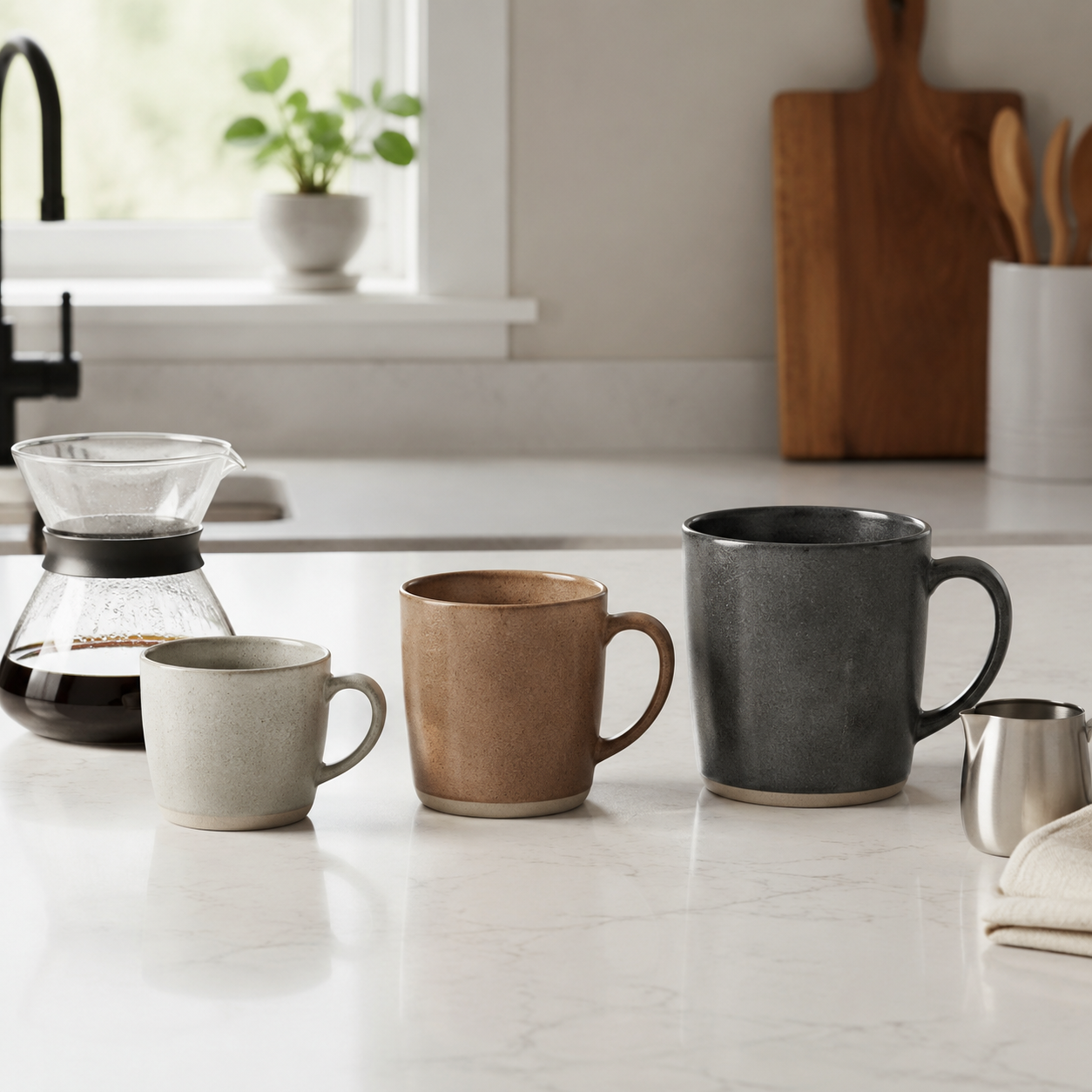
Cafe au Lait Mug Buying Guide: Capacity, Shape, Everyday Fit
Compare 400 ml, 440 ml, and 480 ml mugs using the amount you actually pour, the grip you prefer, and the space available on your desk or counter. This guide also explains what product photos can an...
Weiterlesen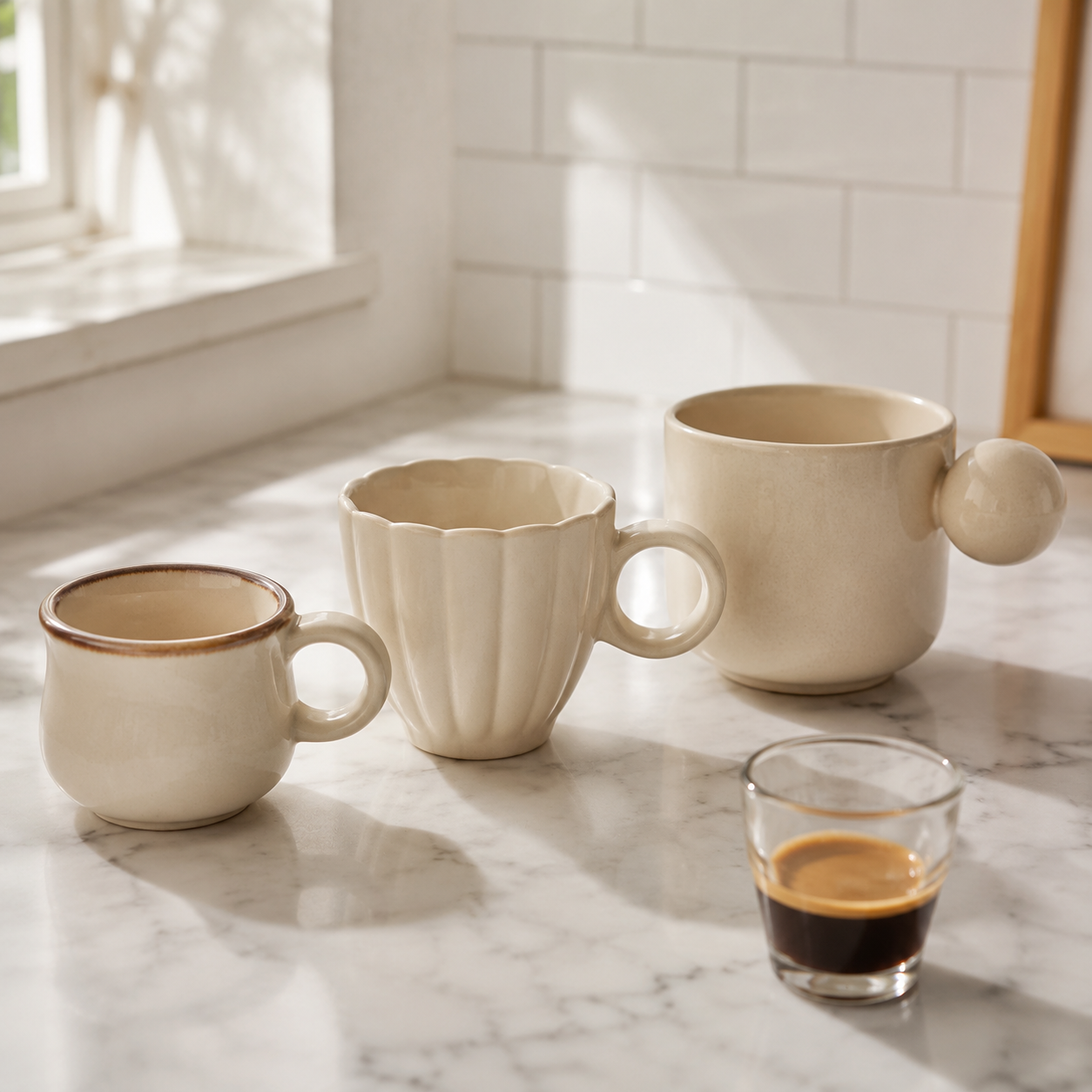
Ceramic Espresso Cup Buying Guide: Capacity, Size, and Honest Fit
Compare 170 ml, 200 ml, and 250 ml ceramic cups by serving size, machine clearance, grip, care, and real-world fit. This guide also explains why all three are larger than a traditional single-shot ...
Weiterlesen
Hinterlasse einen Kommentar
Diese Website ist durch hCaptcha geschützt und es gelten die allgemeinen Geschäftsbedingungen und Datenschutzbestimmungen von hCaptcha.