
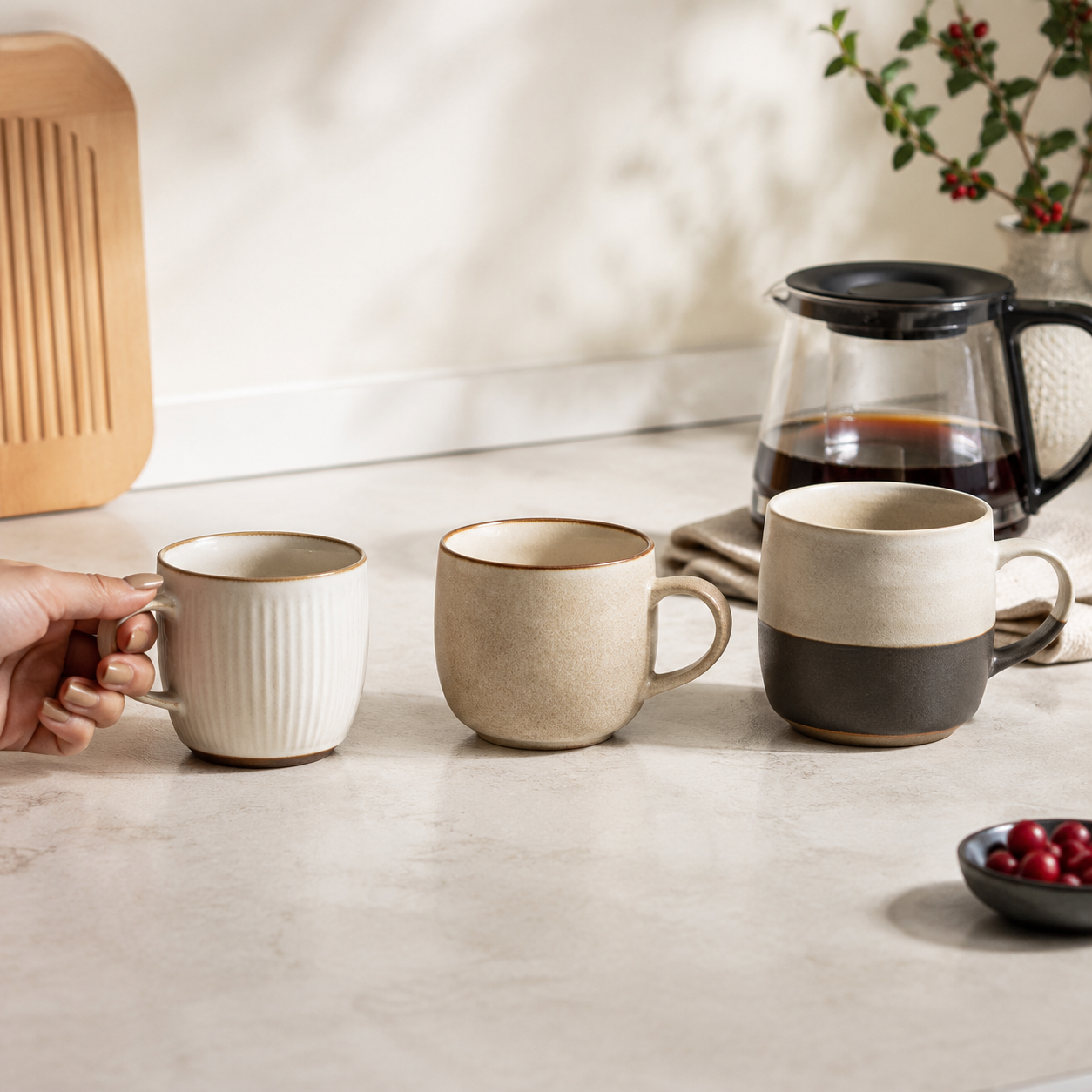
Decaf Coffee Cup Buying Guide: Capacity, Comfort, Daily Use
Reading time: about 10 minutes
A cup can look perfectly sized on a product page and still feel wrong after the first pour. It may leave too little room below the rim, make your fingers crowd the handle, or take up more desk space than expected. Choosing a decaf coffee cup is therefore less about the label on the drink and more about matching capacity, grip, and serving preference to the way you actually use it.
In our store, the most useful starting point is a real capacity comparison. Our current options include the 170 ml Retro Coffee Tea Cup, the 200 ml Pleated Coffee Tea Cup, and the 270 ml Emerald Coffee Tea Mug. Shoppers who want to compare these with other shapes and visual styles can also browse our unique coffee mugs collection.
Which decaf coffee cup capacity matches your usual pour?
Listed capacity is the maximum volume associated with the cup, but a comfortable serving normally stops below the rim. Filling right to the top makes the cup harder to carry from a kitchen counter to a desk and leaves little margin for a natural walking motion. As a practical check, start with the liquid level roughly 10 to 15 mm below the rim and adjust from there.
That usable headspace means a 170 ml cup should not automatically be treated as a full 170 ml serving vessel in daily use. The same principle applies to 200 ml and 270 ml cups. If you already have a favorite cup, fill it to your normal level, transfer that water to a measuring jug, and note the result. This simple kitchen test is more reliable than guessing from photographs.
- 170 ml: Best suited to a compact, intentional serving and a cup that does not linger on the desk for long.
- 200 ml: A middle option for shoppers who find a small cup restrictive but do not want a full-size mug.
- 270 ml: Better for a longer serving, more headspace, or fewer returns to the kitchen.
Capacity alone does not describe height, width, weight, or handle clearance. Two cups with the same volume can feel quite different because one is low and broad while another is taller and narrower. For a wider overview of how those variables interact, our coffee mug sizes guide explains how to compare capacity with everyday fit.
How do 170 ml, 200 ml, and 270 ml cups differ in daily use?
| Capacity | Likely best fit | Main advantage | Trade-off |
|---|---|---|---|
| 170 ml | Short serving at a table or kitchen counter | Compact footprint and a focused serving | Requires more frequent refilling if you prefer a longer drink |
| 200 ml | Moderate serving for a desk, breakfast table, or afternoon break | Balances compact size with extra room | May still feel small to habitual large-mug users |
| 270 ml | Longer serving or added space below the rim | More capacity without moving into oversized-mug territory | Takes up more room and may feel less delicate in hand |
The 170 ml Retro Coffee Tea Cup is the logical next step for someone who serves a compact portion and values a smaller vessel. It is not the best match for a person who dislikes refills or regularly adds enough extras to need substantial headspace.
The 200 ml Pleated Coffee Tea Cup suits the shopper who wants a little more room while keeping the serving controlled. This capacity often makes sense on a busy desk because it avoids the visual and physical bulk of a large mug, though buyers with a generous usual pour should measure first.
The 270 ml Emerald Coffee Tea Mug fits someone who wants a longer serving or a more forgiving gap beneath the rim. It is the strongest option of these three for fewer refills. It is not intended to replace a genuinely large mug, and it may be too roomy for someone who consistently prefers a short serving.
What makes a handle comfortable at a desk or kitchen counter?
Handle comfort cannot be judged by appearance alone. In our experience handling cup and mug choices, buyers notice three contact points after repeated use: finger clearance inside the handle, pressure against the knuckles, and the place where the thumb rests while lifting. A decorative handle may photograph well but still feel cramped if the opening does not suit the user's hand.
Use this grip check as soon as the cup is unpacked:
- Place the empty cup on a level counter and slide your preferred fingers through the handle without forcing them.
- Check whether your knuckles press against the cup wall or the inner edge of the handle.
- Rest your thumb naturally along the upper handle area instead of pinching tightly.
- Add water to your normal serving level and lift the cup a few centimeters above the counter.
- Tilt it gently toward you and notice whether the weight pulls uncomfortably on one finger.
A one-finger grip can suit a small, light serving, while a shopper with larger hands may prefer room for two or more fingers. Neither is universally better. The relevant question is whether the grip remains controlled after the cup is filled. People with limited hand comfort should prioritize generous clearance and a balanced lift over a highly decorative handle.
Desk use adds another variable: the handle should be easy to reach without rotating the cup around a keyboard, notebook, or monitor stand. Left-handed users should also look at the product images carefully if a cup has directional decoration. The handle itself may work on either side, but the preferred face of the design might point away from the user.
How much headspace do you need for carrying and serving?
Usable capacity and listed capacity are not identical in practice. A shopper who pours close to the rim should choose more volume than the measured amount of the usual serving. That extra room is useful when carrying the cup across a room, setting it beside a laptop, or lifting it from a crowded breakfast table.
Start by measuring the serving you already make, then account for the way you use the cup:
- Mostly seated at the same counter: A smaller headspace margin may feel acceptable because the cup travels only a short distance.
- Carried to an office desk: Allow more room below the rim to reduce spills during the walk.
- Served to guests: A moderate fill looks considered and is easier to pass safely than a cup filled to the edge.
- Used with ice: These compact capacities can become restrictive once cubes occupy part of the interior. A larger mug may suit that serving preference better.
If your measured serving is already near 270 ml before leaving headspace, none of the three highlighted capacities is likely to be the right fit. A larger coffee mug comparison will be more useful than trying to make a compact cup serve a large-mug routine.
Will the cup fit your shelf, machine, and work area?
Capacity does not guarantee physical fit. Before ordering, inspect the current product page for overall dimensions when available and compare them with the spaces that matter in your routine. Measure shelf height, the distance beneath any coffee outlet you use, and the clear area beside your keyboard or workstation.
The base matters too. A broad base can occupy more desk space but may feel settled on a flat surface. A narrower base saves room, although the cup's overall balance still depends on its shape and filled weight. If you use a cup warmer, serving tray, or vehicle holder, measure the usable surface or opening rather than relying on a capacity label.
A milliliter figure tells you how much a cup holds. It does not tell you how much room the handle needs beside it or whether the cup clears the shelf above.
For a small kitchen, also think about storage orientation. Handles consume lateral shelf space, and decorative profiles do not always nest or stack. Do not stack cups unless their form is intended for it; rim-to-base contact can cause scuffing or chips over time.
What should you inspect before first use and during care?
We recommend inspecting any new cup in bright, indirect light before washing it. Pay close attention to the rim, the two handle attachment points, and the foot ring underneath. These are common places to spot a small chip, hairline crack, rough patch, or an uneven area that may affect use.
Set the empty cup on a flat counter and press lightly near the rim from several directions. A stable cup should not rock noticeably. Then run a fingertip carefully around the drinking rim to check for sharp or rough spots. Do not use a cup that arrives cracked, has a loose-feeling handle, or shows damage at a handle joint.
Material and finish also affect care, but neither should be inferred from a styled photograph. Check the current product listing or packaging for dishwasher and microwave directions. If dishwasher use is permitted, place the cup so the handle cannot knock against another item during a cycle. For hand washing, use a soft sponge, avoid abrasive pads on decorative finishes, rinse around the foot ring, and let the cup dry fully before returning it to a closed cabinet.
Abrupt temperature changes can be hard on many cup materials, so follow the stated care instructions and avoid moving a cup directly between extreme conditions unless its product guidance specifically allows it. This guide does not claim that every cup in the collection has identical material or care requirements; verify those details on the individual listing before purchase.
Which capacity makes the most practical gift?
A gift cup should reflect the recipient's actual routine, not only the giver's preferred design. For someone known to use compact tableware and short servings, the 170 ml Retro cup offers a capacity aligned with that habit. For an uncertain recipient, the 200 ml Pleated cup is the middle choice: it provides more room than the smallest option without committing to a large mug.
The 270 ml Emerald mug is the better gift direction for a person who tends to keep one cup at a desk or prefers fewer refills. It still is not a substitute for an oversized vessel. If the recipient regularly uses large drinkware, compare broader options in the unique mug collection before selecting solely by appearance.
At gift unboxings, the first details people tend to handle are the rim, handle, and decorative surface. Check the cup promptly after delivery, retain its protective packaging until the inspection is complete, and confirm that the recipient's preferred capacity is compatible with the cup. Shoppers choosing primarily for presentation may also find our fancy coffee cup buying guide useful for balancing visual character with everyday usability.
Frequently asked questions
What size decaf coffee cup should I buy?
Choose 170 ml for a compact serving, 200 ml for a moderate middle option, or 270 ml for a longer serving with more room below the rim. Measure the amount you normally pour and add headspace rather than selecting from product photos alone.
Is a 170 ml cup too small for daily use?
It is not too small for someone who deliberately prefers a short serving and does not mind refilling. It is a poor fit for a large usual pour, substantial headspace, or an iced serving that needs room for cubes.
How can I tell if a coffee cup handle will be comfortable?
Check how many fingers fit naturally, whether your knuckles touch the cup wall, and whether your thumb has a stable resting point. Test the grip again with water added because a handle that feels comfortable on an empty cup may distribute weight differently when filled.
Should I choose a 200 ml or 270 ml cup?
Choose 200 ml if you want a compact cup with more room than a 170 ml option. Choose 270 ml if you value a longer serving, extra headspace, or fewer trips back to the kitchen, provided the larger footprint suits your shelf and desk.
Can I put my decaf coffee cup in the dishwasher or microwave?
Only do so if the current product listing or packaging confirms that use for the specific cup. Decorative appearance does not establish material or appliance compatibility, and care directions can differ between products.
A final 30-second comparison before ordering
- Measure your normal serving instead of estimating it.
- Leave practical space below the rim for carrying.
- Choose 170 ml for compact use, 200 ml for a middle capacity, or 270 ml for a longer serving.
- Check handle clearance against your preferred finger grip.
- Measure shelf, machine, warmer, tray, or desk clearance where relevant.
- Confirm the current material and care instructions on the product page.
- Select a larger style if 270 ml does not accommodate your serving plus headspace.
Once those points are clear, compare the available shapes in our unique coffee mugs collection and choose the capacity that fits the way the cup will actually be poured, carried, held, and stored.
Read more
Wildlife Coffee Mug Guide: Compare Three Current Listings
A fact-bound comparison of three current CoffeifyMug listings identified by koi fish, crane, and elk-and-moon subjects, with practical steps for checking current photos and listing details before b...
Weiterlesen
Americano Coffee Cup Guide: Capacity and Headroom
Compare 200 ml, 270 ml, and 350 ml cups using your planned pour and preferred headroom. This guide shows the capacity trade-offs without assuming a universal Americano size.
Weiterlesen
Hinterlasse einen Kommentar
Diese Website ist durch hCaptcha geschützt und es gelten die allgemeinen Geschäftsbedingungen und Datenschutzbestimmungen von hCaptcha.