
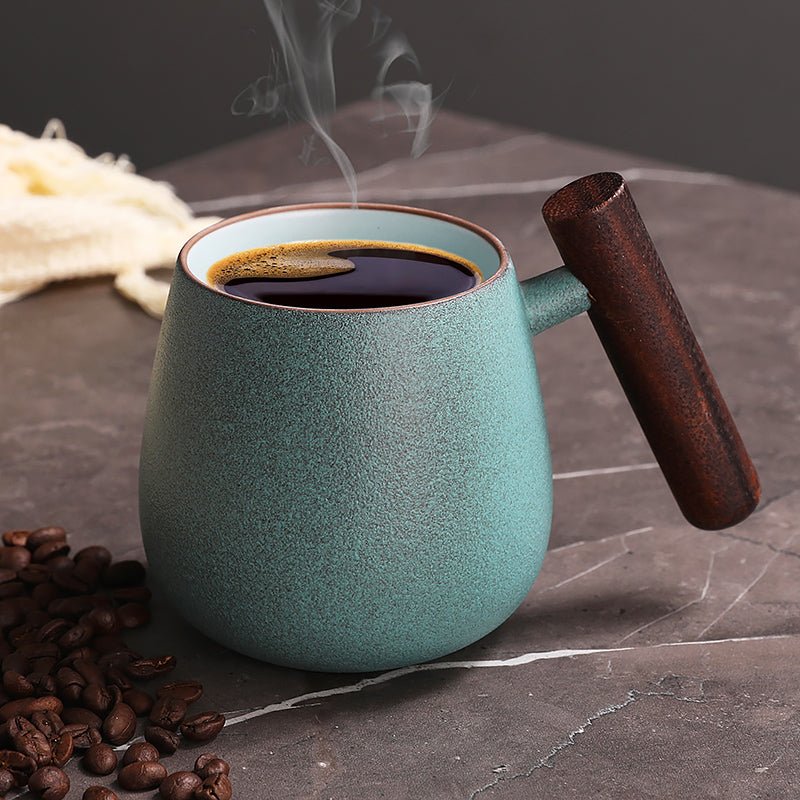
Cacao cup for small coffee setup: compare size and capacity
Reading time: about 8 minutes
A cup can fit your preferred serving and still be awkward in a small kitchen. We see this most often when a buyer checks milliliters but not shelf width, handle clearance, or the space needed to lift the cup past a cabinet. A cacao cup for small coffee setup needs to work in storage, during preparation, and wherever you actually drink it. Among our current options, the listed capacities range from 250 ml to 400 ml, but capacity alone does not reveal which shape will occupy the least useful space.
For a concrete starting point, compare the Ball Handle 250 ml coffee and tea mug with the broader selection in our unique coffee mug collection. The Ball Handle has the lowest listed capacity in this comparison, yet its listed 11.2 cm diameter means it should not automatically be treated as a narrow cup.
Why does shelf width matter as much as cup capacity?
Small-space buyers often assume that the lowest-capacity cup must have the smallest footprint. Cup geometry makes that unreliable. A low, open shape can use more shelf width than a taller mug holding a similar amount, while a projecting handle can determine how many pieces fit side by side.
Measure the storage position before ordering. We recommend recording three numbers:
- Usable shelf width: Measure between neighboring mugs, shelf supports, or cabinet walls rather than measuring the empty cabinet.
- Usable depth: Allow enough room that the cup does not sit against the cabinet door.
- Vertical lifting clearance: Leave space for your fingers and for tilting the cup past the shelf above.
The Ball Handle option is listed with an 11.2 cm diameter. Compare that figure with your available shelf area using a ruler or a paper circle before buying. This quick check is more dependable than judging scale from a product image alone.
Cacao cup for small coffee setup: 250, 390, or 400 ml?
The right capacity depends on what goes into the cup after the cacao is mixed. Listed capacity and comfortable carrying volume are not identical. A drink filled close to the rim leaves little room for stirring, milk, foam, or walking from the kitchen to a desk.
| Option | Listed size | Situation it fits | Main trade-off |
|---|---|---|---|
| Ball Handle | 250 ml; listed 11.2 cm diameter | Shorter everyday servings and buyers who want to limit drink volume | Lower capacity does not guarantee a narrow shelf footprint |
| Round | 390 ml | Larger milk-based cacao, extra stirring room, or a longer drink | More volume to store and carry than the 250 ml option |
| Spittoon | 400 ml | Buyers prioritizing the largest listed capacity and an open-looking presentation | Only 10 ml more than the Round, so shape should decide the comparison |
For a smaller serving, the Ball Handle is the direct next product to inspect. If you regularly add milk or leave generous headroom, review the Round 390 ml coffee and tea mug. Buyers comparing the largest listed option can then check the Spittoon 400 ml coffee and tea mug.
These are everyday coffee and tea mug designs being compared for cacao use. We are not presenting them as traditional, ceremonial, certified, or purpose-built cacao vessels.
What does the visible opening change during daily use?
The opening affects more than appearance. An open cup gives a spoon more working room and makes the surface of a foamy or garnished drink easier to see. It also exposes more liquid at once, which can allow a hot drink to cool sooner than it would in a narrower shape. The actual result depends on the drink temperature, room conditions, and cup construction, so treat this as a geometry trade-off rather than a performance promise.
In our experience handling mug orders, product photos are most useful when shoppers inspect the opening in relation to the base and handle. Do not judge the opening in isolation. Look at the full silhouette and ask where the widest point sits, because that point controls shelf spacing and how comfortably the cup fits near a compact brewer.
A very open shape is not the best choice for every desk. If your cup sits beside a keyboard, paperwork, or a frequently bumped mouse area, a narrower vessel or a lidded travel mug may be more practical.
How much counter clearance should you leave near a compact brewer?
A mug does not only occupy the area directly under it. You need room to set it down, stir without hitting another object, and lift it without catching a handle on the brewer or wall. On a tight counter, place a paper template matching the listed 11.2 cm diameter of the Ball Handle and test the movement with your usual spoon.
- Mark the cup position beside or beneath your brewer.
- Leave room for the handle or gripping area on the side you naturally use.
- Check that a spoon can rotate without striking a jar, kettle, or backsplash.
- Move the template along the route from preparation area to sink.
If a 250 ml drink already meets your needs, extra capacity may add bulk without improving the routine. Buyers who prepare larger coffee drinks in the same area can also use our 12 oz mug comparison for small coffee setups to judge how a roughly mid-sized coffee format fits their storage plan.
Which option fits a kitchen counter, office desk, or gift?
For a compact kitchen: Start with the serving size you make most often, then verify the widest listed or visible point. The Ball Handle 250 ml fits the buyer who wants the lowest capacity in this group, but the listed 11.2 cm diameter still needs a physical shelf check.
For a home office: Choose enough capacity to avoid repeated refills, but do not ignore stability and spill exposure. The Round 390 ml gives more stated volume than the 250 ml option. It is not ideal if the only open space is a narrow strip between a monitor stand and keyboard.
For generous servings: The Spittoon is listed at 400 ml. That makes it the largest option here, although the 10 ml difference from the Round is small. Compare the visible opening, gripping method, and overall shape rather than buying on the 400 ml number alone.
For gifting: Confirm the recipient's normal drink size and storage situation. During gift unboxings, an unusual silhouette can make a stronger first impression, but novelty does not solve a poor cabinet fit. A recipient who mainly drinks concentrated coffee may get more use from a smaller format; our small-space cortado cup comparison covers that different use case.
What should you inspect before the first drink?
We recommend checking any cup in bright light as soon as it is unpacked. Shipping damage is often easier to spot before the cup has been washed or placed among other dishes.
- Run a finger carefully around the rim and check for chips or sharp points.
- Inspect any handle attachment or shaped grip for visible hairline cracks.
- Set the empty cup on a flat counter and confirm that the base rests steadily.
- Check the current product page for material-specific washing and temperature instructions.
- Use a dishwasher only if the current care guidance permits it, and position the cup so it cannot knock against heavier dishes during the cycle.
Avoid sudden temperature changes unless the product instructions explicitly support them. Moving a cold cup directly into very hot conditions can stress many drinkware materials. After washing, dry the base before returning the cup to a wood shelf or placing it on paperwork.
Frequently asked questions
Is a 250 ml cacao cup large enough for daily use?
It can be if you prefer a shorter cacao serving and do not add a large amount of milk, foam, or toppings. The Ball Handle is listed at 250 ml, but leave practical headroom rather than planning to carry it filled to the rim.
Does a cacao cup for small coffee setup need the lowest capacity?
No. The smallest stated capacity may still have a broad diameter or projecting handle. Compare the widest point, shelf depth, and lifting clearance alongside the milliliter figure.
Should I choose the 390 ml Round or 400 ml Spittoon cup?
The capacity difference is only 10 ml, so it should not be the deciding factor for most buyers. Use the product photos to compare visible opening, silhouette, gripping area, and how each shape will fit your shelf or desk.
Is a wide opening better for a cacao drink?
A wider-looking opening can provide room for stirring and a clear view of foam or toppings. It may also expose more of the drink to room air and create a larger spill area, so it is less suitable for crowded desks or buyers who drink slowly.
Can these cups also be used for coffee or tea?
The linked products are listed as coffee and tea mugs, and this comparison evaluates them as everyday drinkware that could also suit cacao. Check the current material and care information on each product page before deciding how it fits your routine.
Use this seven-point checkout test
Before placing an order, check the choice against your actual space:
- Choose your normal drink volume, not your occasional largest serving.
- Allow headroom for stirring and carrying.
- Measure shelf width, depth, and lifting clearance.
- Compare the widest visible point, not only the base.
- Check spoon and handle clearance near your brewer.
- Confirm current material and care instructions on the product page.
- Reject a larger cup if the extra capacity will rarely be used.
For the lowest listed capacity, begin with the 250 ml Ball Handle and verify its 11.2 cm diameter against your shelf. For larger servings, compare the 390 ml Round directly with the 400 ml Spittoon by shape rather than by the small difference in volume. You can then browse our current unique coffee mug collection and choose the cup whose dimensions, opening, and serving capacity match the space you use every day.
More from our blog
Read more
Wassail Mug for Desk Use: Capacity, Footprint, and Fit
Compare CoffeifyMug's 400 ml, 440 ml, and 480 ml options by refill frequency, working footprint, and handle clearance. Includes practical checks for compact desks, keyboards, monitor stands, and sh...
Weiterlesen
Ceramic Sculptural Mug for Small Coffee Setup: What to Compare
Compare how 250, 310, and 400 ml sculptural ceramic mugs use limited shelf and counter space. This guide covers capacity, handle clearance, cleaning, stability checks, and who each current Coffeify...
Weiterlesen
Hinterlasse einen Kommentar
Diese Website ist durch hCaptcha geschützt und es gelten die allgemeinen Geschäftsbedingungen und Datenschutzbestimmungen von hCaptcha.