
Unique Pottery Coffee Mugs Capacity Guide: 200-350 ml Fit
Reading time: about 10 minutes
A mug that looks generous in a product photo can feel surprisingly small after you add milk, while a larger cup may leave a short coffee cooling across a wide empty interior. This unique pottery coffee mugs capacity guide compares the three listed sizes in our current selection - 200, 270, and 350 ml - against the way people actually pour drinks at a kitchen counter or office desk. We begin with the compact Rhombus Coffee Tea Mug, then place it within our broader unique coffee mug collection so you can compare capacity without losing sight of style.
In our store, the most useful capacity question is not simply, “Which mug is biggest?” It is, “How much do I normally pour, and how much empty space do I want above it?” Listed capacity gives you a consistent comparison point. It does not mean you must fill a ceramic mug to the rim, where carrying it from the coffee machine to a desk becomes awkward.
Unique pottery coffee mugs capacity guide: 200, 270, or 350 ml?
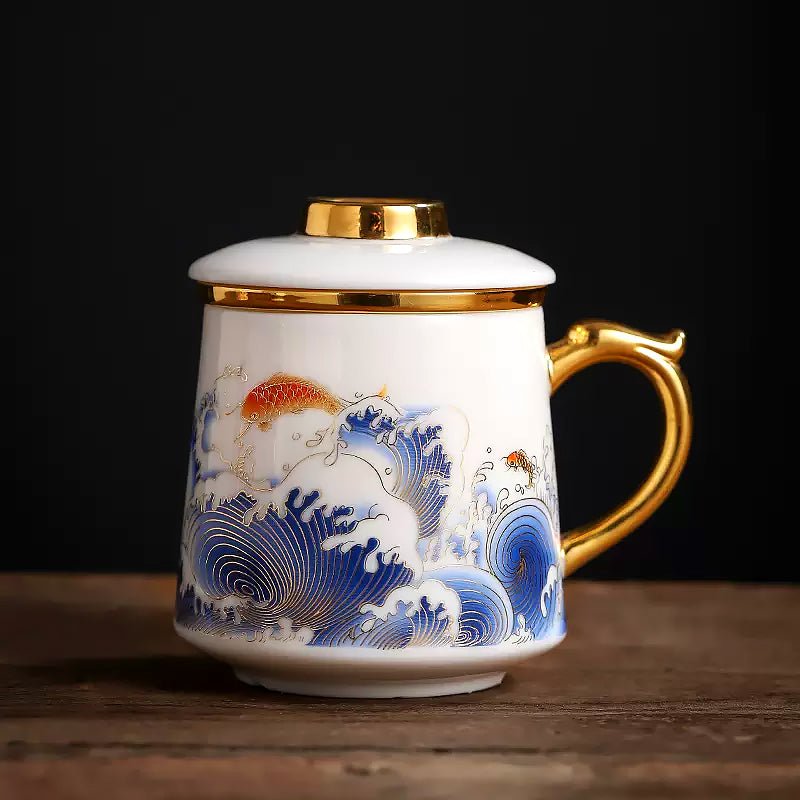
The current product pages in this comparison form three practical capacity steps. The Rhombus mug is the 200 ml option, the Mountain Sea Coffee Tea Mug provides 270 ml, and the Golden Waves Kio Coffee Tea Mug reaches 350 ml. Those capacities equal approximately 6.8, 9.1, and 11.8 US fluid ounces respectively. The ounce figures are rounded conversions, so use the milliliter listings as the primary product comparison.
| Current mug | Listed capacity | Approx. US fl oz | Best daily fit | Main trade-off |
|---|---|---|---|---|
| Rhombus Coffee Tea Mug | 200 ml | 6.8 fl oz | Short coffee, modest tea serving, controlled portions | Likely to require a refill for a long desk session |
| Mountain Sea Coffee Tea Mug | 270 ml | 9.1 fl oz | Medium coffee or tea with practical carrying space | May still be small for a large milk drink or an ice-heavy pour |
| Golden Waves Kio Coffee Tea Mug | 350 ml | 11.8 fl oz | Long coffee, larger tea, or fewer refills | More mug than necessary for espresso-size servings |
Capacity alone does not tell you the mug's exterior dimensions, weight, or how the handle will feel in your hand. Review the current product page for those listing-specific details before ordering. Product information can also change, so the linked listing remains the source of truth for the version currently available.
Which size fits a short coffee without looking oversized?
A 200 ml pottery mug makes sense for someone who pours a compact black coffee, a small coffee with a little milk, or a focused tea serving. If your normal drink is around 150 to 170 ml, the Rhombus leaves roughly 30 to 50 ml of theoretical space below its listed capacity. That is a planning example rather than a measured fill line, but it shows why the smaller mug can be easier to carry without liquid sitting close to the rim.
The trade-off is straightforward. A 200 ml mug is not a good fit for someone who expects one fill to last through a long meeting, adds a large amount of steamed milk, or prefers a tall iced drink. A 400 ml morning routine would mean two full nominal fills. For those habits, buying the smallest design because it looks appealing often leads to more trips back to the kitchen.
This size also keeps a short serving visually proportionate. A small coffee in a 350 ml vessel can look lost, and the larger exposed interior may not provide the compact drinking experience that espresso and cortado drinkers usually want. Readers comparing smaller portions can also use our ceramic cortado cup capacity guide for a more drink-specific comparison.
Is 270 ml the practical middle size for coffee and tea?
For many routines, 270 ml is the flexible middle ground. A 220 to 240 ml pour leaves a hypothetical 30 to 50 ml below the listed maximum, giving you room to lift the mug, walk across the kitchen, and set it beside a keyboard with less risk than a brim-level fill. That is why we would point a shopper with one moderate morning coffee or a standard loose-leaf tea routine toward the Mountain Sea mug.
- Reader situation: You make a medium black coffee and dislike frequent refills. Why it fits: 270 ml gives more working room than the compact 200 ml option. Next step: Check the Mountain Sea product page.
- Reader situation: You add a modest amount of milk but do not make a large latte. Why it fits: The middle capacity accommodates additions without automatically moving to the largest mug. Next step: Compare your finished recipe with 270 ml.
- Reader situation: You alternate between coffee and tea. Why it fits: The capacity is neither specialized for a very short serving nor committed to a large drink. Next step: Confirm the listing details and available design options.
The 270 ml mug is not automatically the best choice for every buyer. Someone who uses a 300 ml coffee machine setting will have little or no practical headspace, while a person who drinks only 90 ml of coffee may find it unnecessarily large. If Americano volume is your main concern, our Americano coffee cup capacity comparison examines the same 200, 270, and 350 ml steps from that drink's perspective.
Who actually benefits from the 350 ml pottery mug?
The 350 ml Golden Waves Kio option fits shoppers who know that a 200 or 270 ml cup will send them back for a refill. It is the strongest match here for a long black coffee, a generous tea serving, or a finished drink around 300 ml that still needs carrying space. Using 300 ml as an example leaves 50 ml between the beverage volume and the listed capacity.
It is also the most workable of these three choices for cold drinks because ice occupies volume before coffee or milk is added. Still, 350 ml should not be confused with a large insulated tumbler. A heavily iced recipe can use the available space quickly, and these pottery coffee mugs are not presented here as sealed travel vessels. Choose dedicated travel drinkware if you need a locking lid, bag-safe transport, or long-duration insulation.
The larger mug has another limitation: it may encourage an oversized vessel for a drink that is intentionally short. If you make espresso-size servings, small cappuccinos, or concentrated tea, the extra interior space provides little practical benefit. In that situation, the 200 ml mug is the more proportionate next step even if the 350 ml design initially catches your eye.
How should headspace change your capacity decision?
Headspace is the difference between the listed capacity and your actual pour. We see shoppers miss this detail because recipes are often described by beverage volume, while a mug listing states its maximum nominal capacity. Filling to that maximum may leave no comfortable margin for walking, stirring, milk foam, or a tea infuser.
- Measure the finished drink you make most often, including milk or added hot water.
- Add the empty space you personally prefer. As a simple planning exercise, 20 to 50 ml can show how quickly a nominal capacity is used, but it is not a required standard.
- Account for anything placed inside the mug, including ice, a tea infuser, or foam.
- Choose the smallest current mug that holds the complete drink with your preferred margin.
For example, a 250 ml finished drink does not fit comfortably into a 270 ml mug if you want 30 ml of space at the top; the total requirement becomes 280 ml. The 350 ml option is then the better fit. A 160 ml drink plus 30 ml of preferred headspace totals 190 ml, making the 200 ml mug a closer match.
How do office desks, kitchen refills, and gift routines affect fit?
At a kitchen table, a smaller mug is easy to refill because the kettle or coffee maker is close. At an office desk, capacity often matters more: interrupting a call for a second pour is inconvenient, but leaving a large drink untouched can mean the last portion is no longer at the temperature you enjoy. The best capacity balances refill tolerance with drinking pace.
For a gift, avoid assuming that bigger is always more useful. A recipient who drinks short black coffee may appreciate the 200 ml format, while a tea drinker who settles in with one substantial cup may get more use from 350 ml. If you do not know the person's exact recipe, 270 ml is the lower-risk middle option among these three, though color, form, handle preference, and storage space still matter.
Check cupboard clearance as well. Capacity describes internal volume, not the full footprint created by the body and handle. Buyers with shallow shelves, crowded mug hooks, or a compact dishwasher rack should review all dimensions and care statements shown on the specific listing rather than inferring them from milliliters.
What care details should you confirm for pottery coffee mugs?
The product page should govern product-specific care. We do not assume that every decorated or glazed pottery mug is microwave-safe or suitable for repeated dishwasher cycles unless the listing says so. This distinction matters because ceramic body composition, glaze, decoration, and firing method can affect the manufacturer's care guidance.
For general handling, our team recommends a few practical checks that apply to ceramic drinkware without replacing the listing instructions:
- Inspect the rim, base, and handle attachment after unboxing for chips or visible hairline cracks before first use.
- Wash the mug before the first drink using the method stated on its product page.
- Use a soft sponge rather than an abrasive pad on glazed or decorated surfaces.
- Avoid abrupt temperature changes, such as moving a very hot ceramic mug directly into cold water.
- Stop using a mug for hot drinks if a crack develops through the body or around the handle attachment.
Small variations in surface character can be part of the appeal of pottery-style drinkware, but a sharp rim chip, unstable base, or structural crack is not a decorative variation. Photograph any shipping damage promptly and keep the packaging while the order is being reviewed.
Your capacity checklist before opening the product pages
- Choose 200 ml if your finished drink is compact and you accept more frequent refills.
- Choose 270 ml for a medium coffee or tea routine with moderate headspace.
- Choose 350 ml for a roughly 300 ml finished drink, fewer refills, or some room for ice.
- Measure milk, water, foam, and ice as part of the total drink rather than counting coffee alone.
- Confirm dimensions, material details, care instructions, and current availability on the individual listing.
Once you know your normal finished volume, return to the unique coffee mugs collection and compare only the sizes that clear that requirement. This keeps an attractive glaze or shape from distracting you into buying a mug that is consistently too small or unnecessarily large.
Frequently asked questions
How should I use this unique pottery coffee mugs capacity guide?
Measure the complete drink you normally prepare, then add the headspace you want for carrying or stirring. Match that total against the listed 200, 270, or 350 ml capacity, and confirm all current product details on the linked listing before ordering.
Is a 200 ml pottery mug large enough for coffee with milk?
It can be if the finished drink remains below 200 ml and you leave enough room at the rim. It is not a practical choice for a large milk-based coffee; the 270 or 350 ml option will usually provide a more workable volume.
How many ounces are 200, 270, and 350 ml?
They convert to approximately 6.8, 9.1, and 11.8 US fluid ounces. These are rounded mathematical conversions, while the milliliter value on the product page is the better figure for comparing the current mugs.
Is the 350 ml mug suitable for iced coffee?
It is the most accommodating option in this three-size comparison because ice takes up part of the listed capacity. It is still smaller than many dedicated iced-drink tumblers and should not be treated as sealed travel drinkware.
Where can I compare the current pottery mug designs?
Start with the CoffeifyMug unique coffee mug collection, then open the Rhombus, Mountain Sea, and Golden Waves Kio listings that match your required capacity. Verify the current dimensions, care directions, materials, and availability on the product page before making the final choice.
More from our blog
Read more
Plain White Ceramic Coffee Mugs Capacity Guide: Daily Fit
Compare the current 400, 440, and 480 ml white ceramic mug options by serving routine, refill frequency, drink headroom, design, and care needs.
Read more
Dandelion Coffee Mug Capacity Guide: 400 ml vs 480 ml
Compare the 400 ml Gradient and Flow mugs with the 480 ml Rock. See how the 80 ml difference affects refills, desk use, handle comfort, tea, and gifting.
Read more
Los kommentaar
This site is protected by hCaptcha and the hCaptcha Privacy Policy and Terms of Service apply.