
Piccolo Cup Capacity Guide: 170, 250, or 270 ml?
Reading time: about 10 minutes
A cup can look suitably compact online and still feel too large once a short coffee is sitting at the bottom of it. The reverse problem appears at office desks: a small cup suits the first pour, but repeated trips to the kitchen become tiresome. This piccolo cup capacity guide compares the three relevant sizes currently in our store - 170 ml, 250 ml, and 270 ml - so you can choose by actual serving routine rather than by the product photo alone.
We sell these as coffee and tea cups or mugs that can suit different piccolo-style routines. We do not present any of them as a certified piccolo cup, and capacity does not prescribe a milk-to-coffee ratio. Recipes, machines, and personal preferences vary. The useful question is simpler: how much room do you want around your usual drink, and how often are you comfortable refilling?
Piccolo cup capacity guide: what changes between 170, 250, and 270 ml?
The difference between the smallest and largest option is 100 ml, which is about 3.4 US fluid ounces. That gap is noticeable in the hand and during a serving, even though all three remain below the capacity of many standard large mugs.
| Listed capacity | Approximate US fluid ounces | Likely daily fit | Main trade-off |
|---|---|---|---|
| 170 ml | 5.7 fl oz | Compact coffee, short tea serving, or controlled portions | Least room for extra milk and most frequent refills |
| 250 ml | 8.5 fl oz | Longer coffee, flexible milk addition, or a moderate tea serving | May feel oversized for a very short piccolo-style drink |
| 270 ml | 9.1 fl oz | Desk use, slower drinking, or fewer kitchen trips | Leaves the most empty space around a small serving |
Capacity is a maximum volume reference, not a target fill line. A cup filled to the rim is awkward to lift, especially when moving from a kitchen counter to a desk. If appearance and proportions matter to you, compare your normal prepared drink volume with the listed capacity and leave some headspace.
The most compact current path is the Retro Coffee Tea Cup at 170 ml. Shoppers who want to compare more shapes beyond these three capacity matches can also browse our unique coffee mugs collection.
170 ml: who benefits from the smallest current option?
The 170 ml Retro cup is the closest fit among these choices for someone who deliberately makes a short drink. It limits the amount of unused space around a compact serving and can make a small coffee look more proportionate at the table. In our experience, this is the capacity shoppers tend to prefer when they care more about a focused serving than about stretching one drink across a long work session.
Situations where 170 ml makes practical sense include:
- A short coffee prepared and finished near the kitchen rather than carried around for an hour.
- A controlled morning serving for someone who dislikes oversized mugs.
- A small tea pour that will be refreshed from a nearby pot.
- A gift for a person known to choose compact cups over large desk mugs.
The limitation is refill frequency. If your prepared drink already approaches 170 ml, there will be little safe carrying room at the top. It is also not the strongest option for a generous milk addition, a long black coffee, or a drink that needs space for stirring without splashing. Buyers expecting the volume of a conventional office mug should move up a size.
For another comparison centered on compact servings, our ceramic cortado cup capacity guide discusses how 170 ml sits beside larger alternatives. The drink name should not be treated as a capacity rule, but the size comparison can help if you switch between short coffee styles.
250 ml: does the middle size give enough flexibility?
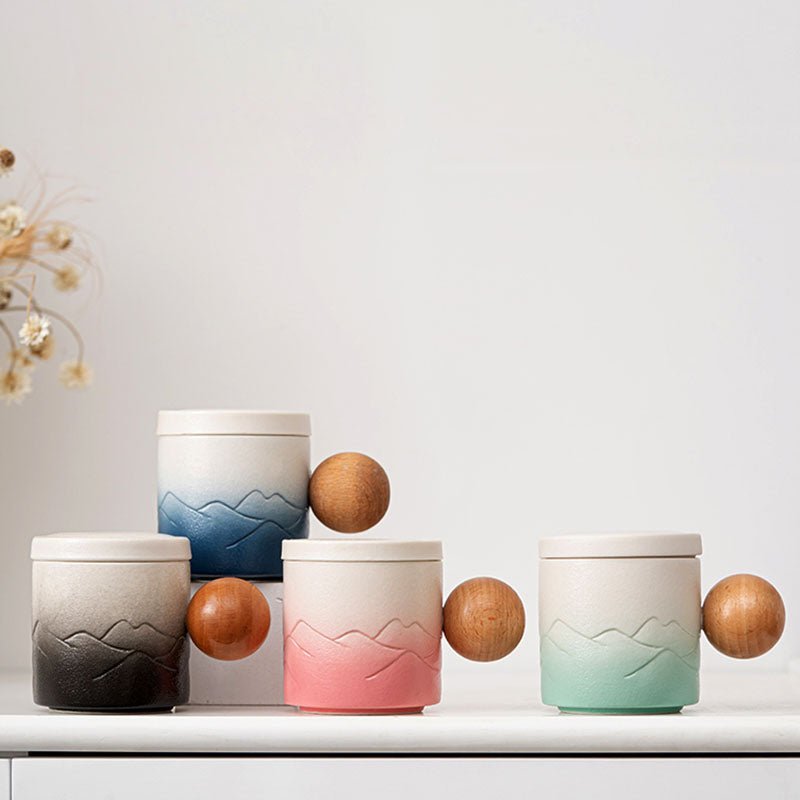
The Ball Handled Coffee Tea Mug at 250 ml adds 80 ml over the Retro cup. That is enough of a jump to change the routine: there is more room for a longer pour, additional milk, or deliberate headspace, while the mug remains smaller than many large everyday formats.
This size fits a shopper whose drinks change during the week. You might prepare a compact coffee on one morning, use more milk on another, and reach for tea in the afternoon. A 250 ml vessel can accommodate those shifts more easily than 170 ml. It also reduces the chance that a normal moderate serving will sit uncomfortably close to the rim.
The ball handle is a visible design feature, so consider handling preference as well as capacity. A distinctive handle can be part of the appeal for a gift or an open shelf, but shape matters during use. Look closely at the product images and consider how you normally grip a mug. Anyone who strongly prefers a conventional loop handle or needs maximum finger clearance should not choose by volume alone.
At the same time, 250 ml is not a visually tight match for every piccolo-style serving. Put a very small coffee into it and you will see more interior space around the drink. That does not affect whether the cup can hold the serving, but it can change presentation and cooling behavior. If a compact visual proportion is the priority, 170 ml remains the clearer fit.
270 ml: when are 20 extra milliliters useful?
The Emerald Coffee Tea Mug at 270 ml is only 20 ml larger than the Ball Handled option. That is less than one US fluid ounce, so buyers should not expect a dramatic capacity change. The decision between these two is more likely to come down to the product's form, handle, and visual style than to refill frequency alone.
Still, the extra room can be useful. It gives a little more tolerance for stirring, milk, or carrying the drink across a room. For an office desk, a 270 ml mug also supports a slower serving routine without moving into an especially large format. Someone who alternates between coffee and tea may appreciate that flexibility.
Choose 270 ml if your situation is a moderate drink that stays beside a laptop, a kitchen-counter serving with room for milk, or a gift where versatility matters more than recreating a compact cafe-style presentation. It is not ideal for a buyer who wants the smallest possible cup, and it is not a substitute for a tall mug used for large brewed coffee or heavily iced drinks. Ice consumes internal volume quickly, so none of these three capacities is particularly generous for an ice-heavy recipe.
If your usual milk-based coffee falls between compact and moderate, the flat white cup capacity comparison provides another view of the 250 ml and 270 ml decision. As with piccolo-style drinks, it avoids treating one recipe ratio as mandatory.
How much headspace should you plan for?
Product capacity and comfortable serving volume are not identical. Maximum capacity tells you what the vessel can contain; it does not mean you should prepare a drink right to the edge. Headspace helps when stirring, lifting the cup, adding milk after brewing, or walking from the coffee machine to another room.
As a simple planning exercise, reserving 15 ml below the listed capacity would leave approximately:
- 155 ml of planned serving room in a 170 ml cup.
- 235 ml of planned serving room in a 250 ml mug.
- 255 ml of planned serving room in a 270 ml mug.
Those figures are examples, not marked fill lines or product specifications. You may need more headspace if you walk upstairs with the cup, stir vigorously, or add milk at the end. You may need less if the cup stays beside the machine and you drink immediately.
A useful home check is to prepare your normal drink in a measuring vessel once. Record the final volume after coffee, water, and milk have all been added. Compare that total with 170 ml, 250 ml, and 270 ml rather than estimating from the amount of espresso alone. This prevents the common mistake of forgetting how much the finished drink grows after additions.
One serving or repeated refills: which routine matches each cup?
Refill tolerance is often more decisive than the drink label. We see buyers focus on the word piccolo, then realize their actual routine involves tea, a longer coffee, or a drink that sits through several calls. Mapping capacity to the day gives a clearer answer.
- Choose 170 ml if you finish a short serving promptly and do not mind returning for a second pour.
- Choose 250 ml if you want one moderate serving with enough flexibility for milk or tea.
- Choose 270 ml if you prefer the most room available here and want fewer concerns about stirring or carrying.
Households buying more than one cup should also consider mixed routines. One person may genuinely prefer the 170 ml option while another consistently uses 250 or 270 ml. Matching capacities is visually tidy, but it is not always the most practical choice. A mixed set can reduce abandoned half-drinks and unnecessary refills.
Our practical rule: buy for the finished volume you prepare most often, then use style and handle shape to decide between products with similar capacity.
Care and daily handling: what should you check before use?
Capacity is only one part of long-term fit. Before the first dishwasher cycle or microwave use, check the care information supplied on the current product page or with the item. Do not assume that every decorative coffee cup has identical appliance compatibility. If a cleaning method is not stated, hand washing with a soft sponge and mild detergent is the cautious option.
Daily handling also affects how long a cup stays presentable:
- Avoid moving a cold cup directly into very hot water, since abrupt temperature changes can stress drinkware materials.
- Inspect the rim after knocks against the sink or tap. Stop using drinkware with a sharp chip where your lips contact it.
- Check the handle attachment area periodically, particularly on a frequently used office mug. Visible cracking or movement is a reason to retire the cup.
- Do not force cups into an unstable stack. Unusual handle shapes and different rim widths may need separate shelf space.
- Rinse coffee or tea residue soon after use if you want to reduce the chance of persistent staining.
Gift buyers should factor in storage and unboxing as well. A distinctive handle can make a cup memorable, but it may require more cabinet width than a plain cylindrical mug. For a small kitchen, the compact 170 ml capacity may be appealing, yet the product's full external shape still deserves a close look in the listing images.
Frequently asked questions
What size cup should I use for a piccolo-style coffee?
There is no single required capacity because recipes and serving preferences differ. Among our current options, 170 ml gives the most compact presentation, while 250 ml and 270 ml provide more room for milk, stirring, and headspace.
Does the piccolo cup capacity guide assume a fixed coffee-to-milk ratio?
No. This piccolo cup capacity guide compares vessel volume and daily use only. Measure your own finished drink after all coffee, water, and milk additions, then choose a capacity that leaves comfortable room below the rim.
Is 250 ml too large for a piccolo-style serving?
It may look spacious around a very short drink, but it can suit someone who wants extra milk or uses the same mug for tea and longer coffee. If compact presentation is your main goal, the 170 ml Retro cup is the closer current fit.
Will the 270 ml mug reduce my refill trips?
It holds 100 ml more than the 170 ml cup and 20 ml more than the 250 ml mug, so it can support a longer serving. The difference from 250 ml is modest, however, and should not outweigh your preference for the mug's shape and handle.
Where can I compare the current CoffeifyMug options?
Start by writing down your finished drink volume, desired headspace, refill tolerance, and preferred handle style. Then compare the 170 ml Retro cup, 250 ml Ball Handled mug, and 270 ml Emerald mug in our unique coffee mugs collection and choose the product that matches the routine you actually follow.
More from our blog
Read more
Peppermint Tea Mug Capacity Guide: 400, 440, or 480 ml?
Compare CoffeifyMug's current 400, 440, and 480 ml options by serving size, refill pattern, desk space, and the effect of a fuller mug on handle comfort.
Read more
Unique Christmas Coffee Mugs Capacity Guide: 400, 440, 480 ml
Compare the current 400, 440, and 480 ml mug options by serving routine, refill frequency, desk space, milk allowance, and gifting fit before choosing.
Read more
Los kommentaar
This site is protected by hCaptcha and the hCaptcha Privacy Policy and Terms of Service apply.