
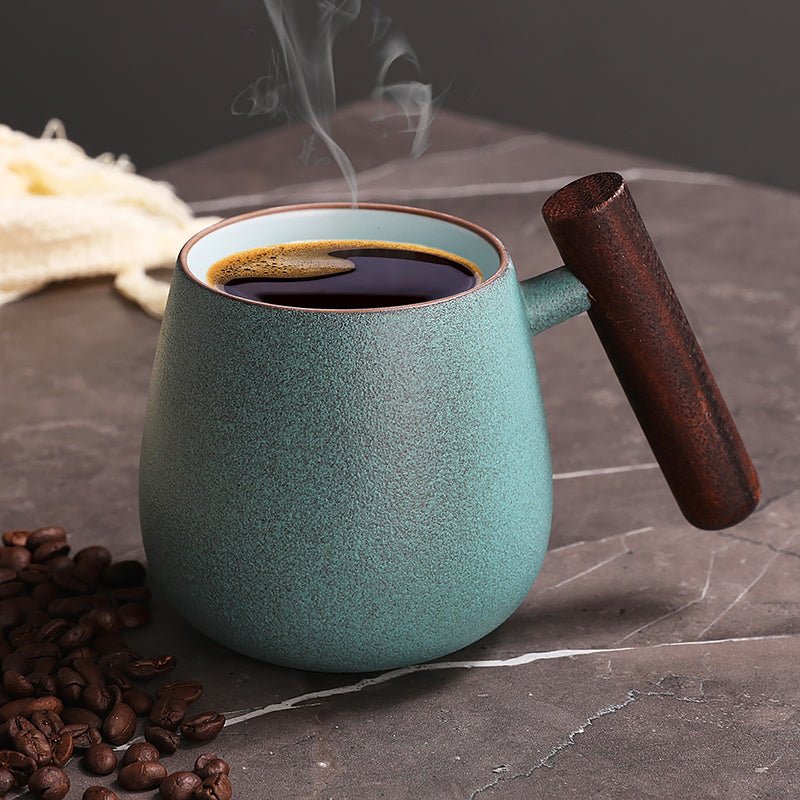
What Size Is a Standard Coffee Mug? Sizes Buyers Should Expect
Reading time: about 9 minutes
What size is a standard coffee mug?
A standard coffee mug is usually 8 to 12 ounces, which is about 236 to 355 ml. In our store, most everyday mugs we handle land in that range because it gives enough room for coffee plus milk, cream, or a small amount of foam without feeling oversized on a desk or crowded in a cabinet.
The problem is that standard does not mean exact. Two mugs can both be sold as standard and still feel very different once you hold them. A shorter, wider mug can feel more open and stable, while a taller mug can look smaller even if it holds the same amount. That is why capacity matters, but shape matters too.
If you want to browse actual mug shapes while you compare sizes, start with our all mugs collection. It is easier to judge the scale of a mug when you see a few silhouettes side by side.
Why does the same mug size feel different in real use?
Capacity only tells part of the story. A glazed ceramic mug with thick walls may hold the same ounces as a slimmer stoneware cup, but the outer size, weight, and hand feel will be different. A mug with a wide opening can look generous on the counter, while a tapered body can feel easier to grip but less roomy for milk drinks.
We see this all the time when shoppers compare a mug for a kitchen counter, an office desk, or a gift box. A mug that sounds large on paper can still feel compact once it sits next to a spoon, a pod machine, or a bag of coffee. If you are checking size before buying, our Coffee Mug Measurement Guide: How to Check Size Before You Buy is a useful companion to this article.
| Mug capacity | What it usually feels like | Best fit |
|---|---|---|
| 8 oz | Compact and controlled | Black coffee, espresso-based drinks, smaller servings |
| 10 oz | Balanced everyday size | Most drip coffee drinkers, smaller milk drinks |
| 12 oz | Roomier and more forgiving | Lattes, longer pours, people who want extra headroom |
| 14 to 16 oz | Large and casual | Big coffee refills, tea, soup, or a desk mug that stays put |
If you are comparing mugs by fill line, remember that a cup rarely gets filled to the rim. A mug sold as 12 oz may only comfortably hold 10 to 11 oz once you leave space for liquid movement, a spoon, or a little foam on top. That margin is normal. It also prevents spills when you carry the mug from counter to table.
How much coffee do most people actually drink from a standard mug?
For daily coffee, a standard mug usually works best for 6 to 10 oz pours. That covers a normal drip coffee, a pour-over serving, or a smaller milk drink without making the cup feel empty. If you drink American-style coffee black, an 8 oz or 10 oz mug often feels right. If you add milk, a 12 oz mug gives more breathing room.
That said, a standard mug is not the best choice for everything. It is not ideal for someone who wants a large, insulated container that keeps coffee hot through a long commute. It is also not the best match for oversized lattes, soup bowls, or recipes that need a very wide opening. In those cases, a larger cup or a travel vessel usually fits the use case better.
Our team tends to think in real routines. Morning coffee on a quiet kitchen counter. A mid-afternoon refill at an office desk. A mug washed, dried, and set back on the shelf. In those settings, a standard size is often less about maximum volume and more about comfort, balance, and how often you refill.
What should you check besides ounces?
Ounces are useful, but they do not tell you everything. A good mug should feel steady in the hand, sit flat on the counter, and hold a comfortable amount without splashing when you move it. These are the details that separate a mug people keep using from one that gets pushed to the back of the cupboard.
- Rim width: A slightly wider rim can make sipping easier, but an overly wide opening cools coffee faster.
- Wall thickness: Thicker ceramic often feels sturdier and holds heat a bit longer, but it also adds weight.
- Handle clearance: If the handle is too tight, two fingers may squeeze together and the mug becomes awkward to hold.
- Base stability: A flat, even base matters on smooth counters and office desks. A wobble usually means poor finishing or an uneven foot ring.
- Glaze quality: Look for a smooth rim and even glaze coverage. Rough spots, pinholes, or pooling on the foot can be signs of lower finish quality.
There are also care details that buyers miss. If a mug has a printed design, metallic accent, or hand-finished decoration, it may need gentler washing even if the body itself is ceramic. If the product page says dishwasher-safe, that usually helps with daily convenience, but top-rack washing is still a safer habit for decorated pieces. If the listing mentions microwave-safe, that is useful for reheating, but not every mug is built for that use.
We also watch for common defect modes when we inspect mugs: hairline cracks near the handle join, rough glaze on the lip, tiny chips on the foot ring, and handles that are technically attached but feel sharp or narrow in the hand. Those are the kinds of flaws that matter after the excitement of unboxing has passed.
Which mug size works best for different drinks?
If you are buying based on how you actually drink coffee, size choice becomes easier. The right mug is the one that matches your routine rather than the one with the largest number on the listing.
- Black drip coffee: 8 to 10 oz is usually enough if you drink a straightforward cup and do not want excess space.
- Coffee with milk or creamer: 10 to 12 oz gives room for a normal pour without bringing the liquid too close to the rim.
- Lattes and cappuccino-style drinks: 12 oz is often the safer everyday pick because the foam and milk need headroom.
- Tea: 10 to 12 oz works well for most hot tea drinkers, especially if you want a mug that does not cool too quickly.
- Soup or oversized servings: 14 oz and above is better if the mug is meant to double as a bowl.
If you want a second perspective on how buyers compare these ranges before ordering, our article Average Coffee Mug Size: What Buyers Should Expect breaks down the usual range without overcomplicating it. For a more everyday shopping angle, Standard Coffee Mug Size: How to Choose the Right Everyday Mug is a good follow-up if you are deciding between one mug for home and one for the office.
How do our mugs fit into a real kitchen, office, or gift order?
When we choose mugs for our store, we think about how they will actually be used. A mug has to look good on a shelf, but it also has to survive sink loading, counter bumps, and the kind of daily handling that reveals weak points fast. The best mug is usually the one that balances size, comfort, and finish rather than chasing the biggest capacity.
For shoppers comparing styles, the shape matters just as much as the ounces. Our Planet Coffee Tea Mug is a good example of a mug that can appeal to someone who wants a clean, everyday profile. The Rhombus Coffee Tea Mug is more geometric and can suit buyers who want something a little more distinctive on a desk or shelf. The Handbag Coffee Tea Mug leans more toward gift-buying and novelty, which can be exactly right if the goal is a conversation piece instead of a plain work mug.
That kind of comparison is useful because not every mug is meant for the same person. A simple ceramic mug is often the better choice for everyday use. A statement mug may be better for gifting, display, or occasional coffee. What it is not good for is someone who wants a perfectly sealed travel mug or a vessel that keeps drinks hot for a long commute. Different jobs call for different shapes.
What size is too small or too large for a standard coffee mug?
Below 8 oz, a mug starts to feel more like a demitasse or an espresso cup than a standard coffee mug. That can be fine for strong coffee or smaller servings, but it is not the size most people picture when they say mug.
Above 12 oz, you are moving into larger everyday mugs. That is not a problem, but there is a trade-off. Large mugs can be heavier when full, take up more shelf space, and cool down a little faster if the opening is wide. They also can be awkward for smaller hands. If the handle is undersized, a large mug becomes more of a two-handed object than a casual coffee cup.
That is why shoppers should not chase size alone. A mug that is technically bigger can be worse for daily use if it spills easily, feels top-heavy, or does not fit under a coffee machine. A slightly smaller mug with a stable base and a comfortable handle often ends up being the better buy.
Frequently asked questions
Is 11 oz a standard coffee mug?
Yes, 11 oz sits comfortably inside the standard range. It is one of the most practical sizes for daily coffee because it leaves enough room for a normal pour, milk, or a little foam without making the mug feel oversized.
What is the most common coffee mug size for home use?
For home use, many shoppers end up choosing something around 10 to 12 oz. That range works for drip coffee, tea, and casual milk drinks, and it still fits well on most counters and shelves.
Is a 16 oz mug too big for everyday coffee?
Not necessarily, but it depends on how you drink. A 16 oz mug is useful if you want a large serving or use the mug for soup and tea too, but it can feel bulky if you only drink a small cup in the morning.
How do I know if a mug will fit under my coffee machine?
Check the mug height in the product listing and compare it with the clearance under your machine's spout or brew basket. If the listing gives only capacity, look for dimensions or ask for them before buying, because two mugs with the same ounces can have very different heights.
What material is best for a standard coffee mug?
Glazed ceramic and stoneware are the most common everyday choices because they are sturdy, familiar, and easy to clean. Porcelain can feel lighter and more refined, while thicker stoneware usually feels heavier and more casual. The best option depends on whether you want lighter weight, more heat retention, or a more decorative look.
What should you do before you buy?
If you want the right mug the first time, compare four things before checking out: capacity, shape, handle comfort, and care instructions. Those details tell you far more than the word standard on its own. A mug that works for your coffee machine, fits your hand, and cleans up easily will get used. A mug that only looks good in the listing often ends up as a backup cup.
If you are still narrowing it down, start with the all mugs collection and compare a few shapes side by side. That is the fastest way to see whether you want a compact everyday mug, a more distinctive design, or a giftable piece with a stronger visual profile.
Read more
New York Mets Coffee Mug Buyer's Guide for Gift and Daily Use
Compare New York Mets coffee mug styles for desk use, gifting, and easy care. We break down shape, finish, durability, and the trade-offs that matter before you buy.
Подробнее
NY Mets Coffee Mug Buyer’s Guide for Daily Use and Gifts
A practical guide for shoppers comparing a NY Mets coffee mug for gifting, desk use, and everyday coffee. We break down size, shape, care, and the trade-offs that matter before you buy.
Подробнее
Оставить комментарий
Этот веб-сайт защищается hCaptcha. Применяются Политика конфиденциальности и Условия использования hCaptcha.