
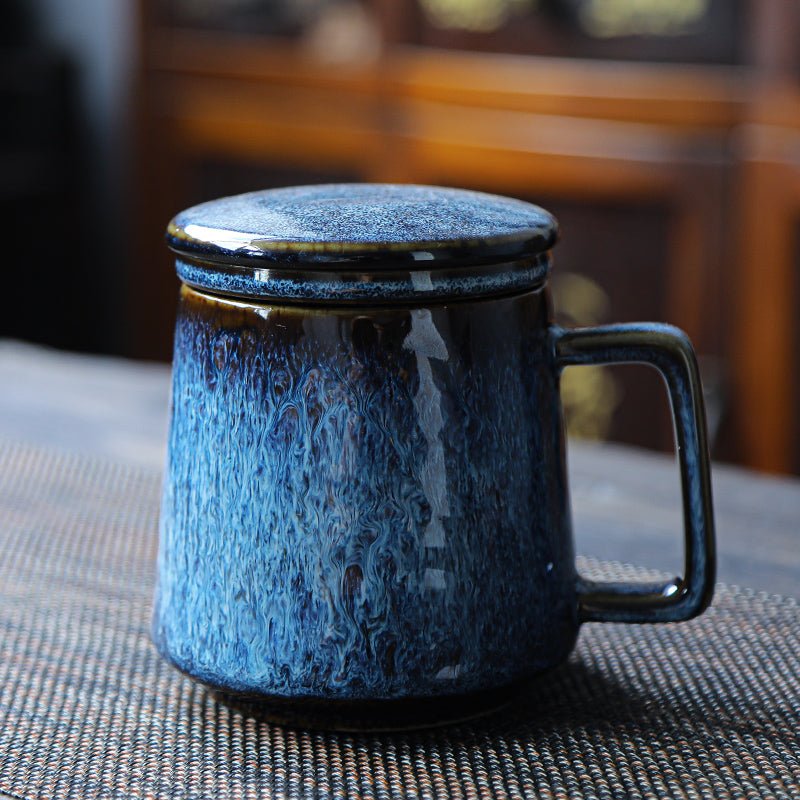
Thick Ceramic Coffee Mugs for Small Coffee Setup: Buying Checks
Reading time: about 9 minutes
A mug can look compact in a product photo and still become the object that blocks a cabinet door, crowds the coffee maker, or refuses to sit neatly beside another mug. Buyers searching for thick ceramic coffee mugs for small coffee setup need to compare more than stated capacity. The outside diameter, handle projection, height, and everyday fill level determine how much space the mug actually consumes.
We handle this category with small kitchens, office desks, coffee carts, and gift purchases in mind. A substantial ceramic mug can feel stable and satisfying, but that extra visual and physical presence has a cost: fewer mugs per shelf, less room beneath low cabinets, and more weight at the desk. The right choice is the one that fits the available space and the way coffee is poured, carried, and cleaned.
Thick ceramic coffee mugs for small coffee setup: which measurements matter?
Start with the storage location, not the capacity printed on a listing. A 12-ounce mug and a 16-ounce mug can have very different footprints, but capacity alone does not tell you whether either one fits your shelf. One may gain volume through height while another uses a wider body.
For a current point of comparison, open The Rock Coffee & Tea Mug and examine its live listing, product images, and any displayed specifications against your own measurements. If you want to compare more silhouettes before narrowing the choice, browse our unique coffee mug collection. Product pages should remain the source for current dimensions, capacity, material details, and care claims; we do not assign specifications that are not shown there.
Measure these four points in the space where the mug will live:
- Total width: Measure the mug body plus the handle. Handle projection is often the reason two otherwise compact mugs cannot sit side by side.
- Body diameter: Check the widest part, not just the foot ring. A tapered mug may occupy more shelf area above its base.
- Total height: Leave roughly 1/2 to 3/4 inch of lifting clearance as a practical target, especially beneath fixed cabinet shelves.
- Door and machine clearance: Confirm that the handle will not strike a cabinet door, coffee maker, kettle, or wall when the mug is picked up.
In our experience, tracing the mug's proposed footprint on paper is more reliable than estimating by eye. Place the paper beside the coffee maker and open nearby doors. That quick test exposes tight handle clearances before the mug arrives.
How much capacity works without taking over the counter?
The largest available mug is not automatically the most useful mug. A high-capacity vessel can reduce refill trips, but it also occupies more counter space, holds more weight when full, and may let a slow drinker's coffee cool before the last sip. A smaller mug is easier to store and often better for short coffee breaks, concentrated pours, or tea.
Separate listed capacity from working capacity. Filling ceramic to the rim is inconvenient in actual use. Coffee needs headspace for walking from the kitchen to a desk, adding milk, stirring sugar, or avoiding spills around a laptop. If your normal serving must leave a comfortable gap below the rim, compare that realistic pour with the size information on the product page.
| Daily situation | Capacity priority | Space trade-off |
|---|---|---|
| Short coffee or tea break | Compact working fill | Usually easier to fit on shallow shelves |
| Milk-based or topped drink | Room for coffee, milk, and stirring | A wider opening may use more shelf width |
| Long desk session | Fewer refills | More full-mug weight and a larger footprint |
| Shared household shelf | Consistent size across several mugs | Distinct handles may prevent tight rows |
If capacity is the difficult part of the decision, use our thick ceramic coffee mug capacity guide to compare daily pour fit. Buyers considering a specific common size can also review the 12-ounce ceramic mug capacity guide. Keep in mind that the live product listing, rather than a general guide, controls the specifications for a particular mug.
Which current CoffeifyMug pages belong on a small-space shortlist?
Our current product pages give you three distinct starting points: The Rock, The Flow, and Spittoon. We recommend treating them as visual and specification shortlists, then checking each live page against the same measurements. That creates a fair comparison and avoids choosing from names or photos alone.
- For a shallow shelf or narrow coffee cart: Start with The Rock Coffee & Tea Mug. It belongs on the shortlist if the dimensions and handle envelope shown on its current listing fit your traced shelf area. It is not the right choice if its full outside width interferes with nearby equipment or cabinet doors.
- For a desk where hand clearance matters: Compare The Flow Coffee & Tea Mug. Use the listing images to inspect the handle and body relationship, then verify any published measurements. A visually appealing handle still needs enough room for your grip without forcing the mug against a monitor stand or notebook.
- For open shelving or a gift with a distinctive profile: Review the pictured form and current details of the Spittoon Coffee & Tea Mug. A characterful shape can work well when the mug remains visible, but unusual profiles may be less efficient for tightly packed cabinets. Confirm the footprint before choosing it for a crowded shelf.
This is deliberately not a ranking. Product availability and displayed details can change, and the most suitable option depends on the buyer's measured space. If none of the three fits the required envelope, return to the collection rather than forcing a favorite design into an impractical setup.
How do rim, foot ring, handle joints, and glaze affect daily use?
Thick ceramic mugs deserve a close look at the construction points that receive the most contact. In product images and during the first inspection after delivery, examine the rim, the handle attachment areas, the glazed surface, and the foot ring. These details influence comfort, stability, and how easily damage can be spotted.
- Rim profile: A visually heavy rim may suit someone who likes a substantial drinking edge, while a buyer who prefers a finer sip may want a less bulky profile. This is personal rather than universally better.
- Handle attachment: Inspect both joints where the handle meets the body. Look for visible cracking, separation, or sharp glaze irregularities before carrying a full mug.
- Foot ring: The unglazed or differently finished base area should be checked for rough points that could mark a delicate desk or shelf. A coaster can protect both surfaces.
- Glaze surface: Look for chips, sharp spots, and fine crack patterns that were not represented in the listing. Handmade-looking variation and actual damage are not the same thing.
A thick wall may retain heat differently from a thin mug, but wall thickness alone does not guarantee a specific temperature result. Beverage volume, starting temperature, lid use, room conditions, and drinking time all matter. Buyers who need sealed, travel-oriented heat retention may be better served by an insulated mug rather than an open ceramic design.
Will the mug fit your dishwasher, microwave routine, and office desk?
Do not infer care compatibility from the word ceramic. Follow the instructions on the individual product page and any packaging supplied with the mug. If a listing does not state that a mug is suitable for a particular appliance, confirm before using it that way.
For dishwasher fit, measure the gap between rack tines and check whether the handle prevents the mug from sitting securely. A broad mug can collide with plates or spray arms even when it technically fits inside the machine. Avoid placing the rim or handle where it repeatedly strikes another hard item during wash cycles.
At an office desk, the limiting factor is often usable surface area rather than cabinet storage. Test the proposed mug location with the keyboard pulled forward and the laptop open. Keep the handle turned toward the dominant hand while leaving a clear zone around papers and electronics. A large mug that must sit behind the monitor is not a practical desk mug, no matter how appealing it looks.
Gift buyers should also think about the recipient's setup. During unboxing, a substantial ceramic mug creates a strong first impression, but that does not solve a storage mismatch. Someone living in a studio apartment or using a shared office kitchenette may prefer one carefully selected mug over a bulky matching set.
What limitations should small-space buyers accept before ordering?
Thick ceramic coffee mugs have clear compromises. They are generally not the best format for a tightly packed travel bag, a vehicle cup holder, or a drink that must remain sealed while walking. They can also feel heavy to someone with limited grip strength, especially after being filled.
Decorative profiles may reduce stacking efficiency. We do not recommend assuming mugs are stackable unless the product information or imagery supports that use. Stacking an unsuitable ceramic mug can put pressure on rims and handles, and a tall stack is a poor choice for a high shelf where mugs must be lifted down one at a time.
A thin, straight-sided mug may be more efficient if maximum cabinet density is the main objective. An insulated vessel may be better for long heat retention or commuting. A smaller ceramic cup may suit espresso-based drinks if the buyer does not need a full coffee-mug serving. For a broader comparison of form, finish, and intended use, our guide to choosing a unique ceramic coffee mug covers additional decision points.
Frequently asked questions
Are thick ceramic coffee mugs for small coffee setup shelves too bulky?
They can be if you compare capacity but ignore outside width and handle projection. Measure the shelf depth, vertical clearance, and usable width, then compare those figures with the current product listing. Leave enough room to lift the mug without scraping the shelf above it.
Should I choose a smaller capacity for a compact coffee station?
Choose the smallest capacity that comfortably holds your normal pour with stirring and carrying headspace. A larger mug is useful for long drinks, but it usually adds weight or footprint. Buyers who refill frequently may find a compact mug easier to live with.
Can I assume a ceramic coffee mug is dishwasher and microwave safe?
No. Ceramic is a broad material category, and appliance compatibility should come from the individual product's current care instructions. Check the listing and supplied packaging before using a microwave or dishwasher.
What part of a mug should I measure for cabinet fit?
Measure the widest outside point, including the handle, along with the tallest point and maximum body diameter. Also measure the cabinet opening because a mug may fit on the shelf but still be awkward to move through a narrow door opening.
Is a thick ceramic mug a good choice for commuting?
An open ceramic mug is usually better suited to a stable kitchen counter, table, or office desk. For walking, driving, or carrying a drink in a bag, a lidded vessel designed for travel is the more practical choice.
A five-point check before adding a mug to your cart
- Measure the available shelf or counter rectangle, including height and door clearance.
- Compare the mug's full outside width, not only its listed beverage capacity.
- Decide how much headspace your usual coffee, tea, milk, or toppings require.
- Read the current material and care details instead of assuming appliance compatibility.
- Inspect the rim, handle joints, glaze, and foot ring promptly after delivery.
Use that checklist while comparing The Rock, The Flow, and Spittoon product pages. If the measurements or shape of those choices do not match your setup, continue through our current unique coffee mugs and keep the same space limits in front of you. The best next step is simple: measure first, shortlist second, and order only after the mug's full footprint fits the place where you will actually use it.
Read more
Loose Leaf Tea Mug for Small Coffee Setup: Compare Size and Fit
Compare three current mug sizes for a compact counter, shelf, or office desk. This guide covers listed capacity, visible opening, storage fit, brewing limitations, and practical care.
Подробнее
Americano Coffee Cup for Small Coffee Setup: Space and Capacity
Compare CoffeifyMug's current 200, 270, and 350 ml options by listed capacity, potential headroom, shelf constraints, and counter-space priorities before choosing a cup for a compact setup.
Подробнее
Оставить комментарий
Этот веб-сайт защищается hCaptcha. Применяются Политика конфиденциальности и Условия использования hCaptcha.