
Matcha Latte Mug Buying Guide: Capacity, Opening, Everyday Use
Reading time: about 9 minutes
A matcha latte can feel undersized in a large vessel, while a generous pour can leave a smaller cup uncomfortably close to the top. That is the practical choice behind a matcha latte mug: start with the amount you actually like to drink, then look closely at the opening profile you will see and use every day. In our store, shoppers often focus on the silhouette first, then realize that a 250 ml cup and a 400 ml cup serve very different routines.
CoffeifyMug currently offers three useful capacity points in this group: 250 ml, 390 ml, and 400 ml. The difference is not trivial. The 390 ml Round holds 140 ml more than the 250 ml Ball Handle, while the 400 ml Spittoon adds 150 ml over the 250 ml option. The Round and Spittoon are only 10 ml apart, so their visual opening profile and the amount you want to serve matter more than trying to separate those two by capacity alone.
Why does listed capacity matter for a matcha latte mug?
Listed capacity is the cleanest comparison point because it gives you a known number before the mug arrives. It is not a promise about a particular recipe, nor does it tell you exactly how far a drink will sit below the edge. The drink level changes with the amount of liquid you prepare and the way you choose to serve it. Treat capacity as the mug's overall volume, then give yourself room for the way you normally fill a cup.
For a smaller everyday drink, 250 ml is a deliberately more contained choice. A 390 ml or 400 ml format makes more sense for shoppers who consistently prepare a fuller drink or simply dislike stopping at a modest serving. This is also a useful distinction for an office desk: the mug should suit the portion you will make between meetings, not the largest drink you might occasionally want on a weekend.
- 250 ml: best starting point for shoppers who prefer a smaller, more restrained serving.
- 390 ml: a substantial step up from 250 ml, with 140 ml of additional listed capacity.
- 400 ml: the largest listed option here, only 10 ml beyond 390 ml but 150 ml beyond 250 ml.
If you are comparing cups for more than matcha, our cafe au lait mug capacity and shape guide covers the same useful habit: choose for the drink you repeatedly make, rather than buying around a vague idea of a “standard” mug.
250 ml Ball Handle, 390 ml Round, or 400 ml Spittoon?
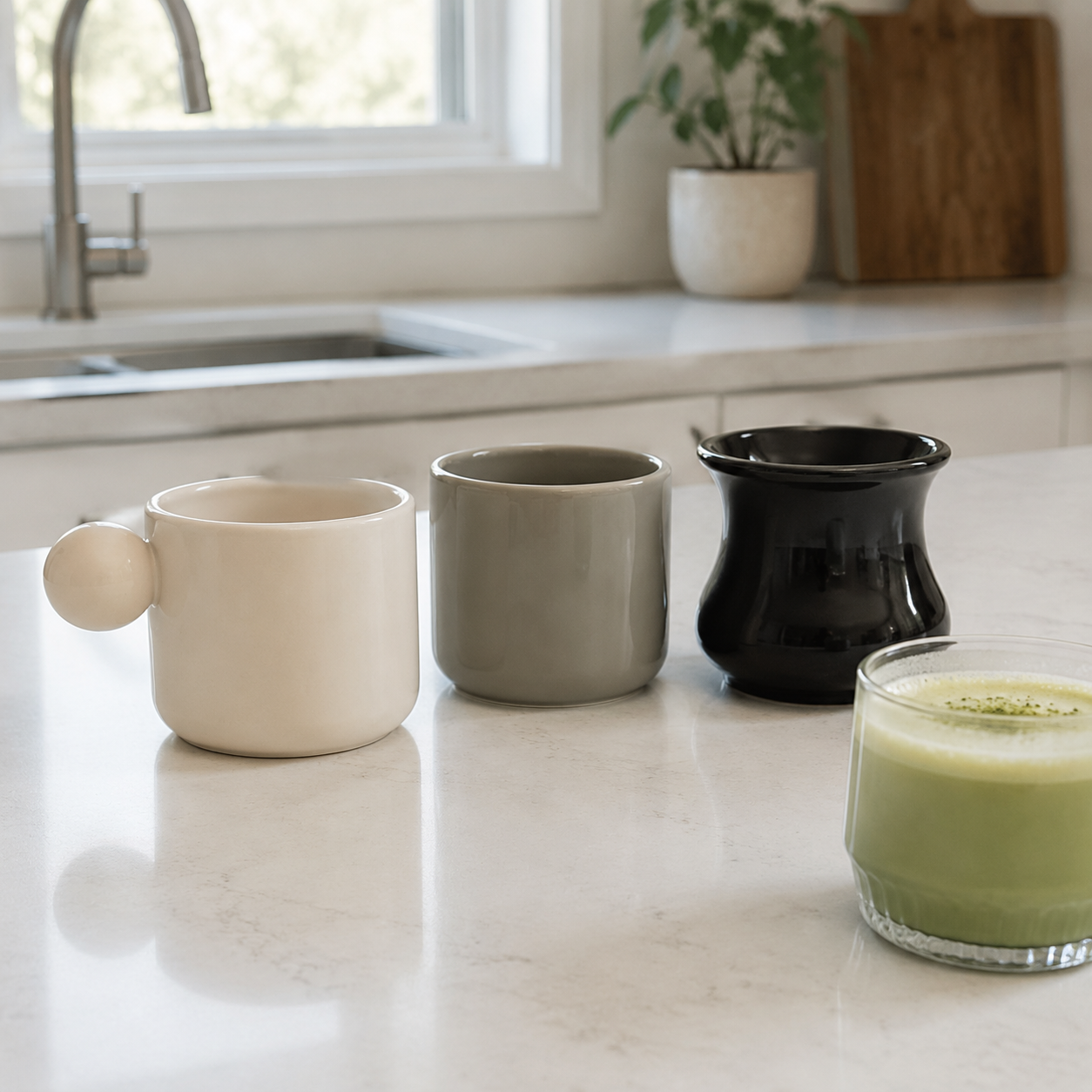
These three listings make it possible to shop by a clear capacity ladder. We recommend opening each product page alongside the table below, because the product images let you compare the visible opening shape as well as the number printed in the listing.
| Option | Listed capacity | Catalog detail to compare | Best shopper fit |
|---|---|---|---|
| Ball Handle coffee tea mug | 250 ml | Listed 11.2 cm diameter and its visible opening profile | Someone seeking the smallest listed capacity |
| Round coffee tea mug | 390 ml | Its visible rounded opening profile | Someone who wants more room than 250 ml without moving to the largest option |
| Spittoon coffee tea mug | 400 ml | Its visible opening profile and overall form | Someone who wants the largest listed capacity in this comparison |
Choose the Ball Handle 250 ml listing if your regular drink is intentionally compact and you want the smallest capacity of the three. Its listed 11.2 cm diameter is a concrete reference point that the other supplied catalog details do not provide. It is not the right pick for someone who routinely wants the volume of a 390 ml or 400 ml drink; moving up later will not change that basic size mismatch.
Choose the Round 390 ml listing if 250 ml sounds limiting but you do not need to chase the very largest number. Its 390 ml listed capacity is already a meaningful increase, so it is a practical middle choice for a kitchen cup used for more than one drink style. The capacity gap to the 400 ml Spittoon is only 10 ml, which means a buyer drawn to this option should make the final call by looking at the opening silhouette and form in the listing photos.
Choose the Spittoon 400 ml listing if your priority is the largest listed capacity in this group. This is the natural direction for a shopper who finds a 250 ml serving too small. It is not automatically better for every recipient, though. For a gift recipient who likes smaller portions or has limited shelf space, the extra 150 ml relative to the Ball Handle may be more mug than they want to use every day.
How should you compare the opening before ordering?
Opening shape is a visual and practical preference, but it should not be treated as a performance claim. From a product-handling perspective, it affects the view you have of the drink and the visual character of the mug on a counter or desk. It does not establish how well a drink can be prepared, and we do not use it to predict whisking results or any other preparation performance.
Use the product photos deliberately. Look at the opening from above and at an angle, then compare it to the drink presentation you find appealing. The Ball Handle listing gives a 11.2 cm diameter reference; the Round and Spittoon listings should be compared by their visible opening profiles rather than by an assumed diameter. A mug name is useful for identifying a style, but the current product images are the better source for judging its visual form.
- Decide your usual listed-capacity range first: 250 ml, around 390 ml, or 400 ml.
- Open the product images and compare the visible openings at the same time.
- Picture the mug on the surface where it will live most often: a kitchen counter, office desk, or open shelf.
- For a gift, choose the capacity that matches the recipient's ordinary drink size instead of selecting only by the most eye-catching profile.
For a broader shape-first comparison, see our latte art mug guide for shape and everyday size. It is useful for shoppers who are deciding between a visually distinctive cup and a format that simply matches their habitual serving.
Which mug fits a kitchen counter, office desk, or gift box?
A mug becomes an everyday favorite because it fits the repeated moment, not because it won a single comparison on paper. In a home kitchen, start with the volume you tend to make before work. On an office desk, a 250 ml option may be the more sensible match for a smaller break-time drink, while the 390 ml and 400 ml choices suit shoppers who want a fuller serving without a refill. There is no universal right answer here; portion preference is the deciding variable.
For gift buying, avoid assuming that larger is more generous. In our experience helping shoppers compare coffee and tea mugs, the better gift is usually the one that resembles the recipient's actual habits. A person who regularly reaches for a compact cup is more likely to use the 250 ml Ball Handle option. Someone who likes a more substantial drink may appreciate the 390 ml Round or 400 ml Spittoon listing. Before gift unboxing, the recipient will not know the capacity difference, so choosing with their daily routine in mind matters more than making a guess based on photographs alone.
Shoppers furnishing a shared kitchen or building a varied mug shelf can browse the CoffeifyMug unique coffee mugs collection after narrowing down capacity. Use the collection for style comparison, but return to the individual product pages before purchase for the specific listing details that apply to that mug.
What should you not assume from capacity or shape?
This is where careful comparison prevents disappointment. A listed capacity does not tell you the exact quantity you will choose to pour. A visible opening does not confirm a preparation method, material, heat retention, or care capability. The 11.2 cm figure on the Ball Handle listing is a diameter reference, not a reason to make claims beyond that published measurement.
We also would not infer microwave or dishwasher suitability from a mug's capacity, name, or appearance. Check the current product page for explicit care information before making a purchase for a busy household or shared office kitchen. If that information is important to your decision, treat its absence as a reason to verify rather than to assume.
The three mugs also are not interchangeable simply because they can suit coffee or tea occasions. The 250 ml option is not ideal for buyers seeking the largest listed volume, while the 400 ml option is not the natural fit for someone who deliberately wants a smaller serving. And if you want to compare a more general set of sizes and forms before choosing, our coffee mug guide for size, shape, and daily use offers a useful wider lens.
Use this three-point check before selecting your mug
Pick the listed capacity you will use most days, inspect the visible opening in the current product photos, and confirm any care detail that matters to your household before ordering.
That check keeps the decision grounded. Select the 250 ml Ball Handle if a contained serving is your priority, the 390 ml Round if you want a significant capacity increase without a major jump beyond it, or the 400 ml Spittoon if you want the highest listed capacity here. Then compare the product photos one final time and choose the opening profile you will be happiest seeing in your daily routine.
Frequently asked questions
What size matcha latte mug should I buy?
Choose 250 ml if you usually want a smaller serving, 390 ml for a notably larger listed capacity, or 400 ml for the largest listed option in this CoffeifyMug comparison. The 390 ml and 400 ml mugs differ by only 10 ml, so use their visible opening profiles to make the final choice between those two.
Is the Ball Handle mug 11.2 cm wide?
The Ball Handle coffee tea mug has a listed 11.2 cm diameter. Review the current product listing and images for the context of that measurement before ordering, especially if diameter is important to your shelf, cabinet, or serving preferences.
Which matcha latte mug is best for a smaller drink?
The 250 ml Ball Handle coffee tea mug is the smallest listed-capacity option among these three. It is a better fit than the 390 ml Round or 400 ml Spittoon for shoppers who prefer a more restrained everyday portion.
Should I choose the 390 ml Round or 400 ml Spittoon mug?
Capacity alone is unlikely to decide it because the listed difference is only 10 ml. Compare each product's visible opening shape and overall form in the current listing photos, then choose the one that better matches the style you want to use each day.
Can I assume a coffee tea mug is microwave or dishwasher safe?
No. Do not assume microwave or dishwasher suitability from capacity, shape, or product category. Verify current care information on the specific product listing before buying if those capabilities are necessary for your routine.
Read more
Piccolo Cup Buying Guide: Compact Ceramic Options for Milk Coffee
Compare 170 ml, 250 ml, and 270 ml ceramic options for milk coffee with practical guidance on headroom, handles, everyday care, and gift-ready selection.
Подробнее
Ceramic Sculptural Mug Buying Guide: Form, Capacity, Daily Use
Compare sculptural ceramic mugs by usable capacity, handle shape, counter footprint, and everyday routines. See where a 250 ml, 310 ml, or 400 ml form makes the most sense before choosing a distinc...
Подробнее
Оставить комментарий
Этот веб-сайт защищается hCaptcha. Применяются Политика конфиденциальности и Условия использования hCaptcha.