
Coffee Mug Shelves: What to Check Before You Buy
Reading time: about 9 minutes
A coffee mug shelf looks simple until the first oversized handle bumps the back panel, a heavy ceramic mug tilts the row, or a pretty display turns into a daily dust collector. We see that problem often in our store conversations: shoppers want a clean kitchen display, but they also need shelves that actually fit the mugs they use every morning.
That is why we start with the practical checks, not the decor photos. If you are comparing coffee mug shelves for a kitchen, office nook, or gift display, the real question is not just how the shelf looks. It is whether the shelf depth, mounting method, and mug shape work together without constant rearranging.
For readers who are still choosing mugs as part of the setup, our all products collection is the best place to compare shapes first, then match the shelf around them. If you want a deeper pre-buy checklist, our related guide Coffee Mug Shelves: What to Check Before You Buy covers the same decision from a narrower storage angle.
What should coffee mug shelves fit?
The first thing we check is not the shelf itself. We check the mugs. A shelf can only be judged against the cup it will hold, and real-life mugs vary more than people expect.
In practice, the biggest fit issues come from three places:
- Handle projection: A wide handle needs more front-to-back room than a plain straight-sided mug.
- Mug height: Taller mugs can block the shelf above them, especially on multi-tier displays.
- Foot ring width: Some mugs have a narrow base that feels stable on a shelf; others sit a little less confidently if the shelf surface is uneven.
In our experience, a shelf that looks roomy in a product photo can still be tight once you place a mug with a chunky ear-shaped handle or a wide stoneware body on it. That is why we like to compare the shelf depth against the widest mug in the house, not the average one.
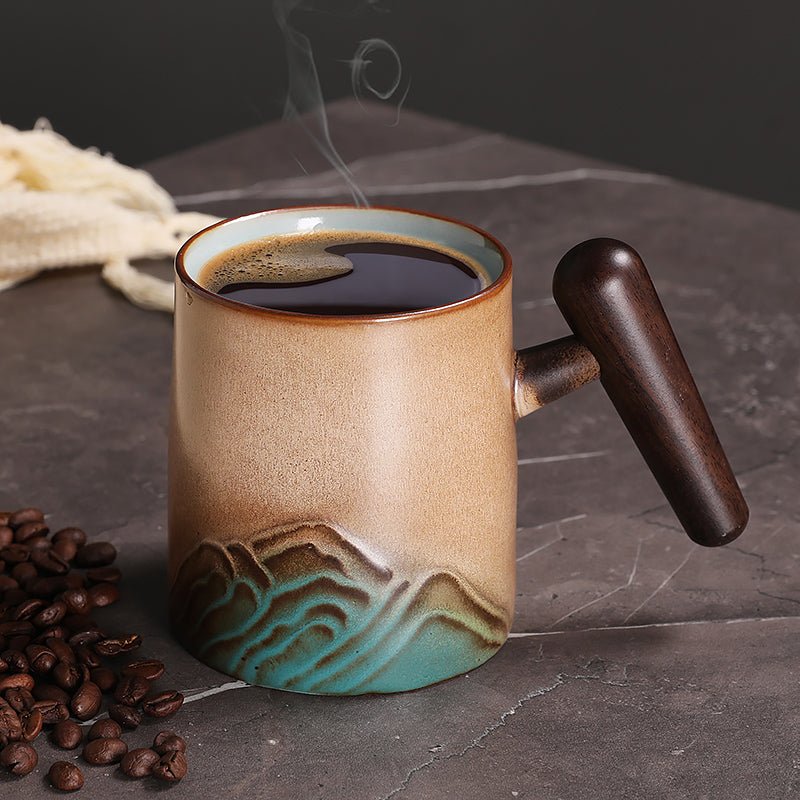
If you want a visual on mug shape before buying the rack, the Cloud Coffee Tea Mug with Wooden Handle is a useful example of a mug that adds visual warmth but also needs enough clearance because the handle changes the overall footprint. By contrast, simpler shapes are easier to line up evenly on narrow shelving.
How much shelf depth and clearance do you actually need?
Depth is where many first-time buyers get caught. A shelf that is too shallow can make mugs sit too close to the edge, which looks messy and raises the chance of a knock-off when someone reaches for one in a hurry. A shelf that is too deep can swallow the cups visually and leave a lot of unused space behind them.
We usually suggest thinking about three clearances:
- Front edge safety: The mug should not feel like it is perched on the lip.
- Handle clearance: The handle should not scrape the wall, backsplash, or another mug.
- Vertical clearance: The shelf above should leave room for the mug to lift out without tilting at an awkward angle.
That third point matters more than people expect. A mug that fits on paper may still be annoying in daily use if you have to pull it forward and tilt it just to get it off the shelf. In a kitchen that gets used every morning, that extra motion gets old fast.
For shoppers who want a more compact display, mug shape matters as much as shelf depth. A lower-profile mug is easier to stack visually across a wall shelf, while a taller novelty mug is better on a single open ledge or a lower row with more air above it.
We tell customers to measure the shelf first, then test the widest mug handle they own. That one check catches most of the fit mistakes before they happen.
What materials and finishes hold up best in real kitchens?
Material choice affects both appearance and maintenance. A shelf that photographs well may still be the wrong choice if it warps, dents, or shows fingerprints every day.
Here is the practical breakdown we use when talking through options:
| Material | What it does well | Trade-off |
|---|---|---|
| Solid wood | Warm look, strong visual fit for kitchen and coffee station displays | Needs more care around moisture and steam near kettles |
| Metal | Good rigidity, clean lines, easy to wipe | Can feel colder visually and may show scratches or chips in coated finishes |
| Composite or engineered board | Budget-friendly, often lighter | Less forgiving if hardware loosens or humidity gets into exposed edges |
Finish matters as much as the base material. Matte finishes tend to hide small marks better. Glossy surfaces can look sharp at first, but they also show fingerprints, water spots, and small glaze chips from mugs more quickly.
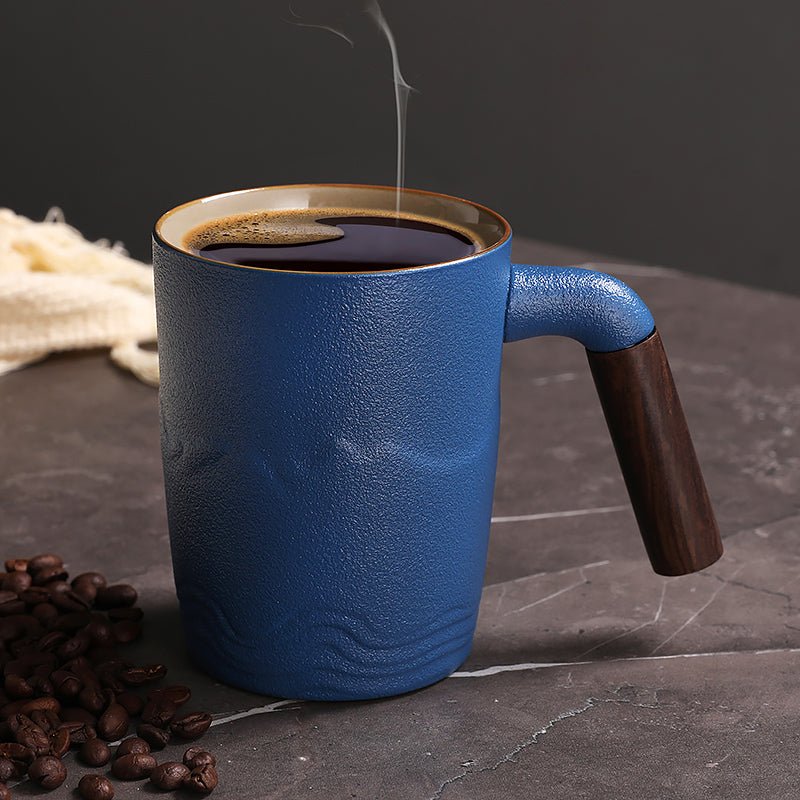
This is also where the mug finish itself comes into the conversation. A textured stoneware cup, such as the Rock Coffee Tea Mug, looks balanced on a sturdier shelf because the visual weight matches the stronger lines of the mug. Softer, lighter-looking mugs can work too, but they usually look best on shelves with a cleaner, less industrial frame.
For shoppers comparing daily-use options, a shelf is not a storage fix for every kitchen. If your mugs are heavy, your wall is weak, or you move cups around several times a day, a countertop rack or cabinet peg system may be a better choice than wall-mounted coffee mug shelves.
Which mug styles look best on open shelves?
Open shelving is part organization, part display. That means not every mug style behaves the same way once it is out in the open.
From what we see in real shopping decisions, these are the easiest categories to style:
- Uniform mugs: Same height and diameter, cleanest for row-based shelves.
- Handmade-looking mugs: Good for a softer, collected look, but they need more spacing so the shelf does not feel crowded.
- Statement mugs: Best used as accents, not as the whole shelf if you want a calm kitchen.
If you are building a display for a breakfast bar or office shelf, the Morning Night Coffee Tea Mug is a useful example of a mug that works in a pair or as a repeated motif. Repetition helps a shelf feel intentional. Mixing too many silhouettes can make a small shelf look cluttered very quickly.
We also think about daily handling. A shelf can make a mug look beautiful, but if the handle is awkward or the lip is too thick for your preferred drink, the display becomes decoration only. That is fine if that is the goal. It is not fine if you want the mug to earn its space every morning.
If you are still comparing cup sizes as part of the shelf decision, our size-focused guides on 10 oz coffee mugs and 11 oz coffee mugs are useful because shelf fit and mug volume usually get judged together in the same purchase.
How do you install coffee mug shelves so they stay level?
Installation is where shelf shopping stops being theoretical. A shelf that is not anchored correctly will tilt over time, especially once mugs are loaded on it every day.
The practical checks we recommend are simple:
- Find the wall type before you buy hardware. Drywall, tile, brick, and plaster all behave differently.
- Check whether the shelf can hit a stud or whether it needs proper anchors.
- Make sure the shelf is level before loading it, not after.
- Leave room for hand movement so mugs do not scrape the wall when lifted.
In a kitchen, steam and heat matter too. A shelf placed directly above a kettle or near a high-heat cooking zone will age faster than one mounted on a dry wall across the room. That does not mean wall shelving is a bad choice. It just means location changes how long it stays clean and stable.
If you want a wider shopping path, start with the all products collection and choose a mug set that matches the shelf depth you can support. A smaller, lighter set is usually easier to keep straight on a narrow ledge than a mixed collection of oversized mugs and mugs with broad handles.
What are coffee mug shelves not good for?
Open shelving is useful, but it is not the right answer for every room or every mug collection. We prefer to say that clearly rather than pretend every shelf solves every storage problem.
Coffee mug shelves are not the best fit if:
- You want dust-free storage with minimal cleaning.
- Your mugs are very heavy and you do not have a strong wall surface for secure mounting.
- You like to rotate seasonal mugs frequently and do not want to re-style the shelf each time.
- Your kitchen is small enough that an open shelf would crowd the counter or block the backsplash visually.
They are also not ideal for mugs that chip easily if stacked tightly. If a mug has a delicate rim, a very thin handle, or a hand-applied finish that needs gentler treatment, a cabinet or closed shelf may protect it better than a fully open display.
That is why the best purchase is usually a matched decision: shelf first, mug second, or mug first, shelf second. We do not push one format as the universal answer because it is not.
Frequently asked questions
How do I know if my coffee mugs will fit on open shelves?
Measure the shelf depth, then measure the widest point of your mug including the handle. If the handle nearly touches the back wall or the mug sits too close to the front edge, the fit will feel cramped in daily use. The easiest test is to compare your largest mug, not your smallest one.
What is the best material for coffee mug shelves in a kitchen?
Solid wood gives the warmest look, metal is usually the easiest to wipe down, and engineered board can work if the shelf is light-duty and properly supported. We would avoid anything that feels flimsy or shows edge swelling in a humid kitchen. Choose based on where the shelf will sit and how often you will use it.
Do coffee mug shelves need wall studs?
For heavier loads, yes, studs are the safer choice. If studs are not available, the right anchor for your wall type matters, but the shelf should still be sized conservatively. A fully loaded mug shelf puts more stress on fasteners than many people expect.
Are open coffee mug shelves hard to keep clean?
They are easier to reach than closed cabinets, but they collect dust and kitchen residue faster. If your shelf sits near a stove, kettle, or coffee maker, expect more wiping. A matte finish and simple mug shapes are easier to maintain than ornate shelves and highly detailed mugs.
What mugs work best if I want a neat shelf display?
Uniform mugs with similar height and handle shape usually look the cleanest. If you want more visual character, mix in one or two statement pieces instead of filling the whole shelf with different silhouettes. For a simple place to start shopping, the Cloud Coffee Tea Mug with Wooden Handle and Rock Coffee Tea Mug show two very different display styles.
If you are comparing coffee mug shelves right now, use this order: measure your widest mug, check shelf depth, confirm the wall mount, then decide whether you want a neat row display or a more decorative open setup. From there, browse the full collection and pick the mugs that match the shelf you can actually live with every day.
Read more
Coffee Mug Sayings: How to Choose the Right Phrase and Mug Style
Coffee mug sayings work best when the phrase matches the person and the mug itself. We break down what reads well on a desk, what works as a gift, and which mug styles are worth buying.
Подробнее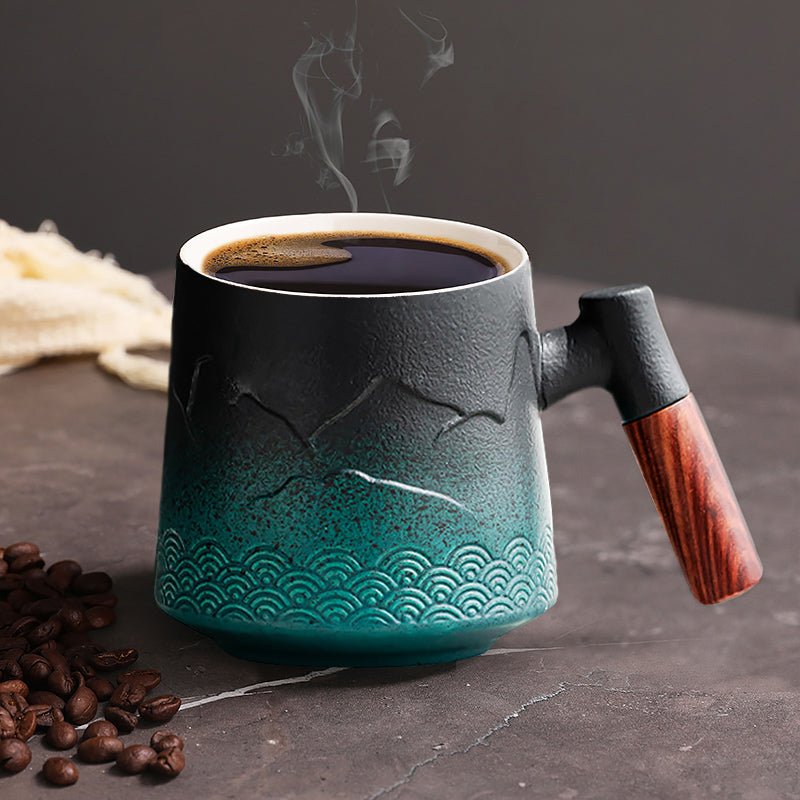
Tea Cups for Sale: How to Choose Size, Material, and Handle Style
Our tea cups for sale guide breaks down the details that matter in real use: size, shape, handle comfort, cleaning, and the trade-offs between different styles. Use it to narrow down a cup that fit...
Подробнее
Оставить комментарий
Этот веб-сайт защищается hCaptcha. Применяются Политика конфиденциальности и Условия использования hCaptcha.