
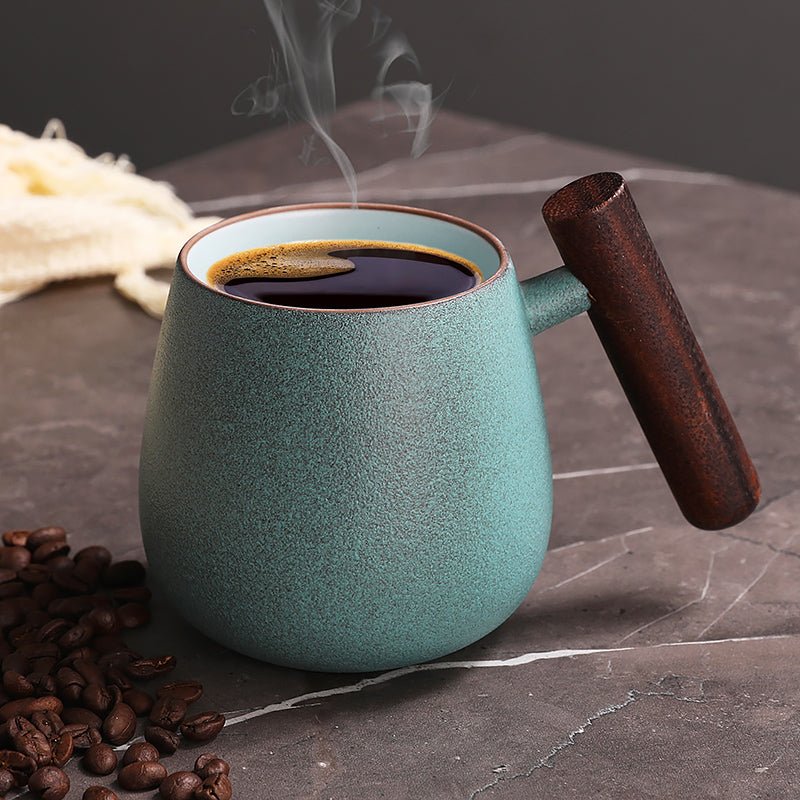
Green Ceramic Coffee Mugs Daily Use Guide: Before You Buy
Reading time: about 9 minutes
A mug that looks right beside a green backsplash can become the one left in the cabinet if its handle crowds your knuckles, its rim feels clumsy, or its height fights the dishwasher rack. Our green ceramic coffee mugs daily use guide starts with those ordinary moments: the first pour at breakfast, a refill beside a laptop, tea residue at the sink, and the return to a crowded cupboard.
In our store, we see color start the search, but routine usually settles the decision. If emerald is your fixed visual cue, begin with the Emerald Coffee Tea Mug. If the overall style is still open, compare it with our unique coffee mugs collection before treating green alone as enough information.
Product-claim boundary: We keep product-specific guidance below to the design direction and coffee-or-tea category established by the linked listings. Check each current product page for exact capacity, dimensions, included pieces, and care instructions. General ceramic guidance is not a promise that every individual mug is microwave- or dishwasher-safe.
Green ceramic coffee mugs daily use guide: what matters from pour to sink?
We use a four-stop test because a daily mug has to work while empty, full, hot, and wet.
- Brewer and kettle clearance: Measure from the drip tray to the coffee outlet, then allow enough room to tilt the mug out. A mug can fit your shelf yet still be awkward under an espresso machine.
- Full weight: A 355 ml drink adds roughly 355 g before counting the ceramic body. A generous mug may feel comfortable when empty but tiring during a long meeting or for someone with limited grip strength.
- Sip and set-down: Check whether your knuckles touch the warm wall, whether the rim suits slow tea sipping or faster coffee drinking, and whether the base feels secure near a keyboard.
- Washing and storage: Compare the mug’s widest point with cabinet space, dishwasher tine spacing, and nearby dishes. Rounded bodies and projecting handles can use more room than front-facing photos suggest.
If one of these steps creates a daily annoyance, an appealing green glaze will not rescue the purchase. Measure the places where the mug will actually live.
Which green design fits a quiet kitchen, a busy desk, or a gift?
The three product names create distinct starting points. The table below maps each one to a shopper situation without assuming unlisted capacities or care features.
| Reader situation | Product to inspect first | Why it may fit, and when it may not |
|---|---|---|
| Emerald is the non-negotiable visual cue | Emerald Coffee Tea Mug | This is the most direct place to start for an emerald-led coffee or tea mug. It is not the best fit if you want a wave-led design, a round-first silhouette, or the current listed measurements do not suit your brewer and cabinet. |
| You want a more expressive wave direction | Green Waves Coffee Tea Mug | The wave concept gives you a clearer decorative direction than color alone. Keep comparing if the recipient prefers restrained drinkware or if you need a plain-looking mug to match an existing set. |
| A rounded shape is the main attraction | Round Coffee Tea Mug | This is the shape-led comparison. It is not automatically the best choice for a narrow shelf, low coffee outlet, or tightly packed dishwasher, so verify the current dimensions before buying. |
A product photo can settle the visual question. It is a poor ruler. Let the current listing settle capacity, size, care, and what arrives in the package.
How do capacity, rim, handle, and base change daily comfort?
Capacity labels tell only part of the story because brim capacity and a comfortable working fill are different. Coffee needs carrying headspace; tea may need room for an infuser; milk drinks need space for foam.
- Measure your real serving: Put your current favorite mug on a kitchen scale, tare it, and add water to your normal fill line. For a practical kitchen comparison, one gram of water is close to one milliliter. If 12 oz is your reference point, our 12 oz ceramic mug daily-use comparison explains the routine trade-offs in more detail.
- Check height and width separately: Overall height affects brewer clearance and shelf fit. The widest body point and handle projection determine how much cabinet and dishwasher space the mug consumes.
- Study the rim: A fuller rounded rim can feel substantial, while a finer lip may give a more precise sip. Neither is universally better. Edge shape also affects how noticeable small impacts are during washing.
- Inspect handle geometry: Count how many fingers you normally place through a handle and notice where your knuckles rest. A small loop may suit a compact hold but frustrate larger hands; an oversized handle takes more storage room.
- Look at the base and wall profile: A flat foot matters on an office desk, while an exposed or rough foot ring may call for a coaster on delicate surfaces. More ceramic mass can change heat feel and full weight, which is why thicker is not always better. Our thick ceramic coffee mug daily-use guide covers that specific trade-off.
Do not infer these measurements from styled photos. If a dimension or care detail controls the purchase, verify it on the current listing before ordering.
Is ceramic practical for dishwasher cycles, microwaves, and iced drinks?
Ceramic is a broad material category, not a specific body type. Do not assume a mug is porcelain, stoneware, or earthenware unless the listing says so, and do not transfer care instructions from one ceramic mug to another.
- Dishwasher: Use a dishwasher only when the product page permits it. Load the mug so its rim and handle cannot knock against plates, cutlery, or another mug during the cycle.
- Microwave: Look for an explicit microwave statement. Metallic decoration is an obvious warning, but the absence of visible metal does not replace the manufacturer’s care direction.
- Temperature changes: Avoid moving a refrigerator-cold mug directly to boiling liquid or rinsing a very hot mug under cold water. Rapid temperature change can stress the ceramic body and glaze.
- Cleaning: Start with a soft sponge and the cleaning method stated on the listing. Abrasive pads can dull a finish, while repeated utensil contact may leave gray metal-transfer marks that look different from a sharp scratch or crack.
- Iced drinks: Use a room-temperature mug, leave room for ice displacement, and avoid striking the inner wall with heavy utensils. Check capacity first; a mug sized for a modest hot drink may feel cramped after ice is added.
Ceramic is also not the strongest choice for every setting. A lidded, impact-resistant travel vessel generally suits commuting, car cup holders, crowded patios, and young children better than a breakable ceramic mug.
Which daily routine changes the best fit: coffee, tea, office, or gifting?
- For a color-led kitchen: The Emerald Coffee Tea Mug is the logical first page if emerald is already part of the room or your existing drinkware. It is less useful as a starting point if pattern or shape matters more than the color name.
- For a personal office mug: The Green Waves Coffee Tea Mug offers a stronger design cue, which can help distinguish a personal mug in a shared kitchen. Desk stability, handle comfort, and full weight still matter more than pattern during a long workday.
- For shape-focused shoppers: The Round Coffee Tea Mug is the page to inspect if a rounded form appeals to you. Confirm its current width, height, and handle proportions rather than assuming a rounded mug will stack or fit under your machine.
- For loose-leaf tea: Check opening diameter and usable depth against your infuser. You also need enough room to lift the wet basket without scraping the rim or spilling onto the counter.
- For gifting: Choose from the recipient’s routine, not your own. Our coffee mug gift idea daily-use guide covers recipient checks such as drink size, care habits, desk use, and unboxing expectations.
If you know the recipient loves green but do not know their preferred capacity or care routine, a design choice alone is risky. Compare the listing details before sending the mug directly as a gift.
What should you inspect at unboxing and after the first wash?
We recommend a quick inspection before the mug enters daily rotation.
- Compare the item with the current listing, allowing for ordinary screen and lighting differences in how green appears.
- Set the empty mug on a flat, dry counter and check for unexpected rocking.
- Inspect the rim, interior glaze, base, and both handle attachment points under bright light.
- Carefully feel the foot ring for a sharp burr before placing it on wood or another scratch-sensitive surface.
- Wash it exactly as directed, then recheck the rim and handle after the first few cleaning cycles.
A sharp chip, through-crack, or loose handle is a stop-use issue, not decorative character. Fine glaze lines may be intentional only when the listing describes a crackle or crazed effect; otherwise, pause use and contact the store. These are category-level inspection checks, not a claim that the linked mugs have those defects.
Frequently asked questions
What should I check before buying a green ceramic mug for everyday use?
A useful green ceramic coffee mugs daily use guide should compare comfortable fill, full weight, handle clearance, brewer and cabinet dimensions, and the listed care method. Use color and motif after those checks. If a specification conflicts with your routine, keep comparing.
Are all green ceramic coffee mugs dishwasher and microwave safe?
No. Ceramic alone does not establish dishwasher or microwave safety, so follow the current product page for the individual mug. If the listing does not confirm a care method, do not assume it is safe.
Is a round ceramic mug good for an office desk?
It can be, provided the base sits securely, the handle clears your knuckles, and the full mug is comfortable to lift repeatedly. Check the widest dimension if desk space is limited. A lidded vessel is a safer option if the desk is crowded or frequently moved.
Can I use a green ceramic mug for iced coffee?
Ceramic can hold iced coffee, but capacity and temperature handling matter. Start with a room-temperature mug, leave space for ice, and avoid a sudden shift from very hot to very cold. Choose a lidded cup instead if you need spill resistance or portability.
Use this 60-second cart check
- Measure your normal drink at its comfortable fill line.
- Measure brewer height, shelf height, and available cabinet width.
- Choose the main design cue: emerald, waves, or rounded form.
- Read the current listing for exact dimensions and care instructions.
- Confirm that the handle, rim, and base suit your grip and setting.
- Reject any option that requires you to guess about a deal-breaking detail.
Run that checklist with the product pages open side by side. If none clearly matches your measurements and routine, return to the unique coffee mugs collection and choose the listing whose current specifications answer every essential question.
Read more

Apple Cider Mug Daily Use Guide: 400 ml vs. 480 ml
Compare the 400 ml Gradient and Flow mugs with the 480 ml Rock for real kitchen and desk use. This guide covers grip, headspace, ceramic care, and situations where a smaller or insulated vessel is ...
Czytaj dalej
Eggnog Mug Daily Use Guide: Practical Trade-Offs Before You Buy
Compare the 170 ml Retro, 200 ml Pleated, and 270 ml Emerald models by portion size, visible shape, refill habits, cleanup, desk use, and gifting. This guide also flags cases where a compact mug is...
Czytaj dalej
Zostaw komentarz
Ta strona jest chroniona przez hCaptcha i obowiązują na niej Polityka prywatności i Warunki korzystania z usługi serwisu hCaptcha.