
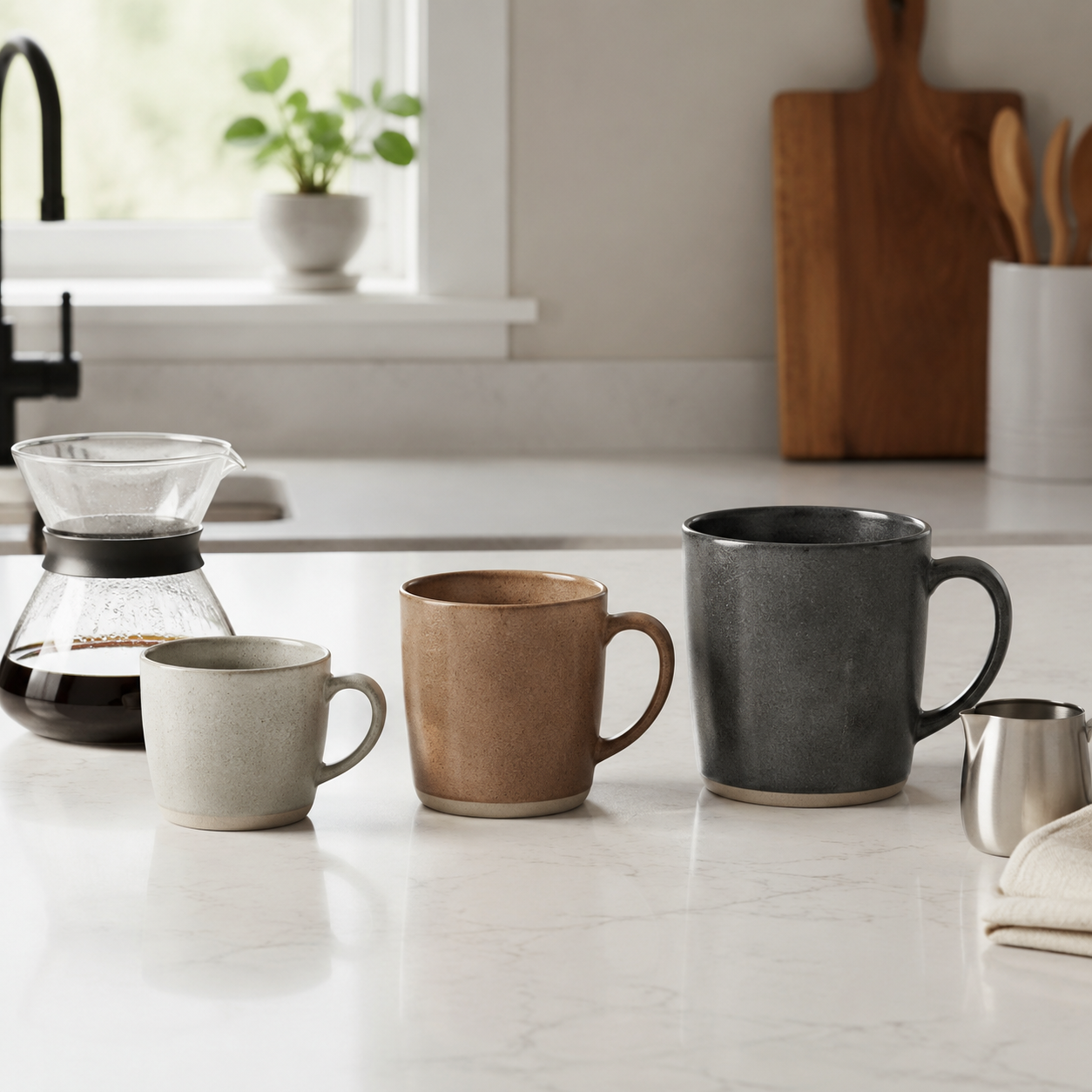
Cafe au Lait Mug Buying Guide: Capacity, Shape, Everyday Fit
Reading time: about 10 minutes
A cafe au lait mug can look perfectly manageable on a product page and feel surprisingly large once it is filled and placed beside a keyboard, breakfast plate, or compact coffee setup. The practical differences in this comparison are modest but meaningful: 400 ml, 440 ml, and 480 ml. That 80 ml span can change how much room you have for your usual pour and how heavy the mug feels in one hand.
From the questions we hear in our store, buyers often focus on the design first and calculate the serving fit later. We recommend reversing that order. Start with the amount of coffee and milk you actually use, then compare shape and handle proportions. This produces a more reliable choice than selecting the largest capacity automatically.
Which cafe au lait mug capacity matches your real pour?
The three CoffeifyMug options sit within a relatively narrow range, but each occupies a distinct position in it. The capacities below are the listed catalog figures.
| Product | Listed capacity | Approximate US fluid ounces | Position in this group | Practical starting point |
|---|---|---|---|---|
| The Flow Coffee Tea Mug | 400 ml | 13.5 fl oz | Smallest | A measured pour below roughly 340 ml, or a preference for less liquid weight |
| Morning and Night Coffee Tea Mug | 440 ml | 14.9 fl oz | Middle | A buyer who wants more capacity than 400 ml without moving to the largest option |
| The Rock Coffee Tea Mug | 480 ml | 16.2 fl oz | Largest | A larger one-pour serving, provided the extra filled weight suits the user |
The ounce figures are conversions, rounded to one decimal place. They do not replace the milliliter values on the listings. Also, a listed capacity is not necessarily a recommended working fill line. If capacity is measured close to the rim, the amount you can carry comfortably without sloshing will be lower, and shape can affect that difference.
Capacity is the firm comparison point here. It does not establish the mug's exact height, rim diameter, base width, or handle opening. Use the current listing photographs to compare visible proportions, and browse the unique coffee mug collection if none of these three has the silhouette you want.
What do 400 ml, 440 ml, and 480 ml change in a real serving?
Measure one normal serving before ordering. Pour the coffee and milk into a marked measuring jug in the quantities you typically use, then note the combined volume. Do not rely on the size printed on a coffee machine or on a visual estimate from your current mug.
- If your combined pour is 320 to 340 ml: The Flow's listed 400 ml capacity leaves an arithmetic difference of 60 to 80 ml. It is the most direct next step for a buyer who does not need the extra volume of the other two mugs.
- If your combined pour is around 360 to 400 ml: Morning and Night provides the middle 440 ml capacity. It suits the shopper who wants a 40 ml step above The Flow while avoiding the largest mug in this group.
- If your combined pour is around 410 to 440 ml: The Rock's 480 ml listing provides the highest nominal capacity. It fits a larger single serving, with the trade-off of more liquid weight when filled.
Those examples show arithmetic margin against the listed capacity, not guaranteed spill-free space. The mug's wall angle, rim opening, and the manufacturer's method of measuring capacity all matter. Added foam or ingredients placed on top of the measured liquid also use space.
The gaps are easier to picture in kitchen measures. Forty milliliters is about 2.7 US tablespoons, while the full 80 ml difference between The Flow and The Rock is about 5.4 tablespoons. That is enough to matter if your current recipe already sits close to the rim, but it may be unnecessary if you usually leave a substantial gap.
How should you judge mug shape from product photos?
Capacity and shape answer different questions. Capacity tells you how much the vessel is listed to hold. Shape influences how the mug occupies the hand, how close your fingers sit to the body, and how it fits among the objects already on your counter or desk.
We use four visual checkpoints when helping shoppers read mug photographs:
- Rim-to-base proportion: Compare how wide the opening appears relative to the base. A photo taken at an angle can exaggerate this, so check more than one view when available.
- Wall profile: Look for sides that appear straight, tapered, or irregular. Do not assume two mugs with the same capacity will share the same height or width.
- Base footprint: A visible base can help you estimate how the mug may sit beside a laptop, notebook, or breakfast plate. Photographs provide proportion, not an exact measurement.
- Handle position: Notice where the handle attaches, how far it projects, and whether its inner opening appears tall, wide, or compact. These details are more useful for grip assessment than the outer handle shape alone.
If shape is your main decision factor, our broader coffee mug buying guide to size, shape, and everyday use provides additional comparison context. For these three products, keep the distinction clear: the capacity values are verified, while exact physical fit still depends on dimensions and your grip.
Will the handle feel comfortable when the mug is full?
Handle comfort is personal, but the load can be estimated. As a simple benchmark, 400 ml of water weighs about 400 g before adding the mug's own weight. At 480 ml, the water benchmark is about 480 g. A coffee-and-milk mixture will not match those figures exactly, yet the comparison shows why the largest option can feel different at the wrist even though the capacity gap looks small on screen.
The Rock can carry about 20 percent more liquid by listed capacity than The Flow. That does not make either one better. The Flow is the more logical option if limiting filled liquid weight matters; The Rock prioritizes volume; Morning and Night sits between them.
Before deciding that a handle looks comfortable, check these points in the listing images:
- Estimate how many fingers can enter the inner opening without stacking tightly.
- Look at the clearance between the opening and the mug wall, especially if your knuckles usually touch the body of compact mugs.
- Consider your normal grip. A one-finger hook, two-finger grip, and full-finger grip need different opening proportions.
- Check whether the handle appears aligned with the mug's center mass or positioned high or low on the body.
- Remember that a projecting handle adds to total shelf and desk width even though it does not add drink capacity.
Without verified handle-opening measurements, we will not label one of these mugs universally more comfortable. Photos can narrow the choice, but your finger size, grip style, and preferred serving volume determine the result.
Which capacity fits a kitchen counter, office desk, or gift?
| Buyer situation | Best starting capacity | Why it fits | Limitation to check |
|---|---|---|---|
| Measured breakfast serving below 340 ml | 400 ml | The Flow is the smallest listed option and avoids unused capacity | Confirm that its visible shape suits the available counter and shelf space |
| Desk drink with a moderate refill interval | 440 ml | Morning and Night adds 40 ml over The Flow without reaching the group's maximum | A larger serving still adds weight and occupies more working space than a small cup |
| Large single pour | 480 ml | The Rock offers the highest listed capacity of the three | Check wrist comfort and the product photos before prioritizing volume |
| Gift when the recipient's serving size is unknown | 440 ml as a middle reference | The capacity falls between the two alternatives | Shape and handle preference remain personal, so middle capacity is not a guaranteed fit |
| Tight cupboard or precisely measured shelf | No capacity-only winner | Milliliters do not reveal exterior dimensions | Confirm exact height, width, and handle projection before ordering |
For office use, count the objects already competing for space: keyboard, mouse, notebook, phone, and charging cable. A larger nominal capacity may reduce the need for another pour, but capacity alone cannot confirm footprint. On a kitchen counter, the same mug may feel less crowded because it is not boxed in by work equipment.
Gift buying adds another variable. The recipient sees and grips the shape before capacity becomes relevant, so review the handle and wall profile instead of choosing solely by the largest number. Morning and Night is a defensible middle-capacity starting point, not a universal gift choice.
Where do these larger milk-coffee mugs stop making sense?
All three options belong on the larger side of many everyday servings. They are not the strongest fit for someone who pours a small amount, wants the lowest possible lifting load, or needs a vessel with tightly specified exterior dimensions. A partially filled large mug can also look oversized to a person who prefers compact drinkware, even if it technically works.
The Rock's 480 ml capacity is approximately 16.2 US fluid ounces. Buyers comparing it with other mugs around that scale can use our 16 ounce coffee mug buyer's guide for additional size context. If 480 ml still falls below your measured serving, the giant coffee mug size and real-world fit guide explains the practical costs of moving larger.
These comparisons also do not establish suitability for transport. If you require a lid, seal, or specific exterior measurements, choose a product listing that states those features directly. Do not infer them from a mug's capacity or lifestyle photograph.
What should you inspect when the mug arrives?
An arrival check catches fit problems before the mug settles into daily use. We focus on the contact points and the way the mug balances, not just the printed capacity.
- Place the empty mug on a clean, flat surface and check for obvious rocking.
- Inspect the rim for chips or rough areas, then look closely at both handle attachment points for visible cracks.
- Slide your usual number of fingers through the handle and check knuckle clearance without forcing the grip.
- Use cool water to recreate your normal measured fill over a sink. Lift it carefully and assess the balance and wrist load.
- Set it in its intended spot beside your coffee equipment or desk items, then check the shelf where it will be stored.
For a gift, complete the visual inspection before wrapping it. Handle-joint cracks, rim damage, and an unstable base are defect concerns; a handle that simply does not suit the recipient's grip is a fit issue. The distinction matters when deciding the next step.
A five-point decision before ordering
- Measure the full drink: Include both coffee and milk in the volume you record.
- Allow practical margin: Do not treat listed capacity as a guaranteed comfortable fill line.
- Compare liquid load: Remember that moving from 400 ml to 480 ml can add roughly 80 g for a water-like liquid, before mug weight.
- Read the shape: Check rim-to-base proportion, wall profile, handle opening, and handle projection in current photos.
- Match the routine: Choose for the actual counter, desk, shelf, grip, and serving size rather than the largest available number.
Frequently asked questions
Is a 400 ml cafe au lait mug large enough?
It can be if your measured coffee-and-milk pour stays comfortably below 400 ml. For example, a 320 to 340 ml combined pour leaves an arithmetic difference of 60 to 80 ml against The Flow's listed capacity, although the mug's practical fill level may be lower than its nominal capacity.
What is the difference between a 440 ml and 480 ml mug?
The difference is 40 ml, approximately 1.35 US fluid ounces or 2.7 US tablespoons. For a similarly dense drink, the 480 ml option can also carry about 40 g more liquid when both mugs are filled to their listed capacities, before accounting for the mugs' own weights.
Can product photos tell me if a mug handle will fit my hand?
Photos can help you compare the handle's inner opening, projection, attachment position, and clearance from the mug wall. They cannot guarantee comfort without measurements because finger size and grip style vary, so avoid treating appearance as an exact fit specification.
Which capacity is most practical for an office desk?
The 400 ml option is a sensible starting point for a smaller measured serving and lower liquid load. The 440 ml option offers a middle position, while 480 ml suits a larger one-pour drink if the added filled weight works for you. Exact desk footprint still requires exterior dimensions.
Does a larger mug capacity always mean a wider or taller mug?
No. Capacity describes internal volume, while height, rim diameter, base width, wall profile, and handle projection determine exterior fit. Two mugs can hold similar amounts and occupy space differently, so verify dimensions whenever cabinet or desk clearance is strict.
Start by measuring tomorrow's normal pour, then compare that number with CoffeifyMug's unique coffee mugs. Choose 400 ml for the lowest capacity in this group, 440 ml for the middle position, or 480 ml for the largest listed serving, then use the product photos to make the final shape and handle check.
Read more
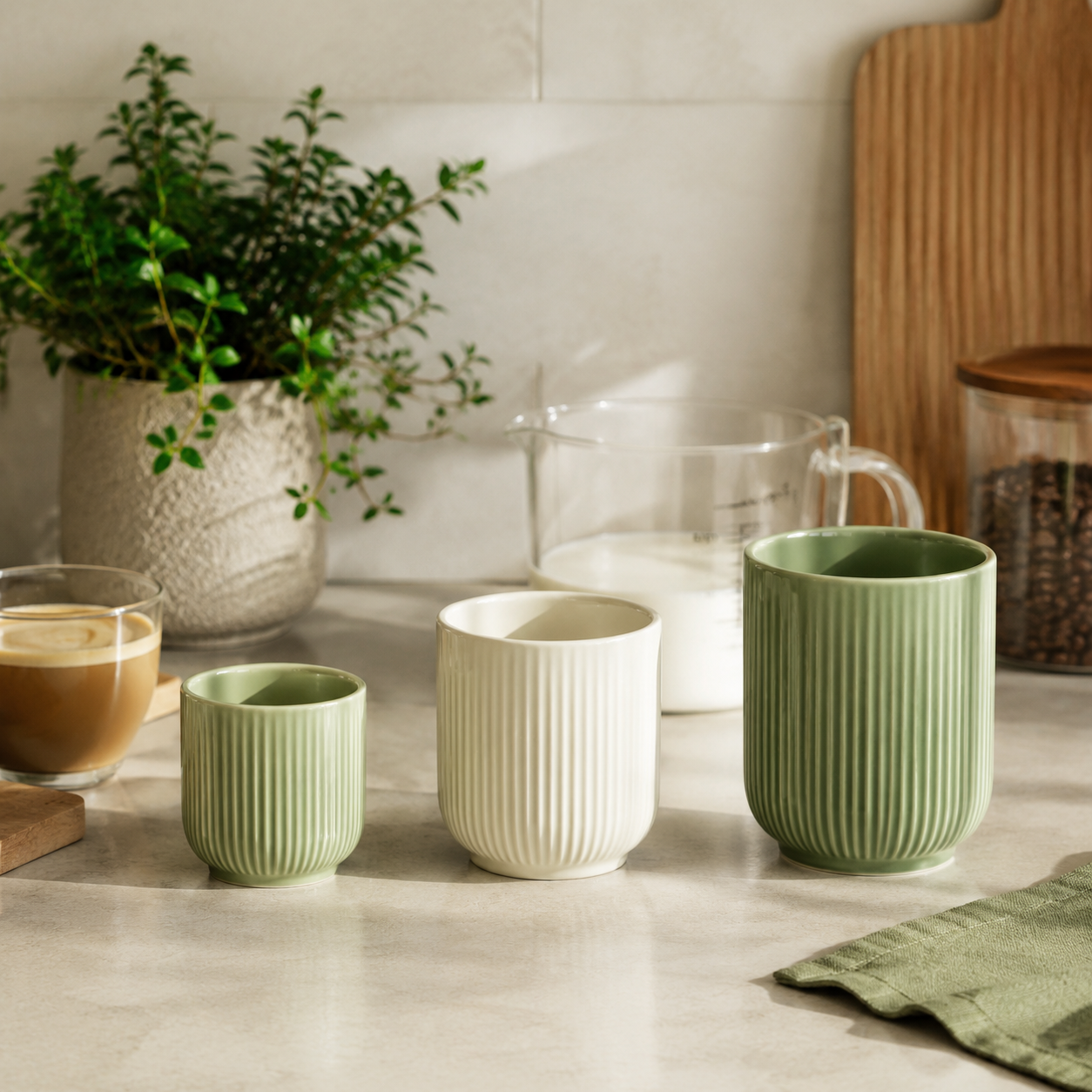
Ceramic Cortado Cup Buying Guide: Size, Headroom, Daily Use
Compare 170 ml, 200 ml, and 270 ml ceramic cup capacities using practical headroom calculations, then match the cup to your drink volume, desk habits, and care checks.
Czytaj dalej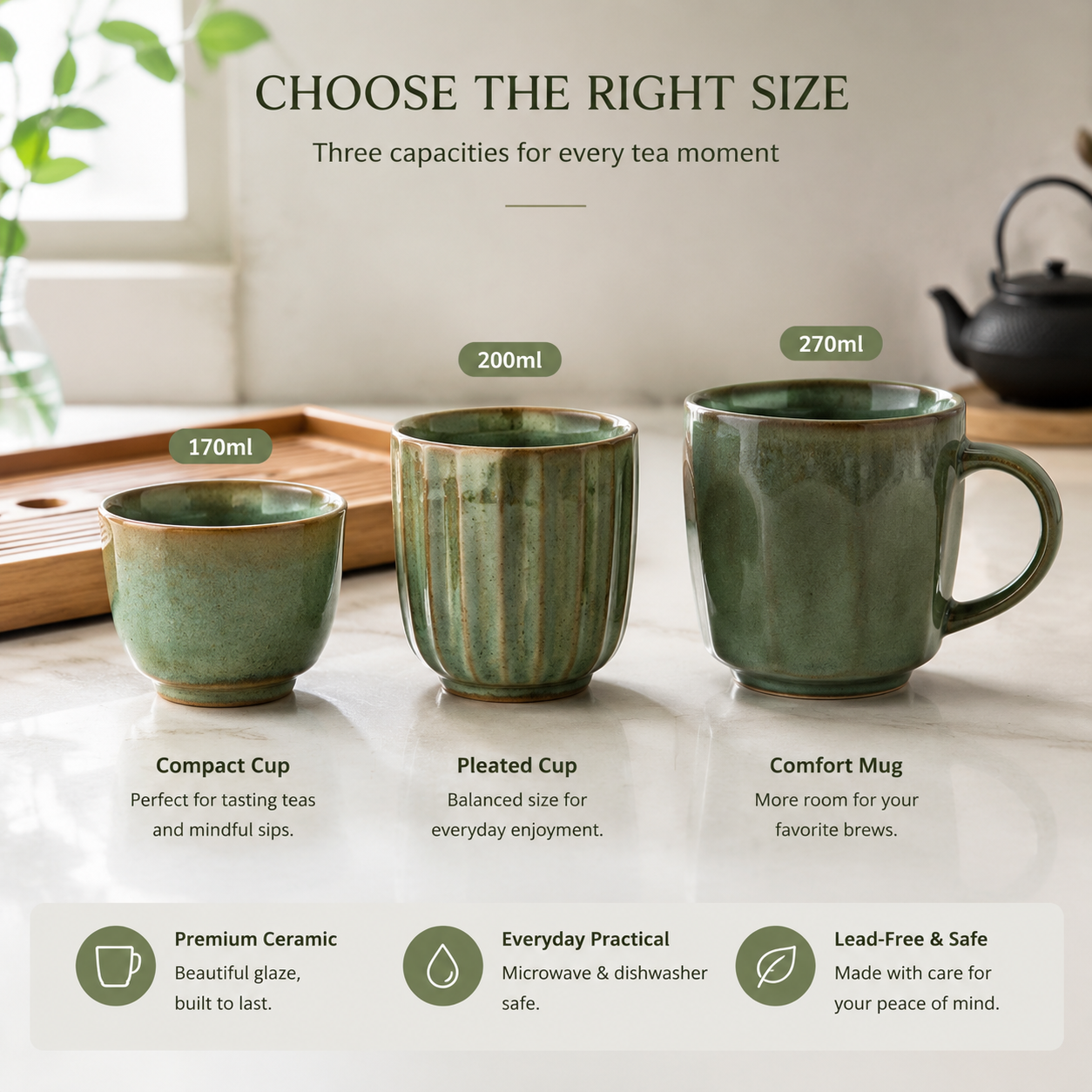
Green Tea Mug Buying Guide: Capacity, Shape, and Ceramic Options
Compare 170 ml, 200 ml, and 270 ml mug options by listed capacity, visible shape, and refill preference. Includes practical ceramic checks for desks, kitchens, and gifts.
Czytaj dalej
Zostaw komentarz
Ta strona jest chroniona przez hCaptcha i obowiązują na niej Polityka prywatności i Warunki korzystania z usługi serwisu hCaptcha.