
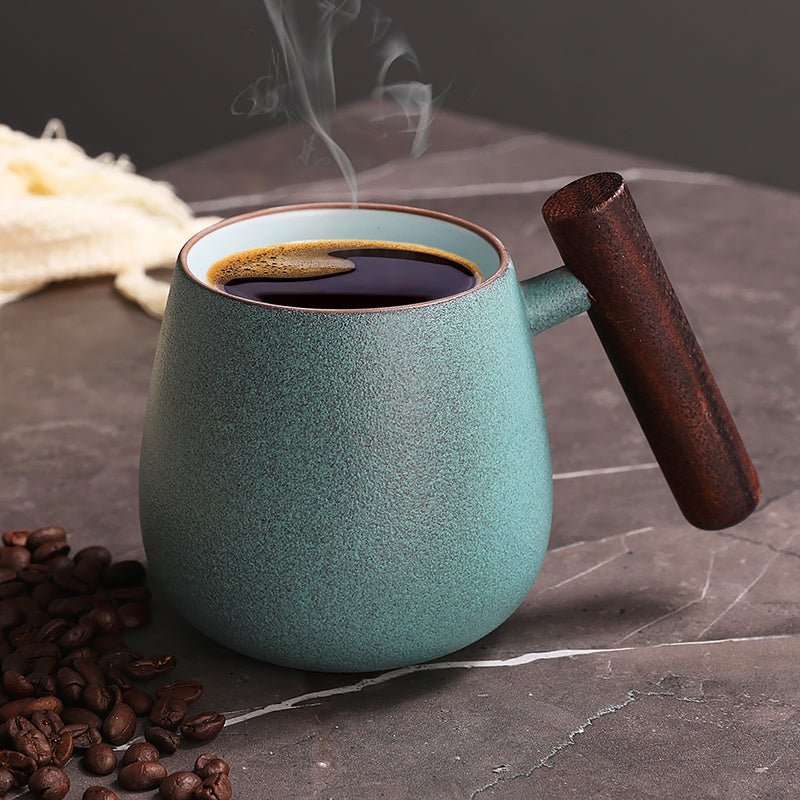
14 Ounce Coffee Mugs: Fit, Materials, and Buying Guide
Reading time: about 9 minutes
A 14-ounce mug solves a very specific problem: the cup that is too small for a long coffee, but not so large that it feels bulky on a desk or gets awkward in a dishwasher rack. In our store, we see shoppers move to this size when they want a little extra breathing room for milk, foam, or a longer pour without jumping all the way to a 16-ounce mug.
That middle ground is the reason 14 ounce coffee mugs stay practical. They are large enough for most daily coffee routines, but still compact enough to feel familiar in the hand. If you want to compare the category before choosing a style, start with our full mug collection, then look at a few examples like the Mountain Coffee Tea Mug, the Great Mountain Coffee Tea Mug, and the Emerald Coffee Tea Mug.
Why do shoppers choose 14 ounce coffee mugs instead of 12 ounce or 16 ounce?
Most buyers land on 14 ounces after using smaller mugs for a while and realizing the extra two ounces matter more than they expected. A 12-ounce mug can feel tight once you add cream, cold foam, or a generous pour. A 16-ounce mug gives you more capacity, but it can also feel oversized if you usually drink a single coffee or tea and do not want the cup to dominate your desk.
We see 14 ounce coffee mugs work well for:
- Standard drip coffee with room for milk or half-and-half.
- Tea drinkers who want a larger serving without moving into a very large mug.
- Office desks where you want one cup, not a travel tumbler, but still want enough volume for a longer meeting.
- People who dislike having the brim too close to the top once the drink is filled.
If you are still deciding between sizes, our related guide on 12 ounce coffee mug buying basics is a useful comparison point. The main difference is not just capacity. It is also how the mug feels in hand, how high the liquid sits below the rim, and whether you like a cup that leaves more room for toppings or froth.
What should you check before buying a 14 ounce mug?
We tell shoppers to look past the headline capacity and check the details that affect daily use. Two mugs can both be labeled 14 ounces and still feel very different on a kitchen counter.
| What to check | Why it matters | What can go wrong |
|---|---|---|
| Rim width | A wider opening cools faster and is easier to sip from | A narrow rim can make the mug feel cramped |
| Handle clearance | Room for a full grip matters if you drink hot coffee | A tight handle can be uncomfortable or hard to clean |
| Wall thickness | Thicker walls can hold heat longer and feel sturdier | Very thin walls may cool quickly or chip more easily |
| Base shape | A stable base matters on smooth counters and crowded desks | A narrow base may feel tippy when full |
Three concrete things we check in this category are the handle opening, the rim finish, and the glaze around the base. If the handle is too tight, the mug is annoying from day one. If the rim feels rough, you notice it every sip. If the foot ring is uneven, the mug can wobble on a desk or catch on a shelf.
Material matters too. Most 14 ounce coffee mugs shoppers compare are ceramic or stoneware. Ceramic usually gives a cleaner, smoother feel and is common for everyday use. Stoneware tends to feel heavier and more substantial in the hand. Neither is automatically better. The right choice depends on whether you want a lighter mug that is easy to lift or a denser mug that feels grounded on the table.
Which materials and shapes are best for daily use?
For everyday drinking, the best 14 ounce coffee mugs are the ones that match your routine rather than the ones that look the largest in a photo. A straight-sided cylinder, a gently tapered bowl, and a rounded shoulder all behave differently in use.
Here is the practical version:
- Straight-sided mugs feel simple and stack neatly in a cabinet, but they can hold heat a little differently depending on wall thickness.
- Tapered mugs often sit nicely in the hand and can feel less bulky even when the capacity is the same.
- Heavier stoneware mugs are a good fit if you like a sturdy desk mug and do not mind the extra weight.
- Lighter ceramic mugs are easier for quick kitchen use and repeated washing.
For a more detailed size comparison, our article on 14 ounce coffee mugs size, fit, and buying guide covers the fit side in more detail. If you are deciding between the middle sizes, you may also want to compare against our 16 ounce coffee mugs for daily use. That is usually where the trade-off becomes clear: 14 ounces keeps the cup manageable, while 16 ounces gives you more room but starts to feel like a larger daily vessel.
One limitation to keep in mind: a 14-ounce mug is not ideal if you routinely pour large specialty drinks, layered lattes, or extra-large tea servings. If you regularly fill above the halfway point and still want more room, a 16-ounce or 20-ounce mug may suit you better.
Are 14 ounce coffee mugs good for coffee, tea, and office use?
Yes, but for different reasons. For black coffee, 14 ounces gives you a little headroom without pushing the mug into oversized territory. For tea, it is often a very comfortable middle size because it handles a full serving without feeling like a soup cup. For the office, it is one of the easiest mug sizes to live with because it balances capacity and footprint.
In our experience, the office test is simple. A mug works if it fits under a cabinet, sits steadily beside a laptop, and can be washed without taking half the sink. That is where 14 ounce coffee mugs usually perform better than larger mugs. They are big enough to be useful, but not so large that they become the only thing on the desk.
They are not the best choice for someone who wants a full extra-large pour, uses lots of ice and milk, or expects a mug to act like a travel cup. They are also not ideal if you want a super-light cup for one-handed sipping while walking around the house. In that case, a smaller 8 ounce or 12 ounce mug may be easier to live with.
What common defects should you look for on arrival?
This is the part many shoppers skip, and it matters. Even a good mug can arrive with a flaw if the finish is off or the piece was handled poorly during packing.
- Check the rim for chips or rough spots. That is the first place a defect becomes obvious in use.
- Set the mug on a flat counter and see if it rocks. A slightly uneven foot ring can make a new mug feel cheap right away.
- Look at the handle join. Hairline glaze issues or rough seams often show up here first.
- Inspect the inside surface under light. Pinholes or glaze marks are not always serious, but they should be visible before the mug enters daily rotation.
Care is straightforward for most ceramic and stoneware mugs: rinse after use, avoid sudden temperature swings, and do not move a very hot mug straight into cold water. That thermal shock can stress the body or glaze over time. If you want the mug to keep looking clean, avoid leaving coffee or tea stains sitting in it overnight for days at a time. Regular washing matters more than aggressive scrubbing.
Which product styles make sense if you want one now?
If you want a ready-made shortlist, we would start with the Mountain Coffee Tea Mug for a straightforward daily option, the Great Mountain Coffee Tea Mug if you want the same basic use case with a different presentation, and the Emerald Coffee Tea Mug if you are leaning toward a more distinctive look for a gift or a personal desk setup.
These are the kinds of pieces people buy after deciding that the mug itself should feel a little more considered than the average everyday cup. If you are comparing options side by side, our collection page is the fastest way to scan the broader range before narrowing down. For buyers who want even more size context, the existing guides on 16 ounce coffee mugs and 20 ounce coffee mugs are useful next reads, especially if you are debating whether 14 ounces is enough headroom.
The trade-off is simple. If you want a mug that disappears into your routine, 14 ounces is a strong middle size. If you want maximum volume, go larger. If you want the smallest possible footprint, go smaller. The right answer depends on how you actually drink at home or at work, not on the number printed in the listing.
Frequently asked questions
Is a 14 ounce mug too big for everyday coffee?
Not for most people. A 14 ounce mug is usually a comfortable everyday size if you drink drip coffee, tea, or coffee with milk and do not want the cup filled to the rim. It only feels too big if you prefer small servings or want a very compact mug.
What is the difference between 12 ounce and 14 ounce coffee mugs?
The difference sounds small, but it changes the drinking experience. Fourteen ounces gives you a bit more room for milk, foam, or a larger pour, which helps reduce the feeling that the mug is too full. Twelve ounces is better if you want a tighter, more compact cup.
Are 14 ounce coffee mugs good for lattes?
They can be, depending on the drink size and how much milk you use. A 14 ounce mug works well for a moderate latte or a drink with room for foam, but it is not the best choice for very large specialty drinks. If you prefer a bigger milk-to-coffee ratio, consider a 16 ounce mug instead.
What material is best for a 14 ounce mug?
Ceramic and stoneware are the most practical choices for most buyers. Ceramic usually feels a little lighter and smoother, while stoneware feels heavier and more substantial. The best option depends on whether you value easy handling or a sturdier feel.
What should I inspect on a new mug before using it?
Check the rim, handle, and base first. A chipped rim, a tight handle, or a wobbly foot ring can all affect daily use. Also look for rough glaze spots inside the mug, especially if you plan to wash and reuse it every day.
If you are choosing one now, use this quick checklist: check the rim, confirm the handle feels comfortable, compare it against a 12 ounce and 16 ounce option, then pick the style that matches your desk or kitchen routine. If you want to browse the range, start with our full collection and narrow from there.
Read more
Coffee Mug Dad Gifts: Size, Style, and Practical Picks
A coffee mug dad gift works best when it matches how he actually drinks coffee: at the kitchen counter, on a desk, or after dinner. We compare three practical styles, what each one does well, and w...
Czytaj dalejCoffee Mug Dad Gifts: Size, Style, and Practical Picks
A coffee mug dad gift works best when it matches how he actually drinks coffee: at the kitchen counter, on a desk, or after dinner. We compare three practical styles, what each one does well, and w...
Czytaj dalej
Zostaw komentarz
Ta strona jest chroniona przez hCaptcha i obowiązują na niej Polityka prywatności i Warunki korzystania z usługi serwisu hCaptcha.