
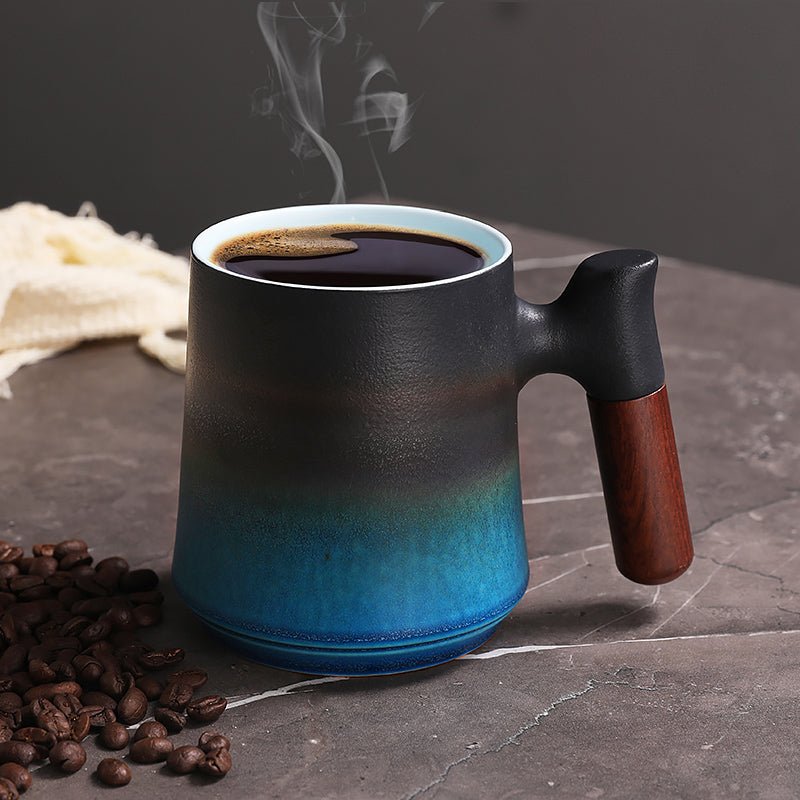
Hot Toddy Mug Capacity Guide: Compare 400 ml and 480 ml
Reading time: about 9 minutes
A mug can look perfectly sized on a product page and still miss the mark at an office desk. Fill it, and the difference becomes clearer: 400 ml may suit a deliberate single serving, while an extra 80 ml can delay a trip back to the kitchen but also makes the full mug heavier. This hot toddy mug capacity guide compares the current CoffeifyMug sizes around those practical moments.
In our store, capacity is the starting point rather than a complete comfort rating. Headspace, refill habits, handle geometry, and the amount you normally finish all matter. The current options covered here are everyday ceramic drinkware: The Gradient and The Flow are listed at 400 ml, and The Rock is listed at 480 ml. We are not attaching recipe ingredients, accessories, insulation ratings, or professional temperature-test claims to those figures.
400 ml versus 480 ml: what changes at the counter?
The catalog difference is simple, but the daily effect depends on your routine. The conversions below are rounded to US fluid ounces and are provided only to make familiar mug sizes easier to compare. They are not recommended fill lines.
| Current mug | Listed capacity | Likely routine fit | Main trade-off |
|---|---|---|---|
| The Gradient Coffee Tea Mug | 400 ml, about 13.5 US fl oz | A moderate serving when refills are easy to reach | Less room than the 480 ml option, so handle and body preference become the deciding factors |
| The Flow Coffee Tea Mug | 400 ml, about 13.5 US fl oz | The same serving volume as The Gradient with a separate design choice | Capacity cannot settle the choice between the two 400 ml mugs |
| The Rock Coffee Tea Mug | 480 ml, about 16.2 US fl oz | Longer desk sessions or fewer planned top-ups | A full serving contains 80 ml more liquid and will feel heavier |
The Rock offers 80 ml more listed capacity than either 400 ml mug. That is about 2.7 US fl oz, or 20% more nominal volume. For a water-like drink, the difference alone adds roughly 80 grams of liquid when both mugs are filled by the same method; exact weight varies with the drink and actual fill level.
Capacity does not tell us the mug's exterior dimensions, empty weight, handle clearance, or comfortable working fill. If the volume is settled but you want to compare other current designs, browse our unique coffee mug collection and check each listing rather than assuming that mugs with equal capacities will feel identical.
Hot toddy mug capacity guide: which refill routine fits each size?
The most reliable decision comes from observing what happens after the first pour. Count how often you refill, how much you leave behind, and where the mug spends most of its time. This hot toddy mug capacity guide maps those patterns to the listed sizes rather than treating the largest mug as the automatic winner.
- Easy access to the kettle or kitchen: A 400 ml mug usually makes more sense if you welcome a fresh refill and do not need the extra 80 ml. Start with The Gradient or The Flow, then let the visible handle and body design break the tie.
- Long office calls or uninterrupted reading: The 480 ml Rock fits a shopper who regularly empties a 400 ml serving and wants fewer top-ups. Its advantage is additional volume, not a claim of longer heat retention.
- Slow drinking with a final portion often left: Choose a 400 ml option. Buying unused capacity only adds liquid weight and can leave more drink unfinished.
- A serving that needs stirring room: The 480 ml option provides more total room, but you should still leave practical headspace instead of filling to the rim. Nominal capacity and comfortable carrying capacity are not the same thing.
For comparisons beyond these three mugs, our coffee mug sizes guide for daily use explains how common capacities fit coffee, tea, and other routines. The narrower choice here remains 400 ml versus 480 ml.
Gradient or Flow: what decides between two 400 ml mugs?
The Gradient and The Flow are both listed at 400 ml, so neither gives you a capacity advantage. That is useful rather than limiting: shoppers who already know that 400 ml fits their serving can focus on the product-page views of the handle opening, the handle's projection from the mug wall, the upper and lower attachment points, and the body profile.
In our experience handling ceramic drinkware, a suitable finger position matters more than a small visual preference once a mug is used every day. Open the two listings side by side and ask how you normally lift a full mug. A one-finger grip, a two- or three-finger grip, and a grip that wraps partly around the mug body need different clearances. We do not have verified numerical handle-opening measurements in this comparison, so we will not claim that either 400 ml model universally fits larger or smaller hands.
- If your routine calls for 400 ml and the handle profile shown on The Gradient matches your usual grip, its product page is the relevant next step.
- If you need the same 400 ml volume but prefer the handle and body relationship shown on The Flow, choose it without expecting a capacity difference.
- If neither visible handle shape looks comfortable, do not force the choice just because the capacity is right. A different mug style will be a better daily purchase.
This distinction is especially useful for gifts. A 400 ml label confirms volume, but it does not promise comfort for an unknown hand size. Check the listing photographs closely and avoid describing either option to the recipient as a universal fit.
Who gets real value from The Rock's extra 80 ml?
The Rock is the direct current choice for someone who repeatedly finishes 400 ml and then gets up for a small second pour. Its 480 ml listed capacity consolidates that routine into one larger serving. That can be useful during a work block, beside a reading chair, or on a kitchen counter while preparing breakfast.
The trade-off is straightforward. More liquid takes longer to finish and feels heavier at the handle. The Rock is not the best fit for someone who routinely abandons the last part of a drink, prefers the lightest possible lift, or needs a sealed commuter vessel. An everyday ceramic mug also is not a substitute for lidded, impact-resistant travel drinkware. If transport and spill control lead your list, choose that different product category.
How does handle shape change the capacity decision?
A mug's stated milliliters describe internal volume, not the leverage you feel while lifting it. This matters more with the 480 ml option because the additional liquid increases the loaded weight. Four handle details deserve a close look in the current photographs:
- Interior opening: The usable height and width determine how many fingers can sit inside without crowding.
- Projection: The distance between the handle and mug body affects knuckle clearance.
- Lower curve: Its position influences where the supporting finger carries the load.
- Attachment points: The upper and lower joins should look intact, and their positions affect how the mug balances as the fill level drops.
Once a ceramic mug arrives, test the grip with cool water before using a hot drink. Measure your normal serving, dry the exterior and handle, and lift it over the sink using your usual finger position. This simple check reveals loaded balance without exposing your hand to a hot first trial. If the handle forces an awkward grip when full, a lower capacity or different handle style is the practical answer.
Ceramic care checks for kitchen counters and office desks
Everyday ceramic drinkware is straightforward to use, but the material name alone does not confirm every care method. Product-specific instructions on the current listing or packaging should take priority. We use these basic checks when evaluating a mug for regular rotation:
- Wash before first use. Use mild dish soap and a nonabrasive sponge unless the product instructions specify another method.
- Check the rim and handle joins. Look for a sharp chip or a structural hairline crack after unboxing and after accidental knocks. Do not continue using a mug with a cracked handle or damaged drinking edge.
- Avoid abrupt temperature changes. Do not move very cold ceramic directly into an extreme hot-fill situation or shock a hot mug with cold water.
- Verify appliance guidance. Do not assume that every ceramic mug is microwave-safe or dishwasher-safe. Check the product page or packaging; if dishwasher guidance is unclear, hand washing is the conservative choice.
- Prevent contact during a dishwasher cycle. If the mug is confirmed dishwasher-safe, position it so the rim and handle cannot knock against heavier dishes.
These steps address common real-world failure points: rim impacts, stressed handle joins, thermal shock, and care assumptions based only on the word ceramic. They do not imply that the mugs have undergone professional durability or temperature testing.
Your 60-second capacity check before ordering
You can test the two listed volumes with a mug and measuring vessel already in your kitchen:
- Measure 400 ml of cool water into your current mug.
- Stop at the headspace you would genuinely leave for carrying and stirring.
- Repeat with 480 ml, provided your current mug can hold it safely.
- Lift each amount using your normal grip and note the extra liquid weight.
- Choose 400 ml if you value a moderate serving; choose 480 ml if you consistently want the additional 80 ml.
If capacity is only one part of your purchase, our broader hot toddy mug buying guide covers the wider category. For this decision, keep the shortlist precise: Gradient or Flow at 400 ml, and Rock at 480 ml.
Frequently asked questions
What size hot toddy mug should I buy, 400 ml or 480 ml?
Choose 400 ml if you prefer a moderate serving, can refill easily, or often leave the final portion of a larger drink. Choose 480 ml if you regularly finish 400 ml and want another 80 ml without returning to the kitchen. Leave carrying headspace with either size.
Which current CoffeifyMug hot toddy mugs hold 400 ml?
The Gradient Coffee Tea Mug and The Flow Coffee Tea Mug are each listed at 400 ml. Because their capacities match, compare the current product photographs and select the body and handle profile that better fits your grip and style preference.
Does this hot toddy mug capacity guide include exact handle measurements?
No. The verified comparison covers the listed capacities, while exact handle-opening dimensions are not part of the facts used here. Review each current listing's photographs for finger clearance and handle projection, and do not assume equal capacity means equal grip comfort.
Will the 480 ml mug keep a hot toddy warm longer than a 400 ml mug?
We do not make that claim. Capacity is not an insulation or heat-retention rating, and this comparison is not based on specialized temperature testing. If measured thermal performance is your priority, look for drinkware that publishes evidence for that specific feature.
How can I check 400 ml versus 480 ml before ordering?
Measure both amounts with cool water in a mug you already own, leaving your normal headspace, and lift each amount using your usual grip. Note whether the extra 80 ml solves a real refill problem or merely adds weight. Then compare the 400 ml and 480 ml options in our current unique coffee mug collection.
More from our blog
Read more
Americano coffee cup capacity guide: 200, 270, and 350 ml
Compare CoffeifyMug's current 200 ml, 270 ml, and 350 ml options by measured pour, volume headroom, and refill routine. Includes a practical capacity check for finding the closest daily fit.
Per saperne di più
Ceramic Cortado Cup Capacity Guide: 170 ml, 200 ml, 270 ml
Compare CoffeifyMug's current 170 ml, 200 ml, and 270 ml ceramic options using finished drink volume, practical headroom, and refill habits. Includes exact fit examples and honest limitations.
Per saperne di più
Commenta
Questo sito è protetto da hCaptcha e applica le Norme sulla privacy e i Termini di servizio di hCaptcha.