
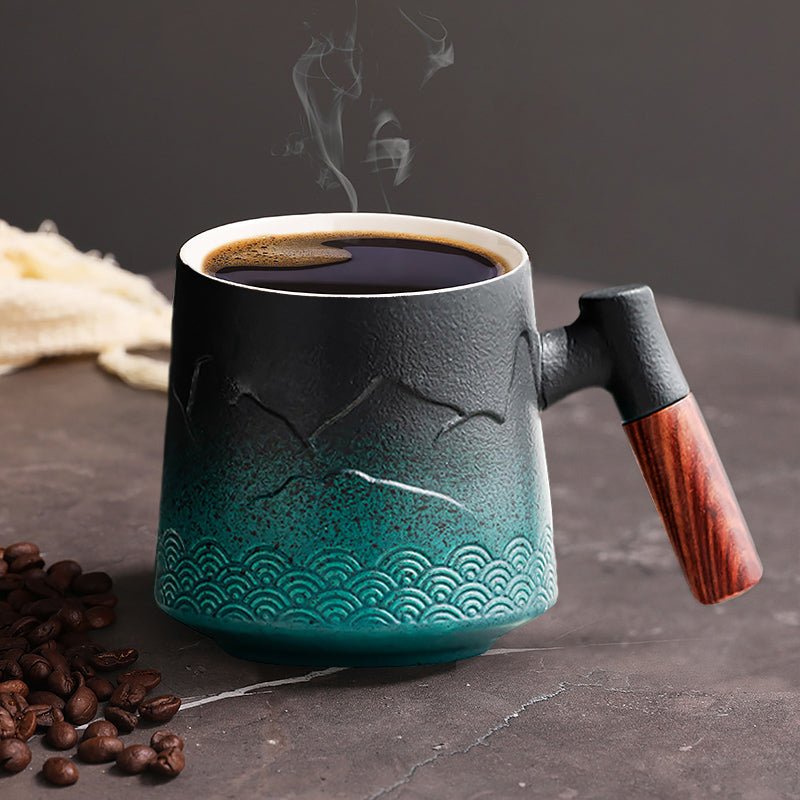
Coffee Mugs with Logos: How to Choose the Right Mug
Reading time: about 9 minutes
A logo can disappear the moment a mug lands on a cluttered desk: the handle blocks it, the artwork wraps too far around the curve, and the cup looks generic from across the room. We see that problem all the time in our store, so we focus on mugs that still read clearly after they have been washed, handled, and set back down next to a keyboard.
If you want style-led examples to compare, start with our Pleated Coffee Tea Cup, Golden Waves KIO Coffee Tea Mug, and The Flow Coffee Tea Mug. If you want to browse the full range first, open our all collection and compare the shapes side by side.
What makes a logo mug easy to read on a real desk?
The best coffee mugs with logos do one simple job well: they show the mark without forcing people to hunt for it. A logo that looks fine in a product photo can fail in a break room if the mug curves away too fast, the handle crowds the design, or the print sits too low near the base.
In practice, we look for a few things before we recommend a mug for branded use:
- Enough flat or gently curved space for the logo to sit without distortion.
- Clear contrast between the artwork and the mug color so the mark stays visible across a desk.
- Handle clearance so the logo is not cut off when the mug is turned toward the user.
- A balanced silhouette that feels steady in the hand and does not tip visually toward the art.
That last point matters more than people expect. A mug with a beautiful logo but a wobbly stance often gets left in the cabinet, and that is the opposite of what a buyer wants from a branded cup.
A good logo mug should look finished before the coffee is poured, not after someone rotates it three times to find the front.
Which mug shape gives the logo the best surface?
Shape changes how a logo behaves. A straight-sided mug gives the cleanest canvas. A lightly tapered mug can still work well, but the design needs to stay compact and centered. Heavy curves are more expressive, yet they are also the easiest place for artwork to stretch or disappear.
That is why we pay attention to the sidewall before anything else. If the mug has a strong profile, it should still leave a readable zone where a logo can sit without fighting the form.
| Shape | Best for | Trade-off | Logo note |
|---|---|---|---|
| Straight-sided mug | Office desks, brand merch, simple gifts | Less sculptural than decorative shapes | Usually the easiest surface for clean placement |
| Gently tapered mug | Daily coffee, client gifts, mixed-use kitchens | Artwork can distort if it wraps too far | Works best with a centered logo or smaller mark |
| Curved or sculpted mug | Design-forward gifting, display pieces | Not ideal for large logos or text-heavy marks | Best when the logo is treated as a detail, not the whole design |
That is also why the three mugs above are useful comparison pieces. They show how a more distinctive silhouette can still fit a practical drinkware role. If your logo is large, text-heavy, or meant to be read from across a conference table, choose the simplest shape you can. If the logo is small and the mug is part of a gift set, a more sculptural cup can work better.
Which size should you choose for office use and gifting?
Size matters because logo mugs are usually bought for one of three reasons: daily coffee, customer gifts, or branded merchandise. A mug that holds too little can feel decorative only. A mug that is too large can overwhelm the hand, take up too much space on a desk, and make the logo feel lost on the surface.
For shoppers comparing capacities, our size guides are the fastest way to match the mug to the use case. See 12 oz Coffee Mugs: How to Choose the Right Mug for Daily Use, 14 Ounce Coffee Mugs: Size, Fit, and Buying Guide, and 16 oz Coffee Mugs: How to Choose the Right Mug for Daily Use if you want a fuller comparison.
- 12 oz works well for standard coffee drinkers, desk use, and smaller gift sets. It keeps the mug footprint compact, which helps if the logo needs room to breathe.
- 14 oz suits people who like a little extra room for cream, tea, or a longer pour. It is a practical middle ground when the mug is a gift and you do not know the recipient’s exact routine.
- 16 oz fits heavier coffee drinkers, long work sessions, and people who prefer a mug that feels more generous in the hand. The trade-off is that the larger surface can make a small logo look undersized if the artwork is not scaled correctly.
We usually tell buyers to think about the desk setup too. A 16 oz mug can be a good pick for a home office counter, but it can feel bulky on a crowded workstation with a laptop, notebook, and mousepad already in place.
What should you check before you place an order?
Most mistakes with coffee mugs with logos happen before the mug ever leaves the box. The artwork looked fine in the mockup, but the placement, finish, or shape did not suit real use. We look for the same practical details every time.
- Logo position: Check whether the mark is centered, offset for left- or right-handed use, or wrapped around the mug. A logo that disappears behind the handle is a common miss.
- Print type: Printed, decal, embossed, or engraved logos wear differently. Raised details can look premium, but they can also trap residue around the edges.
- Rim and base: A smooth rim feels better in daily use, while a wide base helps the mug sit firmly on a desk. Thin bases can feel unstable on a crowded counter.
- Finish: Glossy mugs usually show fingerprints and surface scuffs more readily. Matte finishes can look refined, but they may reveal wear in a different way over time.
- Care needs: If the logo treatment is delicate, handwashing is the safer choice unless the seller clearly says otherwise. Dishwasher heat and repeated cycles can shorten the clean look of some decorations.
- Packaging: For gifts, look at how the mug is packed. A nice mug can still disappoint if it arrives chipped, rattling loosely in the box, or covered in loose paper dust.
The most common defect mode we see is not a broken handle. It is a mug that was never the right fit for the logo in the first place. A good product photo should show the design from the angle a buyer will actually see it on a desk or kitchen counter.
Which mugs work best for offices, gifts, and merch?
The right mug depends on where it will live. A reception desk needs a different mug than a gift box. A staff pantry needs a different one than a customer giveaway. We think in terms of use first, because that is where buying mistakes show up.
- Office desks: Choose a shape with a stable base, a clear front panel, and a logo that reads well from seated height.
- Client gifts: Keep the design restrained. A simple logo, a clean silhouette, and a neutral finish usually land better than a busy surface.
- Brand merch: Focus on repeat use. If the mug is awkward to sip from or hard to wash, it will not stay in rotation long enough to do its job.
- Display pieces: If the mug is meant to sit on a shelf or in a gift hamper, a more sculptural shape can make sense, even if it is not the easiest everyday mug.
There is a limit here. Coffee mugs with logos are not the right choice for travel use, car cup holders, or people who need a leak-resistant container. They are also not the best option if you want soup-bowl capacity or a tall insulated vessel. For those jobs, another category fits better.
How do logo mugs hold up after washing and daily use?
Real-world use is where the decision becomes clear. A mug may look perfect on a white background, then pick up coffee rings, utensil marks, and dishwasher wear after a few weeks on a kitchen shelf. That does not mean it is a bad mug. It means the buyer should know what trade-off they are making.
In our experience, the mugs that keep looking good longest are the ones with simple, well-placed artwork and a finish that matches the use case. A clean logo on a stable mug is easier to live with than a busy design that demands careful handling every day.
Here is the practical version:
- Dishwasher cycles: Repeated washing can be tougher on detailed prints than on simple, solid artwork.
- Microwave use: Metallic accents, specialty coatings, or certain decorative treatments may not suit microwave heating.
- Stacking: If a mug has a sculpted body or raised logo, it may not stack neatly in a break room cabinet.
- Grip and balance: A mug that feels too light can slide easily, while one that is too heavy can be tiring for long use.
If the mug is for someone who washes everything by hand anyway, a more decorative finish can be a reasonable choice. If it is for an office kitchen where everyone drops cups into the dishwasher at the end of the day, choose the simplest construction you can get away with.
Frequently asked questions
What size logo works best on a coffee mug?
A logo should be large enough to read from arm’s length, but not so large that it wraps awkwardly around the cup. Small, centered marks usually age better than oversized artwork because they stay readable across different mug shapes. If the mug has a strong curve, keep the logo simpler and more compact.
Are coffee mugs with logos dishwasher safe?
Some are, but not all logo treatments handle repeated dishwasher cycles the same way. If the finish uses metallic detail, specialty decal work, or delicate print, handwashing is usually the safer choice unless the product listing clearly says otherwise. For office use, check the care instructions before you buy.
What mug shape is best for a business logo?
A straight-sided or lightly tapered mug is usually the easiest surface for a business logo. Those shapes give the artwork a cleaner panel and keep the brand mark readable from more angles. Very curved mugs can still work, but they are better for smaller or more decorative logos.
Are coffee mugs with logos good for gifts?
Yes, if the design is restrained and the mug feels good in the hand. For gifts, a mug should look intentional before it is opened, not like a leftover promo item. A clean shape, stable base, and thoughtful packaging matter as much as the logo itself.
Should I choose 12 oz, 14 oz, or 16 oz?
Choose 12 oz for a compact daily mug, 14 oz for a middle-ground gift or office cup, and 16 oz if the drinker likes a larger pour. The right answer depends on how much room you want for coffee, milk, or tea, and how much desk space the mug will have. If the logo needs a lot of visual breathing room, smaller can actually look better.
If you want the fastest shortlist, open our all collection, compare the mug shapes above, and choose the one that gives your logo the clearest front panel and the most stable base. Start with readability, then pick the size that fits the drinker’s daily routine.
Read more
Flamingo Coffee Mug Buying Guide for Daily Use and Gifting
A flamingo coffee mug should look good on the counter and still hold up to daily use. Here’s what to check before you buy, plus where a flamingo style fits best and where it doesn’t.
Per saperne di più
Ginger Coffee Mug Buying Guide for Daily Use and Gift Giving
A practical guide to choosing a ginger coffee mug for home, office, or gifting, with real size, material, and care trade-offs. Compare our current mug styles, then pick the one that fits how you ac...
Per saperne di più
Commenta
Questo sito è protetto da hCaptcha e applica le Norme sulla privacy e i Termini di servizio di hCaptcha.