
Coffee Mug Oz Guide: How to Choose the Right Size
Reading time: about 9 minutes
A mug can look generous on a product page and still feel small once you pour a full morning coffee into it. We see this all the time in our store: shoppers want a mug that feels comfortable in hand, holds enough coffee, and does not splash on the way from the counter to a desk.
That is why coffee mug oz matters more than most people expect. The number tells you capacity, but it does not tell you everything about lip shape, handle clearance, wall thickness, or how the mug behaves with a real pour of coffee, milk, or tea.
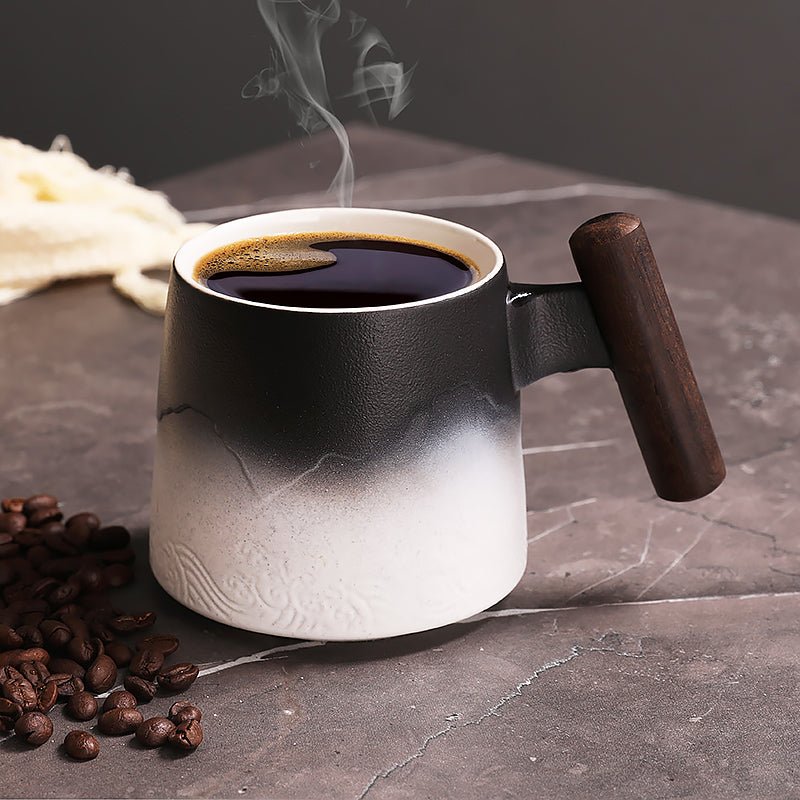
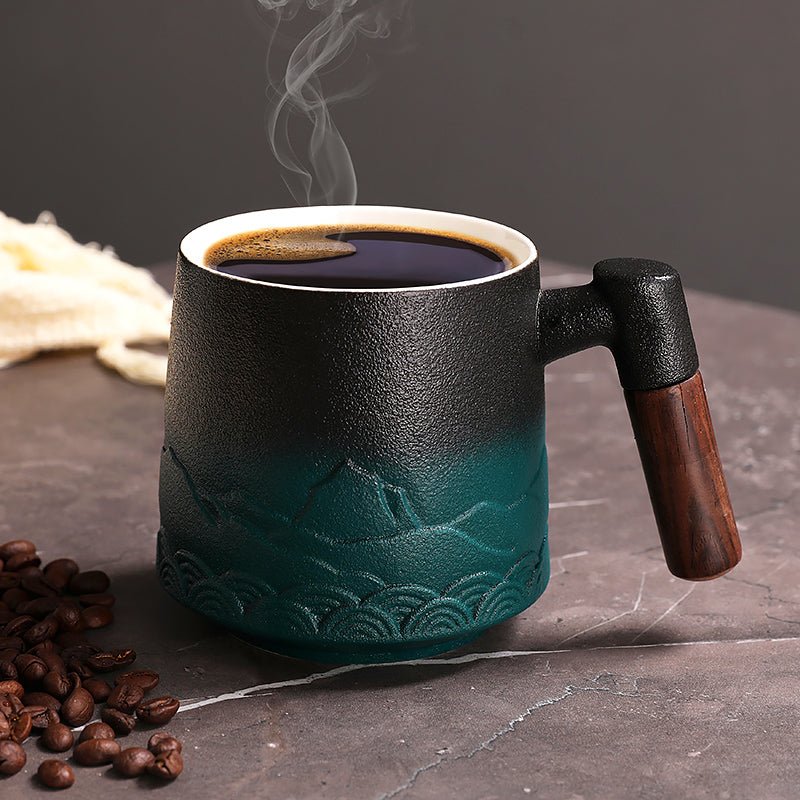
If you are comparing sizes before you buy, start with the basics, then narrow it down by use case. Our full mug collection is the fastest place to compare styles side by side, and if you already know you want a handcrafted feel, the The Rock Coffee Tea Mug and the The Cloud Coffee Tea Mug with Wooden Handle are good examples of how shape changes the way an ounce count feels in daily use.
What does coffee mug oz actually measure?
The ounce number on a mug refers to volume capacity, not the amount of coffee most people pour every morning. In practice, a mug’s usable fill is often lower than the brim-to-brim capacity because nobody wants coffee sloshing into a sleeve, onto a keyboard, or across a breakfast table.
We also tell shoppers to separate capacity from comfort. A tall narrow mug can hold the same ounces as a wider mug, but it may feel heavier at the top and less stable on a crowded desk. A wider mug may cool a little faster. A mug with a wooden handle may feel easier to grip, but the handle shape changes how the mug fits under a single-serve brewer or inside a cabinet.
For shoppers still deciding between the common sizes, our size-specific guides on 10 oz coffee mugs, 11 oz coffee mugs, and 12 oz coffee mugs cover the most common buying questions in more detail.
Which coffee mug oz size works best for daily use?
The right size depends on what you actually drink, where you drink it, and how much room you want left in the mug.
| Size | Best for | Trade-off |
|---|---|---|
| 8 oz | Espresso drinks, small pours, tea cups, and compact desks | Too small for people who refill often |
| 10 oz | Smaller drip coffee, cappuccino-style drinks, tighter hand feel | Can feel short on long mornings |
| 11 oz | Classic everyday coffee and gifting | Not ideal if you add a lot of milk or want a large pour |
| 12 oz | Most standard home and office coffee routines | Can be a little bulky in smaller hands |
| 14 oz+ | Big pours, long work sessions, people who dislike refills | Heavier when full and more likely to crowd a machine or cabinet |
For many buyers, 11 oz or 12 oz hits the balance point. That is large enough for a standard mug of drip coffee without feeling oversized, but not so large that the cup dominates a breakfast tray or desk. If you want a deeper comparison on bigger formats, our article on 14 oz coffee mugs is useful before you commit to a larger body style.
We have found that office shoppers usually care about two things: whether the mug fits under the coffee machine and whether it sits securely on a cluttered desk near a laptop. Home buyers ask different questions. They want something that feels good during a quiet morning pour and cleans up without fuss.
How do shape, handle, and material change the way a mug feels?
Two mugs with the same coffee mug oz rating can feel completely different in the hand. That is where practical comparison matters more than the capacity number.
- Material: Ceramic is the common choice for everyday mugs because it holds heat well and has a familiar feel. It can chip if knocked against a sink or other hard surface, so edge quality matters.
- Handle design: A wooden handle changes the grip and the look. It can feel more comfortable for people who do not like a tight ceramic loop, but wood also asks for more careful handling than an all-ceramic mug.
- Wall thickness: Thicker walls often feel sturdy and can help a mug retain heat, but they also make the mug heavier.
- Mouth shape: A wider opening is easier to sip from and clean, while a narrower opening can slow cooling a bit.
If you like a mug that feels a little more tactile and less generic, our Mountain Sea II Coffee Tea Mug with Wooden Handle and The Cloud Coffee Tea Mug with Wooden Handle show the value of a wooden-handle silhouette. They are not the right choice for someone who wants the lowest-maintenance mug possible, but they are a better fit if you care about grip and presentation.
For buyers comparing everyday ceramic forms, our experience is that the real difference usually comes down to three things: how the handle feels when the mug is full, how much spill room is left at the top, and whether the mug stacks or stores cleanly in the cabinet.
Which size should you buy for coffee, tea, or gifts?
If you are buying for yourself, the drink matters. If you are buying as a gift, the person matters even more. A mug that is perfect for one person can be awkward for another.
- For black coffee drinkers: 10 oz to 12 oz is usually the sweet spot. It gives enough room for a full mug without becoming oversized.
- For latte or milk-heavy drinks: 12 oz to 14 oz is often safer, especially if the drink includes foam or extra milk.
- For tea drinkers: A smaller-to-mid size mug can work well because tea is often sipped more slowly and does not need a huge capacity.
- For gift buyers: 11 oz is a familiar, easy-to-understand size that feels versatile without being too specific.
- For people who sit at a desk for hours: 14 oz can reduce refills, but only if the extra size does not make the mug feel clumsy.
Gifting is where shape matters most. In our store, the first reaction at unboxing is often about the finish and the handle before the buyer even thinks about ounces. A mug with a wood handle looks more considered on a shelf or office desk, while a simpler body may be better for someone who values straightforward utility.
If you are still deciding between common sizes, you may also want to compare the 10 oz and 11 oz write-ups first, then come back to the larger formats once you know whether you prefer a smaller, classic pour or a roomier daily mug.
What should you check before buying a coffee mug oz size online?
We recommend checking the listing for more than the ounce count. A mug can be technically the right size and still be the wrong mug for your counter, cabinet, or routine.
- Capacity and dimensions: Look for the stated ounces, but also check height, rim width, and handle clearance if the mug needs to fit under a brewer or into a narrow shelf.
- Handle comfort: Some handles look large in photos but feel tight once the mug is full. Grip shape matters more than style shots suggest.
- Care instructions: If a mug uses a wooden handle, treat the handle gently. Wood can age differently than ceramic, especially with repeated soaking or harsh washing.
- Finish and edge quality: Smooth glazing, even paint, and a clean rim matter in daily use. Small flaws often show up first around the lip, handle joint, or base.
- Use case: Decide whether this is a desk mug, a breakfast mug, or a gift mug. The best fit changes with the setting.
We look for the details shoppers actually live with: whether the mug is comfortable when full, whether it clears a coffee machine, and whether it still feels good after repeated wash cycles.
That is also why we suggest reading product pages alongside size guides. For example, our posts on what fits in a 10 oz mug and what buyers should check before buying an 11 oz mug are useful when you are trying to avoid a purchase that looks right on paper but feels wrong in daily use.
What mug size is not the best choice?
Not every mug size fits every routine, and that is where honest trade-offs matter.
A larger mug is not the best pick if you drink a short coffee and do not want it cooling too fast. A smaller mug is not the best pick if you hate refilling or you add milk, foam, or hot water and want room to spare. A wooden-handle mug is not ideal if you want a dishwasher-first, minimal-care cup with no extra handling. And a decorative mug is not the best choice if you need something you can toss into a crowded office sink without thinking.
If your priority is pure utility, a standard ceramic mug in a common size is often the easiest path. If your priority is a more distinctive look with a comfortable grip, a wooden-handle mug can be the better buy. We sell both approaches because different shoppers want different trade-offs, and the wrong mug usually fails on the desk, not in the product photo.
Frequently asked questions
How many ounces is a standard coffee mug?
Most shoppers think of a standard mug as falling somewhere around 11 oz to 12 oz, but there is no single universal size. The best choice depends on how much coffee you pour and whether you want extra room for milk or cream.
Is a 10 oz coffee mug too small for daily use?
Not if you drink smaller pours, espresso-based drinks, or tea. It can feel small for someone who wants a full large coffee without refilling, so it is better for modest servings than long work sessions.
Is a 14 oz mug too big for home use?
Not automatically, but it depends on your routine. A 14 oz mug is useful if you want fewer refills, though it can feel heavy when full and may be less convenient if your cabinet space or coffee machine clearance is tight.
Are wooden-handle mugs harder to care for?
They usually need a bit more care than all-ceramic mugs. We recommend following the product care instructions closely and avoiding rough treatment of the wood, especially if the mug will be washed often.
What is the best coffee mug oz size for a gift?
11 oz is usually the safest gift size because it feels familiar and versatile. If you know the person drinks larger coffees or likes extra milk, 12 oz can be the better fit.
If you want the easiest next step, compare the mug style first, then the size. Start with our full collection, then narrow it to the shape you want, and use the size guides to decide whether 10 oz, 11 oz, 12 oz, or 14 oz matches how you actually drink coffee.
Read more
Owl Coffee Mug Buying Guide: Size, Quality, and Best Uses
An owl coffee mug should do more than look cute on a shelf. This guide covers size, handle comfort, print quality, and the trade-offs that matter before you buy.
Per saperne di più
20 Ounce Ceramic Coffee Mug Buying Guide for Daily Use
A practical guide to choosing a 20 ounce ceramic coffee mug that fits your hand, your cabinet, and your daily routine. We cover the details buyers usually miss before ordering.
Per saperne di più
Commenta
Questo sito è protetto da hCaptcha e applica le Norme sulla privacy e i Termini di servizio di hCaptcha.