
Americano Coffee Cup Guide: Capacity and Headroom
Reading time: about 9 minutes
Coffee that looks comfortably below the rim at the kitchen counter can feel uncomfortably close to spilling once you carry it to a desk. That difference is headroom. An americano coffee cup should have enough listed capacity for your complete pour plus whatever empty space you prefer above it, but there is no single cup volume that suits every Americano.
In our store, the useful comparison starts with two numbers: the cup's listed capacity and the amount you actually plan to put in it. We do not treat capacity as a serving recommendation. A 350 ml mug does not require a 350 ml drink, and a 200 ml cup gives no headroom if it is filled with exactly 200 ml.
How much headroom does an americano coffee cup need?
Headroom is the unfilled capacity between your planned total pour and the cup's listed capacity. For a capacity-only comparison, the arithmetic is straightforward:
Listed capacity minus planned total pour equals theoretical headroom.
If you plan to pour 180 ml into a cup listed at 200 ml, the theoretical headroom is 20 ml. The same 180 ml pour in a 270 ml mug leaves 90 ml, while a 350 ml mug leaves 170 ml. These figures compare volume only. They do not describe the vertical distance from the coffee surface to the rim because cup shape and internal dimensions also affect that distance.
There is no universal headroom target. A person who drinks while seated at the kitchen table may accept a fuller cup. Someone carrying coffee past a keyboard may prefer a larger margin. Additions matter too: your planned total should include everything that will occupy space in the cup, not just the first liquid poured.
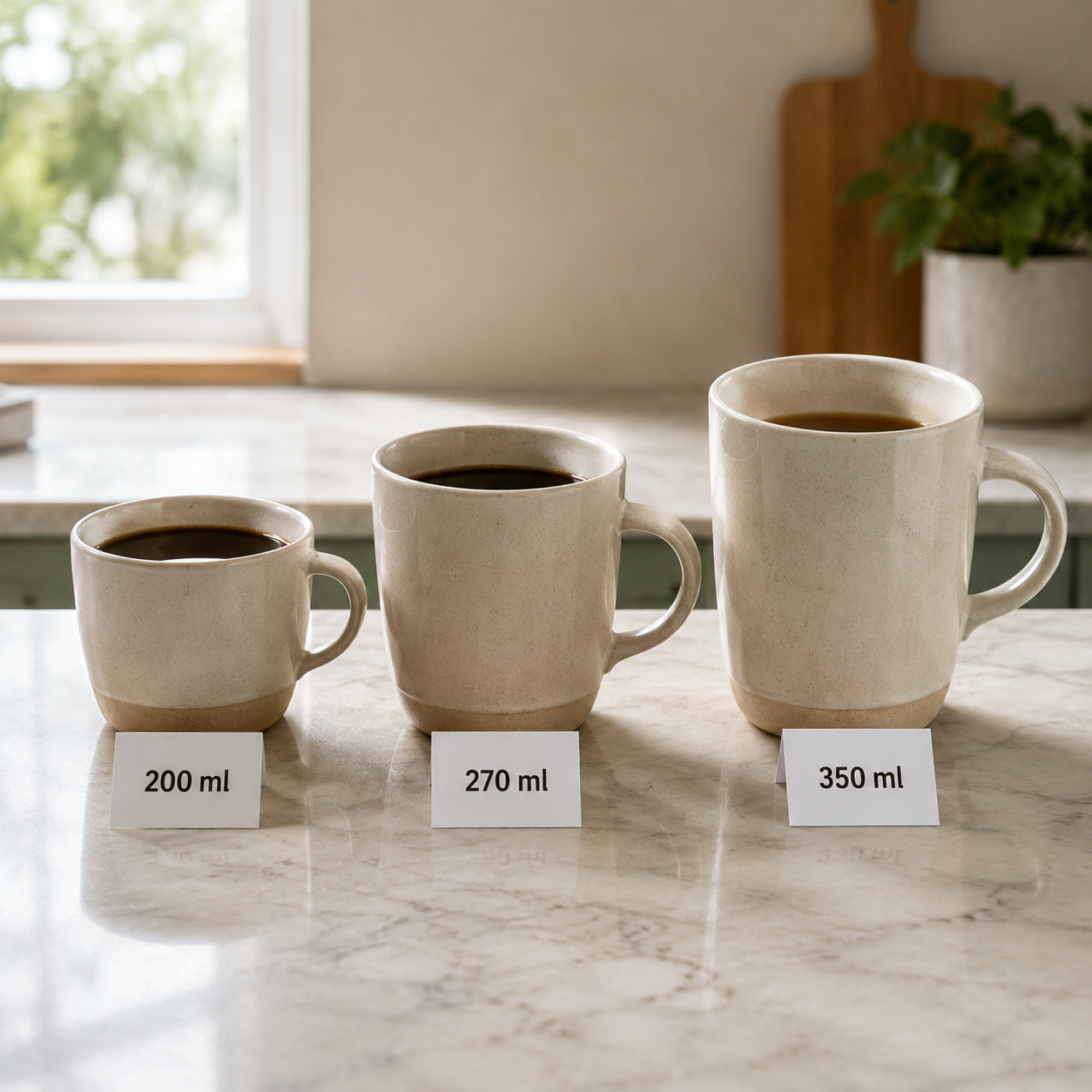
200 ml, 270 ml, or 350 ml: what changes?
CoffeifyMug currently gives shoppers three clearly separated listed capacities in this comparison. Each one suits a different relationship between pour volume and empty space.
| Product | Listed capacity | Capacity-based fit | Main trade-off |
|---|---|---|---|
| Pleated Coffee & Tea Cup | 200 ml | A planned pour below 200 ml when you want less unused capacity | Limited allowance for additions or extra headroom |
| Emerald Coffee & Tea Mug | 270 ml | A planned pour that needs more margin than the 200 ml option provides | More unused capacity than the 200 ml cup for the same pour |
| Landscape Tall Coffee & Tea Mug | 350 ml | A larger planned pour or a smaller pour with substantial theoretical headroom | May feel unnecessarily roomy if you prefer coffee closer to the cup's listed capacity |
The Pleated 200 ml option is the direct next step for a shopper whose measured total stays below 200 ml and who does not want much unused capacity. It is not a suitable capacity choice for a planned 200 ml pour if visible headroom is required, because the arithmetic leaves none.
The Emerald 270 ml option gives the same pour more breathing room. It fits a buyer who finds 200 ml restrictive but does not need the full allowance of the largest option. The trade-off is straightforward: a modest pour will sit farther below the listed maximum than it would in the Pleated cup.
The Landscape Tall 350 ml option offers the most theoretical headroom of these three for any equal pour. It is the relevant next step for a shopper planning more than 270 ml or deliberately choosing a generous capacity margin. It is not the best capacity match for someone who dislikes seeing substantial empty space above a smaller drink.
If none of those capacity relationships matches your routine, browse the unique coffee mugs collection and compare each listing against your measured pour rather than choosing from a product name alone.
What does headroom look like for real pour amounts?
The table below uses example totals to show the calculation. These are comparison scenarios, not prescribed Americano recipes or universal serving sizes.
| Planned total pour | Pleated 200 ml | Emerald 270 ml | Landscape Tall 350 ml |
|---|---|---|---|
| 160 ml | 40 ml headroom | 110 ml headroom | 190 ml headroom |
| 180 ml | 20 ml headroom | 90 ml headroom | 170 ml headroom |
| 220 ml | Exceeds listed capacity by 20 ml | 50 ml headroom | 130 ml headroom |
| 250 ml | Exceeds listed capacity by 50 ml | 20 ml headroom | 100 ml headroom |
| 300 ml | Exceeds listed capacity by 100 ml | Exceeds listed capacity by 30 ml | 50 ml headroom |
A 220 ml plan demonstrates the buying decision clearly. The 200 ml cup is ruled out by listed capacity. The 270 ml mug leaves a closer 50 ml margin, while the 350 ml mug leaves 130 ml. Neither remaining answer is automatically better: choose based on how much unused capacity you want.
Headroom also needs to account for the sequence of your drink. If you pour one component, add another, and then carry the cup, measure or estimate the completed total. Selecting a cup from the first pour alone is a common way to end up closer to the rim than expected.
Which capacity fits a kitchen counter, office desk, or gift?
Context changes the trade-off even when the drink volume stays the same. For a cup that remains on a kitchen counter or dining table, a buyer may prioritize a capacity that sits relatively close to the usual pour. In that situation, a measured total below 200 ml can make the Pleated 200 ml cup the more direct capacity match.
For an office desk, the buyer may deliberately add a margin between the planned pour and the listed maximum. A 180 ml total leaves only 20 ml in the Pleated cup, compared with 90 ml in the Emerald mug and 170 ml in the Landscape Tall mug. More theoretical headroom does not prevent spills, but it gives the liquid more unused capacity before reaching the listed maximum.
Gift buying is less exact because the recipient's usual pour may be unknown. The Emerald 270 ml mug sits between the two verified capacities, so it is a reasonable middle-capacity option when you want to avoid either extreme. That is still a compromise, not proof of fit. A recipient who consistently pours above 270 ml needs the Landscape Tall 350 ml capacity, while someone who favors a smaller total may prefer the closer fit of the Pleated 200 ml cup.
Shoppers comparing cup volume beyond these three options can use our coffee mug sizes guide for daily use. For a broader look at how size and shape enter a buying decision, see the coffee cup and mug buying guide.
What can listed capacity tell you, and what can it not tell you?
Listed capacity gives you a common basis for comparing the three products: 200 ml, 270 ml, and 350 ml. It lets you rule out a cup when your planned total exceeds that number and calculate theoretical headroom when the total is lower.
Capacity alone does not establish the cup's external dimensions, internal profile, weight, handle clearance, wall thickness, material, care requirements, or heat retention. It also does not confirm compatibility with any coffee machine or brewing equipment. We do not infer those details from words such as cup, mug, or tall.
There is another practical limitation: milliliters of unused capacity do not translate directly into millimeters below the rim. Two differently shaped vessels can hold the same total volume while presenting that volume differently. This guide therefore compares only the verified listed capacities and the headroom arithmetic they support.
How do you measure your usual pour before ordering?
A quick kitchen measurement is more reliable than guessing from the apparent size of a current mug. Use cool water for the sizing check so you are not transferring a hot drink between vessels.
- Take the cup you normally use and add cool water to the level where you typically stop pouring.
- Transfer that water into a graduated measuring jug and read the volume in milliliters at eye level.
- If you normally add more liquid afterward, include that amount in the measured total.
- Subtract the measured total from 200 ml, 270 ml, and 350 ml.
- Rule out any result below zero, then compare the remaining headroom values with how full you prefer the cup to feel.
For example, a measured 245 ml routine exceeds the Pleated capacity, leaves 25 ml of theoretical headroom in the Emerald mug, and leaves 105 ml in the Landscape Tall mug. The decision is then concrete: a closer-capacity fill versus a larger margin.
Frequently asked questions
What size americano coffee cup should I buy?
Measure your complete usual pour, then choose a listed capacity above that number if you want headroom. CoffeifyMug's compared options are 200 ml, 270 ml, and 350 ml; no one capacity is a universal Americano size.
Is a 200 ml cup large enough for an Americano?
It is large enough by listed capacity only when your planned total does not exceed 200 ml. A total of exactly 200 ml leaves zero theoretical headroom, while a 180 ml total leaves 20 ml.
How much headroom should I leave in an americano coffee cup?
There is no fixed amount that suits every buyer. Calculate the difference between your planned total and the listed capacity, then choose a larger margin if you carry the cup or dislike filling close to the maximum.
Does choosing a 350 ml mug mean I need to make a larger drink?
No. Capacity is the available volume, not a recipe instruction. A 180 ml pour in the Landscape Tall 350 ml mug simply leaves 170 ml of theoretical unused capacity.
Can I use the word tall to judge how much a mug holds?
No. Product naming does not replace a listed volume. For this comparison, use the Landscape Tall mug's verified 350 ml capacity rather than inferring volume, external height, or equipment fit from its name.
A 30-second capacity checklist before you order
- Measure the completed drink in milliliters, including any additions.
- Decide whether you prefer a close-capacity fill or more unused capacity.
- Compare your total with the verified 200 ml, 270 ml, and 350 ml listings.
- Reject any option whose listed capacity is below your planned total.
- Do not infer dimensions, material, care, or equipment compatibility from capacity.
Start with your measured number: choose the Pleated 200 ml cup for a smaller total and tighter capacity match, the Emerald 270 ml mug for a middle-capacity margin, or the Landscape Tall 350 ml mug for the largest listed allowance. For another capacity or style, continue through our unique coffee mugs collection with the same measurement checklist.
More from our blog
Read more
Decaf Coffee Cup Buying Guide: Capacity, Comfort, Daily Use
Compare 170 ml, 200 ml, and 270 ml cups by practical serving size, handle comfort, desk fit, care, and gifting suitability. This guide explains where each capacity works well and where a larger cup...
Per saperne di più
Hot Toddy Mug Buying Guide: Capacity, Handle, and Ceramic Options
Compare 400 ml and 480 ml ceramic mugs by usable capacity, handle comfort, counter space, and care needs. This guide also explains which CoffeifyMug option fits a moderate serving, a roomier pour, ...
Per saperne di più
Commenta
Questo sito è protetto da hCaptcha e applica le Norme sulla privacy e i Termini di servizio di hCaptcha.