
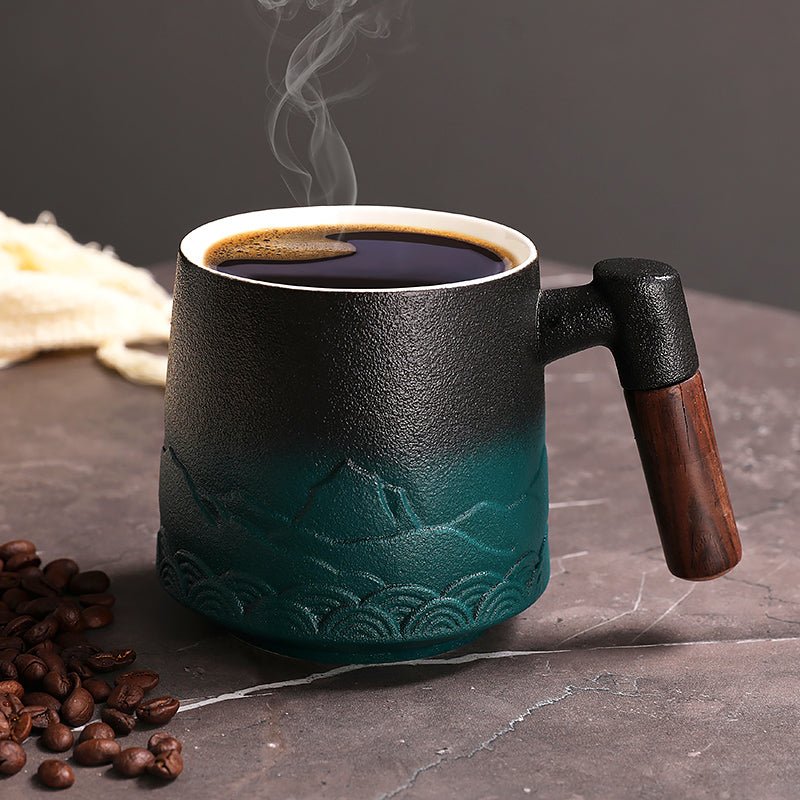
How Many Oz in a Coffee Mug? Common Sizes and Fit Guide
Reading time: about 9 minutes
A mug labeled 12 oz rarely drinks like a full 12 oz cup to the rim. Once you leave room for heat, foam, and a safe grip, the usable pour is usually smaller, and that is where a lot of buyers get tripped up.
In our store, the most common mistake is choosing by the number alone. The right size depends on what you actually pour in it at a kitchen counter, on an office desk, or during a gift unboxing when the recipient is looking for a mug that feels good in hand, not just one that looks big on paper.
How many oz in a coffee mug?
Most everyday coffee mugs fall between 8 oz and 16 oz. If you shop by the shelf label, you will also see 6 oz, 10 oz, 12 oz, 14 oz, 15 oz, and 20 oz options, but the middle of the range is where most real buyers land.
The number printed on a mug is often the brimful capacity. That means the mug is technically filled to the top edge, which is not how people drink coffee. A practical pour usually leaves a little space below the rim so the drink does not slosh on the way from the counter to the couch or desk.
| Listed mug size | What it usually suits | Real-world note |
|---|---|---|
| 6-8 oz | Espresso drinks, small tea servings | Compact and neat, but too small for most drip coffee |
| 10 oz | Short coffee pours, smaller hands, tea | A safe middle ground if you do not want a bulky mug |
| 12 oz | Standard daily coffee for many buyers | Feels balanced on a desk and usually works well for a full cup without waste |
| 14-16 oz | Large coffee, milk-heavy drinks, soup | Good for longer sipping, but can feel oversized if you drink small servings |
| 20 oz+ | Big pours, iced drinks, very long sessions | Useful for volume, less ideal if you want a lighter mug |
If you want a broader comparison, we also cover the same sizing question in [How Many Oz Is a Standard Coffee Mug? A Buyer’s Guide](https://coffeifymug.com/blogs/news/how-many-oz-is-a-standard-coffee-mug-a-buyers-guide) and [How Many Oz in a Coffee Mug? Common Sizes and What Fits Best](https://coffeifymug.com/blogs/news/how-many-oz-in-a-coffee-mug-common-sizes-and-what-fits-best).
Why does a mug feel smaller than the number on the bottom?
Because a mug is not a measuring cup. Ceramic walls take up space, the handle removes a small amount of interior room, and the drinkable fill is usually below the rim. A mug may be sold as 14 oz, yet the pour you actually enjoy is closer to a comfortable working fill rather than the top edge.
That difference matters more than people expect. A thick-walled ceramic mug can look substantial from the outside, but the inner cavity may feel tighter than a thinner mug of the same listed capacity. That is one reason two mugs with the same number can drink very differently on a kitchen counter.
The practical question is not just “how many oz does it hold?” It is “how many oz do I want to pour before I have to worry about spill space, heat, and the last safe sip?”
We see the same trade-off with finishes and construction. A plain ceramic mug usually handles daily use well, but a glossy glaze, a printed decal, or metallic accent changes how you care for it. If a mug has metallic detailing, skip the microwave. If the design is fully ceramic without special trim, dishwasher use is often fine, but the rim and handle are still the first places to chip if the mug gets knocked against a sink or rack.
Which mug size fits your drink best?
The right answer depends on what goes in the mug, not just the volume on the tag. A black drip coffee drinker has different needs than someone who adds a lot of milk or drinks tea slowly over an hour.
- 3-6 oz: Best for espresso, macchiato-style drinks, or a small tea pour. Not good if you want a full cup of coffee.
- 8-10 oz: Better for smaller servings, tighter desk setups, and buyers who dislike oversized mugs.
- 11-12 oz: The most practical everyday range for many coffee drinkers. It usually feels like a normal cup without wasting counter space.
- 14-16 oz: Good for larger drip pours, milk-heavy drinks, and people who do not want to refill often. It can feel too large for short, concentrated drinks.
- 20 oz and above: Useful for big iced drinks or long sipping sessions, but not ideal if you want a lightweight mug that stays comfortable in one hand.
If your main drink is a cappuccino or flat white, a very large mug is usually the wrong shape. You end up with too much empty space and a drink that cools faster. If you are shopping for tea, a slightly larger mug can be useful because leaves and bags take up room, but a giant mug still may not be the best fit if you prefer a concentrated brew.
For people comparing styles as well as capacity, our [Mountain Sea Coffee Tea Mug](https://coffeifymug.com/products/mountain-sea-coffee-tea-mug), [Spittoon Coffee Tea Mug](https://coffeifymug.com/products/spittoon-coffee-tea-mug), and [Planet Coffee Tea Mug](https://coffeifymug.com/products/planet-coffee-tea-mug) are good starting points. If you want to compare the full range in one place, browse our [collection](https://coffeifymug.com/collections/all) and match the listed size to the way you actually drink coffee.
How do you measure a mug at home before you buy?
If you already own a mug that feels right, the easiest move is to measure it against what you actually pour. We use this approach when someone asks whether a mug is too small for their morning coffee or too large for a gift basket.
- Fill the mug with water to the level you would realistically drink to, not all the way to the rim.
- Pour that water into a measuring cup and check the volume.
- Repeat once more if the mug has a wide mouth, since wide mugs often feel bigger than they measure.
- Look at the handle comfort too. A mug can have the right ounces and still feel awkward if the handle is too tight for your fingers.
- Check the rim thickness. A thicker rim can make a mug feel heavier and slightly reduce the sense of usable space.
If you are buying online, this simple test is more useful than guessing from photos. A tall 12 oz mug and a short 12 oz mug do not feel the same in hand. The tall one may fit better under a coffee machine, while the short one may feel steadier on an office desk.
We also see buyers confuse mug capacity with cup capacity. That is why our team pays attention to shape, not just the number. A smooth-sided ceramic mug with a balanced handle can feel more usable than a visually larger mug with a bulky base.
What should you avoid if size is your main concern?
If the number on the mug matters to you, do not buy purely for appearance. A decorative oversized mug can look great in a photo and still be a poor fit for a small pour, a narrow cup holder, or a compact office setup.
There are a few common trade-offs we see all the time:
- Very large mugs: Great for volume, but they can cool unevenly and feel heavy when filled to the top.
- Very small mugs: Nice for espresso or tea, but frustrating for anyone who wants one full serving of drip coffee.
- Extra-thick ceramic: Durable in feel, but it can reduce the usable interior space more than buyers expect.
- Decorative finishes: Good for gifting, but they may need gentler care than plain everyday ceramic.
That is the honest trade-off. A mug that is perfect for morning drip coffee may be the wrong choice for iced drinks, and a big mug that feels right on a couch may be overkill on a crowded workbench or an office desk with limited space.
How do you choose a mug for daily use, gifting, or the office?
For daily use, we usually steer shoppers toward the size that matches their most common drink. If you top up once and move on, a 12 oz mug is often the best balance. If you drink slower, want extra room for milk, or like a larger hand feel, 14 to 16 oz may be a better call.
For gifting, the safest pick is usually not the biggest mug. A mug that is easy to hold, easy to wash, and easy to fit under a coffee maker tends to get used more. That is why we pay attention to the basics first: interior volume, rim comfort, and how the handle fits a real hand rather than how the product looks on a screen.
For office desks, the best mug is often the one that avoids spills and does not dominate the workspace. A medium mug is usually easier to live with than a giant one, especially if the desk already has a keyboard, notebook, and water bottle on it.
That is also why size guides are only half the story. If you want to keep comparing by fit and style, our deeper guides on [How Many Oz Is a Coffee Mug? Common Sizes and Real-World Fit](https://coffeifymug.com/blogs/news/how-many-oz-is-a-coffee-mug-common-sizes-and-real-world-fit) and [How Many Oz Is a Regular Coffee Mug? A Practical Buyer Guide](https://coffeifymug.com/blogs/news/how-many-oz-is-a-regular-coffee-mug-a-practical-buyer-guide) can help you narrow the choice without guessing.
Frequently asked questions
How many oz is a normal coffee mug?
A normal coffee mug is usually 8 to 16 oz, with many everyday buyers landing around 11 to 12 oz. The exact number depends on the shape, wall thickness, and how much empty space you want left at the top.
Is a 12 oz mug enough for drip coffee?
For most people, yes. A 12 oz mug is a practical everyday size for drip coffee if you are not filling it to the rim. If you add a lot of milk or want extra spill room, a 14 oz mug may feel better.
Why does my 14 oz mug only feel like 12 oz?
Because some of that labeled volume is taken up by the mug walls, the curve near the rim, and the space you leave empty for a safer pour. The listed size is usually a brimful measure, not the amount you should actually drink from it.
What mug size is best for latte drinks?
Many latte drinkers prefer 12 to 16 oz, depending on how much milk they use. A smaller mug can make the drink feel crowded, while a very large mug can make the drink look and taste diluted.
Should I buy a bigger mug for iced coffee?
If you add ice, yes, a larger mug can help. Ice takes up space fast, so a mug that is perfect for hot coffee may feel too small once the cubes and milk go in.
If you want the simplest next step, compare the mug size you already use at home against the listings in our [collection](https://coffeifymug.com/collections/all), then choose the one that matches your actual pour, not the biggest number on the page.
Related from our store
More from our blog
Read more
Otagiri Coffee Mug Buying Guide: Condition, Fit, and Daily Use
An otagiri coffee mug can be a great buy if the glaze is clean, the rim is intact, and the size fits how you actually drink coffee. We cover the condition checks, daily-use trade-offs, and better m...
Read more
Fathers Coffee Mug Buying Guide for Practical Gift Shoppers
A practical guide to choosing a fathers coffee mug that feels good in the hand, fits the drink he actually makes, and holds up in daily use. We compare handle styles, size trade-offs, and where eac...
Read more
Leave a comment
This site is protected by hCaptcha and the hCaptcha Privacy Policy and Terms of Service apply.