
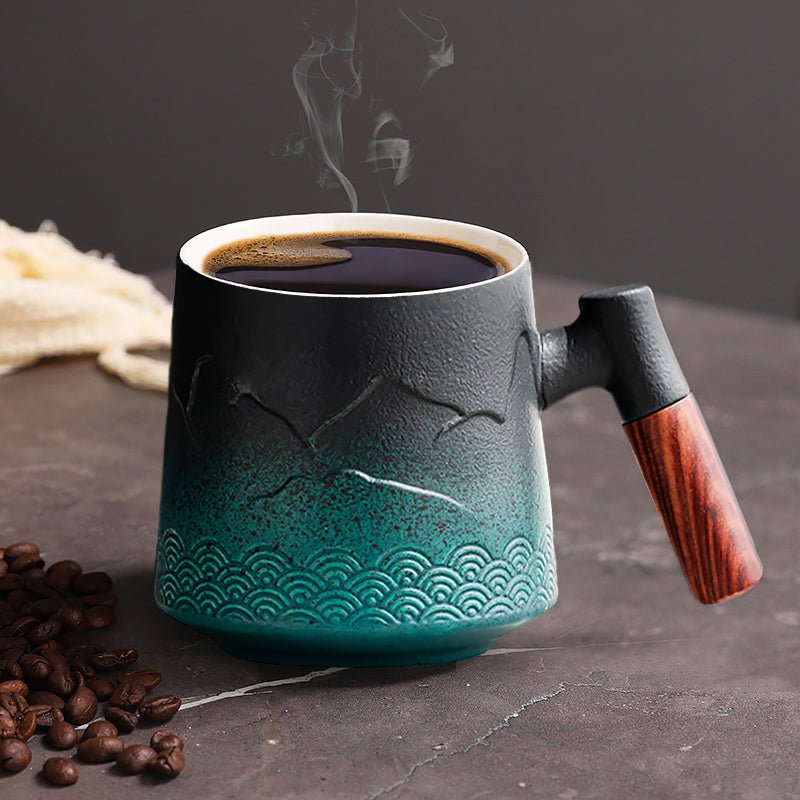
Wood Cups: What to Check Before You Buy for Coffee or Tea
Reading time: about 9 minutes
A mug on a kitchen counter gets judged quickly. If the handle feels awkward, if the finish looks cheap, or if the cup is annoying to hand-wash after breakfast, it stops being a daily mug and becomes shelf decor. That is the real test we apply when we look at wood cups in our store.
If you are comparing styles, the details matter more than the headline. A good place to start is our Mountain Sea II coffee and tea mug with wooden handle, then compare it against the rest of our full collection to see which shape and feel fit your routine.
What makes wood cups different from ceramic mugs?
Most shoppers use the phrase wood cups loosely, but what they usually want is a cup or mug with a wood-forward feel, often through a wooden handle or a natural-looking accent. That changes the experience in a few practical ways. The grip feels warmer, the piece looks less generic on a desk, and the mug tends to read as more giftable right away.
The trade-off is that wood needs more respect than plain ceramic. We do not recommend treating it like a throw-it-anywhere cup. If the piece has a wooden handle, that handle should be kept dry, wiped down after washing, and never left soaking in a sink. It is also not the right choice for people who want a microwave-friendly mug they can forget about between reheats.
In our experience, buyers choose this category for one of three reasons: they want a more natural look, they want a handle that feels comfortable in the hand, or they want a mug that feels special enough to give as a present without needing extra packaging.
Which details should you check before buying?
We look at wood cups the same way a careful customer does at the kitchen table. The surface can look great online and still fail in day-to-day use if the wrong small detail is off. If you are comparing options, check these points first:
- Handle attachment: The handle should feel secure, with no wobble or sharp transition where it meets the cup.
- Finish quality: A good finish should look even, not streaky, chalky, or rough at the edges.
- Grip comfort: There should be enough room for your fingers without forcing your knuckles against the cup.
- Rim and lip feel: The drinking edge should feel smooth, especially if you sip coffee or tea every morning.
- Cleaning access: If the shape has tight corners or a very narrow opening, residue can build up faster.
These are the kinds of details we also call out in our guide Wood Cups: What to Look for Before You Buy, because the common problems are rarely dramatic. They are usually small things: a finish that wears unevenly, a handle that feels too rigid, or a mug that looks beautiful but is awkward to wash by hand.
| What to check | Why it matters | What we look for |
|---|---|---|
| Handle comfort | It decides whether the mug feels natural for daily coffee or tea | Space for a relaxed two-finger grip |
| Finish consistency | It affects both appearance and long-term wear | Even coverage with no obvious rough spots |
| Cleaning routine | Wooden parts can degrade if abused | Simple hand-wash care and fast drying |
| Daily use fit | Some mugs are better for display or gifting than constant use | A shape that feels practical on a desk or kitchen counter |
Two common defect modes are worth calling out because shoppers do not always think about them until after the first wash. One is a handle that loosens or feels slightly off-balance. Another is a wood finish that dulls quickly when it gets soaked or scrubbed too hard. Neither is something you want on a mug that is supposed to feel premium.
Are wood cups better for daily coffee, tea, or gifting?
For everyday coffee and tea, the best wood cups are the ones that are easy to pick up, easy to wash, and easy to leave out on the counter without looking cluttered. They work especially well on a work-from-home desk, a breakfast nook, or an office shelf where the mug is part of the visual environment, not just a container.
For gifting, this category usually performs well because it feels more thoughtful than a plain generic mug. The natural material cue does some of the work for you. That said, wood cups are not the best gift if the person wants to toss everything in the dishwasher or microwave without thinking. If they are rough on dishware, a tougher, simpler ceramic mug may be a better fit.
For shoppers comparing gift-ready styles, our article Beautiful Coffee Cups for Daily Use and Gifting is a useful companion read. It covers the same buying problem from a broader angle: how to choose something that looks good on day one and still feels right after the novelty wears off.
If you want a cleaner visual choice with a softer profile, the The Cloud coffee tea mug wooden handle is the sort of piece that suits a lighter, more minimal setup. If you want something that feels more grounded and a little more graphic on the table, the Mountain Sea II style is the kind of mug people remember after an unboxing.
How should you care for wood cups so they last?
Care is where most people make or break this category. A wood-accent mug can last a long time in normal home use, but only if you keep the routine simple. We tell customers to treat the wood like wood, not like coated stoneware.
- Wash by hand with mild soap and warm water.
- Do not soak the mug or leave the wooden handle sitting in water.
- Dry the wood immediately after washing, especially around joints and edges.
- Avoid abrasive pads that can scratch the finish.
- Store it somewhere with airflow instead of stacking it damp in a crowded cabinet.
That routine is not complicated, but it matters. A mug that is repeatedly left wet is much more likely to show cosmetic wear, uneven color, or a rougher touch over time. If you want the lowest-maintenance option, standard glazed ceramic still wins. Wood cups are for buyers who are willing to trade a little convenience for a better feel and look.
They are also not the right choice for every environment. A busy office kitchen with heavy dishwasher use is a poor match. So is a house where dishes are often left in the sink overnight. If that is your reality, choose a simpler mug and save the wood-forward style for weekends or gifting.
Which style should you choose if you want one mug for most uses?
If you only want one wood cup in the rotation, choose the one that fits your most common habit, not your best-case scenario. People often buy for an ideal desk setup and then discover they actually drink coffee while standing at the sink or moving around the kitchen.
Here is the simplest way to sort the options:
- Choose a lighter, more minimal profile if you want a mug that disappears visually and works with modern interiors.
- Choose a more sculptural profile if you want the mug to feel like a small object, not just utility.
- Choose the easier-to-grip handle if you drink coffee quickly and one-handed.
- Choose the simpler care routine if the mug will be used daily and washed often.
If you are comparing against other mug styles, our guides on Beautiful Coffee Cups: What to Look for Before You Buy and Big Coffee Cups: How to Choose the Right Large Mug for Daily Use are useful next reads, especially if you are deciding between a design-led mug and a larger everyday option.
One more trade-off is worth being direct about: wood cups are usually best when you want a warm, intentional look, not when you want maximum ruggedness. If your main priority is durability above all else, a plain heavy ceramic mug is the safer buy.
What should you expect from the mug when it arrives?
Real buyers care about the unboxing moment because it tells them a lot about the product they are actually going to live with. A good wood cup should arrive with a finish that looks clean under bright kitchen light, a handle that feels aligned, and no obvious rough patches where your hand naturally lands.
We inspect this category with the assumption that it will be handled on a breakfast counter, rinsed after tea, and set down next to a laptop. That means the mug should look good from a distance and feel comfortable up close. Tiny manufacturing flaws tend to show up fast in that kind of use, especially along edges, joins, and coated surfaces.
If a mug looks beautiful but feels fussy to wash, most customers stop using it. The best wood cups are the ones that earn a place in the daily stack.
Frequently asked questions
Can wood cups go in the microwave?
No, not if they have wooden parts. Wood does not belong in the microwave, and heat can damage the finish or dry out the material. If you reheat drinks often, choose a standard microwave-safe ceramic mug instead.
Are wood cups hard to clean?
Not if you keep the care routine simple. Hand wash with mild soap, rinse well, and dry the wooden areas right away. They are harder to maintain than plain glazed ceramic, but they are not difficult if you avoid soaking and harsh scrubbing.
Do wood cups work for tea as well as coffee?
Yes, especially for hot tea served at the table or at a desk. The main requirement is a comfortable grip and a finish that can handle regular hand washing. They are less ideal if you want to leave tea in the cup for long stretches and reheat it repeatedly.
What is the biggest downside of buying wood cups?
The biggest downside is maintenance. Wood needs more careful drying than standard mugs, and it is not suited to dishwasher-heavy households. If you want a low-effort item, ceramic is usually the better fit.
Are wood cups a good gift?
Yes, if the recipient likes design-led home items and will use them by hand. They make sense for coffee drinkers, tea drinkers, and people who care about how their kitchenware looks on open shelving. They are not the best gift for someone who wants fully low-maintenance drinkware.
If you are ready to compare styles, start with our full collection, then check the handle feel, finish, and care routine against the points above. That will tell you quickly whether a wood cup belongs in your kitchen or whether a simpler mug is the better buy.
Read more
Latte Art Cup Buying Guide: Shape, Size, and Material That Work
A practical latte art cup guide from our store perspective, focused on shape, size, material, and the small details that affect pour control, presentation, and daily use.
En savoir plus
Lotus Coffee: Choosing the Right Mug for Daily Use
Lotus coffee tastes better in a mug that fits the drink, the hand, and the routine. This guide compares real-world shape, size, and care trade-offs so shoppers can choose with confidence.
En savoir plus
Laisser un commentaire
Ce site est protégé par hCaptcha, et la Politique de confidentialité et les Conditions de service de hCaptcha s’appliquent.