
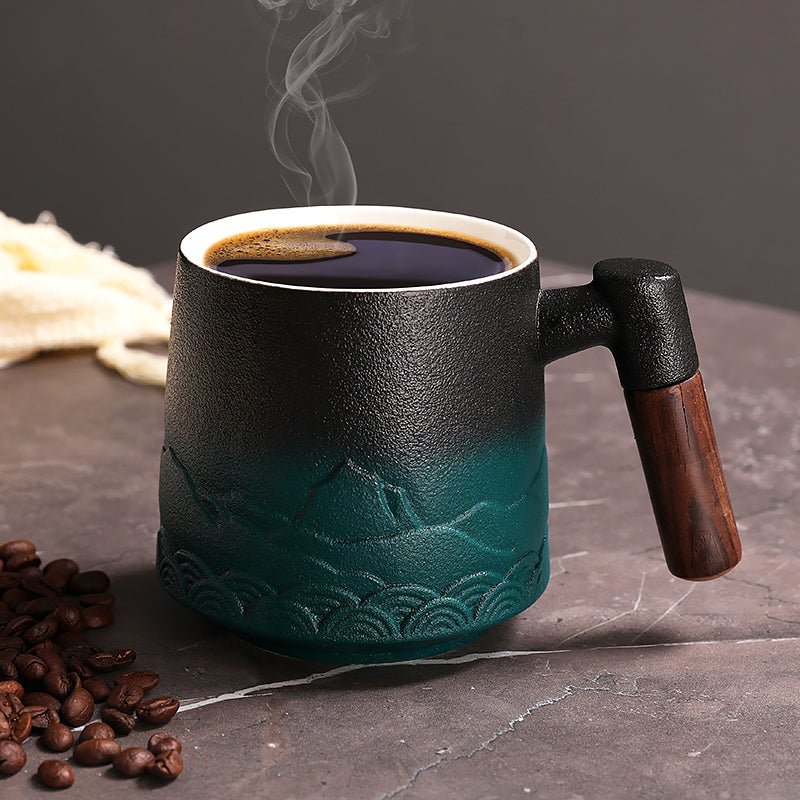
Vintage pottery coffee mugs daily use guide: 3 styles
Reading time: about 9 minutes
A mug can look perfect beside the coffee canister and still become the one nobody reaches for. The handle crowds your knuckles, the filled cup feels heavier than expected, or its care instructions do not match a household that runs the dishwasher every night. This vintage pottery coffee mugs daily use guide starts with those ordinary moments, because visual character earns cabinet space only when the cup also works at breakfast, on a desk, and during cleanup.
In our store, we separate style evidence from function evidence. A name such as retro or mountain establishes a design direction; it does not prove age, a particular clay body, a capacity, or appliance compatibility. Treat the current product page and chosen option, if offered, as the source for those product-specific details.
Vintage pottery coffee mugs daily use guide: start with the first refill
Use the drink you actually make, not an imagined special-occasion recipe. Fill your current favorite mug to its normal line, then pour that liquid into a measuring jug. Measuring to the brim overstates the usable room available for walking, stirring, milk foam, or a tea infuser.
- Black coffee at the kitchen counter: prioritize comfortable loaded weight, a stable base, and the amount your brewer dispenses.
- Milk drinks: count every component. A 60 ml double espresso plus 180 ml of milk already reaches 240 ml before foam and carrying headspace.
- Tea at a desk: check that the rim accepts your usual infuser and that the handle leaves knuckle clearance beside a notebook or keyboard.
- Two-refill mornings: a smaller cup may keep each serving fresher, but it also means more trips to the brewer.
A useful weight check is equally concrete: 300 ml of drink adds roughly 300 g to the empty mug. From handling mugs in our store, we have learned to set each cup on a flat counter, inspect both handle joints in side light, and run a finger around the foot ring before judging the decoration.
Retro, Mountain Sea, or Great Mountain: which style fits the room?
Once the routine checks are settled, use the unique coffee mugs collection to compare the visual direction of current options. The three pages below make different style promises through their names and product imagery; they should not be treated as interchangeable specifications.
For a kitchen that needs one clear retro accent
A shopper with plain dishes who wants the cup itself to carry the period-inspired cue should start with the Retro Coffee Tea Cup. It is the most direct fit among these three for a retro-led brief and for someone shopping across coffee and tea use. It is not automatically the best office or recipe mug: confirm the current capacity, dimensions, base shape, and care information before ordering.
For a gift recipient who likes mountain-and-sea imagery
The Mountain Sea Coffee Tea Mug is the logical next page when the recipient has already shown a preference for scenic, nature-led pieces. That visible theme gives a gift decision more basis than choosing a generic vintage-looking cup. Skip it for someone who prefers undecorated tableware, and do not infer material, size, or dishwasher status from the artwork.
For a mountain-led shelf or desk
Compare the Great Mountain Coffee Tea Mug when the desired cue is specifically mountain-focused rather than the combined mountain-and-sea direction. Open it beside the Mountain Sea page and compare the currently shown options, dimensions, and care wording line by line. If exact matching across a set matters more than a focal design, a simpler coordinated mug set will be a better fit.
We have intentionally kept those recommendations to visible design positioning. Product details can change, so the live listing controls any claim about material, measurements, included pieces, or care.
Capacity, handle clearance, and cabinet height: what should you measure?
Capacity alone does not answer daily fit. A US 12 fluid ounce drink is about 355 ml, but a mug described by brim capacity may not leave practical carrying room at that volume. If that is your usual serving, use our 12 oz ceramic coffee mugs daily-use comparison to pressure-test the recipe before choosing on appearance.
| Buyer variable | Home test | Why it changes daily fit |
|---|---|---|
| Normal fill | Measure your finished drink at its usual fill line, not at the rim. | This preserves room for stirring, foam, an infuser, and carrying. |
| Brewer clearance | Measure from the drip tray to the outlet with any removable tray in its normal position. | Compare that space with the mug's full height, including its rim and base. |
| Handle clearance | Note how many fingers you use and where your knuckles sit. | A decorative handle can still be uncomfortable if its inner opening is too tight for your grip. |
| Cabinet space | Measure shelf height, opening width, and the space between neighboring handles. | Do not assume a shaped mug nests or stacks unless the product page says so. |
| Loaded weight | Add roughly one gram for every milliliter of drink to the listed empty weight, if provided. | This gives a more realistic sense of one-handed lifting at a desk or kitchen counter. |
For a car cup holder, base diameter and taper matter more than rim width. None of these mugs should be assumed to fit a holder or accept a lid unless the listed measurements support that use.
Material, glaze, dishwasher, and microwave claims: what counts?
General category guidance starts here, separate from the three product recommendations. Shoppers often group earthenware, stoneware, and porcelain under pottery, but those terms are not interchangeable specifications. Read the material field on the live listing; a vintage look or glossy glaze cannot identify the clay body.
- Dishwasher use: rely on an explicit care statement from the current page. Repeated detergent, heat, and contact with dishwasher racks can be hard on decoration and exposed edges.
- Microwave use: look for explicit compatibility. Do not microwave metallic decoration, and never assume a decorative finish is metal-free from a small product image.
- Thermal change: avoid pouring boiling liquid into a very cold mug or adding ice immediately after a hot drink. Rapid temperature changes can stress ceramic bodies and glazes.
- Drying: dry the foot and any unglazed area before setting the mug on wood or stacking it in a cabinet.
Wall thickness is another separate variable. A thicker ceramic cup can feel substantial and may warm more slowly, but thickness alone is not proof against chipping. If a listing confirms that construction and it matters to you, compare the handling trade-offs in our thick ceramic coffee mugs daily-use guide.
Which finish issues should stop you from using the mug?
Pottery can show variation, but variation and damage are not synonyms. At unboxing, remove the packing and inspect the dry mug in bright side light before washing it according to the listed instructions.
- Handle joints: look for hairlines where the upper and lower handle ends meet the body. A structural line is not decorative character.
- Rim and interior: stop if you find a sharp chip or a crack that runs into the body. Check an interior pinhole or glaze skip against the listing and seller guidance rather than guessing that it is intentional.
- Base: place the empty mug on a flat, hard counter. Persistent rocking can make a full desk mug easier to knock.
- Foot ring: feel for a sharp burr. An exposed rough point can mark a finished desk even if the rest of the cup looks sound.
- Leak check: after the visual inspection, fill the mug over a sink and watch the base and handle areas. Stop using it if it leaks or a line changes after filling.
A fine network confined to the glaze is often called crazing; a line penetrating the ceramic body is a crack. That terminology helps describe a concern accurately, but it does not make an unlisted finish suitable for food contact or a cracked vessel usable.
Who should skip a style-first vintage pottery mug?
These pages are poor starting points if decorative direction is not one of your main requirements. A different category will serve you better if any of these situations applies:
- You need authenticated antique age, maker provenance, or collectible valuation; retro styling does not establish any of those.
- You need leak-resistant commuting; choose a travel vessel with an explicitly listed lid and cup-holder dimensions.
- You repeat the same latte recipe and the current listing does not state capacity clearly; start with volume, not motif.
- You rely on the microwave or dishwasher every day and explicit care approval is absent.
- You need six pieces to match exactly; choose a coordinated set with its matching or variation terms stated.
The trade-off is simple: a distinctive mug can add pleasure to a repeated routine, but design cannot compensate for a missing functional requirement.
Does the design work for an office desk or gift unboxing?
For an office, map the mug's footprint before buying. Put your current mug beside the keyboard, coaster, charger, and notebook, then note which side the handle needs to face. A stable base and comfortable loaded weight matter more during a crowded video-call morning than they do in a product photo, so verify them from the listed dimensions and current images rather than assuming.
For gifts, start with evidence from the recipient's home: retro kitchen pieces support the Retro choice, scenic art supports Mountain Sea, and a specific mountain interest supports Great Mountain. Then screen for care and drink habits. Our coffee mug gift idea daily-use guide covers this practical side, including why a striking unboxing is not enough when the recipient needs machine-safe cleanup or a known capacity.
Frequently asked questions
What should a vintage pottery coffee mugs daily use guide help me check?
It should connect appearance to normal fill volume, loaded weight, handle clearance, storage space, and verified care. It should also distinguish product-page claims from general ceramic guidance, so retro styling is not mistaken for antique provenance or a material specification.
Are retro-style CoffeifyMug cups genuine vintage antiques?
Do not assume that from a style name. In this guide, vintage and retro describe the visual direction shoppers are comparing; only an explicit live product-page statement could establish age, provenance, or production method.
Can I put these coffee and tea mugs in the dishwasher or microwave?
Use either appliance only when the current product page explicitly says the chosen item is compatible. If the care wording is missing or unclear, do not buy that mug for an appliance-dependent routine; choose an option with specific care guidance instead.
Which CoffeifyMug design is best for a gift?
Choose Retro for a documented taste in period-inspired objects, Mountain Sea for someone who likes combined landscape imagery, or Great Mountain for a specifically mountain-led preference. If you do not know the recipient's style, a neutral design with clear capacity and care information is lower-risk than guessing.
How much extra capacity should I allow above my normal drink?
There is no useful universal number. Measure the finished drink at your usual fill line, then choose a listed capacity that leaves room for stirring, foam, an infuser, and carrying; also check whether the published value refers to brim or usable capacity.
Your 60-second checkout check
- Match the visual cue: Retro, Mountain Sea, or Great Mountain.
- Confirm the material and included pieces on the live product page.
- Compare your normal drink volume with the listed capacity and needed headspace.
- Check full height, base width, and handle clearance against your brewer, cabinet, and desk.
- Require an explicit dishwasher or microwave claim if your routine depends on it.
- Read the current care and variation wording before payment.
If all six answers line up, choose the design you will enjoy seeing every day. If one functional answer is missing, pause rather than filling the gap with an assumption; return to the current unique coffee mug collection and compare another option against the same checklist.
Read more
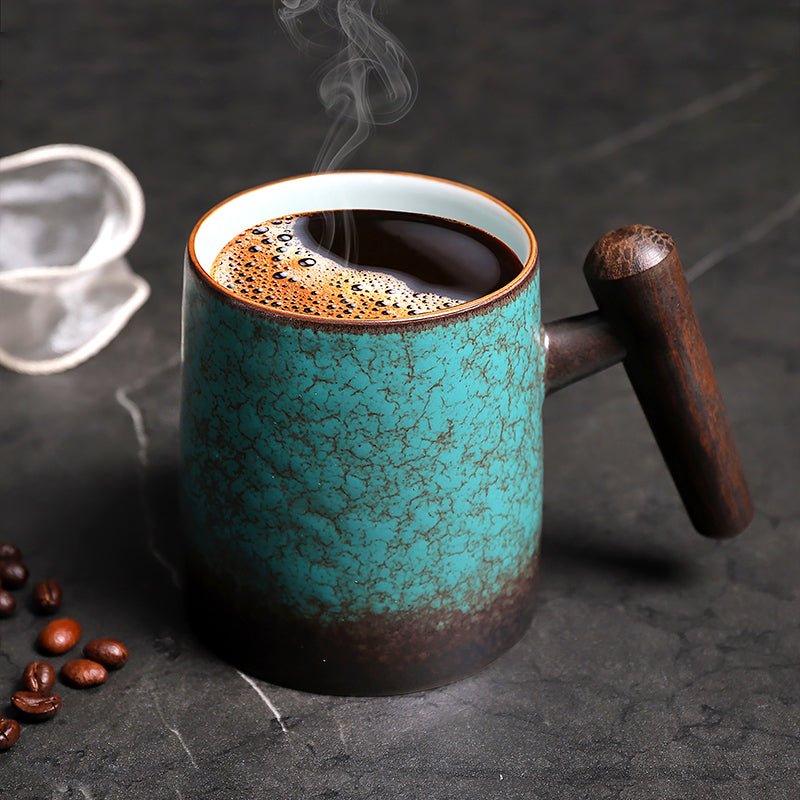
Decaf Coffee Cup Daily Use Guide: 170 ml, 200 ml, or 270 ml?
Compare CoffeifyMug's Retro 170 ml, Pleated 200 ml, and Emerald 270 ml options by refill habits, handle comfort, desk use, gifting, and care. This guide also explains when none of the three is the ...
En savoir plus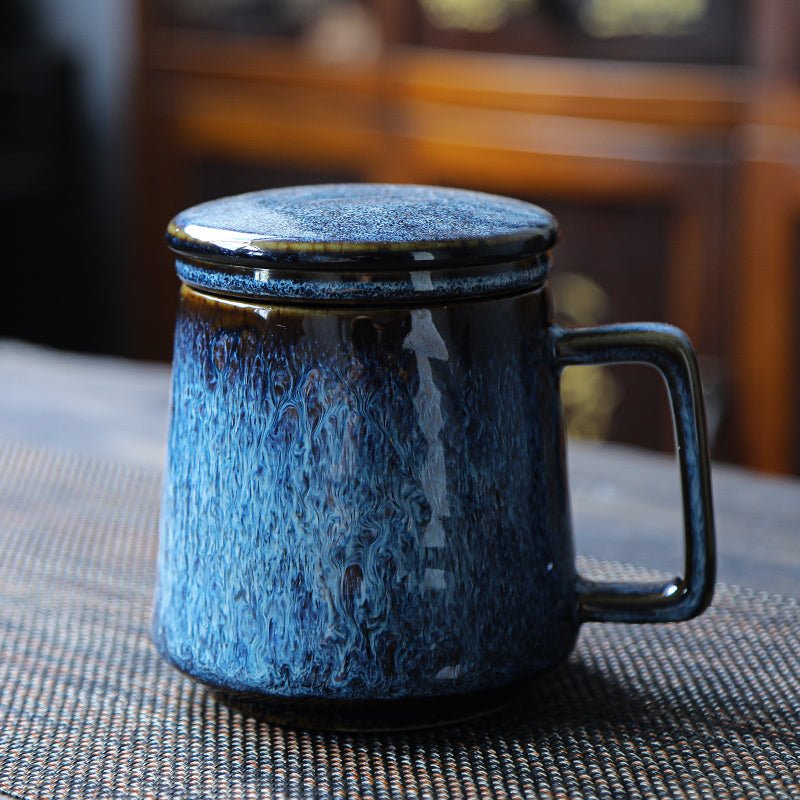
Heavy Ceramic Coffee Mugs Daily Use Guide: Practical Trade-Offs
This practical guide shows where mug heft helps and where it becomes work: full-pour lifting, desk stability, grip, washing, storage, and gifting. It also explains how to compare The Rock, Spittoon...
En savoir plus
Laisser un commentaire
Ce site est protégé par hCaptcha, et la Politique de confidentialité et les Conditions de service de hCaptcha s’appliquent.